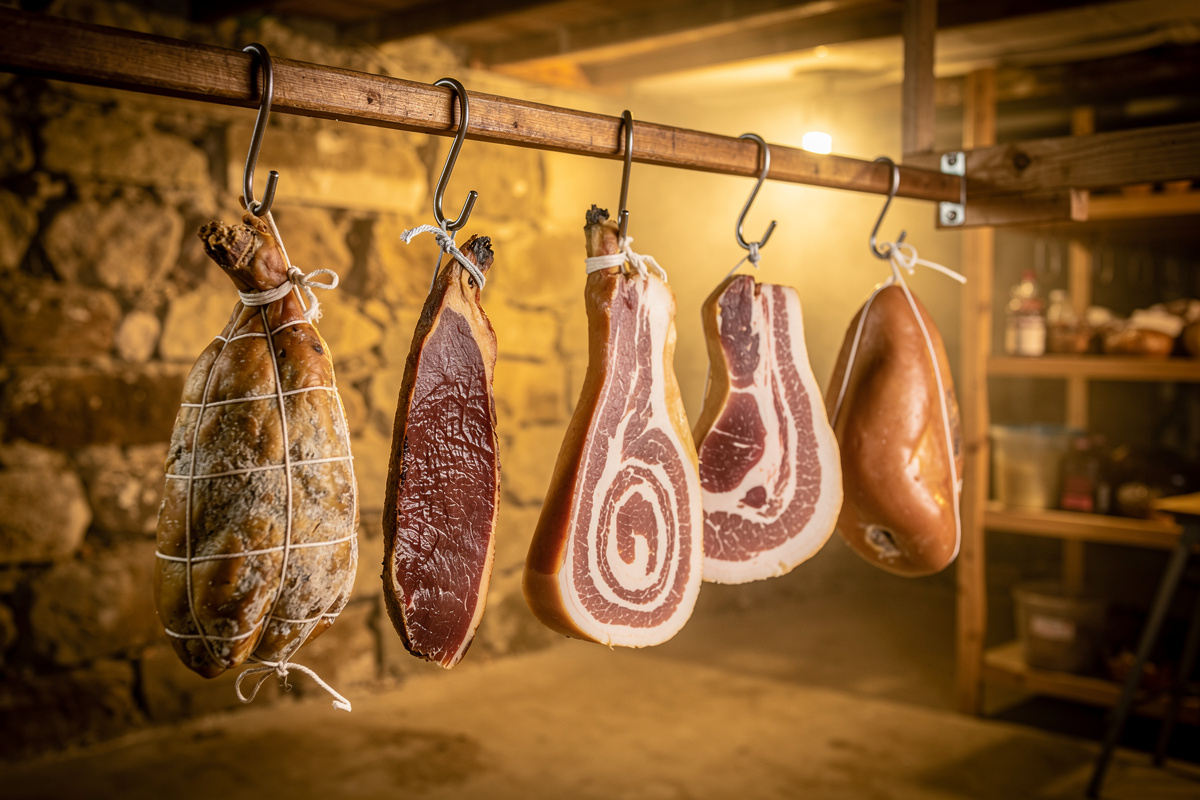

Whole-muscle charcuterie is the family of dry-cured meats made from intact muscle pieces — prosciutto, bresaola, coppa, lonza, lardo, speck, pancetta — rather than ground meat in casings.
As an Amazon Associate I earn from qualifying purchases.
Each piece is salt-and-cure-cured for days to weeks — the salt plus sodium nitrite/nitrate combination that inhibits Clostridium botulinum during the cure step — rinsed, hung in a controlled chamber at 50-55°F (10-13°C) and 75-80% RH, and dried until 30-35% weight loss. Total timeline runs 4 weeks (duck prosciutto) to 18 months (full prosciutto di Parma).
Whole-muscle charcuterie is more forgiving than salami in some ways and less forgiving in others. There is no fermentation phase to nail, no pH meter check, no starter culture to source. But the salt has to penetrate every millimeter of muscle uniformly, the climate has to hold for months instead of weeks, and case hardening (which I have personally triggered twice on coppas during dry winter months when basement humidity dropped below 65% and the chamber humidifier could not keep pace — one was rescuable with a 12-day paper-wrap, one was past saving and went in the bin) on the surface ruins the whole piece because there is no casing to even out moisture loss. This guide walks the cuts, the cure methods, the climate, and the patience that produces the result that turns a 12-dollar pork loin into 30-dollar lonza. My ladder so far runs duck prosciutto (14 days) → coppa (10 weeks) → lonza (16 weeks) → bresaola (12 weeks) → a still-hanging guanciale at the time of writing. The duck was the validation cure that proved my chamber held climate for two consecutive weeks; the bresaola was the project that confirmed I could hold it for three months. The guanciale in progress at writing time is the project now covered step by step in the homemade guanciale guide.
What Whole-Muscle Charcuterie Is
Whole-muscle charcuterie preserves intact muscle pieces through salt curing followed by extended air-drying in controlled climate. Unlike salami, where ground meat-and-fat mix is mechanically intimate from start, whole-muscle work depends entirely on salt diffusion through intact muscle tissue. The salt must penetrate uniformly over days to weeks before the surface dries enough to slow further migration; once the surface forms a pellicle, salt redistribution stops.
The protective system is salt + cure (sodium nitrite/nitrate) during the cure phase, then water activity below 0.92 plus surface drying during the hang phase. There is no fermentation step in most whole-muscle work, which means pH stays at meat’s natural 5.5-6.0 and the safety calculation depends entirely on salt and aw reaching threshold. This is why salt percentage is non-negotiable: the salt math from how to calculate salt percentage for equilibrium curing is the same protective system that applies here.
Climate Targets for Whole-Muscle Hang
Hold 50-55°F (10-13°C) at 75-80% RH for the duration. Drift under 3°F and 5% RH. Larger pieces (full prosciutto, beef coppa) tolerate slightly higher humidity (80%) because their mass means slower moisture migration. Smaller pieces (duck prosciutto, bresaola) need slightly lower humidity (72-75%) to maintain drying pace.
The chamber-build philosophy in how to build a curing chamber applies directly. The climate-control framework in curing chamber climate control details the four interacting layers that must work together for months. Air movement is essential — a still chamber grows surface mold; a fan blowing directly at the meat case-hardens within 48 hours. The case-hardening conversation in case hardening in curing chambers is what kills more whole-muscle projects than any other failure.
The 8 Classic Whole-Muscle Cuts
Each whole-muscle style maps to a specific muscle, salt percentage, cure schedule, and hang time. Pick by the time you have, the chamber capacity, and the meat available.
| Style | Muscle | Cure Time | Hang Time | Salt % | Notes |
|---|---|---|---|---|---|
| Duck prosciutto | Duck breast | 24-36 hours | 2 weeks | 2.5% | Beginner project; guide |
| Bresaola | Beef eye-of-round | 10-14 days | 4-6 weeks | 3.0% | Lean; needs careful drying |
| Lonza | Whole pork loin | 10-14 days | 3-5 weeks | 2.7% | Beginner-friendly whole pork |
| Coppa (capicola) | Pork neck/shoulder | 14-21 days | 2-3 months | 2.7% | Marbled; produces visible fat-and-lean cut |
| Pancetta tesa | Pork belly (flat) | 7-10 days | 3-5 weeks | 2.5% | Italian uncooked bacon |
| Pancetta arrotolata | Pork belly (rolled) | 7-10 days | 5-8 weeks | 2.5% | Rolled with herbs and pepper |
| Lardo | Pork backfat | 30-90 days (heavy salt) | 2-4 months | 4-5% | Salt-heavy preservation |
| Speck | Pork leg, lightly smoked | 21-30 days | 20-30 weeks | 2.7% | Cold-smoked then aged |
| Prosciutto (Parma-style) | Full pork leg, bone-in | 30-45 days | 9-18 months | 3.0% | Pro project; chamber-monopolizing |
Beginners should start with duck prosciutto — small piece, fast feedback, hard to ruin. The detailed walk-through is in duck prosciutto: the 2-week beginner charcuterie project. Once that succeeds, scale up to bresaola or lonza, then to coppa. Skip directly to prosciutto-leg only after a year of smaller successful projects.
Cure Methods: Saltbox vs Equilibrium vs Brine
Three methods get salt and cure into intact muscle. Each trades simplicity, control, and finish texture differently.
Saltbox cure (traditional): Coat the muscle in a thick layer of salt + cure + spices, place in a non-reactive container, refrigerate, flip daily. The meat draws salt from the surrounding salt; equilibrium is approximate. Used for prosciutto, lardo, and traditional Italian projects. Forgiving on salt amount but produces salt gradient (saltier at surface, less salty at center).
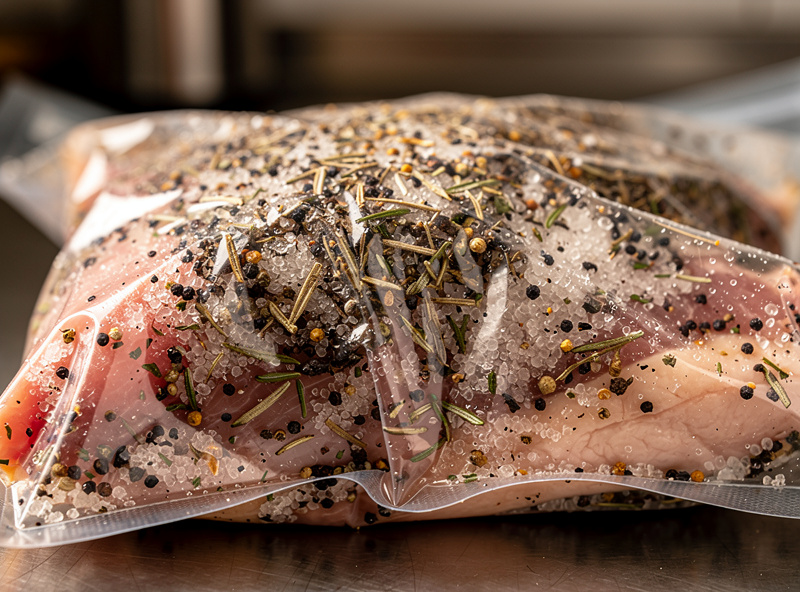
Equilibrium cure: Calculate exact salt + cure as percentage of meat weight, mix into spice rub, vacuum-bag with the meat, refrigerate, flip daily. The bag prevents over-salting; salt distributes uniformly through diffusion. Modern, precise, the standard for home charcuterie because it is hard to over-salt. Math walkthrough in how to calculate salt percentage for equilibrium curing.
Brine cure: Submerge in salt-water brine for days. Used for some hams and traditional pancetta variants. Produces juicier meat than dry cure but slightly less concentrated flavor. Brine percentage 8-10% NaCl typically.
For most home whole-muscle work, equilibrium cure in a vacuum bag is the right answer. Calculate salt at 2.5-3.0% of trimmed muscle weight, calculate cure #2 at 0.25% — cure #2, not cure #1, for every style on this page, because none of them are cooked before the hang and none of them have a fermentation phase to drop pH; the full breakdown of why cure #2’s nitrate reservoir matters for a hung uncooked cure is in pink salt and nitrates in charcuterie — weigh with a scale that reads to 0.1 g, mix with spices, vacuum-seal with the meat, refrigerate at 38-40°F, flip daily. Cure time is roughly 1 day per 1/2 inch of thickness through the meat (so a 4-inch-thick muscle needs 8 days minimum).
The Air-Dry Phase
After cure, rinse the meat under cold water, pat dry, hang in cool airflow for 4-12 hours to form a pellicle, then move to the curing chamber. Spice rubs (cracked pepper, paprika, juniper, fennel, herbs) can be applied at this stage if desired. Tie with butcher twine or hang in a netting bag if the cut shape needs support.
Drying continues until 30-35% weight loss from the post-cure-and-rinse weight. Weigh at hang and mark the target (0.65 to 0.70 of post-rinse weight). Pull when target is reached; calendar time is rough. Smaller pieces (duck, bresaola) hit target in 4-6 weeks; medium pieces (lonza, coppa) in 8-12 weeks; large pieces (whole prosciutto) in 9-18 months.
Surface mold colonization during the hang is normal and expected. White Penicillium is beneficial; the conversation about distinguishing helpful from problematic is in salami casing mold guide — same logic applies. The complete troubleshooting guide covers the symptom-to-fix decision tree for whole-muscle problems.
Surface, Pellicle, and Mold Coverage
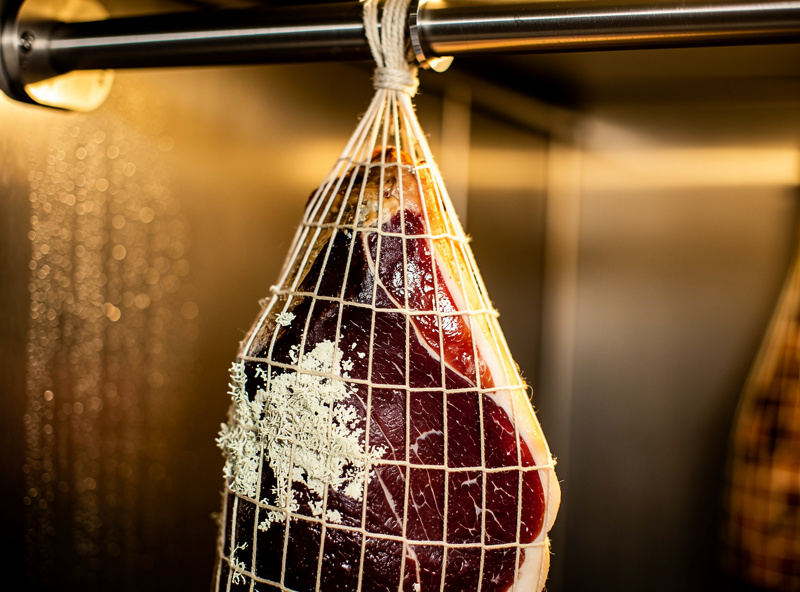
The pellicle is the slightly tacky, dried surface that forms in the first 48 hours of hanging. A good pellicle is uniform color, clean smell, and slightly dry to the touch. The pellicle resists pathogens and acts as the first line of surface protection during the long hang.
Mold colonization develops over weeks. White, soft, even Penicillium nalgiovense is the textbook coverage and looks like a thin powdery dust. Patchy black, fuzzy growth is Aspergillus and should be wiped off with vinegar; if extensive, the piece may need to be discarded depending on internal smell. The detailed mold ID conversation crosses over with the salami work in Penicillium cultures for salami casings.
Some traditional whole-muscle styles (prosciutto, coppa) intentionally develop a heavier mold coverage; others (bresaola, lardo) are wiped clean weekly with vinegar to preserve the bare-meat appearance. Choose your method by which style’s tradition you are following.
Dry Spots, Soft Spots, and Surface Issues
Watch for two surface problems during a long hang.
Dry spots are areas where the surface dried too fast, often where airflow was strongest. The surface is hard, sometimes cracked, and the area underneath dries unevenly. Move the affected piece to a higher-humidity, lower-airflow zone of the chamber for 1-2 weeks; the moisture inside redistributes. Detailed mechanism in case hardening in curing chambers.
Soft spots are areas where the surface is normal but pressing produces a soft depression that springs back slowly. This indicates internal moisture pockets that drying has not yet reached. Continue the hang at lower RH; the spot usually firms up within 2-3 weeks. If accompanied by off-smells or slime, treat as a spoilage indicator and inspect the interior.
Smell on whole-muscle work follows the same logic as dry aging smell: what is normal vs what means trouble. Funky, earthy, slightly cheesy is good. Sharp ammonia, sulfur, or putrid notes are problems and the piece should be inspected.
The Cost Math: Buy vs Make
Whole-muscle charcuterie at home is one of the few hobbies where the math reliably beats retail at the moderate-to-high quality tier. A 4-pound pork loin at 6 dollars per pound costs 24 dollars; once cured and aged into lonza, the 4 pounds becomes about 2.6 pounds of finished product (35% weight loss), or roughly 9 dollars per pound effective cost. Retail lonza at a specialty butcher runs 25-40 dollars per pound. The same math runs even better on bresaola (eye-of-round at 8/lb to bresaola at 35/lb retail) and coppa.
The break-even point on chamber investment is roughly 4-6 batches at the budget tier. The chamber-build cost analysis is in curing chamber build cost: what I spent on my setup. Beyond break-even, every batch is essentially free margin against the retail equivalent — assuming the chamber holds spec and the project succeeds.
Spice Profiles for Whole-Muscle Styles
The cure spice mix is what makes lonza taste like lonza and coppa taste like coppa. Quantities below are per kilogram of trimmed muscle weight. Adjust within taste, but stay within historical ranges.
- Bresaola: Cracked black pepper 4 g, juniper berries 4 g (crushed), bay leaves 3, garlic powder 2 g, dry red wine 30 ml.
- Lonza: Cracked black pepper 5 g, fennel pollen 1 g, fennel seed 2 g, garlic powder 2 g, dry white wine 25 ml.
- Coppa: Cracked black pepper 4 g, sweet paprika 8 g, hot paprika 2 g, fennel 3 g, garlic 3 g, white wine 25 ml. Calabrian-style coppa adds 5 g hot paprika.
- Pancetta: Cracked black pepper 6 g, juniper 3 g, bay 2, garlic 3 g, brown sugar 5 g; full recipe and rolling technique in the homemade pancetta guide.
- Speck: Cracked black pepper 4 g, juniper 6 g, bay 3, garlic 3 g, brown sugar 4 g, then cold-smoke per cold smoking at home guide.
- Lardo: Cracked black pepper 4 g, rosemary 6 g, garlic 4 g, bay 2 leaves; pure-salt cure with herbs.
Toast whole spices lightly in a dry pan before grinding. Pre-ground spices lose volatile aromatics within weeks; the whole-muscle you spend 3 months drying deserves spices that taste like spices.
Storage After Aging Reaches Target
Once whole-muscle reaches its target weight loss, you have options. Vacuum-seal portions for refrigerated storage (2-3 months) or frozen storage (6-12 months). Slice and re-vacuum-seal in 4-ounce portions for grab-and-eat convenience. Store whole pieces wrapped in butcher paper inside a vacuum bag (not vacuum-sealed against the meat) for 4-6 weeks at refrigerator temperature without losing texture.
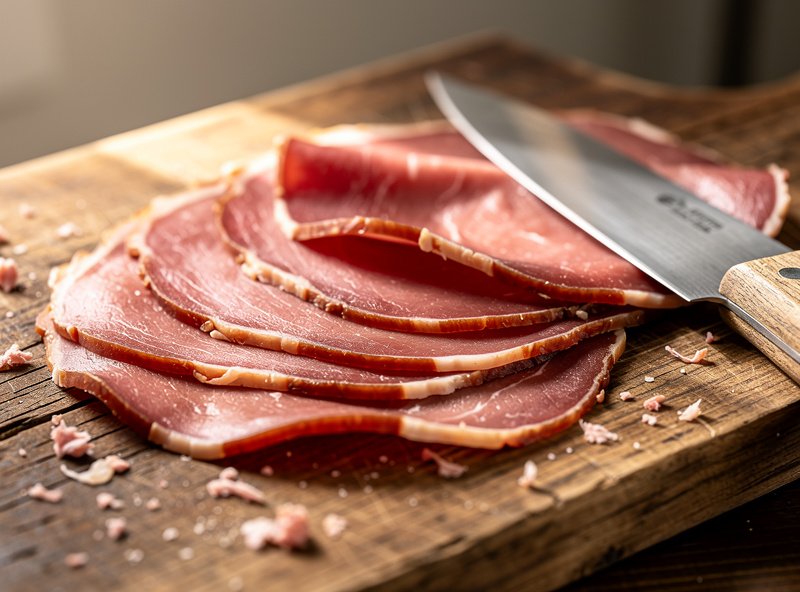
Slice on demand for the best texture. Whole-muscle pre-sliced and stored more than 2 weeks loses the marbled fat-meat balance and tastes flat. A sharp chef knife at a 30-degree angle to the muscle fiber produces the proper paper-thin slices for prosciutto-style consumption; for bresaola and lonza, slightly thicker slices (2-3 mm) work better.
Larger pieces destined for long storage benefit from being wrapped in clean butcher paper, then placed inside a partially-open paper bag in a cool dark cellar or refrigerator. The paper-bag method allows residual moisture to leave the cut surface gradually rather than condensing under vacuum and producing wet patches. Many traditional Italian households held a coppa or pancetta in a paper bag in the cantina for months without further intervention; the same technique translates to a refrigerator with good airflow.
Common Whole-Muscle Mistakes
Mistake 1: Insufficient cure time for thick muscles. A 5-inch-thick coppa needs 21 days of cure to reach the center; pulling at 14 days leaves uncured meat in the middle that does not drop water activity during hang. Calculate cure time at 1 day per 1/2 inch of thickness minimum.
Mistake 2: Surface-only salt distribution (in saltbox cure). If the salt does not penetrate uniformly because flips were skipped or the container was poorly draining, the surface is salty and the center is undercured. Use equilibrium cure in vacuum bag if you cannot reliably flip.
Mistake 3: Hanging too soon after cure. Skipping the rinse-and-pellicle-form step puts wet meat into the chamber. The surface case-hardens unevenly and mold colonizes patches that should have been clean. Always rinse, pat dry, and air-dry 4-12 hours before hanging.
Mistake 4: Pulling before target weight loss. A whole-muscle at 25% weight loss is still too wet inside the muscle. The interior is gummy, the salt protection is incomplete, and the texture is wrong. Wait for 30-35% weight loss confirmed by the scale. The honest readiness indicator is weight, not appearance.
Mistake 5: Sharing chamber with high-humidity work during the long hang. A 9-month prosciutto cannot share with a 6-week cheese aging cycle. The cheese pushes humidity to 85% RH; the prosciutto needs 75-78% RH. The prosciutto fails first because its multi-month timeline amplifies any humidity drift. Run the long-hang projects as chamber-monopolizing.
Trimming Before You Cure: Why Silver Skin and Surface Fat Change the Math
The weight you calculate salt and cure #2 percentages against is the trimmed weight, not the weight the cut comes off the delivery paper at. Silver skin (the pearly connective sheath on a loin or eye-of-round) doesn’t absorb salt or cure the way muscle does, and leaving it on means the piece underneath is getting a lower effective salt percentage than the math says, while the skin itself contributes nothing but toughness once sliced. I trim it off completely before weighing for the cure calculation, not after — weigh, then trim, and you’ve cured against the wrong number.
Surface fat is a judgment call rather than a hard rule. A coppa or lardo wants some fat cap left on for flavor and texture, so I weigh with a light fat cap intact and account for it by leaning toward the lower end of the salt percentage range, since fat takes up salt more slowly than lean muscle and a cut with more surface fat effectively needs a bit less salt relative to its total weight to hit the same equilibrium in the lean portion. Bresaola and lonza get trimmed harder — bresaola in particular should come off the eye-of-round nearly bare, since any fat cap left on turns rubbery and unpleasant over a multi-week hang and doesn’t render the way it would in a shorter cook.
Why Duck Prosciutto Gets There Faster — And Why the Cure Rules Don’t Change
Duck prosciutto is the fastest style in this guide by a wide margin — 24-36 hours of cure against a 2-week hang, compared to months for the pork whole-muscle styles — and the reason is straightforward geometry, not a different safety profile. A duck breast is thin relative to its surface area, so salt penetrates to the center in under two days instead of the week-plus a thick pork loin or coppa needs, and the same thinness means moisture migrates out fast enough to hit target weight loss in two weeks instead of two months. That’s the entire explanation. It is not evidence that a fast, small cut needs less cure salt or a looser safety margin — duck prosciutto is still an uncooked, hung, whole-muscle cure with zero fermentation step, and it runs on the same cure #2 percentage as everything else on this page for exactly the same reason: the nitrite/nitrate protection has to be present for the full length of the hang, however short that hang turns out to be.
This is also why duck prosciutto is the right first project — not because the safety math is more forgiving, but because a 2-week feedback loop teaches you to read a pellicle, weigh a piece, and recognize a properly firm finished texture in a fraction of the time a coppa or lonza costs you to learn the same lessons. The full walkthrough, cure #2 ratio included, is in duck prosciutto: the 2-week beginner charcuterie project.
Labeling and Rotating a Multi-Project Chamber
Once you’re running more than one whole-muscle piece at a time — which happens fast, since a coppa alone occupies chamber space for 2-3 months — losing track of which piece started when becomes the single easiest way to pull something too early or let it go weeks past target without noticing. I tag every hanging piece with a laminated card: cure date, hang date, starting post-rinse weight, and target weight at 30-35% loss, zip-tied to the twine or S-hook it’s hanging from. The weight log lives separately (a shared spreadsheet, one row per piece, weighed on the same day each week), but the card on the meat itself is what stops a quick chamber-door glance from turning into a guess.
Rotation matters too, not just labeling. Pieces started weeks apart occupy different stages of the same chamber and can end up needing slightly different airflow exposure — a piece three weeks in with a settled pellicle tolerates more direct fan exposure than one still forming its pellicle in the first 48 hours, so I hang newer pieces further from the fan and shift them as they age. It’s a small thing, but it’s the difference between every piece finishing evenly and the one nearest the fan case-hardening while the rest of the batch is fine.
Frequently Asked Questions
What is whole-muscle charcuterie?
Whole-muscle charcuterie is dry-cured meat made from intact muscle pieces rather than ground meat. Examples include prosciutto, bresaola, coppa, lonza, lardo, speck, and pancetta. Each piece is salt-cured for days to weeks, rinsed, then hung at 50-55F and 75-80 percent RH for 4 weeks to 18 months until 30-35 percent weight loss. There is no fermentation phase, unlike salami.
What temperature and humidity for whole-muscle drying?
Hold 50 to 55 degrees F (10 to 13 degrees C) at 75 to 80 percent relative humidity for the entire hang. Drift under 3 degrees F and 5 percent RH. Larger pieces tolerate slightly higher humidity (80 percent) because their mass slows moisture migration. Smaller pieces need slightly lower humidity (72-75 percent) to maintain drying pace.
What is the difference between whole-muscle and salami?
Salami is ground meat and fat in casings, fermented to drop pH below 5.0, then dried. Whole-muscle uses intact muscle pieces, cured with salt only (no fermentation), then dried. Salami depends on pH drop plus salt for safety; whole-muscle depends on salt plus water activity reduction. Both reach about 35 percent weight loss before being safe to eat.
How long does prosciutto take to make at home?
A traditional bone-in prosciutto leg requires 9 to 18 months total: 30-45 days of cure followed by 9-18 months of hang. Smaller whole-muscle styles run faster: duck prosciutto in 2 weeks, bresaola in 4-6 weeks, lonza in 3-5 weeks, coppa in 2-3 months. The longer projects need a chamber that can hold spec for months without intervention.
What salt percentage for whole-muscle charcuterie?
Most home whole-muscle recipes use 2.5 to 3.0 percent salt by trimmed muscle weight. Cure #2 (sodium nitrite plus sodium nitrate) is added at 0.25 percent — this applies to every style in this guide, not just the longest hangs. Whole-muscle charcuterie is an uncooked, hung product with no fermentation step to drop pH, so cure #2’s slow-release nitrate reservoir is the ongoing protection across the entire hang, whether that hang is 2 weeks (duck prosciutto) or 18 months (prosciutto di Parma). There is no day-count below which cure #1 or no cure salt becomes an acceptable substitute. Lardo runs higher at 4-5 percent salt because the heavy salt is the primary preservation, but still uses cure #2, not cure #1. Always weigh meat trimmed of silver skin and bone before calculating — the full ratio math is in the pink salt and nitrates guide.
Saltbox vs equilibrium cure for whole-muscle?
Equilibrium cure (exact salt percentage in a vacuum bag) is the modern standard. It cannot over-salt, distributes uniformly through diffusion, and is hard to mess up. Saltbox cure (covering the meat in salt) is traditional and forgiving on salt amount but produces a salt gradient and requires daily flipping. Use equilibrium for repeatability; use saltbox if you are following a traditional recipe.
How do I know when whole-muscle charcuterie is ready?
Weigh the meat after rinsing and forming the pellicle. Mark the target weight at 0.65 to 0.70 of post-rinse weight (30-35 percent weight loss). Pull when target is reached. The meat should be firm but not rock-hard, with even color throughout the cut surface. Calendar time is a rough guide; the scale is the truth. Smaller pieces hit target in weeks; large prosciuttos hit target in 12-18 months.
Related Articles
- Duck Prosciutto: The 2-Week Beginner Charcuterie Project — the gateway whole-muscle build.
- How to Calculate Salt Percentage for Equilibrium Curing — the math that drives salt safety and flavor.
- How to Build a Curing Chamber: The Complete Guide
- Curing Chamber Climate Control: The Complete Guide
- Curing Chamber Troubleshooting: The Complete Guide
- Case Hardening in Curing Chambers: Causes and Fixes
- Home Salami Making: The Complete Guide
- When Is Charcuterie Done? Weight Loss and Readiness Guide
- How to Slice Charcuterie Paper Thin at Home