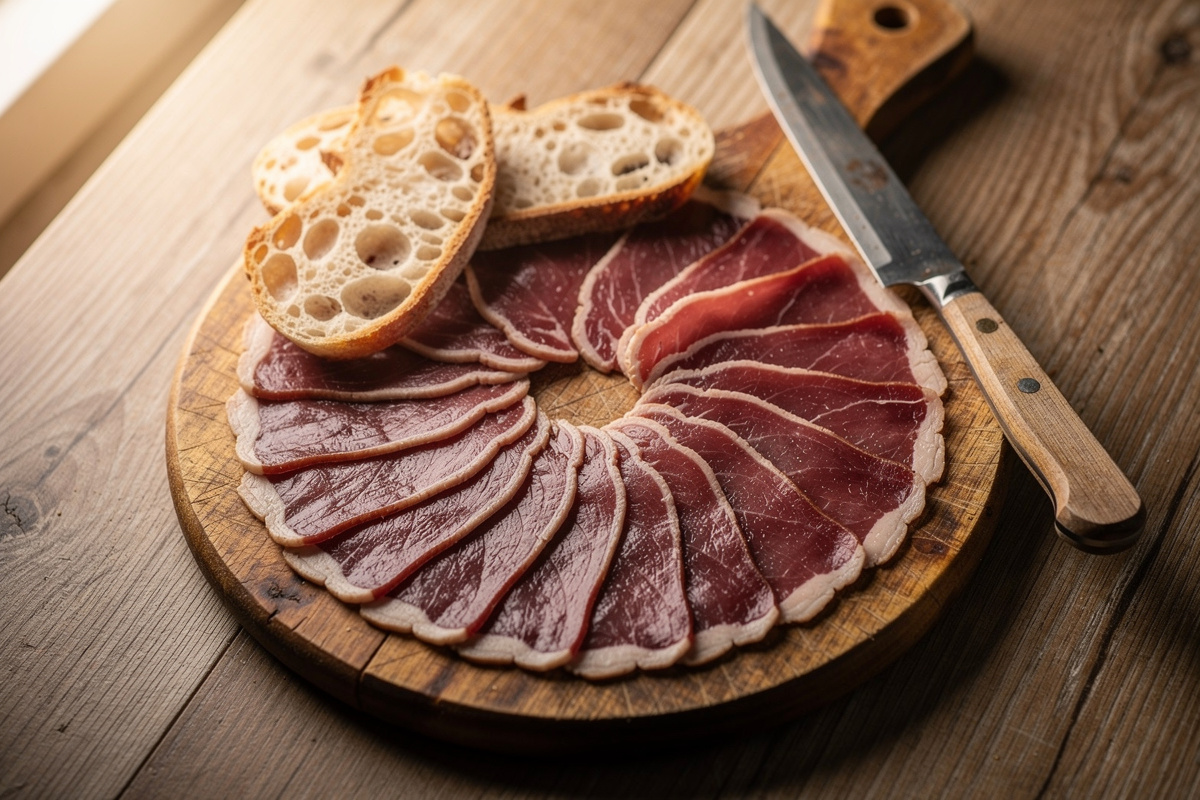

Duck prosciutto was my first cured-meat project — two Pekin breasts, kosher salt, pink salt #2, and pepper for about $5 in materials, 14 days in the chamber, and a sliceable result that beat what my local deli was charging $42 a pound for. It also validated that my chamber held 55°F and 75% RH for two consecutive weeks before I committed to a 5-month coppa, which is the real reason every new charcuterie hobbyist should start here.
Duck prosciutto is the fastest entry point to home charcuterie: two duck breasts, kosher salt, pink salt #2, cracked pepper, herbs, and 14 days of cure time produce sliceable cured duck that compares favorably to commercial $40-per-pound product. Total active prep time is about 30 minutes spread across two sessions; chamber time is 10 to 14 days at 55°F and 75% humidity. The yield from two 12-oz breasts is roughly 16 oz finished prosciutto. The broader cuts, methods, and climate framework are in whole muscle charcuterie: the complete guide.
Unlike whole-muscle pork prosciutto (which requires 6 to 18 months), duck prosciutto works in 2 weeks because the breasts are small (12 to 14 oz each), the meat is dense, and the equilibrium-cure salt percentage moves through the muscle in days rather than weeks. This makes duck prosciutto the ideal first project for a new curing chamber — you get a finished product fast enough to validate that your chamber works before committing to a 6-month cure.
Why Duck Prosciutto Is the Best First Charcuterie Project
Speed: 2 weeks vs 6 months for traditional pork prosciutto. You learn whether your chamber holds temperature and humidity long enough to validate the equipment without losing a $40 piece of meat to chamber failure.
Cost: $25 to $40 in materials per project (two duck breasts at $12 to $20 each, plus salt and herbs). Even if the cure fails, the loss is small. Pork prosciutto loss is $30 to $60 per leg — much higher stakes.
Forgiveness: Duck breast tolerates a wider salt-percentage range and humidity range than other charcuterie. The equilibrium cure (2.5 to 3% salt by weight) gives consistent results even if your scale is slightly off or your cure time runs long.
Yield: Each duck breast loses about 30% weight during cure, leaving you with 8 oz of finished product per breast. Two breasts make 16 oz total — enough for a few charcuterie boards or sliced over salads for a week. Commercial duck prosciutto retails for $40 to $60 per pound in 2026; home production cost is $20 to $25 per pound.
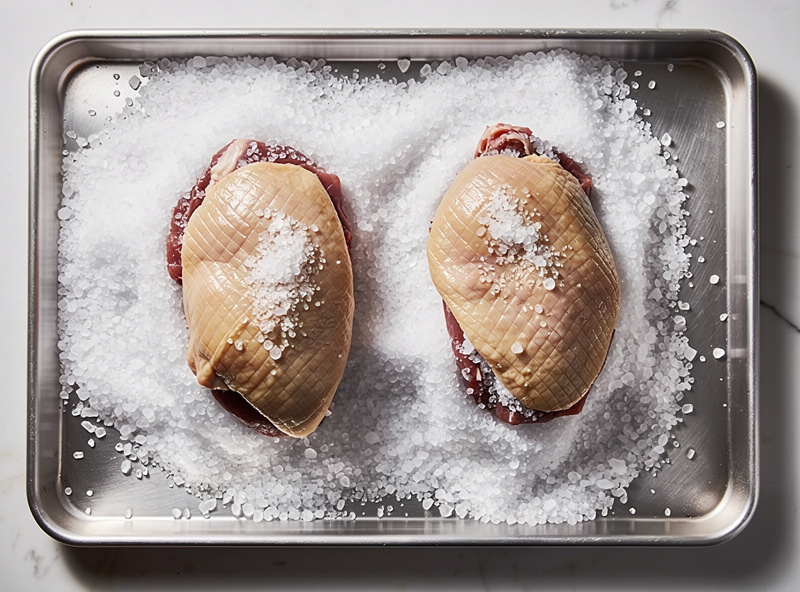
Ingredients and Equipment
Duck breasts: 2 whole magret or Pekin duck breasts with skin and fat cap intact (12 to 14 oz each). D’Artagnan and Maple Leaf Farms are reliable national brands. I’ve used both — D’Artagnan magrets are slightly thicker (closer to 14 oz) so the cure week extends to 7 days for me; Pekin breasts at 12 oz hit equilibrium at 5 days. The thickness, not the brand, drives cure time. Frozen breasts work fine — thaw fully in the fridge for 24 hours before cure.
Salt: 2.5% of the breast weight in kosher salt or fine sea salt. For two 12 oz breasts (340 g each = 680 g total), use 17 g salt total. Use a digital scale that reads to 1 g — eyeballing salt percentages produces inconsistent results.
Optional flavor: 1 teaspoon cracked black pepper, 1 teaspoon dried thyme, 1 teaspoon ground juniper berries, 2 cloves crushed garlic. These flavors penetrate the meat during the cure phase. Skip if you want pure-duck flavor.
Pink salt #2 (required): 0.25% of total weight (1.7 g for 680 g of duck). Pink salt #2 is sodium nitrite plus nitrate, and it’s what makes this a safe dry cure rather than a salt-only experiment — it’s not optional here. Duck prosciutto is never cooked and spends 10 to 14 days hanging in the chamber, which puts it in the same curing-salt category as any other whole-muscle charcuterie, not a special short-cure exception. Don’t skip it and don’t substitute plain salt.
Equipment: Digital scale (1 g resolution), curing chamber set to 55°F and 75% RH, cheesecloth (1 yard), butcher’s twine, large zip bag or vacuum bag, baking sheet for the salt-cure step.
Step 1 (Day 0): Trim and Weigh
Pat the duck breasts dry with paper towels. Trim any silverskin from the meat side (silverskin is the silvery membrane that won’t tenderize during cure). Don’t trim the fat cap — the skin and fat are essential to the prosciutto’s texture and flavor. Score the fat cap with shallow diagonal cuts about 1 cm apart in a crosshatch pattern; this lets the cure penetrate evenly.
Weigh the trimmed breasts together to the gram. Calculate the cure mix: total weight × 0.025 = salt grams; total weight × 0.0025 = pink salt #2 grams (if using). Mix the salt, pink salt, pepper, thyme, juniper, and garlic in a small bowl.
Record the starting weight on a piece of tape stuck to the curing chamber. You’ll use this to calculate weight loss at the end of the cure (target: 30% loss for prosciutto texture).
Step 2 (Day 0): Apply the Cure
Place each duck breast in a separate zip-top bag or vacuum bag. Divide the cure mix equally between the two bags. Massage the cure into the meat from outside the bag, working it into all surfaces — skin, fat, meat side. Press out as much air as possible before sealing.
Refrigerate the bagged breasts for 5 to 7 days. The standard equilibrium cure: 24 hours per centimeter of meat thickness. A 2.5 cm thick duck breast cures fully in 2.5 days, but home charcuterie typically over-cures slightly (5 to 7 days) for safety margin.
Flip the bags daily. Liquid will accumulate inside the bag — this is normal (salt is drawing moisture out of the meat). Don’t drain it. The liquid contains dissolved salt that continues to cure the meat through indirect contact.
Step 3 (Day 7): Rinse, Dry, and Wrap
Remove the breasts from the cure bags. Rinse briefly under cold running water to remove excess surface salt — about 15 to 30 seconds per breast. Don’t soak; you only want to remove surface salt, not extract cured-in salt.
Pat dry thoroughly with paper towels. The breasts will feel firm to the touch (the cure has drawn out moisture and tightened the protein structure) and the meat side will be a darker red than fresh duck.
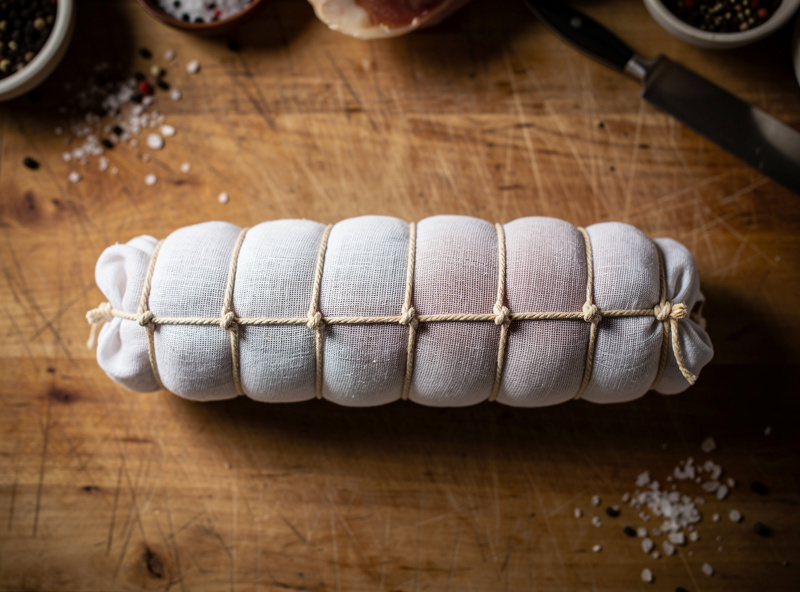
Cut a piece of cheesecloth roughly 12 inches square per breast. Wrap the breast snugly in 1 to 2 layers of cheesecloth, fully enclosing it. Tie butcher’s twine around the wrapped breast in a series of loops every 1 to 2 inches, creating a sausage-like binding pattern that compacts the meat. Leave a 6-inch loop at one end for hanging.
The cheesecloth and twine combination protects the meat from chamber dust, supports the meat’s shape during dehydration, and gives a hanging point. Don’t skip the wrap — bare meat in a chamber dries unevenly and develops case hardening.
Step 4 (Days 7 to 21): Hang in the Chamber
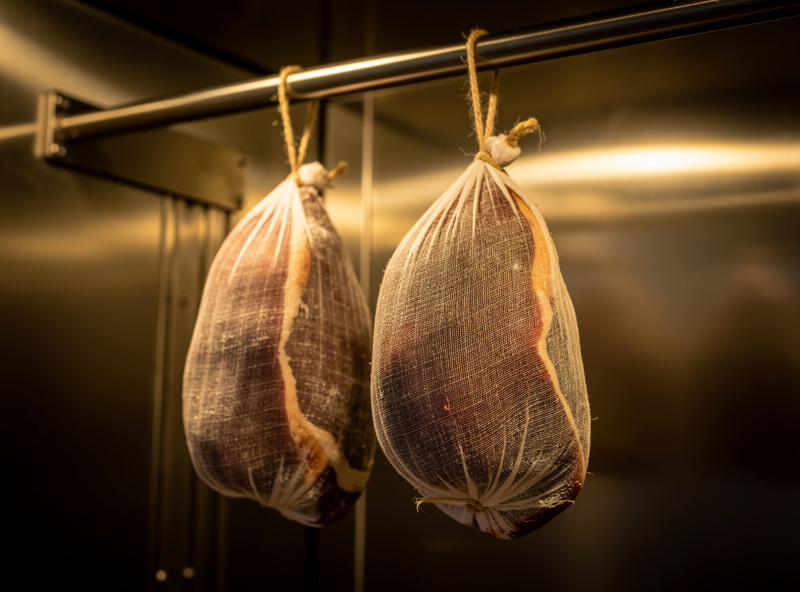
Hang the wrapped breasts from the chamber’s stainless rod using the twine loops. Space them at least 4 inches apart for airflow. Verify chamber is at 55°F (range 52-58°F acceptable) and 75% RH (range 70-78% acceptable).
Check daily for the first 3 days, then every 2-3 days. You’re checking for: visible mold on the cheesecloth (white = good, fuzzy = re-inoculate; black/green spots = wipe with vinegar), unusual smells (should smell faintly of duck and herbs; ammonia or sour means trouble), and cheesecloth saturation (should dry over 24-48 hours; staying damp means humidity is too high).
Weight check at day 14: unwrap one breast briefly, weigh, and re-wrap. If it’s lost 28-32% of starting weight, the prosciutto is done. If less than 25%, hang another 3-5 days. If more than 35%, you’ve over-dried — usable but firmer texture than ideal.
Step 5 (Day 14 to 21): Slice and Store
Unwrap the cheesecloth and brush off any surface mold. Slice the duck prosciutto paper-thin (about 1 to 2 mm) across the grain — the grain runs lengthwise in a duck breast, so slice perpendicular to the long axis. A sharp slicing knife works fine; a meat slicer gives better consistency for serving multiple guests.
The interior should be deep ruby red with a thin white-to-yellow fat layer at the top of each slice. Texture is firm but pliable — should bend without snapping. Smell is concentrated duck with herb notes, slightly sweet.
Store wrapped in butcher’s paper or parchment in the refrigerator. Refrigerated duck prosciutto keeps 4 to 6 weeks. For longer storage, vacuum-seal in 4 oz portions and freeze up to 6 months — the texture survives freezing better than commercial deli meats because the cure has already removed most of the freezable water.
Duck Prosciutto Recipe Summary Table
| Variable | Specification |
|---|---|
| Duck breast count | 2 (Pekin or Magret, skin-on) |
| Starting weight | ~24 oz total (680 g) |
| Salt percentage | 2.5% of starting weight (17 g) |
| Pink salt #2 (required) | 0.25% of starting weight (1.7 g) |
| Cure days (refrigerator) | 5 to 7 days |
| Hang days (curing chamber) | 10 to 14 days |
| Chamber temperature | 55°F (52-58°F range) |
| Chamber humidity | 75% (70-78% range) |
| Target weight loss | 28-32% from starting |
| Yield | ~16 oz finished product |
| Total project cost | $25 to $40 |
| Refrigerator storage | 4 to 6 weeks wrapped in parchment |
Common Mistakes and Fixes
Salt percentage wrong: Too much salt (over 3.5%) makes the prosciutto unpleasantly salty and tough; too little (under 2%) increases spoilage risk. Always weigh the cure precisely. The 2.5% rule applies to total starting weight including skin and fat. My second batch I eyeballed the salt because I’d done it once already and felt confident — ended up at roughly 4.1%, and the cured breast was so salty I had to slice it whisper-thin and serve it with un-salted bread to balance. Now I never skip the digital scale, even for what feels like a routine recipe.
Skipping the cheesecloth wrap: Bare hanging duck breast develops a hardened crust in 3-5 days because the surface dehydrates much faster than the interior. The cheesecloth slows evaporation enough to keep the cure even.
Chamber humidity too low: Below 65% RH, the breast over-dries and becomes leathery. Use a humidifier or add a salt-saturated water tray to the chamber. The humidity control guide covers both directions.
Cure time too short or too long: The 5-7 day cure window is critical. Less than 5 days and salt hasn’t fully equilibrated through the meat; more than 10 days and the cure becomes overpowering. Set a calendar reminder for day 5 to start checking.
Pink salt confusion: Pink salt #1 (sodium nitrite only) is for meats that get cooked before eating, like bacon. Pink salt #2 (sodium nitrite plus nitrate) is for whole-muscle and long-dried charcuterie that’s eaten uncooked — duck prosciutto is never cooked and hangs for 10 to 14 days, so it belongs firmly in the pink salt #2 category, not the cook-before-eating category. The equilibrium curing salt-percentage walk-through covers cure salt selection in detail. Nitrite is doing the actual botulism-control work in a hung, uncooked cure — no amount of extra salt or drying time substitutes for it, which is the same safety hurdle that shows up in Pork Information Gateway’s dry-sausage validation guidance.
What to Make Next After Duck Prosciutto
Once duck prosciutto succeeds, the next-step charcuterie projects are: pork loin lonza (3-4 weeks, similar technique with pork loin), bresaola (4-6 weeks, beef eye of round), and small whole-muscle items like coppa or pancetta tesa. Each one extends the cure time and builds skill in chamber stability.
Avoid jumping directly from duck prosciutto to whole pork leg prosciutto — the 6 to 18 month cure on pork leg requires confident chamber operation across seasonal temperature changes. Build through 4 to 6 month-long projects first to validate that your chamber stays within tolerance year-round. The whole muscle charcuterie hub sequences these projects in order of difficulty. Guanciale — pork jowl cured 4-6 weeks — is a natural bridge between duck prosciutto and a full coppa; the homemade guanciale guide covers jowl prep, spice cure, and hang time in detail.
Frequently Asked Questions
How long does duck prosciutto take to cure?
About 14 to 21 days total: 5 to 7 days dry cure in the refrigerator with kosher salt and pink salt #2, then 10 to 14 days hanging in a curing chamber at 55 degrees F and 75 percent humidity. Active prep time is about 30 minutes spread across two sessions.
What salt percentage for duck prosciutto?
2.5 percent of the duck breast starting weight in kosher salt or fine sea salt. For two 12 oz breasts (680 grams total), use 17 grams of salt. Always weigh the cure precisely on a digital scale rather than estimating volume.
Do I need pink salt to make duck prosciutto?
Yes. Pink salt #2 (sodium nitrite plus nitrate) at 0.25 percent of starting weight (1.7 grams for 680 grams of duck) is what makes this a safe dry cure rather than a salt-only experiment. Duck prosciutto is never cooked and hangs for 10 to 14 days, which puts it in the same curing-salt category as any other whole-muscle charcuterie. Don’t skip it.
What temperature and humidity for duck prosciutto?
55 degrees F (acceptable range 52 to 58) and 75 percent relative humidity (acceptable range 70 to 78). I hold both with an Inkbird IHC-200 for humidity and a separate temperature controller on the chamber compressor. Stable conditions matter more than hitting exact targets.
How much weight should duck prosciutto lose?
28 to 32 percent of starting weight gives the proper sliceable prosciutto texture. Less than 25 percent and the meat is still too soft; more than 35 percent and it becomes leathery. Weigh after 14 days hanging and decide whether to extend.
Why wrap duck prosciutto in cheesecloth?
The cheesecloth slows surface dehydration so the cure dries evenly throughout the meat instead of forming a hardened crust on the outside. It also protects from chamber dust and provides a hanging point. Do not skip this step — bare hanging duck breast develops case hardening in 3 to 5 days.
Related Articles
- Whole Muscle Charcuterie: The Complete Guide
- How to Calculate Salt Percentage for Equilibrium Curing
- Curing Chamber Troubleshooting: The Complete Guide
- Curing Chamber Build Cost: My $200 DIY Setup
- Curing Chamber Too Humid: How to Fix Oversaturation Fast
- How to Slice Charcuterie Paper Thin at Home