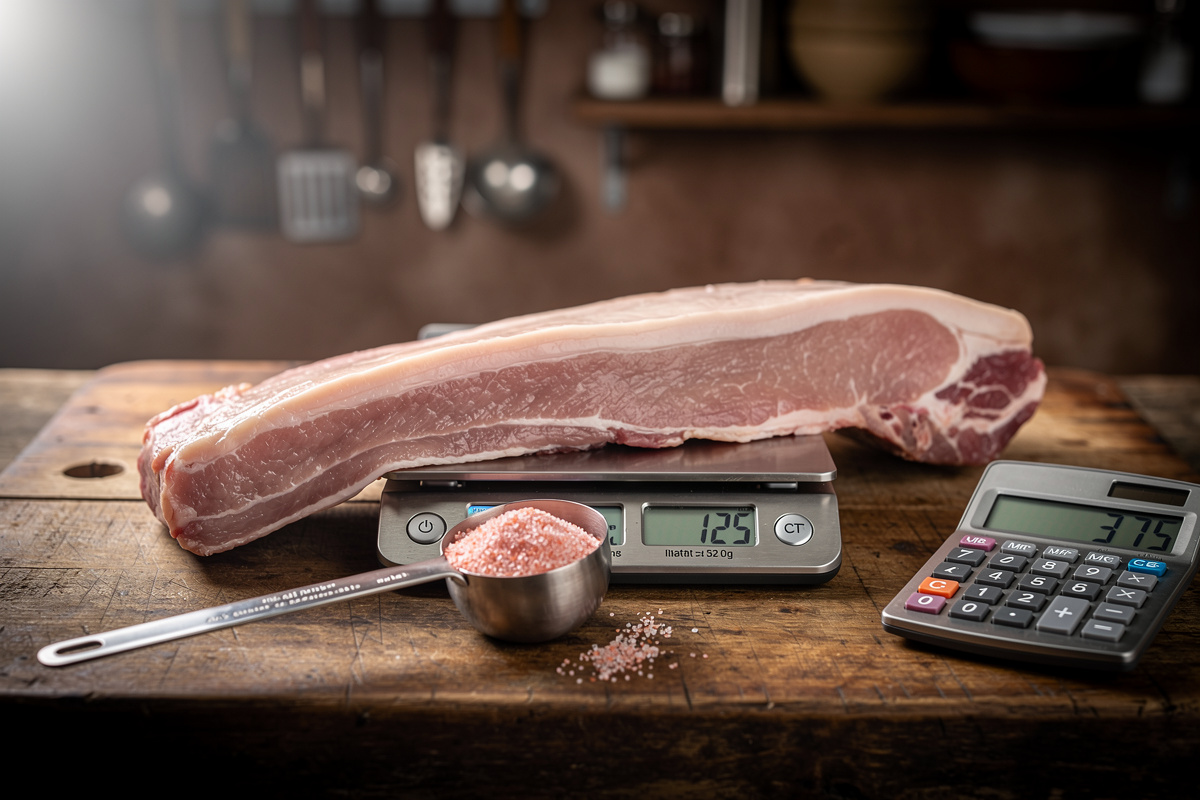

I weigh every cure on a $25 OXO digital kitchen scale that reads to 1 g, and I run 2.75% salt by weight on whole muscle as a default — split between 2.5% kosher and 0.25% Cure #2 for anything that hangs longer than 30 days.
As an Amazon Associate I earn from qualifying purchases.
The same scale is what I use for the Penicillium spore suspension and for portioning finished prosciutto into 4-ounce vacuum bags. Calculate equilibrium curing (EQ curing) salt percentage by multiplying meat weight in grams by 0.025 to 0.035 — that gives 2.5% to 3.5% salt by weight, the safe range for whole muscle charcuterie. For a 1000g pork loin: 25g salt at 2.5% (mild), 30g at 3.0% (standard), 35g at 3.5% (firm). Add cure #2 at 0.25% (2.5g per kilo) for any product that will hang uncooked for an extended aging period — the nitrate acts as a slow-release reservoir that keeps converting to nitrite over weeks, which a nitrite-only cure #1 cannot sustain. The validated process parameters for long-aged dry/semi-dry products are in the Pork Information Gateway sausage validation guide. The cure methods, cuts, and hang times that use this math are in whole muscle charcuterie: the complete guide.
Equilibrium curing replaced traditional pile-of-salt curing in serious home charcuterie around 2010 because it produces predictable consistent results without the variable saltiness of overnight rinse-cures. The math is simple but the precision requirements are real — too little salt and dangerous bacteria survive, too much and the product is unpalatably salty. Get the percentage and the timing right and the rest of charcuterie becomes much more reliable.
The EQ Curing Math: Why Percentages Beat Volume
EQ curing measures salt as a percentage of meat weight rather than volume of salt — the historical “tablespoons per pound” approach is unreliable because different salt types pack differently (Diamond Crystal kosher salt runs roughly half the density of fine table salt by volume, so a tablespoon of one is nowhere near a tablespoon of the other). Weight-based percentages are repeatable across salt brands, kitchens, and recipes.
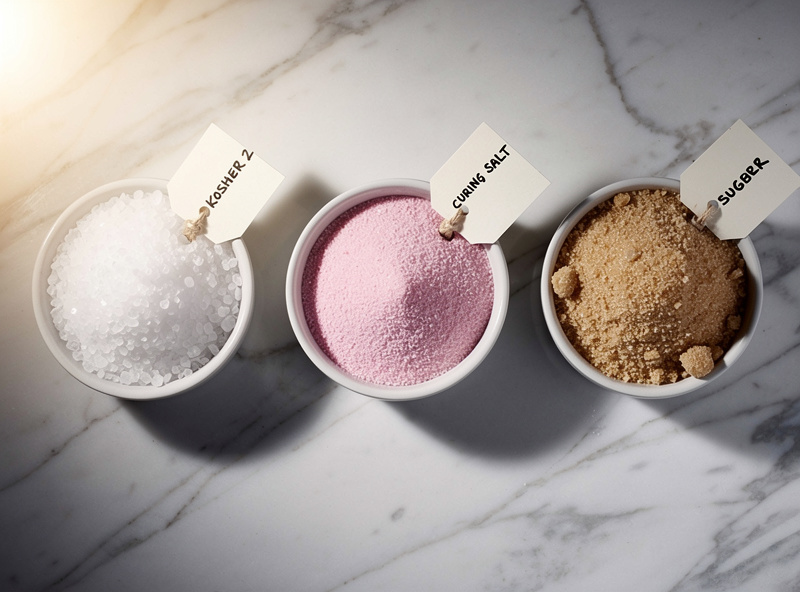
The standard percentages by product type:
- 2.0% salt: Bacon, pancetta, shorter cures (under 14 days). Mild salt level; suitable for products that will be cooked or further processed.
- 2.5% salt: Most whole-muscle charcuterie — coppa, lonza, bresaola, capocollo. Mild but safe; the most-used target.
- 3.0% salt: Standard prosciutto and most aged whole muscle. Slightly firmer texture; safer for longer aging.
- 3.5% salt: Salami and fermented sausages. Higher salt to support fermentation safety.
- 4.0%+ salt: Some traditional regional recipes (e.g., specific Italian salumi). Firm texture; highly seasoned final taste.
- Below 1.5% salt: Unsafe. Insufficient to control pathogen growth during the cure. Never go below 2.0%.
- Above 4.5% salt: Unpalatable for most modern tastes. Some traditional preparations exceed this for historical preservation reasons.
The 2.5-3.0% range covers 80% of home charcuterie projects. For first attempts, 2.5% is forgiving and produces good results. As experience develops, adjusting to 2.7-2.9% based on personal taste preferences and product type is the natural progression. Read about specific cures in our duck prosciutto beginner guide.
Adding Pink Curing Salt #2 for Long-Aging Products
Pink curing salt #2 (sometimes labeled Prague Powder #2 or InstaCure #2) contains sodium nitrate and sodium nitrite that prevent botulism in long-aged products. Use 0.25% (2.5g per kilogram of meat). The deciding question is not a day count, it is whether the product will be cooked: cure #2 is required for anything that hangs uncooked through an extended aging period, because the nitrate keeps converting to nitrite over weeks in a way a nitrite-only cure cannot sustain. This is USDA-FSIS territory, not FDA — the Pork Information Gateway breaks down the actual ingoing nitrite limits by product category (200 ppm for pumped or massaged whole-muscle cures, 156 ppm for comminuted products like sausage, 120 ppm for pumped or massaged bacon) that this 0.25% rate is built around. Pink curing salt #1 contains only nitrite and is appropriate for products that will be fully cooked, or for short cures that finish within roughly two weeks — never for a long uncooked hang, regardless of how few days the cure step itself takes.
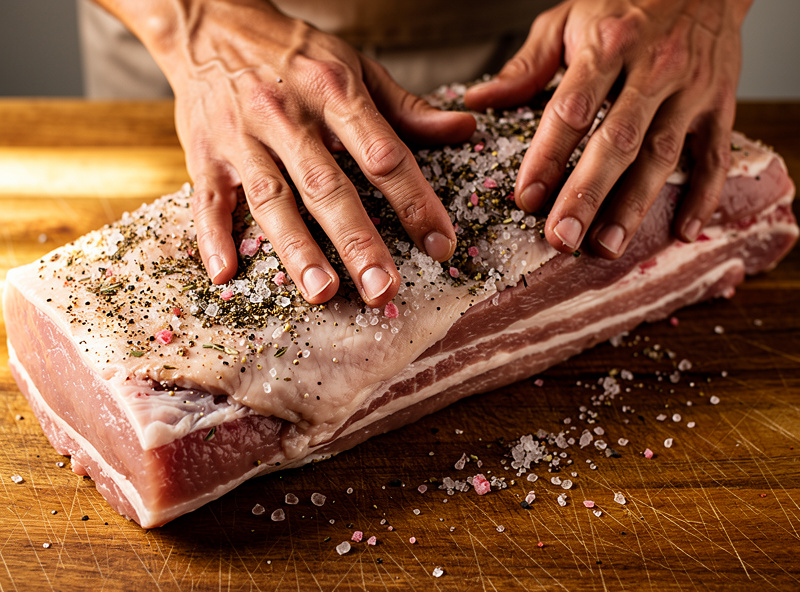
Pink salt usage by product:
- Cure #1 (sodium nitrite, 0.25%): Bacon, pastrami, shorter wet cures — typically 7-14 days in the cure itself. Only for products that will be fully cooked, or very short cures; never for a product that hangs uncooked afterward.
- Cure #2 (sodium nitrate + nitrite, 0.25%): Long-aged whole muscle and salami — anything that hangs uncooked through an extended aging period, which in practice means most products aged 30+ days total. The nitrate slowly converts to nitrite over weeks, providing extended protection a nitrite-only cure cannot.
- No cure (just regular salt): Only acceptable for products that will be hot-smoked to a safe internal temperature or fully cooked. Never skip cure on a product that will be eaten raw after hanging.
- Skipping cure on aged products: Unsafe. Botulism is rare but lethal. Pink curing salt costs roughly 0.05 dollars per kilogram of meat — there is no economic reason to skip it.
The 0.25% pink curing salt rate is fixed regardless of meat weight or product type. Calculation: meat weight in grams × 0.0025 = grams of pink curing salt. For a 1000g cut: 2.5g pink curing salt. This is added IN ADDITION to the regular salt percentage. Total cure for 1000g pork at 2.5% regular salt + 0.25% pink #2: 25g regular salt + 2.5g pink salt #2 = 27.5g total salt mixture.
Comparison Table: Salt Percentages by Project
| Product | Regular Salt | Pink Curing Salt | Cure Time | Use Case |
|---|---|---|---|---|
| Bacon (cooked) | 2.0-2.5% | 0.25% Cure #1 | 7-10 days | Cooked product, mild flavor |
| Pancetta | 2.5-3.0% | 0.25% Cure #2 | 14-21 days | Aged, salt-cured pork belly |
| Coppa / Capocollo | 2.5-3.0% | 0.25% Cure #2 | 14-21 days | Aged whole muscle |
| Lonza (pork loin) | 2.5% | 0.25% Cure #2 | 10-14 days | Beginner-friendly aged |
| Bresaola (beef) | 2.5-3.0% | 0.25% Cure #2 | 14-21 days | Aged whole muscle beef |
| Prosciutto | 3.0-3.5% | 0.25% Cure #2 | 30-60 days | Long-aged whole muscle |
| Guanciale | 2.5-3.0% | 0.25% Cure #2 | 14-21 days | Pork cheek aged |
| Salami | 3.0-3.5% | 0.25% Cure #2 | 30-60 days | Fermented aged sausage |
| Duck prosciutto | 2.5% | 0.25% Cure #2 | 10-14 days | Beginner project |
The cure time refers to the time the meat sits in the salt cure (in a vacuum bag or under salt) before transferring to the curing chamber for aging. After the cure period, products move to the chamber for additional weeks or months of aging at the chamber’s temperature and humidity targets.
The Equilibrium Curing Procedure
Weigh the meat precisely on a digital scale, calculate the salt percentages and weights, mix all dry cure ingredients (salt, pink salt, sugar, spices) thoroughly in a bowl, rub the entire cure mixture into the meat surface, vacuum seal the cured meat in a plastic bag, refrigerate at 34-38°F for the cure period, flip the bag every 2-3 days for even distribution. After cure period, rinse, dry, and transfer to the curing chamber for aging.
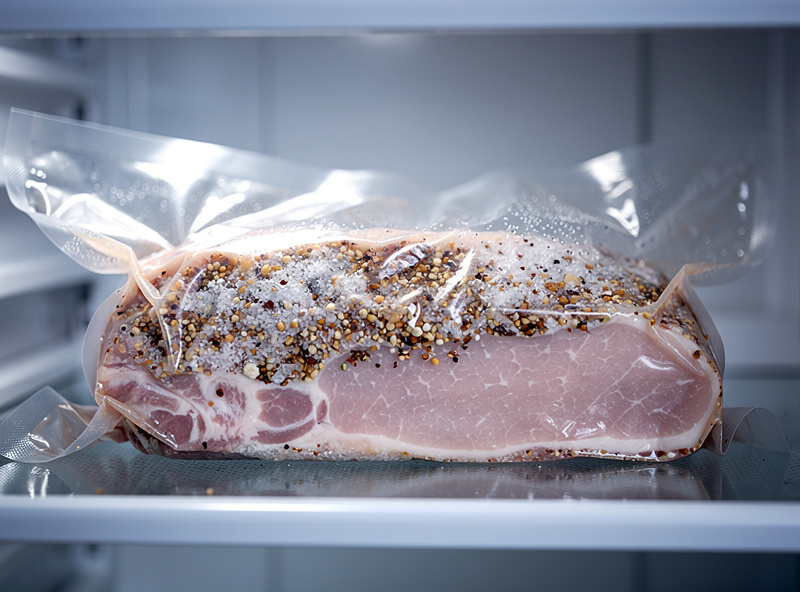
Step-by-step procedure:
- Weigh meat precisely: Use a digital scale accurate to 1g. The meat weight drives all calculations.
- Calculate salt: Meat weight × 0.025 (or your chosen percentage) = grams of salt. Verify the math.
- Calculate pink curing salt: Meat weight × 0.0025 = grams of pink curing salt #2.
- Mix all dry ingredients: Salt, pink salt, sugar, and spices in a bowl. Mix thoroughly so distribution is uniform.
- Rub the cure into the meat: Cover all surfaces — every face of the cut. Use ALL the cure; nothing left over.
- Vacuum seal: Place in a vacuum bag using a vacuum sealer and seal aggressively. The vacuum keeps the cure in contact with all meat surfaces.
- Refrigerate at 34-38°F: Place flat on a fridge shelf. The cure does not run off because there is no excess water.
- Flip every 2-3 days: The bag lying flat means cure pools slightly at the bottom. Flipping ensures even distribution.
- Calculate cure time: Approximately 1 day per 0.5cm of meat thickness, minimum 7 days. A 5cm thick cut needs roughly 10 days.
- After cure period: Rinse the meat surface to remove excess salt, pat dry, weigh again to verify minimum 5-10% weight loss.
- Transfer to curing chamber: Hang in chamber at proper temperature and humidity for the additional aging period (weeks to months depending on product).
The procedural step most beginners skip is post-cure rinsing — removing the excess surface salt before chamber aging. Skipping the rinse leaves a salt-encrusted surface that draws too much moisture out during chamber aging. Read about specific recipe execution in our duck prosciutto beginner guide.
Common Salt Calculation Mistakes
Six mistakes show up consistently in beginner EQ curing: using volume measurements instead of weight, confusing kosher salt and table salt, skipping pink curing salt for aged products, calculating salt as a percentage of total cure (not meat weight), forgetting to flip the bag during cure, and using table salt with iodine which interferes with cure development.
My second batch I weighed the salt in ounces on a kitchen scale that the box claimed was ±1 g but actually rounded to 5 g; I caught the salt at 6 g instead of 17 g for a 680 g cure pair, which is 0.9% — undersalted to the point where the duck went grey on day four. Now I keep a calibration weight on the scale and verify zero before every cure.
Mistakes and corrections:
- Volume instead of weight measurement: “1 tablespoon per pound” is unreliable. Different salt types pack at 50-100% different densities. Always weigh in grams.
- Wrong salt type: Use only non-iodized salt — kosher salt or sea salt work; iodized table salt interferes with cure chemistry. The most-used home charcuterie salt is Diamond Crystal kosher.
- Skipping pink curing salt: For products aged longer than 7-10 days, pink salt is genuinely safety-critical. Botulism is rare but lethal. Use the appropriate cure (#1 for short, #2 for long).
- Salt as percentage of cure (not meat): Some recipes confusingly express salt as a percentage of the total cure mixture rather than meat weight. Verify which the recipe means before scaling.
- Forgetting to flip the bag: Without flipping, cure distribution is uneven and one side absorbs more salt than the other.
- Iodized salt: The iodine catalyzes color and flavor changes that produce off-tastes in cured meat. Buy non-iodized salt specifically.
- Sugar as 100% replacement for salt: Sugar adds flavor balance but is NOT a salt substitute. Maintain at least 2.0% real salt; sugar is added separately at 0.5-1.5%.
The reliable practice is to write down the calculation on a piece of paper before mixing the cure: meat weight, salt %, pink salt %, sugar %, total grams of each. Recheck the math. Mix in a separate bowl. Apply. Skipping the calculation step is where most percentage errors happen. Read about food-safety considerations in our black mold on charcuterie guide.
Frequently Asked Questions
What is equilibrium curing for charcuterie?
Equilibrium curing measures salt as a fixed percentage of meat weight (typically 2.5-3.5%), then seals the cure with the meat in a vacuum bag where 100% of the salt enters the meat over the cure period. Replaces traditional excess-salt cures with predictable repeatable results.
How much pink curing salt do I use for charcuterie?
Always 0.25% (2.5 grams per kilogram of meat) regardless of product type. Cured meat and poultry fall under USDA-FSIS jurisdiction (not FDA), which sets the ingoing nitrite limits this rate is built around. Use Cure #1 only for products that will be fully cooked, or very short cures; use Cure #2 for anything that hangs uncooked through an extended aging period.
Can I use sea salt instead of kosher salt for curing?
Yes — pure sea salt without iodine works fine. Avoid iodized salt for any curing. The salt-to-meat ratio is calculated by weight, so different salt types produce identical results when measured in grams.
What happens if I use too much salt in my cure?
The product becomes overly salty (above 4.5% is unpalatable for most palates) but remains safe. The texture also becomes firmer than intended. The remedy is shorter cure time or rinsing more aggressively post-cure; you cannot remove salt that has fully equilibrated with the meat.
How long should I cure pork loin in the EQ method?
Approximately 1 day per 0.5cm of meat thickness, minimum 7 days. A typical 4-5cm thick whole loin needs 8-10 days. Slightly longer is fine; significantly shorter risks underdone areas. Equilibrium is reached at the calculated time.
Do I need a vacuum sealer for EQ curing?
Strongly recommended. Vacuum bags maintain consistent cure-meat contact across all surfaces. Without a vacuum, you must flip the meat in a sealed container daily AND the cure may not penetrate uniformly. A 75-150 dollar vacuum sealer pays back in cure consistency.
Related Articles
- Duck Prosciutto Beginner Project
- Salami Casing Mold: Good vs Bad
- Black Mold on Charcuterie
- Humidity for Dry Aging Beef vs Charcuterie
- How to Convert a Fridge Into a Curing Chamber