Case Hardening in Curing Chambers: Causes, Prevention, and Fixes
May 4, 2026

I have case-hardened exactly two coppas in 18 months of running my chamber, both during the dry winter months when the basement humidity floor dropped below 65% and my chamber humidifier could not keep pace.
The first one I rescued by paper-wrapping for 12 days; the second was past saving and went into the bin at week four when I sliced into a hollow grey interior. Case hardening in curing chambers is when the surface of meat dries and seals before the interior fully dehydrates, trapping moisture inside that supports bacterial growth and produces a hollow soft center. The cause is humidity below 70% RH, drying too fast in the first 7-14 days, or insufficient air circulation creating dry spots. Prevention is keeping humidity 75-80% RH and using a small fan for even circulation. Mild case hardening can be reversed by paper-wrapping the affected meat for 7-14 days to redistribute moisture. The full diagnostic checklist and recovery protocols are in curing chamber troubleshooting: the complete guide.
Case hardening is the most common single defect in home curing chambers and the failure that ruins more home charcuterie than mold or bacterial contamination combined. The frustrating part is that case hardening looks great externally — the meat appears beautifully aged with a crusty exterior — until you slice it and find a wet hollow interior that ruins what looked like a successful cure. This guide covers the science, the prevention, and the recovery options.
As an Amazon Associate I earn from qualifying purchases.
What Case Hardening Looks Like and How It Forms
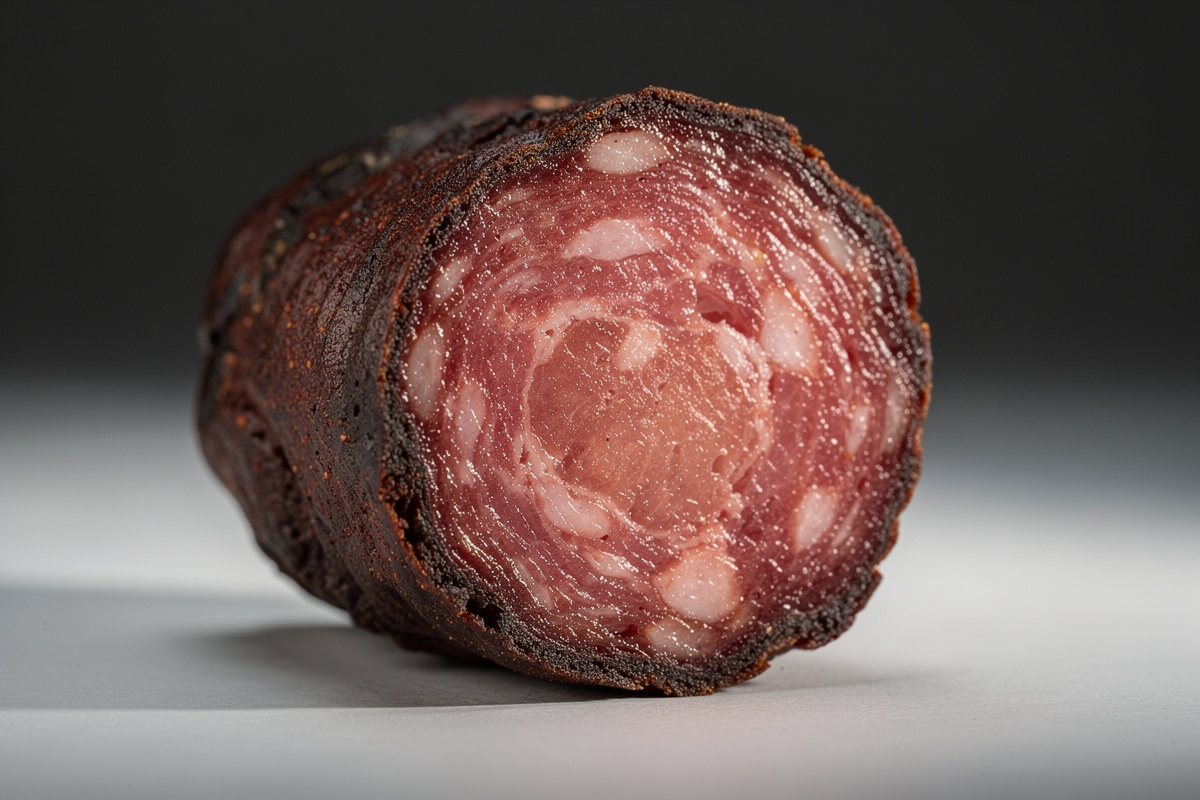
Case hardening shows as a distinct outer ring 3-8mm thick that is darker, harder, and drier than the interior, surrounding a softer paler center that may feel sticky or slightly wet. Visible only by slicing — externally, the meat appears properly aged. The hardened ring forms when surface moisture evaporates faster than interior moisture migrates outward, sealing the surface against further moisture transfer.
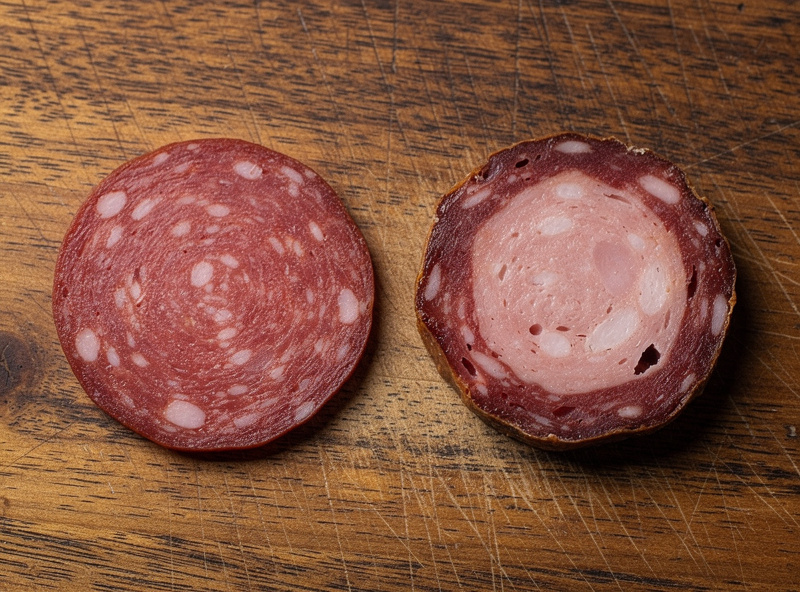
The FAO’s small-scale sausage production manual describes the same failure from the manufacturing side: if the sausage loses moisture too fast in the early drying period, “the surface becomes hardened and a crust or ring develops immediately adjacent to the casing… this hardened ring inhibits further transmission of moisture and the sausage has an excessively moist centre” — see the FAO drying and ageing guidance. The mechanism step by step:
- Initial drying phase: Surface moisture evaporates first; interior moisture begins migrating outward to replace it.
- Surface protein denaturation: The dried surface develops protein cross-links that progressively reduce moisture permeability.
- Sealed pellicle formation: Protein cross-links produce a hard outer ring that no longer allows interior moisture to escape.
- Trapped interior moisture: Interior cannot dry through the sealed surface; remains wet for the duration of aging.
- Bacterial proliferation risk: Trapped moisture supports bacterial growth not controlled by salt percentage alone — the same reasoning the National Center for Home Food Preservation applies to case-hardened jerky: a sealed, dry-looking exterior with a moist interior is a food-safety problem, not just a texture flaw.
- Visible failure mode: Slice reveals the hardened ring around the wet interior. Often discovered weeks into aging when “it should be done by now.”
The visual deception is what makes case hardening particularly frustrating — externally everything looks correct. Many home charcuterie makers proudly serve case-hardened salami, only to slice into it at a charcuterie board and discover the hollow ruined interior. Read about diagnostic visual cues in our dry aging smell normal vs bad guide.
Causes: The Five Reasons Chambers Produce Case Hardening
Five chamber conditions produce case hardening: humidity too low (below 70% RH), drying too fast in the early aging period, no air circulation creating dry spots, fluctuating humidity (90% then 60% then 90%), and using too-thin meat that cannot tolerate uniform drying conditions. Each one shows up differently but produces the same end result.
Cause-by-cause diagnosis:
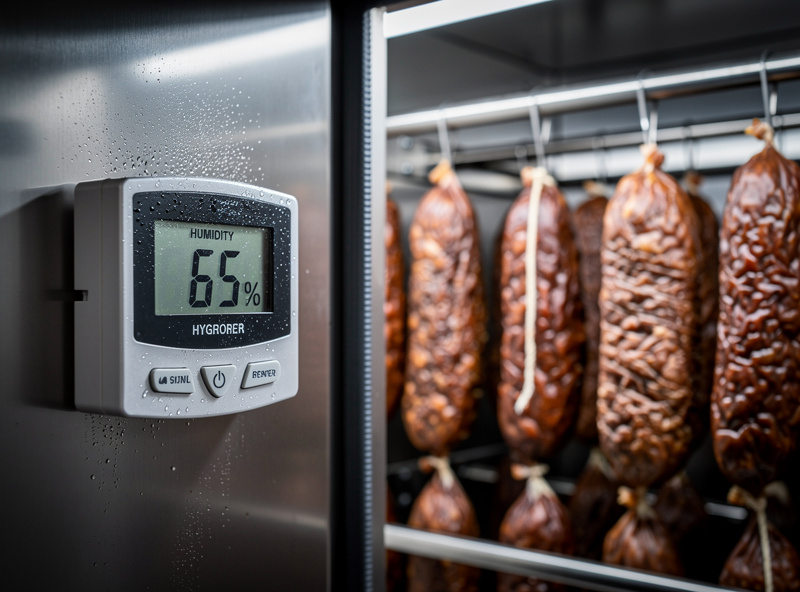
- Humidity below 70% RH: Surface dries faster than interior; classic case hardening within 7-14 days. Most common single cause in home chambers.
- Aggressive early-stage drying: Even within proper humidity range, dry-aging beef or whole muscles in the first week with too much air movement seals the surface before the interior can equilibrate.
- No air circulation: Stagnant chambers develop microclimate dry spots near vents or door seals. Salamis hung in dry spots case-harden while siblings 12 inches away do not.
- Fluctuating humidity: A chamber that swings 60-90% RH multiple times daily seals the surface during dry phases. The high-humidity recoveries don’t undo the protein cross-linking.
- Too-thin meat for the chamber conditions: A 30mm salami in conditions calibrated for 60mm casings dries too fast at the surface; thin product magnifies any humidity weakness.
- Wrong air-circulation fan placement: Fan blowing directly on the meat surface accelerates surface drying. Fans should produce gentle ambient circulation, not direct airflow.
- Door opening frequency: Each door opening drops chamber humidity 10-20% briefly. Frequent door opens (more than 2-3 times daily) produce cumulative case hardening.
Most home cases combine multiple causes — low humidity AND no air circulation AND frequent door opening. The fix often requires addressing 2-3 issues simultaneously rather than just one. Read about specific chamber adjustments in our curing chamber too humid guide for the related opposite condition.
Prevention: Chamber Setup That Prevents Case Hardening
Prevent case hardening by maintaining 75-80% RH for charcuterie (80-85% for dry-aged beef), running a small fan for gentle continuous air circulation, opening the chamber door less than twice daily, using a calibrated digital hygrometer (not just the controller’s reading), and matching meat size to chamber conditions. The total cost of fixing a problematic chamber is typically 30-80 dollars in additional sensors and circulation equipment.
Prevention checklist:
- Calibrated hygrometer: Salt-test the hygrometer every 3 months. Hygrometers drift; the reading you trust may be 5-10% off true humidity.
- Air circulation fan running 24/7: Small USB fan creating gentle ambient circulation. Place it on a sidewall facing across the chamber, not directly at the meat.
- Multiple humidity readings within the chamber: Place 2-3 hygrometers at different heights and zones. Microclimate variation 5-15% RH is common; you need to know.
- Limit door opens to 2 per day maximum: Combine inspection and water refills into single openings. Each opening drops humidity briefly.
- Match meat size to chamber: Smaller chambers should host smaller meats. Trying to age a 5-pound prosciutto in a converted mini-fridge is a recipe for case hardening because the chamber cannot maintain humidity around the large meat.
- Pre-stabilize the chamber 24 hours before adding meat: Run the chamber empty until temperature and humidity hold steady. Adding meat to an unstable chamber produces uneven aging.
- Spread meat to allow air gaps: Crammed-together meat creates microclimate dry zones around the cluster perimeter where airflow concentrates.
- Use a humidifier with continuous regulation: Set-and-forget humidifiers that just run on a timer fail; you want a humidistat-controlled humidifier or an Inkbird IHC-200 humidity controller (which I run in my own chamber, paired with the ITC-308 on the temperature side) paired with a basic humidifier.
The most overlooked prevention factor is pre-stabilization — most home setups receive meat the same day the chamber starts running. The first 24 hours of any new chamber load involves the meat cooling and the chamber re-equilibrating. Without 24 hours of empty stabilization first, the chamber’s first day of “aging” is actually a chaotic temperature/humidity equilibration period. Read about chamber design in our how to convert a fridge into a curing chamber guide.
Comparison Table: Case Hardening Severity and Recovery
| Severity | Visual Sign | Recovery Method | Outlook |
|---|---|---|---|
| Mild (early-stage) | Slight surface dryness, no visible ring yet | Increase chamber humidity 5-10%, wait 7-14 days | Recovers reliably in my experience — catch it here if you can |
| Moderate | 1-3mm hardened ring on slice, soft interior | Wrap in butcher paper for 7-14 days at 75% RH | Worth the wrap — softened both times I’ve tried it, texture never fully matches an unaffected piece |
| Severe | 5-8mm hard ring, hollow wet interior | Cut hardened ring off, refrigerate interior 7 days | Sometimes saves the interior; treat as a coin flip, not a plan |
| Extreme | Bacterial wet spot in interior, sour smell | Discard – food safety risk | No recovery — toss it |
Recovery depends on catching case hardening early. The mild stage is essentially preventable by adjusting humidity; the moderate and severe stages require active intervention; the extreme stage means the trapped interior moisture has supported bacterial growth and the meat is unsafe. I don’t have enough case-hardened pieces of my own to hand you a clean percentage — I’ve had exactly two in 18 months — so treat the outlook column as informed judgment, not statistics.
Recovery: How to Save Case-Hardened Charcuterie
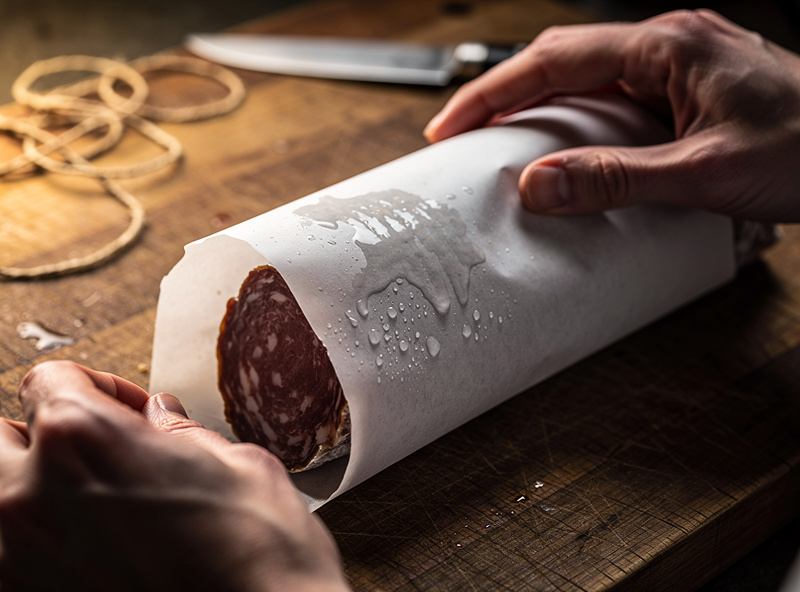
Recover mild-to-moderate case hardening by wrapping the affected meat in butcher paper or unwaxed parchment, placing it in a sealed plastic bag in the refrigerator at 34-40°F for 7-14 days. The wrapping creates a humid microenvironment that allows interior moisture to migrate outward, softening the hardened exterior ring. After recovery, the meat can return to chamber aging at slightly higher humidity.
The full recovery procedure:
- Slice a small piece to confirm case hardening: The diagnosis is by slice; do not assume from external appearance.
- Choose recovery approach by severity: Mild = humidity adjustment only. Moderate = paper wrapping. Severe = cut off ring, save interior.
- For paper wrapping (moderate): Wrap meat in butcher paper or unwaxed parchment paper. The paper absorbs surface moisture as it migrates out.
- Place in a sealed plastic bag: Plastic bag prevents the recovered moisture from immediately re-evaporating.
- Refrigerate at 34-40°F: Standard fridge-safe temperature (at or below 40°F) prevents bacterial growth during the moisture redistribution period.
- Check at 7 days: Squeeze the meat — the ring should feel softer; the meat should feel more uniform top to bottom.
- Continue another 7 days if needed: Most moderate cases need 10-14 days; severe cases may not fully recover.
- Slice a test piece after recovery: Confirm the ring has softened and interior moisture has redistributed.
- Return to chamber at higher humidity: Restart aging at 78-82% RH instead of the previous lower setting that caused the issue.
The recovery outlook is meaningful but not perfect. Mild cases recover almost completely; moderate cases come back noticeably improved but rarely match the texture of a piece that never hardened; severe cases sometimes save the interior but the exterior ring is essentially lost. Plan recovery as a Plan B rather than counting on it. Read about complete chamber troubleshooting in our companion curing chamber too humid guide.
Frequently Asked Questions
What causes case hardening in curing chambers?
The primary cause is humidity below 70 percent RH allowing surface moisture to evaporate faster than interior moisture migrates outward. Secondary causes include no air circulation, fluctuating humidity, and aggressive early-stage drying. Most cases combine multiple factors.
Can I save case-hardened salami?
Mild and moderate case hardening can be saved by wrapping the meat in butcher paper and placing in a sealed bag in the refrigerator for 7-14 days. The interior moisture migrates outward and softens the hardened ring. Severe cases (5+ mm hard ring) often produce only partial recovery.
How do I know if my chamber is causing case hardening?
Slice a test piece every 2-3 weeks during aging. The ring forms early; catching it at week 2-3 is much easier to fix than catching it at week 6 when most product is affected. Visible cross-sections are the only reliable diagnosis.
What humidity prevents case hardening?
75-80 percent RH for charcuterie (whole muscle and salami), 80-85 percent RH for dry-aged beef. Below 70 percent RH almost guarantees case hardening for any product. Above 85 percent RH risks bacterial wet spot, the opposite problem.
Why does my chamber show 80 percent humidity but still produces case hardening?
Chamber microclimate variation. Air pockets near the door, the lid, or far from the humidifier can run 10-15 percent below the central reading. Add a small fan for circulation; place 2-3 hygrometers in different chamber zones to identify dry spots.
Should I wrap meat for the entire aging period to prevent case hardening?
No — wrapping during normal aging prevents the desired moisture loss. Wrapping is a recovery technique used briefly to redistribute trapped moisture. The right answer is fixing chamber humidity to prevent case hardening rather than continuously wrapping to compensate.