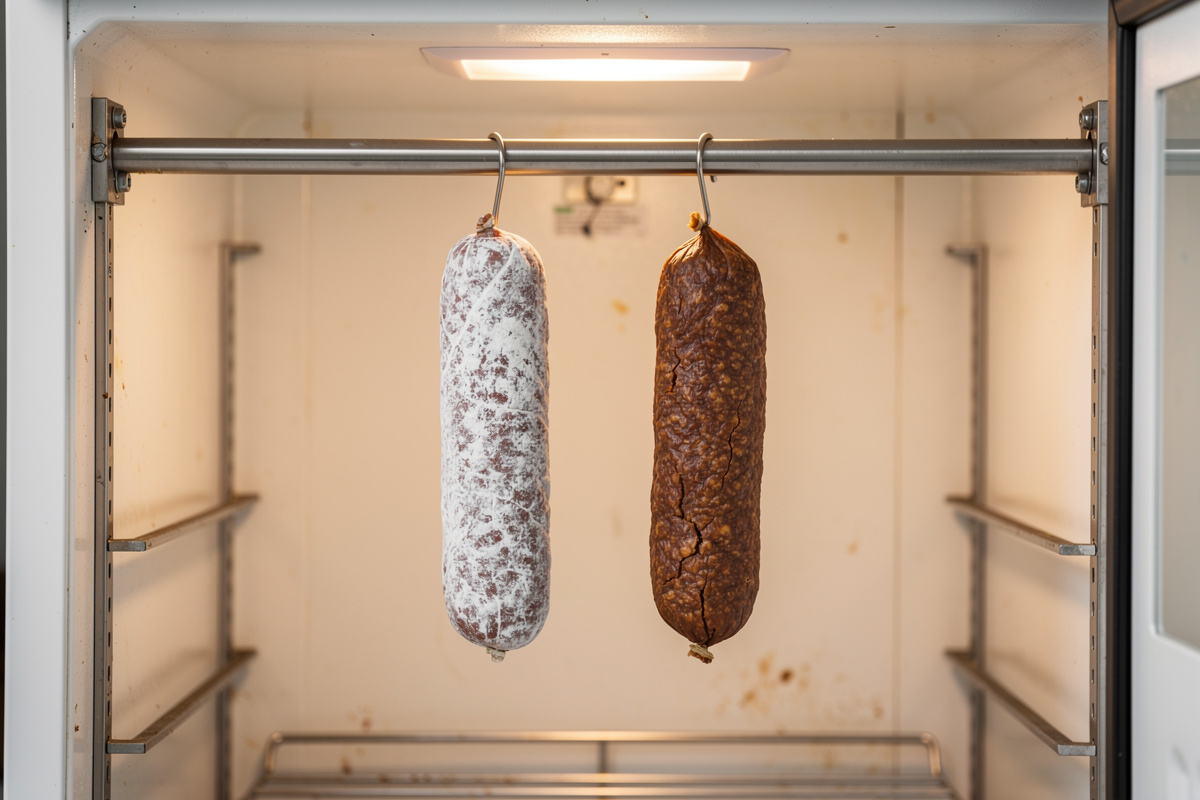

Most curing chamber problems trace back to four root causes: climate drift (temperature or humidity outside the safe band), insufficient air movement (saturated boundary layer around hanging meat), wrong starter culture or salt percentage (fermentation failure to hit the pH 5.0-5.3 / water-activity 0.90-0.94 shelf-stability thresholds documented in published dry-sausage validation guidance), or sensor drift (the chamber appears in spec while actually drifting).
Each cause produces predictable symptoms that this guide maps to specific remedies.
The hardest problems are the ones where the chamber climate looks fine on the controller display (mine is an Inkbird ITC-308; the IHC-200 humidity controller display reads the probe directly above the humidifier outlet, which can read 8% high during a mist cycle) while the meat surface tells a different story. A salami at week 3 with a hard outer ring, a wet center, and growing mold on the casing has lived through climate that drifted away from spec for hours or days you did not see. Diagnosis requires reading the meat surface as the truth and treating sensor readings as a data point. This guide walks the symptoms to root cause to fix, with the call-it-or-toss-it judgment for each scenario. The 18 months I have run my own chamber have produced two case-hardened coppas, one Aspergillus niger event on a salami chub, one over-humidified Mucor cobweb event when my fan died for two days, and a probe-drift catch in week three of a 14-week salami cure. Each one had a tell I missed for at least 24 hours before symptoms became obvious.
The 7 Most Common Curing Chamber Problems
Across hundreds of reader photos and emails, seven problems account for almost all curing chamber failures. They cluster into four groups: climate failures, mold issues, texture problems, and equipment failures. The same root cause often produces multiple symptoms, so symptom-only diagnosis is incomplete; trace each symptom back to the root.
- Bad mold on casings (black, green, pink, or fuzzy)
- Case hardening (hard outer rind, wet center)
- Slime or wet surface (insufficient airflow + over-humidity)
- Off-smells (ammonia, sulfur, rotten, sour-vinegar)
- Stalled drying (no weight loss week-over-week)
- Failed fermentation (pH never drops below 5.0)
- Broken or split casings (over-tight stuff, drying too fast)
Climate Failures: When the Numbers Are Wrong
Climate failure is the broad category for any drift outside target. Temperature drifting below 50°F slows enzyme activity and pH drop and pushes drying time out. Drift above 60°F accelerates spoilage and grows surface bacteria. Humidity drift below 70% RH case-hardens; above 80% RH grows surface mold and pushes water back into the meat.
Diagnose climate failure with logs from a smart sensor, not spot readings. The full diagnostic framework is in curing chamber climate control: the complete guide. The most common climate failures are auto-defrost cycles spiking humidity, drift across seasons, and probe placement reading the wrong microclimate. Sensor drift is documented in smart sensors for curing chambers; recalibrate every 6-12 months with a salt-test (75% RH at saturated NaCl).
Mold Problems: Color, Type, and Remedy
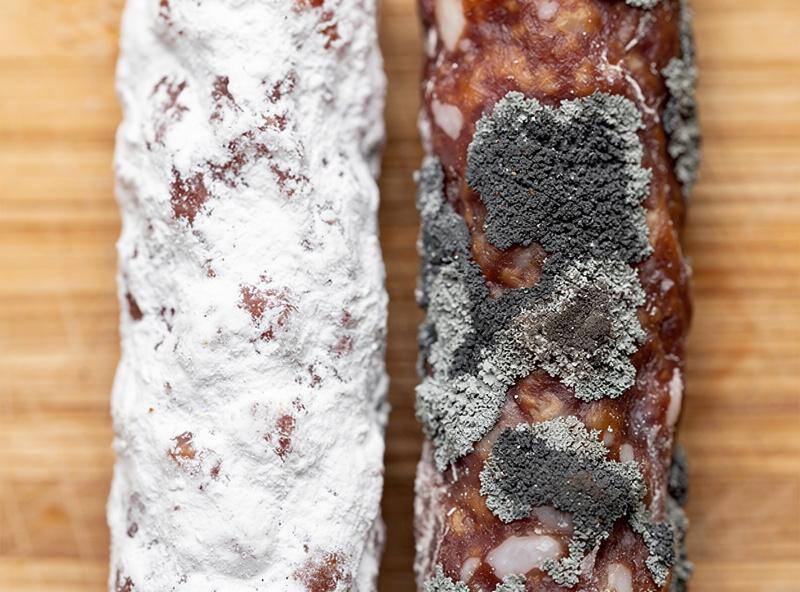
Surface mold on charcuterie is a normal, expected, and often beneficial part of the process. The trick is distinguishing helpful mold from problematic mold. Color is the first cue, but texture and smell finalize the diagnosis.
| Mold Color | Typical Identity | Risk | Action | Detail |
|---|---|---|---|---|
| White, soft, even | Penicillium nalgiovense / candidum | None — beneficial | Leave alone | The classic salami rind |
| Pale gray-green, fine fuzz | Penicillium camemberti / similar | Low — usually fine | Leave alone or wipe with cloth | Common on cheese rinds |
| Black, fuzzy or hairy | Aspergillus or Cladosporium | High — toxic | Wipe off with vinegar; if extensive, discard | See black mold guide |
| Bright orange or red | Neurospora or Fusarium | High — discard, no salvage | Discard the affected piece | Rare but unmistakable; Fusarium species are documented mycotoxin producers |
| Bright pink, slimy | Bacterial colonization (Serratia) | Moderate — surface only | Wipe with vinegar brine; investigate climate | Often signals high RH |
| Yellow, slimy patches | Wet bacterial colonization | High — pull and inspect | Discard if widespread | Indicates pH or climate failure |
| Blue-gray, smooth | Penicillium roqueforti (cheese mold) | Variable | Wipe off if on salami; ID if on cheese | Common cross-contamination |
The ID logic for the helpful vs problematic white-vs-black distinction is documented with photos in salami casing mold: good white mold vs dangerous black/green.
Smell and Off-Flavor Problems
Smell is the most informative diagnostic. A normal aging chamber has a slightly funky, earthy, slightly cheesy character. Specific off-smells map to specific failures.
- Ammonia (sharp, urine-adjacent): Late-stage proteolysis or surface bacterial overgrowth. On cheese, normal at end-of-life; on charcuterie, indicates pH-protection has lost. Investigate the pH and the climate.
- Sulfur (rotten egg, brimstone): Bad fermentation or putrefactive bacteria. Discard. This is a clear safety failure.
- Sour vinegar: Acetic acid bacteria producing dominant note instead of lactic. Often from low-pH starter under-performing. Check pH; usually salvageable but flavor is off.
- Soapy or fatty rancid: Light exposure during aging accelerated fat oxidation, or fat content too high in lean cure. Trim affected surface; aggressive cases are unsalvageable.
- Earthy mushroom mild: Normal Penicillium activity. Welcome.
The detailed dry-aged smell pattern by week is in dry aging smell: what is normal vs what means trouble; the same logic applies broadly to all curing chamber work.
Texture Problems: Case Hardening, Slime, Soft Spots
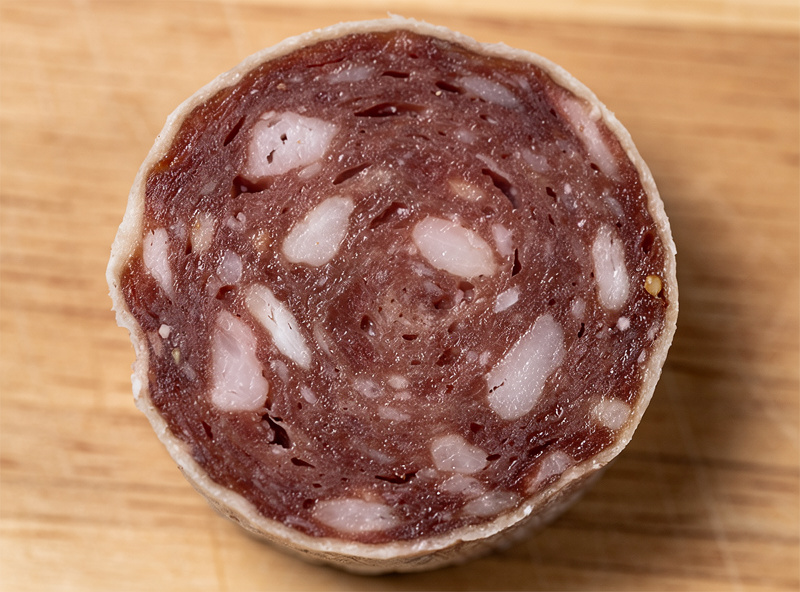
Case hardening is the surface-dries-faster-than-center failure. The salami or whole-muscle has a hard outer ring you can feel by squeeze, a wet center inside. Causes: humidity too low (under 70% RH), fan blowing directly at the meat, casing pulled too tight before fermentation, or salt percentage too high. Fix: move to slightly higher humidity (78-80% RH) and lower air velocity for 1-2 weeks; the moisture redistribution can save many cases. Detailed guide in case hardening in curing chambers: causes, prevention, and fixes.
Slime or wet surface is the opposite: humidity too high (over 80% RH) plus insufficient airflow. Surface stays wet, supports bacterial colonization (often pink Serratia), and prevents normal pellicle formation. Fix: increase fan duty cycle, reduce humidifier output, possibly crack the door for 10 minutes a few times a day until surface dries.
Soft spots on whole-muscle (a finger-pressed depression that springs back slowly) usually indicates internal moisture pockets that drying did not reach. May be saved with continued aging at lower RH; may indicate spoilage if accompanied by off-smells.
Pellicle and Surface Problems
The pellicle is the slightly tacky, dried surface layer that develops on the first 24-48 hours of aging. A good pellicle smells clean, has uniform color, and is slightly dry to the touch. Pellicle failures fall into three groups.
No pellicle forms: Surface stays wet for more than 48 hours. Climate is too humid or airflow is too low. Fan more, humidify less.
Pellicle is hairy or fuzzy: Mold colonized before the surface dried enough to inhibit it. Wipe with brine, increase airflow, accept the salami may have a heavier mold rind.
Pellicle is patchy: Uneven contact with airflow, often because casings were touching each other or the chamber wall. Re-hang with proper spacing for the next batch.
pH and Fermentation Failures
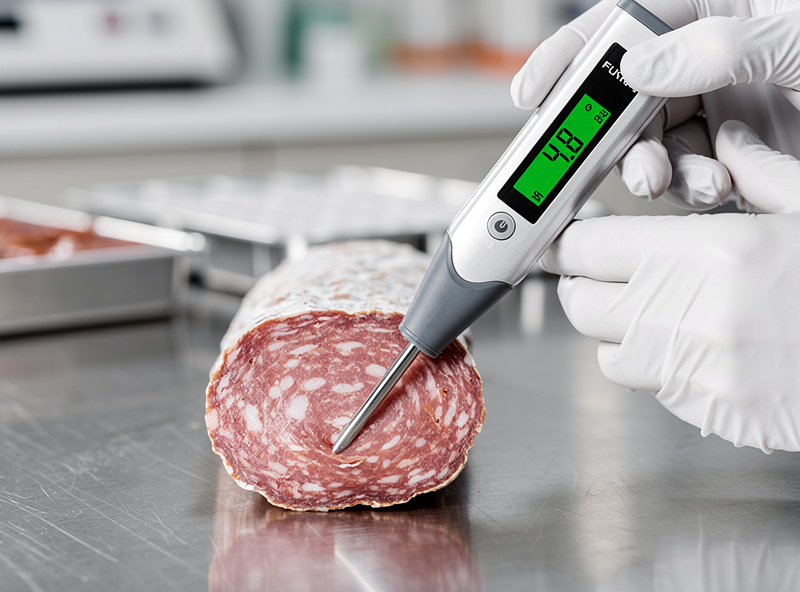
If pH does not drop below 5.0 after 48 hours of fermentation, the salami is unsafe and must be discarded. There is no save. Common causes: starter culture too old or stored wrong (always refrigerate culture and check expiry), fermentation temperature out of range (too cold for the culture you used), or insufficient sugar — published dextrose-to-pH-drop guidance puts the working range at 0.5-0.7% dextrose by meat weight to reliably pull pH under 5.0; short the sugar and the culture stalls before it gets there.
Test pH at 24 hours and 48 hours with strips or a meter. If pH at 48 hours is above 5.0, end the run. This is one of the few situations where there is no salvage path; nitrite protection during fermentation is conditional on pH dropping to threshold within the warm-phase window.
The full fermentation-and-salt walkthrough is in home salami making: the complete guide and the salt math is in how to calculate salt percentage for equilibrium curing.
Equipment and Power Failures
Equipment failures fall into expected (compressor wear, humidifier reservoir empty) and unexpected (power outage, fan stops, controller fails). All become climate failures over time.
Power outage handling: a 600VA UPS rides 4-8 hours of outage with the door shut. For longer outages, especially during fermentation or week 1 of drying, the meat is at higher risk. The off-grid backup system in off-grid curing chamber: battery and inverter sizing covers 12-72 hour resilience.
Compressor failures usually announce themselves with rising chamber temperature over hours. Move salami to a backup fridge if possible; whole-muscle work can usually wait a day. Fan failures are quieter — the chamber climate looks fine but boundary-layer humidity rises around the meat. Check fan operation weekly.
Preventive Maintenance Schedule
A maintained chamber is dramatically less prone to the failures above. The schedule that catches drift before it becomes a problem.
- Weekly: Check humidifier reservoir, top up with distilled water. Wipe down chamber walls with a clean dry cloth (no soap, no chemicals).
- Monthly: Salt-test calibrate primary hygrometer. Check fan operation (visual confirm of blade rotation; tissue test for airflow). Sanitize the humidifier reservoir with a vinegar rinse.
- Every 3 months: Pull and clean the entire chamber between batches. Wipe walls with food-grade sanitizer. Replace any chamber-style filters on humidifier or dehumidifier. Inspect door gaskets for wear.
- Every 6 months: Replace the humidifier reservoir if it is showing scale buildup. Calibrate all sensors against the salt test. Check for compressor cycling at appropriate intervals (compare to known-good baseline).
- Annually: Replace door gaskets if compressing flat. Defrost completely (manual-defrost units), clean coils on the back of the fridge, replace any sensor that has drifted more than 5% in 6 months.
Weekly Diagnostic Checklist for Every Batch
A 5-minute weekly inspection catches problems while they are still recoverable. Run this checklist every weekend during any active batch.
- Visual surface check: color uniform, no patches, mold (if any) consistent across the batch.
- Smell test: open chamber door briefly, sniff once at meat level. Earthy and slightly funky is good; sharp, sulfurous, or sour is a problem.
- Touch test: firm-and-yielding is normal. Hard outer with soft give underneath is case hardening starting. Slimy is over-humid + under-airflow.
- Weight check: for salami specifically, weigh and log against the post-stuff baseline. Track weekly weight loss percentage. A salami that loses 2-4 percent per week is on track; a stalled salami at 1 percent or below indicates climate problems.
- Sensor sanity: open the secondary smart sensor app and compare to controller reading. Drift over 3 percent RH is sensor calibration; drift over 5 percent is replace-the-sensor.
- Chamber log review: look at the last week’s graph for any spikes or sustained excursions. Note the time and check if it correlates with door openings.
Recovery Protocols for Salvageable Failures
Most curing chamber problems are not catastrophic if caught early. Three recovery protocols handle the bulk of recoverable failures.
Recovery Protocol 1 — case hardening (recoverable up to 5% weight loss past target): Move the affected pieces to a sealed plastic bag, leave at refrigerator temperature for 7-10 days. The internal moisture migrates outward through the casing and the surface softens. Open the bag every 2-3 days to release any condensate. Return to chamber for final 1-2 weeks of normal drying.
Recovery Protocol 2 — bad mold colonization (under 30% surface coverage): Wipe the affected casings with a 1:4 white vinegar to water solution. Air-dry for an hour. Adjust chamber humidity downward by 5% RH and increase fan duty cycle (8 minutes on, 22 off instead of 5/25). Inspect every 2 days for return of bad mold; if it returns within a week, the underlying climate is wrong, not just colonization.
Recovery Protocol 3 — slime / wet surface (immediate fix): Crack the chamber door for 15 minutes twice a day for 2-3 days. Increase fan duty cycle. Confirm humidifier is not over-running (humidistat may be miscalibrated). Wipe slime off with brine vinegar, do not just dry-wipe. Surface should re-establish dry pellicle within 4-7 days.
When to Pull, Trim, or Discard
Three judgment calls for every problem.
Pull and trim: Surface mold is bad but limited (under 20% coverage), no off-smells, internal texture is normal. Trim 1/4 inch into the underlying meat, wipe with brine vinegar, return to chamber. Most mold issues fall here.
Pull and inspect: Off-smells, large mold coverage (over 50%), or visible color change in the underlying meat. Cut the salami in half. Internal color and smell tell you what’s left. If the interior smells off, discard. If interior smells fine, salvage the unaffected portion.
Discard: Sulfur smell, putrid notes, slime over 30% of surface, pH that never dropped, internal color black or grey. No exception. The sunk cost of weeks does not change the safety calculation.
Document every failure. Take a photo of the affected piece, write down the symptoms, and note what the chamber climate was doing in the prior week. Over a year of charcuterie work, these notes turn into a personal pattern library that lets you diagnose new problems by analogy. The most common pattern by far: a chamber climate excursion you did not see, caught only because the meat surface tells the truth that the sensor missed.
Reading the Weight-Loss Curve as a Diagnostic Tool
Stalled drying rarely announces itself as a single bad reading — it shows up as a flattening curve on the weight log, which is why I weigh every piece at the same point in the week and plot it rather than trusting a gut feeling about how a batch is going. A salami that’s tracking 2-4% weekly weight loss for the first three weeks and then drops to under 1% is telling you something changed in the chamber even if the controller display hasn’t moved. The two most common causes of a flattened curve are a case-hardened surface sealing in moisture (the scale keeps reading the same because water is trapped, not gone) and an RH creep that’s slowly closing the gap between chamber air and meat surface, which shows up as weight loss slowing gradually over 2-3 weeks rather than stopping all at once.
The useful trick is comparing the weight-loss curve against the chamber log for the same window. A stall with a clean, flat humidity log points to case hardening — pull the piece and check by squeeze. A stall that lines up with a visible RH climb on the log points to climate drift, and the fix is in the climate-control layers rather than anything you do to the meat directly. Logging both side by side turns two separate data points into one diagnosis, which is the whole reason the weight log earns its place next to the thermometer on my bench.
Culture Dosing Errors: The Quiet Cause Behind Slow or Stalled Fermentation
A fermentation that never hits pH target is sometimes blamed on temperature or a bad batch of meat when the real cause is a scale error at the mixing bench. Starter cultures are dosed by weight against the total batch — Bactoferm-type LAB blends and mold cultures both come with a manufacturer ratio printed on the packet, and the two failure directions are opposite problems with the same root cause: mis-weighing the culture rather than mis-timing the ferment. Under-dosing starves the LAB population and the pH drop drags out past the window where nitrite is doing the protective work alone; over-dosing a mold culture like Bactoferm Mold-600 doesn’t cause a safety failure the way under-dosing LAB does, but it does waste product and can shift the mold bloom’s texture and timing. I keep a dedicated 0.01g-resolution scale just for culture weighing, separate from the kitchen scale used for the meat and salt, because a scale that rounds to the nearest gram is not precise enough at these dose sizes — a full breakdown of getting mold-culture dosing right is in Penicillium mold cultures for salami casings.
The other quiet culture-dosing failure is water temperature when rehydrating a culture before pitching it. Chlorinated tap water above about 110°F can kill a chunk of the LAB population before it ever reaches the meat, and the ferment that follows looks identical to an under-dosed one on paper — slow, or stalled pH drop — even though the gram count on the scale was correct. Use cool, dechlorinated (or bottled) water for rehydration and give the culture the manufacturer’s stated rest time before mixing it in.
Troubleshooting a Shared Chamber: Cross-Contamination Between Salami and Cheese
Running salami and cheese in the same chamber — or even in a second chamber that shares air handling with the first — introduces a failure mode that’s easy to miss because both products can look individually fine while something is drifting between them. Cheese rinds carry their own mold cultures (often Penicillium candidum or roqueforti depending on style), and a chamber with active cheese wheels can seed unwanted mold spores onto salami casings, or the reverse — a heavy Penicillium nalgiovense salami bloom can show up faintly on cheese that wasn’t meant to have it. Neither is usually dangerous by itself, but it muddies the diagnosis when you’re trying to trace a mold problem back to a root cause, because the mold you’re looking at might not have come from the meat’s own culture at all.
The other cross-contamination vector is humidity target mismatch — cheese generally wants a higher RH than salami (the target-range breakdown is in ideal humidity for dry aging beef vs charcuterie), and running both in one chamber means one product is always slightly outside its ideal band. My own workaround is running cheese in the smaller second chamber on its own schedule rather than mixing it with an active salami batch, which keeps both the humidity target and the mold population separate. The full cheese-aging climate walkthrough, including the case for a dedicated chamber once you’re aging more than the occasional wheel, is in home cheese aging: the complete guide.
Frequently Asked Questions
What is the most common cause of curing chamber problems?
Insufficient air movement is the single most common root cause. Without a cycling fan, a saturated humidity boundary layer forms around hanging meat, growing surface mold and slime even when the controller reads spec. The fix is a 120mm PC fan on a 5-on, 25-off cycle mounted on the back wall, blowing across the meat rather than at it.
Is white mold on salami safe to eat?
Yes. The thin, soft, even white mold (Penicillium nalgiovense or candidum) that develops on properly aged salami is beneficial and is the same family of molds used in commercial production. It contributes flavor and protects the casing. Wipe off if you do not want it, but it is safe and standard.
What does black mold on charcuterie mean?
Black fuzzy or hairy mold (typically Aspergillus or Cladosporium) is not safe and can produce mycotoxins. Wipe off small spots with vinegar and re-evaluate; if mold returns or covers more than 30 percent of surface, discard. Black mold often signals over-humidity or insufficient air movement; address the root cause before the next batch.
My salami has a hard outer rind and a wet center — what do I do?
This is case hardening. Move the salami to slightly higher humidity (78 to 80 percent RH) and lower air velocity for 1 to 2 weeks. The moisture inside will redistribute outward and the surface will soften slightly. Many cases are salvageable. For the next batch, fix the climate (humidity floor below 70 percent RH and direct fan flow are the usual causes).
What temperature is the danger zone for charcuterie?
The food safety danger zone is 40 to 140 degrees F (4 to 60 degrees C) where pathogens grow most rapidly. Cold smoking deliberately lives near the bottom of this range and depends on cure to compensate. Salami fermentation lives in the lower half of this range and depends on rapid pH drop to compensate. The discipline of curing chamber work is staying out of this zone except when the cure or the pH provides protection.
Why did my salami fermentation fail?
Three common causes: starter culture was old or stored above refrigeration (always check culture is alive before mixing), fermentation temperature was out of range for that culture (each Bactoferm strain has a different optimal range), or recipe contained insufficient sugar (published dextrose-to-pH-drop guidance puts the working range at 0.5 to 0.7 percent dextrose by meat weight to reliably pull pH under 5.0). If pH does not drop below 5.0 within 48 hours, the salami is unsafe and must be discarded.
Should I discard salami with off-smells?
Depends on the smell. Earthy, slightly funky, mild blue-cheese notes are normal. Sharp ammonia, sulfur (rotten egg), or putrid smells indicate spoilage and the salami should be discarded. Sour vinegar smell often indicates fermentation issues but the salami is usually safe; flavor will be off. When in doubt, cut the salami in half and inspect the interior — internal color and smell finalize the call.
Related Articles
- Black Mold on Charcuterie: Is It Dangerous or Just Ugly? — visual ID and decision tree.
- Case Hardening in Curing Chambers: Causes, Prevention, and Fixes — the texture failure that fools beginners.
- How to Build a Curing Chamber: The Complete Guide
- Curing Chamber Climate Control
- Salami Casing Mold: Good White Mold vs Dangerous Black/Green
- Dry Aging Smell: What Is Normal vs What Means Trouble
- Curing Chamber Too Humid: How to Fix Oversaturation Fast
- Case Hardening in Salami: Causes and How to Fix It
- Sticky or Slimy Charcuterie: How to Fix It