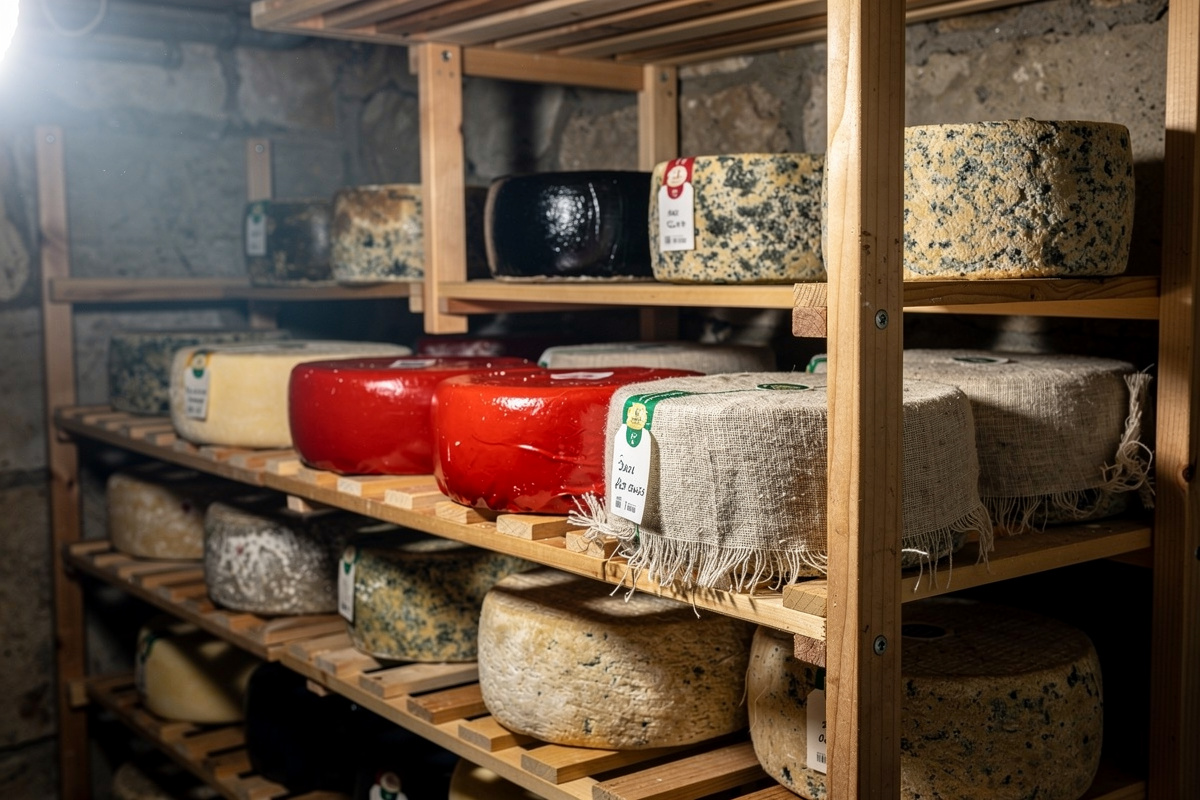

Aging cheese at home means holding a small chamber at 50-55°F and 85% relative humidity for weeks to years while the rind develops, the moisture profile evens out, and the proteolytic and lipolytic enzymes break the cheese down into the flavors you actually paid for.
As an Amazon Associate I earn from qualifying purchases.
A repurposed mini fridge with a temperature controller and a humidifier ages cheddar, gouda, gruyere, and feta with a setup cost under 300 dollars.
The setup is the easy part. The reason most home aging projects produce gummy texture, cracked rinds, or off-flavors is that the climate range for cheese (cooler and more humid) collides with anyone trying to share the same chamber as charcuterie (warmer and drier), and the aging methods (wax, bandage, natural rind, vacuum, brine) each demand different rind care over the timeline. This guide walks the climate, the chamber, the methods, and the cheese-by-cheese timeline I follow on every wheel I age. FDA 21 CFR 133.113 caps cheddar specifically at 39% moisture by weight (other hard styles have their own limits under the same part), and the American Cheese Society’s Best Practices Guide for Cheesemakers covers aging-room temperature, humidity, and airflow control for exactly this scale of operation — it puts surface-ripened styles at 53-57°F, in the same neighborhood as the 50-55°F I run for cheddar and gouda. The first cheddar I tried to age I waxed too early — the wheel’s surface was still tacky from the brine and I trapped moisture under the wax. Three weeks later I had a soft yellow patch under the wax and had to scrape, dry for 48 hours, and re-wax. The cheese-by-cheese protocol below catches that exact mistake at the right step.
What Cheese Aging Is and Why a Refrigerator Will Not Work
Cheese aging is the slow, controlled enzymatic and microbial transformation of fresh cheese into mature cheese. Aging is not the same as storage. Storage holds a cheese steady at the state it is in. Aging deliberately advances the cheese — drying it, concentrating flavor, building rind structure, and developing complex breakdown products from milk fat and protein. The chamber climate is what allows aging to happen without spoilage.
A regular kitchen refrigerator runs at 35-40°F and 30-50% RH. That is too cold for the enzyme work to proceed at any meaningful rate, and far too dry for any rind that is not vacuum-sealed. A wheel of cheddar in a kitchen fridge will dry, harden at the edges, and develop a sharp ammonia note within weeks instead of the rounded depth that a true cave produces over months. The chamber’s job is to slow the cheese without stopping it.
The Climate Cheese Aging Needs
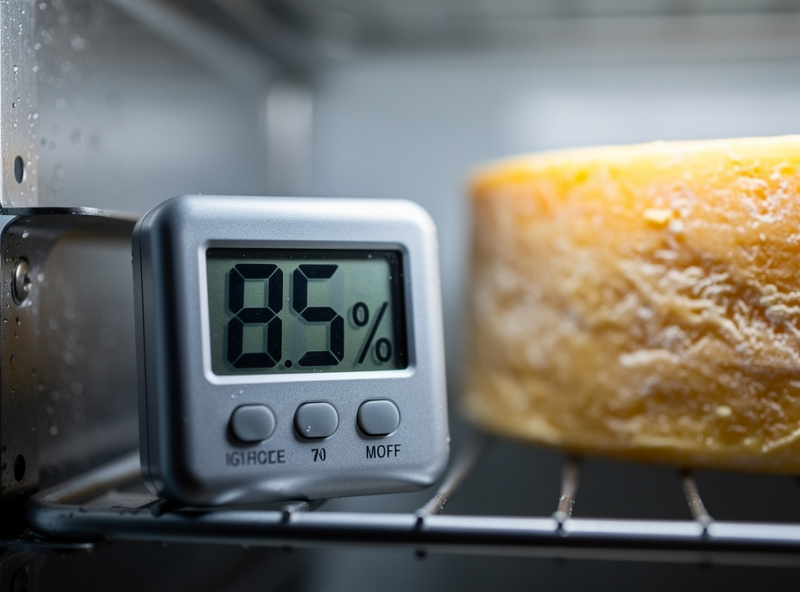
Most aged cheeses sit happiest at 50-55°F (10-13°C) with 80-90% relative humidity. Hold the band 50-55°F and 80-90% RH with no more than 3°F and 5% RH drift. Cooler shifts the rate slower; warmer accelerates breakdown but raises spoilage risk. The 85% RH center is the sweet spot for most semi-hard and hard cheeses.
Different cheese families want narrower bands inside that envelope. Cheddar and gouda do well at 52-55°F and 80-85% RH. Gruyere and alpine styles run slightly warmer, 55-58°F at 90-95% RH for the smear-rind. Brie and camembert want 50-55°F at 90-95% RH to encourage the white penicillium rind. Feta and other brined cheeses live in their brine and care less about ambient RH.
For practical RH management, the same equipment that solves a too-humid curing chamber applies to over-saturated cheese caves, and the calibration patterns from smart temperature and humidity sensors for curing chambers work directly. The 85% RH target for cheese is intentionally higher than the 75% RH target for salami, which is why mixing them is hard — see ideal humidity for dry aging beef vs charcuterie for the same logic applied to whole-muscle work.
Choosing a Cheese Cave: Repurposed Fridge vs Wine Fridge vs Cabinet
The chamber that ages cheese well is the same kind of box that holds salami well, with two differences: cheese chambers tolerate a slightly warmer floor, and cheese chambers need very stable humidity rather than raw airflow. The wine fridge I now use as a dedicated cheese cave hits 56°F at its coldest — marginal for charcuterie, but fine for cheddar — so a Peltier unit that struggles to hold 55°F is still a workable cheese cave even though I would not trust it for salami. Anything with strong forced airflow inside, meanwhile, needs the fan deflected off the wheels rather than run wide open.
| Box Type | Capacity | Used Cost | Best Cheese Sizes | Watch For | Climate Notes |
|---|---|---|---|---|---|
| Mini fridge (3-4 cu ft) | 2-4 medium wheels (5 lb each) on a wire shelf | $30-$80 | Small wheels, brick cheddar, feta jars | Door shelves are wasted space; insulation can spike at compressor cycle | Easy to hold 55F; needs humidifier upgrade for 85% RH |
| Full fridge (15-20 cu ft) | 10+ medium wheels plus brining containers | $80-$200 | Full wheels of gouda, cheddar, alpine | Auto-defrost cycles dry the chamber; plug the drain | Needs aggressive humidification to maintain 85%+ |
| Wine fridge (24-bottle+) | 4-8 wheels on wire shelves | $150-$400 | Aesthetic display; small to medium wheels | Peltier units cycle heat into the room when warm | 55F is comfortable; humidity comes from manual misting |
| Insulated cabinet (custom) | 20+ wheels with shelving | $400-$1,200 to build | Long-aged styles; dedicated facility | Build time and electrical work | Most predictable climate; pro-tier reliability |
For most home cheesemakers, a converted full-size fridge is the best value. Conversion follows the same pattern as converting a fridge into a curing chamber, with two changes: set the controller higher (52°F instead of 55°F is fine for cheese) and budget for a larger humidifier or a passive humidity source like wet pebble trays. The complete build philosophy is in how to build a curing chamber; cheese-specific tweaks come down to the climate setpoint and rind management routines.
Aging Methods: Wax, Bandage, Natural Rind, Vacuum, Brine
The aging method controls the rind, which controls how the cheese loses moisture and which microbes colonize the surface. Five methods cover almost every home aging project. Each demands different chamber care and produces a different finished texture.
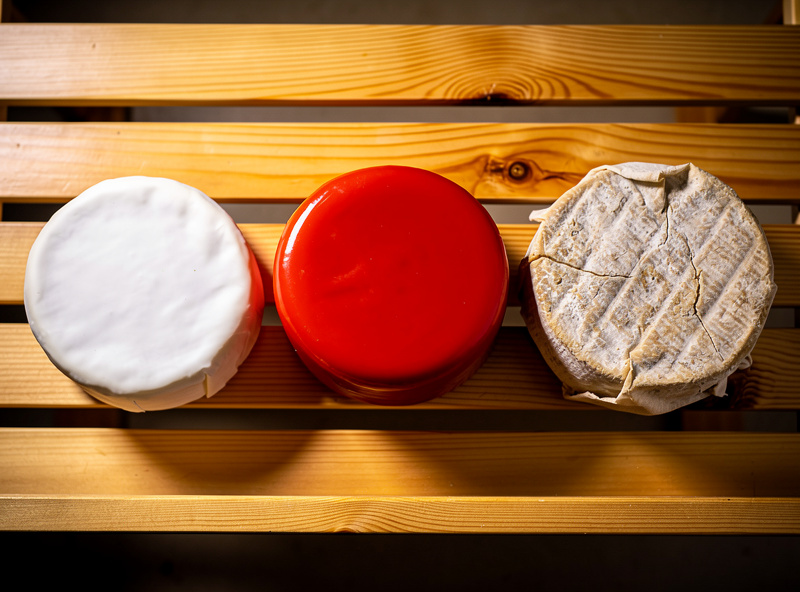
- Wax: A thick coat of food-grade wax seals the rind. The cheese ages without losing surface moisture and without rind contact with chamber air. Cheddar, gouda, and many farmhouse styles take to wax. Apply at 4-6 weeks once the cheese has formed a clean dry surface. Step-by-step in how to wax cheese for aging: cheddar, gouda, gruyere.
- Bandage (cloth-wrapped): A muslin or cheesecloth wrapper soaked in melted lard or butter holds rind contact while protecting the wheel. Traditional clothbound cheddar uses this method. Slower moisture loss than natural rind, faster than wax.
- Natural rind: The cheese ages exposed to chamber air and develops a real rind from yeasts and molds in the environment. Highest flavor depth, hardest to control, requires daily turning and weekly brine-rubbing on most styles. Tomme and many alpine cheeses go this route.
- Vacuum-bag: A plastic vacuum bag protects the rind from any aerial contamination. The texture and flavor stay closer to fresh. Used for commercial production and home aging on cheeses where you want to skip rind care entirely. Aged cheddar in vacuum bag is what most grocery stores sell.
- Brine: Submerged in salt brine. Feta, halloumi, and bryndza age this way. Brine concentration (typically 6-10% NaCl) controls salt uptake and acid production. Brine cheeses skip the chamber climate question entirely; refrigerator temperatures are fine.
Choose the method before you make the cheese. Wax is the most forgiving for first-time agers; bandage is the most traditional; natural rind has the highest reward and the steepest learning curve.
Cheese-by-Cheese Aging Timeline
Aging time is style-dependent and not a quality dial you can turn arbitrarily. Pulling a cheese too early gives bland flavor and rubbery texture; aging too long produces ammonia notes, bitterness, or surface failures. Ranges below assume the climate band 52-55°F and 85% RH with weekly turning.
- Mild cheddar: 2-3 months. Pull at month 2 for snackable texture and balanced acid.
- Medium cheddar: 5-7 months. The body firms and tang sharpens; this is where cheddar starts getting interesting.
- Sharp cheddar: 9-12 months. Crystal formation begins; flavor deepens to grassy, nutty, sharp.
- Extra-sharp / aged cheddar: 18-36 months. For practiced agers; risk of off-flavors rises sharply if any rind care was sloppy.
- Young gouda: 6-10 weeks. Mild and milky; pull when the rind has set firm.
- Aged gouda: 8-12 months. Caramel and butterscotch notes; tyrosine crystals.
- Gruyere style: 6-12 months. Smear-rind care every 5-7 days through month 6, then less frequently.
- Brie / camembert: 4-6 weeks. Rind blooms in week 1-2; pull before center turns liquid unless you want a runny brie.
- Feta: 30-60 days in 6-8% brine; longer for sharper bite.
- Tomme: 2-4 months on a wood board with weekly brine-wipes; a forgiving introduction to natural rind work.
For first-time agers, the safe starter list is in best cheese to age at home for beginners (5 low-risk recipes).
Mold and Rind Management on Aging Cheese
A natural-rind cheese will grow mold. Not all of it is desirable. Beneficial colonization is white, blue-gray, or pale-yellow penicillium and geotrichum that develops a soft fuzzy or smooth-pasty surface. Problem mold is fuzzy black, bright orange, pink, or hairy green colonies that should be wiped off promptly.
Standard rind care is a damp brine wipe (1-2% NaCl in cooled boiled water) every 5-7 days for the first month, then weekly. Wipe with a clean cloth, dry the surface lightly, and return to the chamber. Cheese-specific molds — the white camembert bloom, the gray-blue aspirate of bloomy rinds — should be left alone once they establish; do not wipe them off.
Cross-contamination risk runs high if you are also aging charcuterie in the chamber. Cheese rinds can carry the wrong molds onto salami casings, and the lactic flora from cheese can flavor cured meat in unwanted ways. The mold ID logic from salami casing mold: good white mold vs dangerous black/green applies broadly to cheese as well, and the black mold on charcuterie guide is the same conversation. If you want one chamber for both, partition with food-safe plastic and add a second small fan zone.
Sharing a Chamber With Charcuterie
Cheese aging at 85% RH and salami curing at 75% RH live in the same temperature band but ask for different humidity. The compromise that works in practice is to push humidity to the cheese’s preferred 85% and accept slightly slower salami drying, then increase fan duty cycle to keep airflow over both. Many home setups simply run cheese-only batches and salami-only batches in alternation. The shared-chamber question gets covered in detail in curing chamber humidity control: adapting hydroponic reservoir tech, where the humidifier reservoir math is the same.
Cold-smoking aged cheese is a natural extension once you have a chamber. The DIY cold smoke generator attaches to most converted fridges; cold smoke at 60-80°F for 2-4 hours per day over 2-3 days produces a smoked cheddar with depth that retail smoked cheese cannot match. The temperature control rules from cold smoking salami timing and temperature apply to cheese as well.

Costs of a Cheese Aging Setup
Setup costs for a dedicated cheese cave run lower than a salami chamber because the humidity bar is forgiving and the controller demands are looser.
- Budget tier (~$180): $50 used mini fridge, $35 Inkbird ITC-308, $25 ultrasonic humidifier, $15 hygrometer, $20 wire rack and slatted board, $15 ventilation fan + smart plug, $20 misc supplies and brine containers.
- Mid tier (~$340): $120 used full fridge, $35 Inkbird, $35 humidifier with auto-fill, $25 humidistat, $15 fan + timer, $40 SwitchBot logging sensor, $30 cedar slat shelving, $40 600VA UPS.
- Pro tier (~$700): $300 commercial cabinet or upcycled glass-door cooler, $80 PID controller, $60 reservoir humidifier, $60 dual-stage humidistat, $40 fan + control, $40 cloud-logging sensor, $80 dedicated dehumidifier, $40 UPS.
The exact itemized parts and used-marketplace tactics are in curing chamber build cost: what I spent on my setup; cheese-specific equipment delta is mostly humidifier capacity and food-grade shelving.
Common Cheese Aging Mistakes
Mistake 1: Not turning wheels. Cheese aging on one face only develops uneven moisture and rind. Turn every 2-3 days for the first month, then weekly for the duration. Mark the date and last-turn on a tag.
Mistake 2: Waxing too early. Wax applied to a moist surface traps water against the rind and the cheese ferments inside the wax — the result is a wet, blown wheel with a fissured rind. Wait until the cheese has formed a dry, slightly waxy-feel surface, typically 4-6 weeks for most styles.
Mistake 3: Skipping the brine wipe. Natural-rind cheeses without weekly brine wipes grow whatever mold the chamber air carries. Many of those molds are aesthetically unpleasant or actually problematic. Brine-wipe weekly even when you do not see anything; it is preventive, not reactive.
Mistake 4: Ignoring case hardening on the rind. The same fan-blowing-on-the-cheese mistake from charcuterie work case-hardens cheese rinds. The detailed mechanism is in case hardening in curing chambers; the fix on cheese is to deflect or cycle the fan, not to remove airflow entirely.
Mistake 5: Using cracked or fissured wheels. Surface cracks let pathogenic mold inside the body of the cheese where you cannot wipe it off. Inspect every wheel before placing it in the chamber. Patch small cracks with a thin smear of beeswax or a vacuum bag overlay; discard or eat young any wheel with deep cracks.
How to Tell When a Cheese Is Ready to Pull
Aging windows give a target range, not a hard date. Real readiness comes from three pull-tests: rind feel, gentle squeeze, and a small core sample on cheeses you intend to age long. Rind should feel firm and slightly elastic for semi-hard styles, hard and dry for long-aged styles, and yielding-but-not-collapsing for bloomy rinds. A finger pressed gently on the side of a wheel should leave only a faint mark; deep depression means the cheese is still soft and active inside.
For long-aged cheeses where you want to confirm the interior is on track, use a cheese trier (a small hollow tool that pulls a clean cylindrical core). Trier samples taken at month 6 and month 9 of an aging cheddar tell you whether to pull at month 12 or push to month 18. A wheel that smells of clean butter and lactic tang is on track. A wheel that smells of ammonia, sulfur, or wet-cardboard is past its window or has a rind care problem and should be pulled and trimmed back.
Logging Each Wheel: Why I Track Weight Loss on Cheese Too
On the charcuterie side of the chamber, weight loss is the whole doneness signal — I have never pulled a salami or a bresaola without checking the scale first. I run the same habit on cheese, and it catches problems the rind-feel test misses on its own. A fresh wheel goes on the digital scale the day it enters the cave, gets logged again at every turn for the first month, then weekly after that. A wheel losing weight steadily and predictably is drying evenly through the rind. A wheel that stalls for two weeks and then drops fast usually means the rind sealed over (wax applied too early, or a natural rind that crusted before the interior caught up) and the moisture finally broke through unevenly — the same case-hardening mechanism that hits salami, just slower because cheese starts with more fat and less surface area relative to volume.
Roughly, a hard cheddar aging past 9 months will have lost 10-15% of its original weight by the time it is ready to pull; a young gouda at 8 weeks is closer to 3-5%. Those are my own bench numbers across the wheels I have run side by side in the same cave, not a lab figure, and I would not treat them as a hard pass/fail line — they are a second signal alongside the rind-feel and squeeze tests above, useful mainly for catching a wheel that is drying far faster or slower than its siblings on the same shelf. If two wheels of the same cheese, started the same week, show a 10%+ weight-loss gap by month two, something in the airflow or shelf position is uneven and worth investigating before you trust either wheel’s timeline. The same log book I keep for whole-muscle charcuterie has a cheese section now — it is the one piece of charcuterie discipline that transferred over without any adjustment.
Frequently Asked Questions
What temperature and humidity should a home cheese cave hold?
Hold 50 to 55 degrees F and 80 to 90 percent relative humidity for most cheddar, gouda, gruyere, and tomme styles. Brie and camembert prefer 50 to 55 degrees F at 90 to 95 percent RH. Drift should stay under 3 degrees and 5 percent RH. The 85 percent RH center is the sweet spot for most semi-hard and hard styles.
Can I age cheese in a regular kitchen refrigerator?
Not effectively. A kitchen fridge runs at 35 to 40 degrees F and 30 to 50 percent humidity, which is too cold for enzymatic ripening and too dry for any non-waxed rind. Wheels harden at the edges and develop sharp off-flavors within weeks. You need a dedicated chamber with a temperature controller and added humidity.
How long does cheddar take to age at home?
Mild cheddar pulls at 2 to 3 months. Medium cheddar runs 5 to 7 months. Sharp cheddar comes off at 9 to 12 months and develops the calcium-lactate crystal flavor pop. Extra-sharp aged cheddar runs 18 to 36 months and demands strict rind care. Pull early if you spot ammonia notes or blue mold inside cracks.
Should I wax cheese before aging?
Wax cheese if you want to age cheddar or gouda without daily rind care, especially for ages over 3 months. Apply food-grade cheese wax at 4 to 6 weeks once the surface feels dry and slightly waxy. Skip wax if you want a natural rind, a cloth-bound cheddar, or a bloomy-rind brie style. Vacuum-bag aging is the alternative for hands-off projects.
Can I age cheese in the same chamber as salami?
Yes, but with care. Cheese needs 85 percent RH and salami prefers 75 percent RH, so you compromise toward the higher humidity and accept slightly slower meat drying. Run separate batches when possible, partition with food-safe plastic, or simply choose one product family per chamber. Cross-contamination from cheese rinds onto salami casings is the bigger risk.
What size cheese cave do I need for home aging?
A 3 to 4 cubic foot mini fridge holds 2 to 4 medium wheels (about 5 pounds each) on a wire shelf, which covers most home cheesemakers. A 15 to 20 cubic foot full fridge holds 10 plus full-size wheels and gives room for brine containers and bandaged styles. A typical home cheesemaker who makes a wheel a month is fine with the mini setup.
Why is my aged cheese cracking on the rind?
Rind cracking comes from low humidity, especially during early aging when the cheese loses surface water fast. Raise the humidifier setpoint to 85 percent RH and check that the cycling fan is not blowing directly on the wheel. If cracks already formed, patch with beeswax to prevent mold ingress and accept a slightly imperfect wheel; for the next batch, hold humidity tighter from day one.
Related Articles
- Best Cheese to Age at Home for Beginners (5 Low-Risk Recipes) — the safe starter list with recipes that forgive small mistakes.
- How to Wax Cheese for Aging: Cheddar, Gouda, Gruyere — the wax workflow with timing, application, and patch repair.
- How to Build a Curing Chamber: The Complete Guide
- How to Convert a Fridge Into a Curing Chamber
- Smart Temperature and Humidity Sensors for Curing Chambers
- Curing Chamber Too Humid: How to Fix Oversaturation Fast
- DIY Cold Smoke Generator: Build a Maze From Scratch