Ideal Humidity for Dry Aging Beef vs Charcuterie: Why They Differ
May 4, 2026

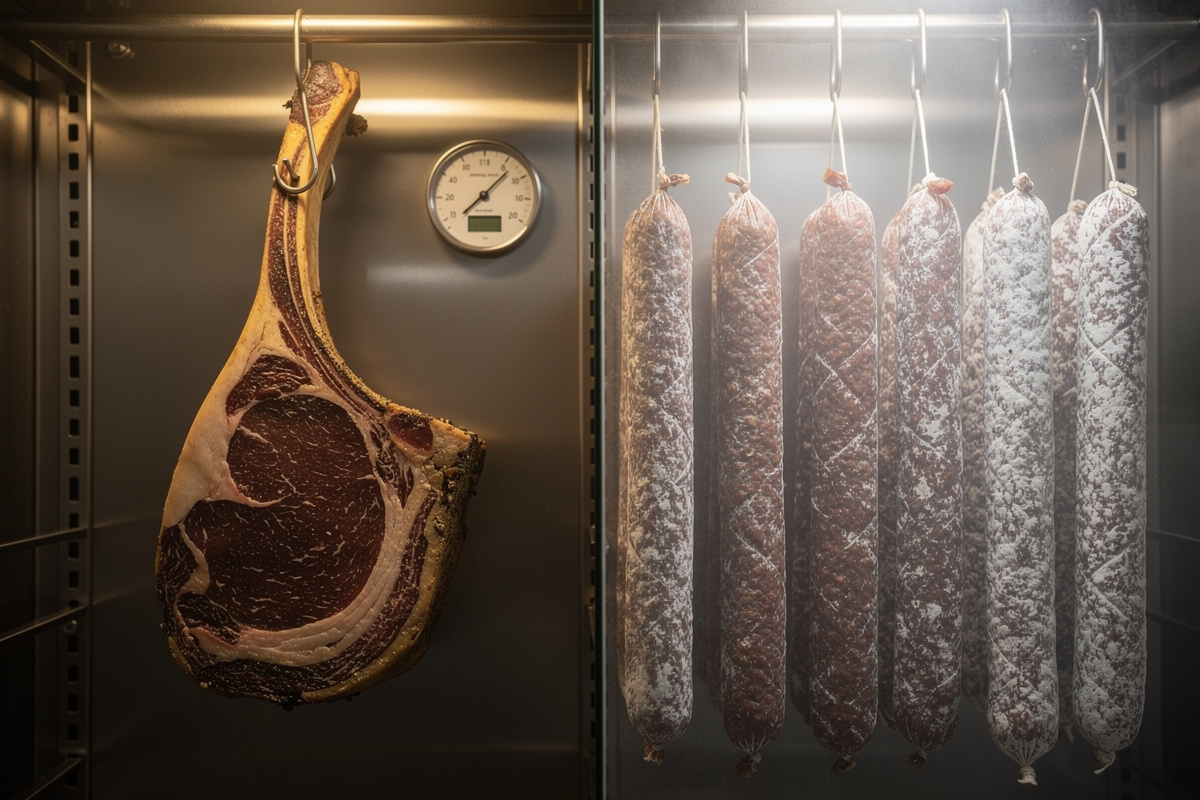
I run my chamber at 78% RH for whole-muscle beef and drop to 73% RH the moment a salami batch goes in alongside it — switching the Inkbird IHC-200 setpoint takes 15 seconds and the chamber re-equilibrates within an hour, which I confirm on the digital hygrometer I keep at meat height rather than trusting the controller’s own probe. The published research range for dry-aged beef spans roughly 61-85% RH at 32-39°F, with most studies clustering around 75-80% RH — right where my own numbers land. On my own casings, the white Penicillium nalgiovense bloom shows up fastest right around 75% RH and stalls out noticeably below 65%, which is why I do not chase the low end of the charcuterie range on purpose.
Dry-aged beef wants 75-85% relative humidity; charcuterie wants 70-80% RH. The 5-10% difference matters because beef is whole muscle that needs slow controlled moisture loss without case-hardening, while charcuterie includes salt-cured and fermented products where lower humidity prevents excess mold growth on casings. Running both at the same humidity produces sub-optimal results on at least one. The full set of bands and the reasoning behind them is in curing chamber climate control: the complete guide.
The “what humidity for my chamber” question is among the most-asked in home charcuterie forums, and the answer is genuinely “it depends” — primarily on whether you are aging beef or making charcuterie, and secondarily on the specific cut and stage. This guide explains the science behind the humidity targets, the visible failures when humidity drifts off target, and how to manage a single chamber that hosts both beef and charcuterie at the same time.
As an Amazon Associate I earn from qualifying purchases.
Why Beef Aging and Charcuterie Need Different Humidity
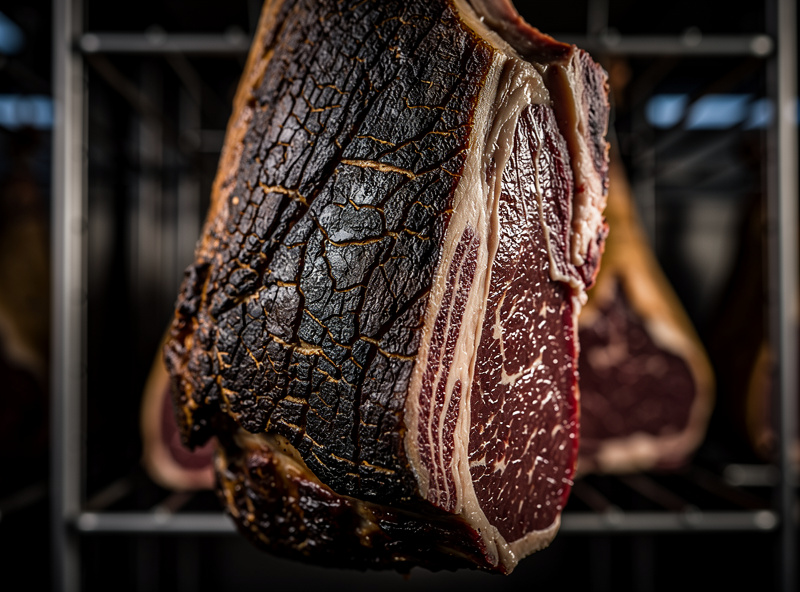
Dry-aged beef is whole intact muscle relying on its own surface to develop a protective pellicle (a hard exterior crust); the pellicle forms at 75-85% RH where moisture loss is slow enough to prevent case-hardening but fast enough to concentrate flavor. Charcuterie products like salami and bresaola use casings or salt-cured surfaces, where 70-80% RH balances mold growth (which is desired on casings) against excessive surface wetness that supports unwanted bacterial growth.
The science of each humidity target:
- Dry-aged beef at 75-85% RH: Allows roughly 1-2% weight loss per day for the first 2 weeks, slowing to 0.5-1% per day thereafter. Total target weight loss is 15-30% over 30-60 days. The pellicle protects the interior; meat tenderizes through native enzyme action.
- Charcuterie at 70-80% RH: Whole muscle products like prosciutto and bresaola want 75-80% RH; salami in casings tolerates 70-75% RH. Lower humidity keeps casings firm and prevents dripping wet appearance.
- Both ranges allow controlled mold growth: Penicillium nalgiovense (the white “good” mold on charcuterie) grows well at 75% RH and slowly at 65%. Below 60% RH most beneficial molds stop entirely.
- Both ranges prevent dangerous mold growth: Aspergillus and Trichoderma (the green “bad” molds) prefer 85%+ RH and slow at 75%. Staying under 85% reduces these growths.
- The danger zone is 90%+ RH: Wet surface conditions support bacterial growth that produces “wet spot” and outright spoilage.
The 5-10% gap between optimal beef and optimal charcuterie ranges is small enough that one chamber can run both within an acceptable compromise (75-78% RH works for both), but specialized chambers running each type at its optimum produce noticeably better results. Read about specific chamber humidity troubleshooting in our curing chamber too humid guide.
Beef Aging Humidity by Stage
Dry-aged beef goes through four humidity-sensitive stages at home: pellicle formation at 80-85% RH for the first 7 days, active aging at 75-80% RH for days 7-21, deep aging at 72-78% RH for days 21-45, and late aging at 70-75% RH from day 45 out to my 60-day home ceiling. Adjusting humidity slightly down as aging progresses concentrates flavors without over-drying the surface.
Stage-by-stage humidity:
- Days 1-7 (pellicle formation): 80-85% RH, 34-38°F. The surface seals; meat begins enzyme tenderization.
- Days 7-21 (active aging): 75-80% RH, 34-38°F. Active flavor development; weight loss 1-2% per day.
- Days 21-45 (deep aging): 72-78% RH, 34-38°F. Funk and umami develop; weight loss slows to 0.5-1% per day.
- Days 45-60 (late aging, my home ceiling): 70-75% RH, 34-38°F. Pronounced funky flavor; surface trim losses 30-40% by total weight. I stop every ribeye I hang at 60 days.
I do not push a home chamber past 60 days, and I would not recommend it to a reader either. The dry-aging research literature documents restaurants running 90-240 day aging programs, but that is inside commercial rooms with dedicated air-filtration and UV-lighting systems controlling surface mold and bacteria the whole time — equipment a converted fridge does not have. Past 60 days without that control, proteolysis and surface flora run ahead of what trimming can reliably clean up. Most home dry-agers run a fixed 80% RH target for simplicity. The slight loss of optimum flavor versus stage-adjusted humidity is far less than what most people would notice. Focus on temperature stability (34-38°F) over fine humidity adjustment as a beginner.
Charcuterie Humidity by Product Type
Different charcuterie products want different humidity within the broad 70-80% range. Whole muscle products (prosciutto, bresaola, coppa) want 75-80% RH; salami and fermented sausages want 70-75% RH; pancetta wants 70-75% RH. The 5% difference per product type matters less for total quality than maintaining consistent humidity across the aging period.
Per-product humidity targets:
- Prosciutto, coppa, capocollo, lonza (whole muscle): 75-80% RH, 50-58°F. Allow slow uniform moisture loss. Aim for 30-40% total weight loss over 6-12 months.
- Bresaola, eye of round cured beef: 75-80% RH, 50-58°F. Similar to prosciutto; whole muscle behavior.
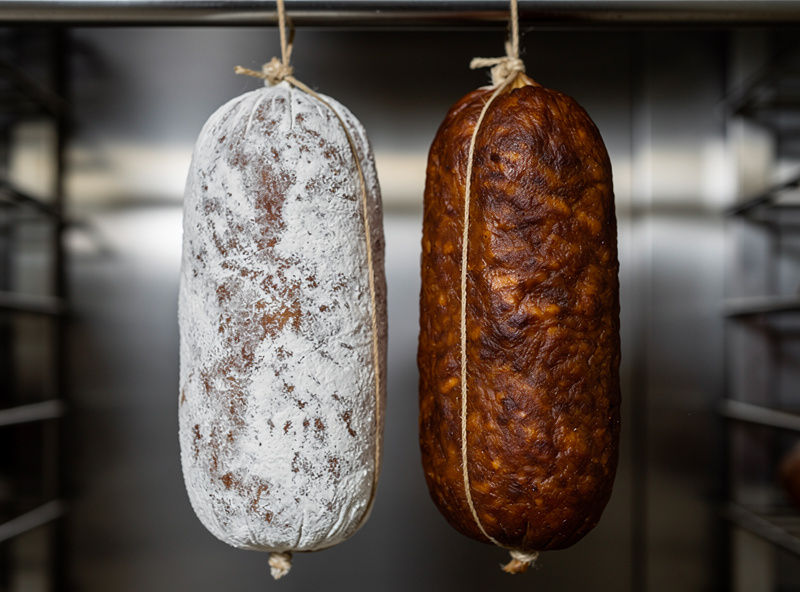
- Salami, fermented sausage in casings: 70-75% RH, 55-60°F. Lower humidity prevents wet casings and excessive mold.
- ‘Nduja (spreadable salami): 70-75% RH, 55-60°F. Lower-end of charcuterie range.
- Pancetta (rolled or flat): 70-78% RH, 50-58°F. Slightly drier than coppa to develop the firm texture.
- Guanciale: 70-78% RH, 50-58°F. Similar to pancetta; pork cheek with high fat content.
- Duck prosciutto: 75-80% RH, 50-55°F. Smaller mass, faster aging cycle of 2-3 weeks.
The “ideal” humidity for any specific product matters less than holding humidity stable. A chamber that fluctuates between 65% and 85% RH ruins charcuterie even if the average is “perfect”; a chamber that holds 75% ±2% reliably produces excellent charcuterie even if 75% is not the absolute optimum for the specific product. Read about specific salami humidity troubleshooting in our salami casing mold guide.
Comparison Table: Humidity Targets by Project
| Project Type | Humidity Range | Temperature | Duration | Why This Range |
|---|---|---|---|---|
| Dry-aged beef ribeye | 75-85% RH | 34-38°F | 30-60 days | Slow controlled moisture loss |
| Dry-aged whole loin | 75-82% RH | 34-38°F | 30-60 days | Pellicle formation + flavor |
| Prosciutto whole muscle | 75-80% RH | 50-58°F | 6-12 months | Slow uniform aging |
| Bresaola | 75-80% RH | 50-58°F | 3-6 weeks | Whole muscle dehydration |
| Salami in casings | 70-75% RH | 55-60°F | 4-8 weeks | Casings stay firm, controlled mold |
| Pancetta | 70-78% RH | 50-58°F | 3-4 weeks | Develops firm texture |
| Coppa / capocollo | 75-80% RH | 50-58°F | 3-4 months | Slow uniform aging |
| Duck prosciutto | 75-80% RH | 50-55°F | 2-3 weeks | Small mass, fast aging |
| Cheese (most styles) | 80-95% RH | 50-55°F | 2-12 months | Cheese needs higher humidity |
The critical comparison: cheese aging at 85-95% RH is incompatible with charcuterie aging at 70-80% RH. Running both in one chamber produces sub-optimal results on both. Dedicate a separate chamber or accept compromised results.
Symptoms of Wrong Humidity
Visible signs reveal humidity problems within 5-14 days of starting any aging project. Too-low humidity (below target by more than 5%) produces case-hardening, cracking, and dramatic weight loss in days 1-3. Too-high humidity (above target by more than 5%) produces wet sticky surfaces, accelerated mold growth, and bacterial wet spot. Both visible within the first 2 weeks.
Diagnostic visual symptoms:
- Case-hardening (humidity too low): The exterior of the meat hardens and seals before the interior dries. The meat continues to lose interior moisture but cannot escape the hardened exterior. Result: split surface, hollow interior, ruined product.
- Surface cracking (humidity too low): The drying surface cracks open along grain lines. Visible within 5-10 days.
- Excessive weight loss in days 1-3 (humidity too low): Beef should lose 1-2% per day in the first week. Losses above 3% per day mean humidity is too low.
- Wet sticky surfaces (humidity too high): Drips of moisture form on the meat surface. Surface becomes shiny and slick.
- Aggressive mold growth (humidity too high): Mold colonies appear within 3-5 days instead of the normal 7-14. Often the wrong color (green or black instead of white).
- Bacterial wet spot (humidity too high): Yellowish slimy patches with sour or ammonia smell. Toss the entire batch.
- Slow aging with no visible mold (humidity right but temperature wrong): Meat hangs without changing in any direction. Verify temperature first; humidity is not the issue.
Diagnose the chamber, not the meat. If multiple products at the same time develop the same symptom, the chamber is the problem. If only one product develops a symptom while others are fine, the product-specific cure or salt level is more likely the issue.
Running One Chamber for Both Beef and Charcuterie
For chambers hosting both beef aging and charcuterie simultaneously, target 75-78% RH at 38-50°F as the compromise zone. The slightly cooler-than-ideal beef temperature and slightly higher-than-ideal charcuterie temperature land in a workable middle. Beef ages slightly slower; charcuterie ages slightly faster. Acceptable trade-off for hobby setups without dedicated chambers.
Compromise chamber strategy:
- Single setpoint: 75% RH at 45-50°F: Workable for both, ideal for neither. Most home dual-purpose chambers run this.
- Stage by stage aging: Run beef alone for first 3 weeks (80% RH), then add charcuterie at 75% RH. Less optimal for beef late stages but acceptable.
- Two chambers (best solution): A small dedicated beef chamber at 80% RH and a separate charcuterie chamber at 73% RH. Total cost roughly $400-700 for two converted fridges; produces meaningfully better results.
- Compromise temperature: 42-45°F: Slightly cool for charcuterie (which ages slightly slower) and slightly warm for beef (which is fine but reduces aging length flexibility).
- Skip cheese entirely in charcuterie chambers: The 80-95% RH cheese needs is incompatible. Use a separate small mini-fridge for cheese.
The reliable pragmatic answer for most home setups is 75% RH at 50-55°F as a single chamber compromise. Beef ages slightly differently than at 80% but produces good results; charcuterie produces excellent results. Dedicated beef chambers at proper 80% RH appear after 1-2 years of hobby commitment, when project volume justifies the second chamber. Read about the build process in our how to convert a fridge into a curing chamber guide.
Frequently Asked Questions
What humidity should I run for a curing chamber?
For most charcuterie 70-80% RH at 50-58°F. For dry-aged beef 75-85% RH at 34-38°F. For a chamber doing both, compromise at 75% RH at 45-50°F — sub-optimal for both but produces good results on each.
Why does dry-aged beef need higher humidity than salami?
Beef relies on its own surface to develop a protective pellicle. Higher humidity (80-85%) allows the pellicle to form slowly without case-hardening. Salami already has a casing for protection, so it tolerates lower humidity (70-75%) which prevents excess wetness on the casing.
What happens if my humidity is too low?
Case-hardening — the surface dries and seals before the interior, trapping interior moisture. The product develops a split surface and hollow interior. Beef ribeyes show this within 5-10 days at 65% RH; salamis show it within 7-14 days at 60% RH.
What happens if my humidity is too high?
Wet sticky surfaces, accelerated unwanted mold growth (often green or black instead of white), and bacterial wet spot. Salamis develop slimy casings; beef develops dripping moisture. Toss anything with bacterial wet spot signs (sour smell, slimy texture).
Can I age beef and salami in the same chamber?
Yes, with compromise. Run 75% RH at 45-50°F as the single setpoint. Beef ages slightly slower than at 80% RH; salami ages slightly faster than at 70% RH. Workable for most home setups; dedicated chambers per product type produce better results but require more equipment.
Why does my hygrometer read different values in different chamber spots?
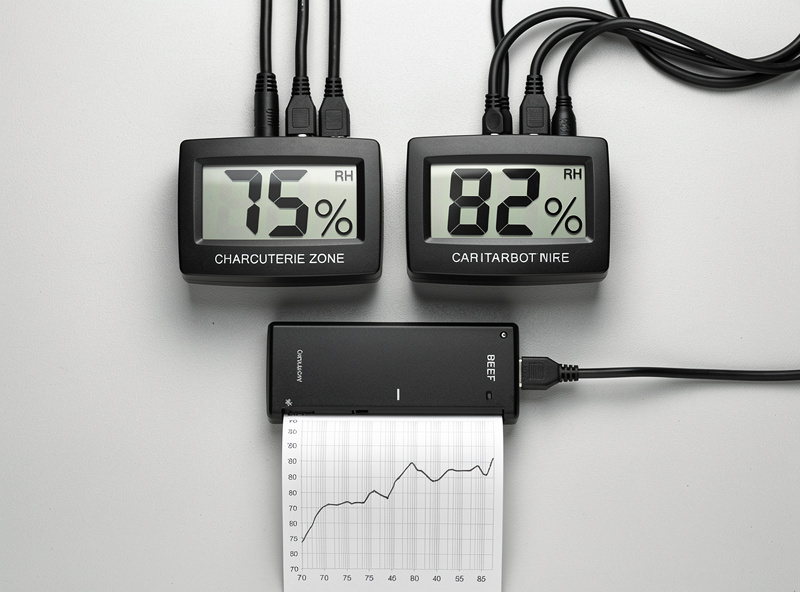
Microclimate variation. Air circulation is uneven without a fan, creating humidity gradients of 5-15% within the chamber. Add a small USB fan running 24/7 for circulation, and place the hygrometer at the same level as your aging products to measure conditions where the meat actually hangs.
Related Articles
- Curing Chamber Too Humid: How to Fix
- How to Convert a Fridge Into a Curing Chamber
- Dry Aging Smell: Normal vs Trouble
- Salami Casing Mold: Good vs Bad
- Black Mold on Charcuterie