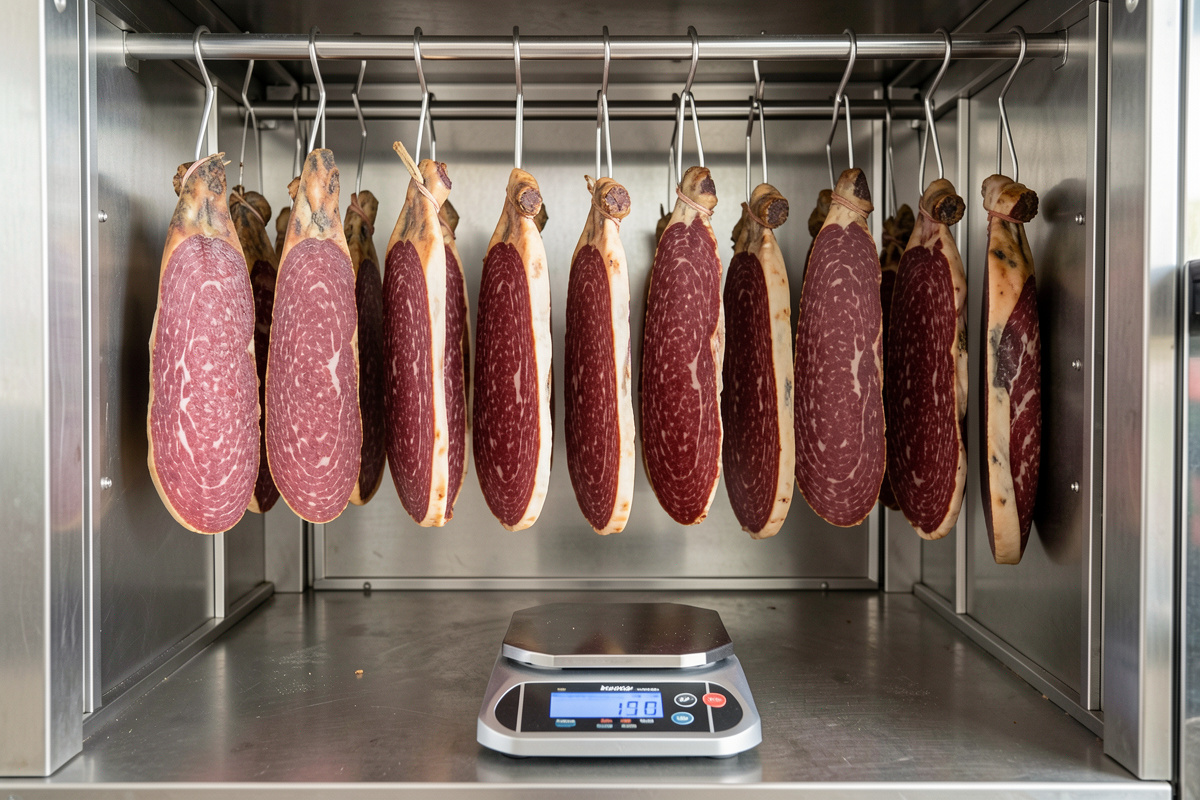

Charcuterie food safety comes down to one idea: you are not “preserving meat” so much as making it a place where dangerous bacteria cannot grow. The four levers that do that work are salt, curing salt (nitrite/nitrate), acidity, and water activity, and a finished dry-cured piece typically needs to lose about 30–40% of its starting weight before those hurdles line up. This guide is the map of how those levers fit together, and where to go deeper on each one.
I run converted-fridge curing chambers in Sweden, and I have logged the weight loss on every coppa, pancetta, bresaola, and salami I have hung. That weight log is the spine of everything below. But I want to be plain about something up front, because the rest of this guide leans on it: I can tell you exactly how I build the hurdles and what the numbers mean, and I can point you at the authorities who set the limits. I cannot guarantee that any single piece you make at home is safe to eat. Home charcuterie carries real risk — Clostridium botulinum, Listeria, and Staphylococcus aureus are the names worth knowing — and the honest position is to report what the science and the regulators say, follow the conservative practice, and when something looks or smells wrong, throw it out.
The Five Hurdles That Make Cured Meat Safe
Cured meat is safe because no single condition lets pathogens grow, and that is the whole game. Food scientists call this hurdle technology: you stack several partial barriers — salt, nitrite, acidity, low water activity, and temperature — and a bacterium that could climb over any one of them on its own cannot climb over all of them at once. Remove one hurdle and the others may not hold.
The reason this matters for a home maker is that recipes hide the hurdles. A salami recipe reads like a spice list, but underneath it is a salt percentage, a cure #2 dose, a fermentation that drops pH, and a drying phase that pulls water activity down. When a batch goes wrong, it is almost always because one hurdle quietly failed — the ferment stalled, the chamber ran too humid, the salt was eyeballed. Knowing the five hurdles by name lets you diagnose which one slipped instead of guessing. The five are: salt concentration, curing salt (nitrite for the short game, nitrate as a reservoir for the long one), pH (acidity), water activity (free water), and temperature. The rest of this guide takes them one at a time.
Salt: The Oldest Hurdle and the One You Control by Weight
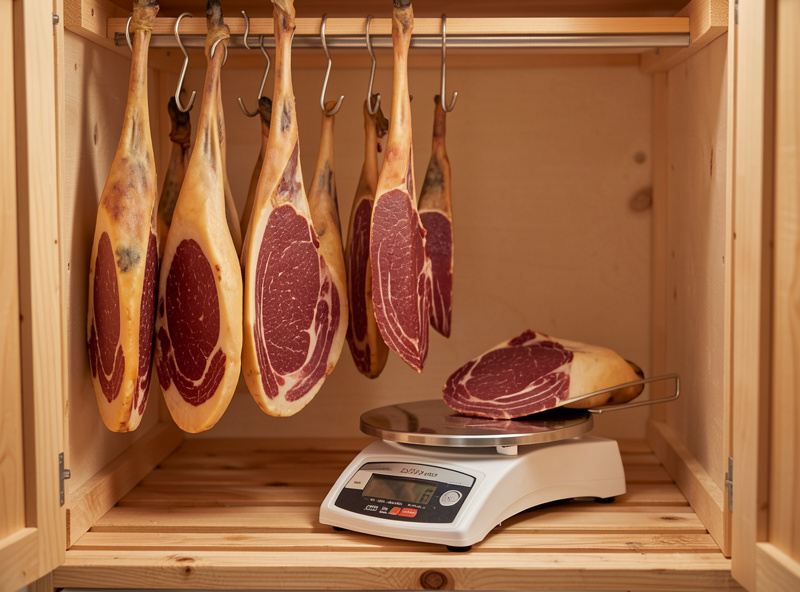
Salt is the first barrier, and the single most reliable thing you can do for safety is weigh it instead of guessing. For whole-muscle pieces I run an equilibrium cure at roughly 2.5–3% of the meat’s weight in salt, which means the salt is calculated against the meat and rubbed on, then the piece sits sealed until the salt distributes evenly. You cannot over-salt past the target because there is only as much salt as you weighed — that is the safety beauty of the method, and it is why I switched away from the old salt-box cover cure for anything I care about.
Salt does two jobs. It pulls free water out of the meat (lowering water activity, hurdle four) and it directly suppresses many spoilage and pathogenic bacteria. Under-salting is one of the most common ways a home cure drifts into the danger zone, because the piece stays wetter and the other hurdles never catch up. If you realize a batch came out under-salted, do not improvise — I wrote up the honest options in salvaging under-salted charcuterie, and sometimes the answer is the bin. For the math behind dialing in a precise percentage, see how to calculate salt percentage for equilibrium curing. One hard rule from the start: never use iodized table salt for a cure, because the iodine interferes with the fermentation cultures that secure a salami.
Curing Salt: Nitrite, Nitrate, and Why “No-Nitrate” Is Not a Shortcut
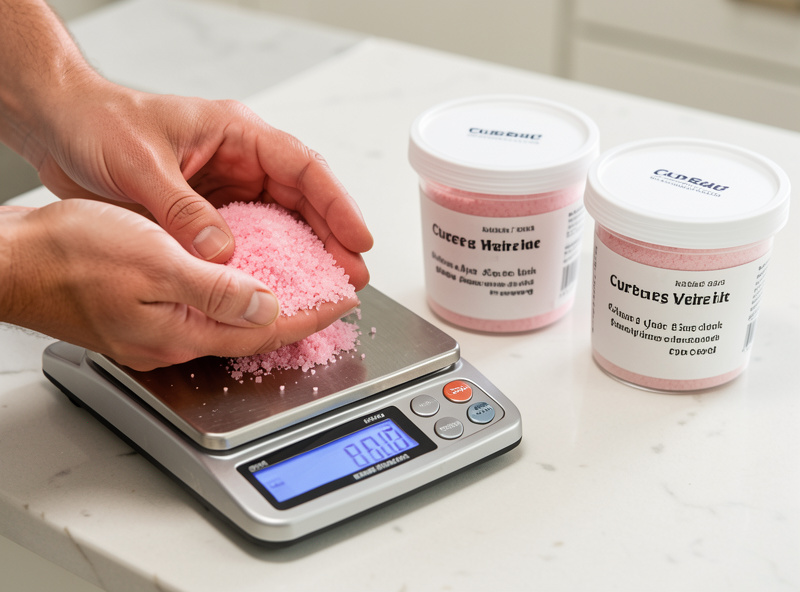
Curing salt — the pink-dyed nitrite and nitrate mixes — is the hurdle that specifically targets botulism, and it is the one home makers are most tempted to skip. The pink dye exists so you never confuse it with regular salt; the active ingredients are sodium nitrite and, in the long-cure version, sodium nitrate. Cure #1 (Prague Powder #1) is 6.25% sodium nitrite and is used for products that will be cooked or cold-smoked and eaten relatively soon, like bacon. Cure #2 (Prague Powder #2) adds sodium nitrate as a slow-release reservoir and is the correct choice for anything air-dried over weeks or months without cooking — salami, coppa, pancetta, bresaola.
Both are dosed at the same conservative home rate: 2.5 grams per kilogram of meat, which lands the ingoing nitrite well within regulatory limits. I break down the chemistry and the swap rules in pink salt and nitrates explained and the head-to-head selection in curing salt type 1 vs type 2. If you have ever grabbed the wrong tub, the rescue path is in Prague Powder #1 vs #2 mixup, and the bacon-specific ratios live in bacon curing salt ratios. The point that the romantic “natural, no-nitrate” framing misses: celery-powder cures still deliver nitrite, just unmeasured, and going genuinely nitrate-free on a long dry-cure removes your only dedicated botulism hurdle. That is not a free pass — it is the one corner I will not let a reader cut.
pH and Fermentation: How Salami Earns Its Safety
Fermented sausage adds a fifth lever the whole-muscle cures do not need: acidity. A salami is, chemically, a controlled ferment — you add a starter culture of lactic acid bacteria plus a little dextrose for them to eat, hold the sausage warm and humid for a day or two, and the bacteria drop the pH from around 5.8 down toward 5.3 or below. That acid drop is a genuine safety hurdle: it suppresses pathogens during the vulnerable early window before drying has done its work. This is the same lactic-acid chemistry that ferments a jar of sauerkraut — same bacteria family, different substrate — which is the crossover that got me into charcuterie from the fermentation bench in the first place.
The danger in fermentation is holding meat warm without a working acidification path. Warm, moist, low-oxygen, neutral-pH ground meat is exactly the environment Staphylococcus aureus and other pathogens want, so “let it ferment naturally” is a needless gamble — you want a known culture driving a known pH drop on a known schedule. I cover the chemistry in salami fermentation chemistry, the culture choices in the salami starter culture guide, and the realistic way to read the ferment if you do not own a pH meter in how to ferment salami without a pH meter. For the full build, the home salami making guide ties it together.
Water Activity: The Hurdle You Cannot See but Have to Trust
Water activity (written aw) is the amount of free water available to bacteria, on a scale from 0 to 1.0, and it is the hurdle that finally makes a dried piece shelf-stable. It is not the same as moisture content — salt and drying both lower aw by binding or removing free water. The numbers worth memorizing: most strains of Clostridium botulinum stop growing below about aw 0.93, Listeria monocytogenes can still grow down to roughly 0.92, and Staphylococcus aureus toxin production is shut down below about 0.86. A finished dry-cured product is generally aimed at aw 0.90 or lower, with the safest fully shelf-stable target nearer 0.85.
Here is the practical bridge most home makers never get told: I cannot watch aw directly without a meter, so I watch weight loss as its proxy. When a whole-muscle piece has lost 30–40% of its green weight, its water activity has dropped into the safe band — that is why the scale, not the calendar, tells me when a coppa is done. I explain the relationship in water activity and food safety, and if you want to measure it directly rather than infer it, the aw meter guide for home charcuterie covers the actual instruments. Reading doneness off the scale is the same skill as knowing when whole-muscle charcuterie is done.
Temperature and the Chamber Envelope
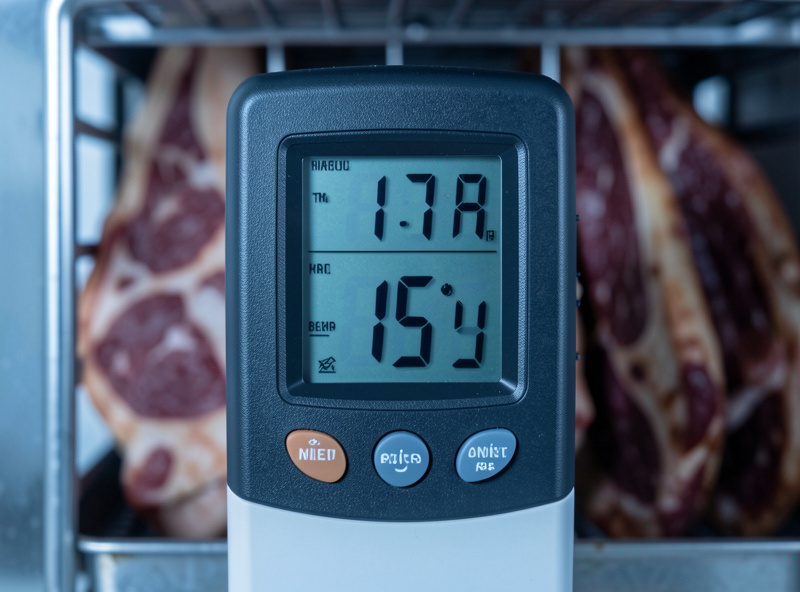
Temperature is the hurdle your chamber manages around the clock. The drying envelope I dial in sits at roughly 12–15 °C and 75–80% relative humidity — cool enough to slow spoilage bacteria, warm enough that the piece dries steadily, and humid enough that the surface does not seal shut and trap a wet core. That last failure is case-hardening, and it kills more home pieces than mold ever does; the fix is in case hardening in curing chambers. Holding that envelope is the entire job of a converted-fridge build, which is why I treat chamber climate control as a food-safety system and not just a comfort setting.
Temperature also defines the danger zone — the 4–60 °C band where bacteria multiply fastest. Curing works by keeping the meat cool while the salt, cure, acid, and drying do their slow work, never by parking it warm. If a chamber drifts hot, or the humidity swings, the safe assumption is that a hurdle has slipped; the diagnostic walk-through lives in the curing chamber troubleshooting guide.
Mold: Knowing Good White From Dangerous
Not all mold on charcuterie is a problem — in fact a clean coat of white Penicillium nalgiovense is the goal on a salami casing, a protective bloom I deliberately encourage with a white-mold culture. The skill is telling the welcome mold from the unwelcome. Powdery white and pale grey-green are normal; fuzzy black, slimy black, or “spider” growth with long aerial hyphae is not, and a slimy or genuinely foul-smelling surface means the piece is done for. I lay out the visual ID in good white mold vs dangerous black/green and the specific black-mold question in black mold on charcuterie. When in doubt on mold, the rule is the same as everywhere else in this guide: throw it out.
The Hurdles at a Glance
The table below is the quick reference I keep in my head when I build a recipe. Read it as: which hurdle, what it actually does, and the conservative target I aim for. None of these numbers is a personal invention — they track the published thresholds, and the regulators’ own documents are the authority.
| Hurdle | What it controls | Conservative home target | Main pathogen it blocks |
|---|---|---|---|
| Salt | Lowers free water, suppresses bacteria | 2.5–3% of meat weight (equilibrium) | Broad spoilage + pathogens |
| Cure #1 (nitrite) | Botulism protection, short cures/cooked | 2.5 g per kg of meat | C. botulinum |
| Cure #2 (nitrite + nitrate) | Botulism protection, long air-dried | 2.5 g per kg of meat | C. botulinum |
| pH (fermentation) | Acidity in the early warm window | Drop to ≤ 5.3 (salami) | S. aureus, early pathogens |
| Water activity (aw) | Removes free water, shelf stability | ≤ 0.90 finished (≈ 30–40% weight loss) | Listeria, C. botulinum |
| Temperature | Slows growth during the slow cure | Chamber 12–15 °C, never warm-holding | All, by slowing them |
Where Botulism Fits, and Why It Gets Its Own Guide
Clostridium botulinum is the pathogen that justifies the entire curing-salt hurdle, because it is anaerobic — it thrives in exactly the low-oxygen interior of a stuffed sausage or a sealed cure — and its toxin is the deadly one. It is also the reason cold-smoked and air-dried products, which never reach a temperature that would kill the toxin, depend on nitrite plus salt plus low water activity rather than heat. Because the stakes are highest here, I keep the testing-and-prevention discussion in its own piece: testing for botulism prevention, alongside the cold-smoking-specific risk in cold smoking safety and botulism. The short version is that you prevent botulism by stacking hurdles, not by testing your way out of a bad batch — there is no reliable home test for the toxin, which is precisely why the prevention has to be right the first time.
The Danger Window: When Risk Is Highest
Risk in a cure is not spread evenly across the weeks — it is front-loaded into the first few days, before the hurdles have established. A fresh piece of meat starts at full water activity, neutral pH, and whatever surface bacteria it carried in, and it is most vulnerable in that early window when salt is still penetrating, the cure has not fully equilibrated, and a salami’s ferment has not yet dropped the pH. Everything I do at the start of a cure is about getting through that window fast and clean.
For whole muscle, that means a cold, clean cure phase in the fridge so the salt and nitrite distribute before the piece ever sees the warmer chamber. For fermented sausage, it means pitching a vigorous starter culture with enough dextrose to drive a prompt pH drop, rather than hoping wild bacteria sort it out — the warm, humid fermentation hold is the most dangerous phase of the whole process precisely because the meat is warm before it is acidic. Hygiene matters most here too: clean hands, clean equipment, chilled grinder plates, and good-quality meat from a source you trust. Once the piece is salted, cured, acidified where needed, and steadily losing weight in a well-controlled chamber, the daily risk falls. The scale climbing toward 30–40% loss is the visible sign that the window has closed behind you.
A Pre-Serve Safety Walkthrough
Before any piece comes off the hooks and onto a board, I run the same mental checklist, and it is built entirely on the five hurdles. Did this piece get the correct salt percentage, weighed not guessed? Did it get the right curing salt for its method — Cure #2 for the long air-dried pieces, Cure #1 for the short or smoked ones? If it was a salami, did the ferment actually drop the pH, on schedule, with a real culture? Has it lost the weight — that 30–40% for whole muscle and finished salami — that tells me water activity is where it needs to be? Was it held cool and humid the whole way, with no chamber drift I failed to correct?
If every answer is yes, I am confident in the piece. If any answer is “I am not sure,” that uncertainty is the answer: a hurdle I cannot account for is a hurdle that may have failed, and a dry-cured piece is not worth a hospital trip. Then there is the sensory final check — surface, smell, and feel. Clean white or pale grey-green bloom is fine; fuzzy black or green is not. A nutty, meaty, faintly funky smell is fine; sharp ammonia, sourness gone wrong, or anything genuinely foul is not. Firm and evenly dried is fine; slimy, sticky, or a soft wet core under a hard shell is not. This is reporting what to look for, not a guarantee — but a piece that passes the hurdle audit and the sensory check is one I am willing to stand behind for my own table.
What the Authorities Actually Say
I want to be careful here, because this is where home charcuterie writing tends to over-claim. The relevant authorities in the United States are the USDA’s Food Safety and Inspection Service (FSIS), which sets the nitrite limits and the time-temperature rules commercial processors follow, and the National Center for Home Food Preservation (NCHFP) at the University of Georgia, which translates food-safety science for home cooks. It is worth knowing that NCHFP and USDA do not broadly endorse home dry-curing of fermented sausage, because the home environment cannot validate its hurdles the way an inspected plant can. I unpack what that guidance means in practice — and where it leaves the home maker — in USDA guidelines for home curing.
That gap is the honest center of this whole hobby. I follow the conservative practice, I weigh everything, I use the correct cure, I keep finished pieces refrigerated unless I have strong reason to believe they are fully shelf-stable, and I still treat every piece as something I am responsible for judging before I serve it. This guide reports what the science and the regulators say. It cannot guarantee your batch. If a piece smells wrong, feels slimy, shows fuzzy black or green growth, or you simply cannot account for one of the five hurdles — do not taste-test your way to a decision. Throw it out and build the next one better.
Frequently Asked Questions
Is home charcuterie safe to make?
It can be, but only when every hurdle is correct: weighed salt, the right curing salt, a controlled ferment for sausage, and enough drying to reach low water activity. The USDA and NCHFP do not broadly endorse home dry-curing because the hurdles cannot be validated at home, so the conservative practice and your own judgment carry the safety.
Do I really need pink curing salt?
For anything air-dried over weeks without cooking, yes. Curing salt is the dedicated botulism hurdle, and no-nitrate methods remove it. Cure #1 is for short or cooked products like bacon; Cure #2, with added nitrate, is for long dry-cured salami, coppa, and pancetta. Both are dosed at 2.5 grams per kilogram of meat.
How do I know when a cured piece is safe to eat?
For whole muscle, weight loss is the honest signal: roughly 30 to 40 percent loss from the green weight corresponds to water activity dropping into the safe band near 0.90 or below. Weigh every piece and let the scale, not the calendar, decide. An aw meter measures water activity directly if you want certainty.
What is water activity and why does it matter more than moisture?
Water activity is the free water available to bacteria, on a 0 to 1.0 scale. Bacteria cannot use bound or removed water, so salt and drying lower it independently of total moisture. Clostridium botulinum stops below about 0.93 and Staphylococcus aureus toxin below about 0.86, which is why dried charcuterie targets 0.90 or lower.
Can I taste a small piece to check if it is safe?
No. Botulinum toxin can be present without any off taste or smell, and there is no reliable home test for it. Safety comes from getting the hurdles right before the fact, not from tasting after. If a piece smells wrong, feels slimy, or shows fuzzy black or green mold, discard it without tasting.
Why do the USDA and NCHFP seem cautious about home curing?
Because a home maker cannot validate hurdles the way an inspected plant can, with measured pH, water activity, and time-temperature logs. Their caution is not that curing is impossible at home, but that the margin for error is real. Following their published limits, weighing everything, and keeping finished pieces refrigerated is how home makers stay on the safe side.
Related Guides
- Pink Salt and Nitrates Explained for Charcuterie
- Curing Salt Type 1 vs Type 2: Which to Use
- Water Activity and Food Safety in Charcuterie
- Aw Meter Guide for Home Charcuterie
- Testing for Botulism Prevention in Charcuterie
- USDA Guidelines for Home Curing Explained
- Whole Muscle Charcuterie: The Complete Guide
- Home Salami Making: The Complete Guide