Salami Fermentation Chemistry: pH Drop, Lactic Bacteria, Sauerkraut Science
May 8, 2026

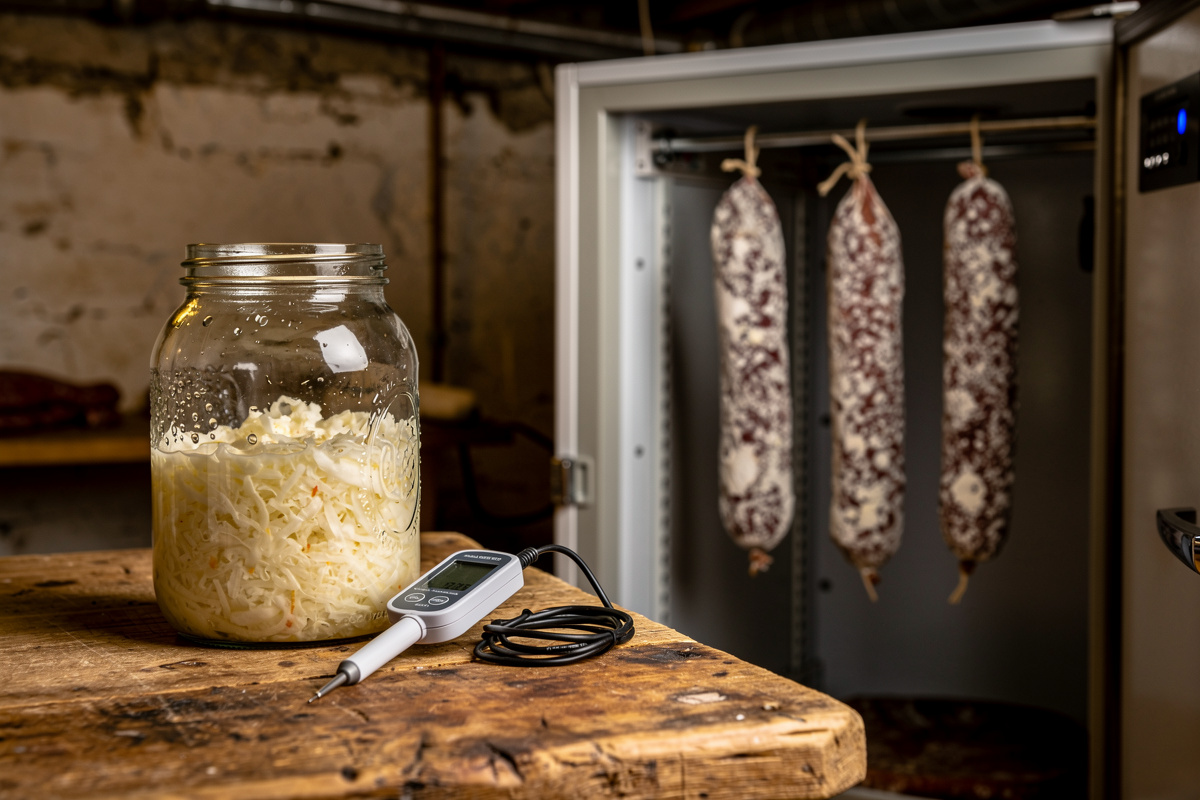
The same lactic acid bacteria that drop sauerkraut from neutral pH 6.5 to acidic pH 3.5 in five days are doing nearly identical work inside a curing salami over six weeks — the pH drop that finishes a salami is the same chemistry that ferments sauerkraut, same bacteria family, different substrate, which is the crossover that got me hooked on both hobbies at once. Published dry-sausage validation guidance puts the shelf-stable threshold at pH 5.0-5.3 with water activity at or below 0.90-0.94 for fermented sausage.
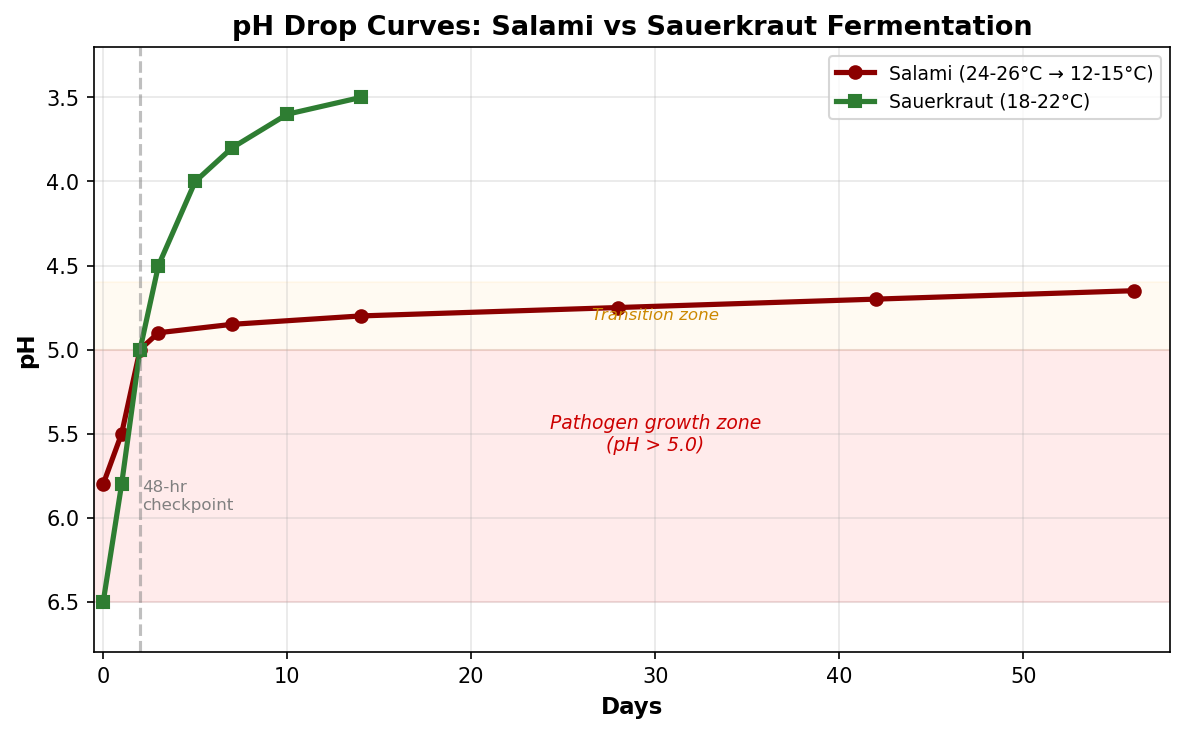
Lactobacillus and Pediococcus eat sugar, produce lactic acid, the pH drops from 5.8 to 4.8 within 72 hours, the meat sets, and pathogens lose the warm-and-neutral environment they need to grow. The biology of cabbage fermentation and salami fermentation is the same chemistry at different speeds and substrates.
As an Amazon Associate I earn from qualifying purchases.
This guide covers the pH math that drives both processes, the bacterial cultures involved, and the practical implications for charcutiers who want to understand why their salami “sets” or doesn’t. Hardware target is a basic digital pH meter (Apera PH60, Hanna HI-98103) and a kitchen scale. The science scales from a single salami stick to a 12 kg production run.
Why pH Drop Is the Single Most Important Salami Variable
Fresh ground meat sits at pH 5.7-5.9, which is exactly the pH range where most foodborne pathogens (Salmonella, E. coli, Listeria) reproduce comfortably. Below pH 5.3, growth slows; below pH 5.0, most pathogens stop reproducing entirely. Below pH 4.8, the meat enters the “set” zone where proteins denature and the salami firms into a sliceable texture. Hit 4.8 in 72 hours and you have a safe, well-textured product; miss it and you have either a soft slimy mess or a food-safety hazard.
The pH drop happens in two phases. Phase 1 (24-72 hours): the commercial starter culture (Bactoferm T-SPX, F-RM-52) eats added dextrose and produces lactic acid, dropping pH from 5.8 to 5.0. Phase 2 (week 2-6): residual lactic acid production plus protein breakdown drops pH further to 4.6-4.8. Both phases require warm fermentation temperatures (24-26°C) for the first 48 hours, then standard curing temperature (12-15°C) for the rest of the cure.
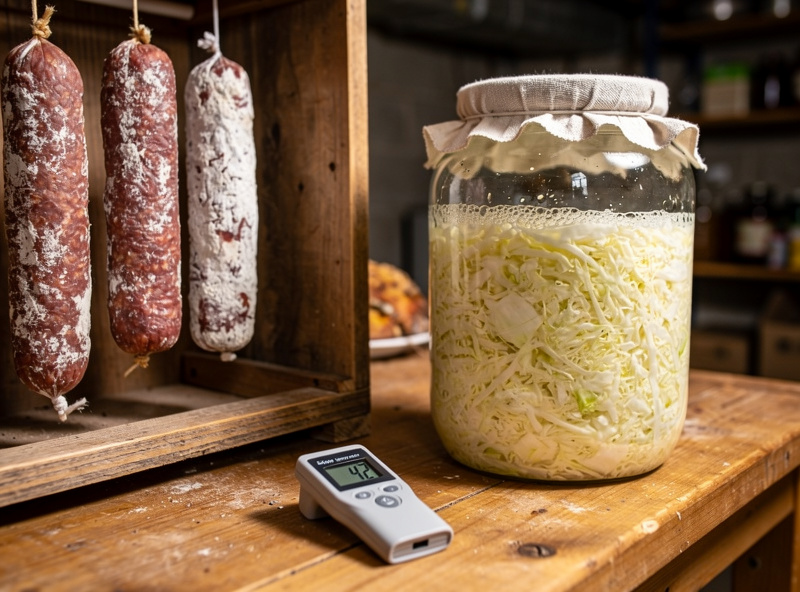
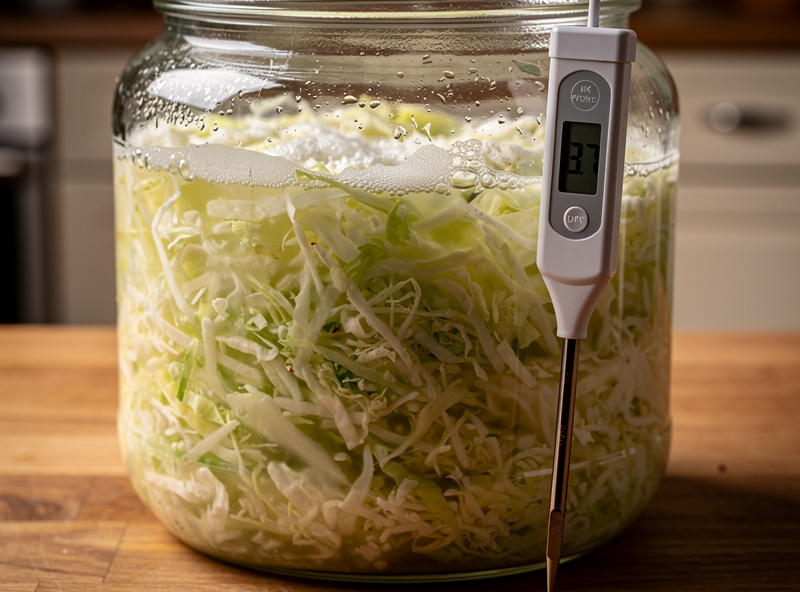
The same biology runs in cabbage at room temperature. Sauerkraut starts at pH 6.5 (raw cabbage), drops to 4.5 within 5 days as Leuconostoc and Lactobacillus colonize, and finishes at pH 3.4-3.5. The lower final pH is partly substrate (cabbage has more available sugars) and partly bacterial succession — sauerkraut runs through three distinct bacterial waves — Leuconostoc mesenteroides (days 1-3), Lactobacillus brevis (days 3-7), and Lactobacillus plantarum (days 5-14) — over two weeks. The detailed cabbage-fermentation biology is on the sauerkraut mold vs kahm yeast guide, which covers the visible signs of healthy versus contaminated fermentation.
The Lactic Acid Bacteria That Power Both Processes
Three genera do most of the heavy lifting in both salami and sauerkraut. Lactobacillus species (L. plantarum, L. sakei) are the dominant bacteria in mature salami and the third-stage colonizer in sauerkraut. Pediococcus species (P. pentosaceus) drive the fast initial pH drop in salami starter cultures. Leuconostoc species (L. mesenteroides) initiate the sauerkraut ferment with rapid CO2 production that drives oxygen out of the crock.
| Bacteria Genus | Salami Role | Sauerkraut Role | Optimal Temp |
|---|---|---|---|
| Lactobacillus plantarum | Final pH stabilizer | Phase 3 colonizer | 30 C |
| Lactobacillus brevis | Mid-ferment acidifier | Phase 2 colonizer | 25-30 C |
| Lactobacillus sakei | Cold-tolerant pH driver | Minor | 15-22 C |
| Pediococcus pentosaceus | Fast acid drop | Minor | 30-35 C |
| Leuconostoc mesenteroides | Minor | Phase 1 starter | 18-22 C |
| Staphylococcus xylosus | Color, flavor | None | 20-30 C |
Commercial salami starter cultures (Bactoferm T-SPX, T-SP, F-RM-52) blend these bacteria in proportions tuned for specific style outcomes — a Spanish-style chorizo gets a different blend than a French saucisson sec or a Hungarian kolbász. The home salami making complete guide covers the culture selection per style and the dextrose dose that powers the fermentation.
Wild fermentation (no added culture) works for sauerkraut because cabbage carries enough Leuconostoc on the leaves to start the ferment reliably. Wild fermentation in salami works some of the time but introduces unacceptable pathogen risk because raw meat does not carry a useful starter population. For salami, always use commercial starter culture; for sauerkraut, you can skip it.
The Nitrite Layer: Why pH Drop Isn’t the Only Safety Lever
Salami safety is a two-gate system: pH drop handles the bacterial front, and sodium nitrite handles the spore-forming front — specifically Clostridium botulinum, which produces a neurotoxin at aw above 0.93 and pH above 4.6. I use Insta Cure #2 (6.25% sodium nitrite + 4% sodium nitrate) at 0.25% of meat weight, which delivers roughly 156 ppm in-going nitrite — the published USDA in-going nitrite limit for comminuted cured meats. The nitrate component hydrolyzes slowly over the 4-12 week cure, providing a time-release nitrite reservoir that the pH drop alone cannot replicate.
The nitrite does three things simultaneously: it fixes the myoglobin into a stable pink-red cure color (without it, salami turns grey-brown by week 3), it inhibits C. botulinum spore germination during the 48-hour window before pH drops below 5.0, and it contributes to the characteristic “cured” flavor through nitric oxide-myoglobin chemistry. To be unambiguous about where the line actually sits: this applies to every fermented, dried salami on this site, full stop, regardless of how short the hang is. There’s no day-count below which cure #2 becomes optional for a dried, uncooked sausage — the only category that’s genuinely different is a fresh sausage you cook and eat the same week without ever fermenting or hanging it, which isn’t the same food and isn’t what this guide covers. Prague Powder #2 and Insta Cure #2 are functionally identical; I keep a 1-lb bag of the latter in the chamber-side cabinet.
Measuring pH: When and How
For salami, take a pH reading at hour 24, hour 48, hour 72, then weekly for the rest of the cure. Hour 48 is the most important — pH should be at or below 5.0 by then. If pH is still above 5.3 at hour 48, the fermentation has stalled and the salami is at risk; raise temperature to 26°C, add more dextrose if possible, and re-test in 12 hours.
For sauerkraut, pH measurement is less critical because the visible CO2 production and brine clarity reliably indicate health. Take a single reading at day 5 to confirm the ferment dropped below 4.0; another at day 14 to confirm final pH below 3.6. After that, the kraut is shelf-stable in the fridge for 6+ months.
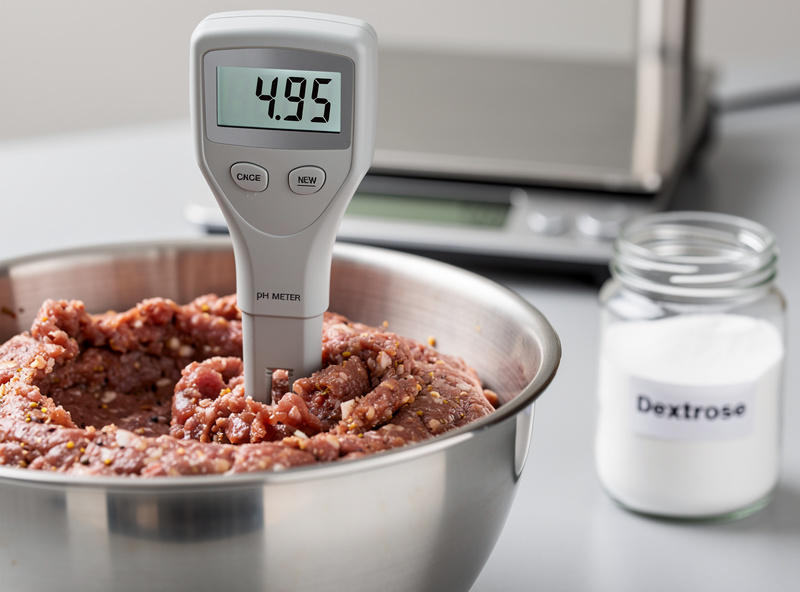
pH meter calibration matters. Calibrate with pH 4.0 and pH 7.0 standard solutions before any production batch. A drift-prone uncalibrated meter can read 5.5 when actual pH is 4.8, hiding a fermentation problem until it shows up as soft texture or off-flavor. Cheap pen-style meters need calibration weekly during active production.
Temperature Control: The Critical First 48 Hours
Salami fermentation needs 24-26°C for the first 48 hours. This temperature window is high enough for Pediococcus to produce acid quickly but low enough to discourage spoilage organisms from outcompeting the starter. After 48 hours, drop to standard curing temperature (12-15°C) for the rest of the cure. The temperature step is the single most common home-charcutier mistake.
For curing chambers without precise temperature control, a small fermentation tent inside the chamber works: a polystyrene cooler with a dimmable seedling heat mat at the bottom, the salami sticks suspended above the mat, a thermometer monitoring the air. Hold 25°C for 48 hours, then move the salami into the main chamber. The full chamber-build details are on the how to build a curing chamber guide.
For sauerkraut, room temperature (18-22°C) is the sweet spot. Below 16°C the fermentation stalls and risks mold; above 24°C the ferment runs too fast, produces off-flavors, and can soften the cabbage texture badly. Mason jars on a kitchen counter sit in this range naturally most of the year.
Diagnosing a Stalled Ferment
When pH does not drop on schedule, four causes account for 90% of cases. Insufficient dextrose: the starter ate all available sugar before producing the acid drop. Add 0.3% additional dextrose by meat weight and re-warm. Old starter culture: cultures more than 12 months past production date may have lost viability. Buy fresh and re-inoculate. Salt too high: above 3.2% salt, lactic acid bacteria slow significantly. Reduce salt next batch. Temperature too low: under 22°C, the bacteria are sluggish. Raise to 25°C.
I have had a batch sit at pH 5.3 at hour 48 — a 4 kg batch of Genoa-style salami where I had misread the dextrose as 0.2% instead of 0.5%. The chubs were soft, the surface was tacky, and the Apera meter was telling me the ferment had flatlined. I raised the chamber to 26°C, dissolved 12 g of dextrose (0.3% of meat weight) in 30 mL of distilled water, injected four spots per chub with a clean syringe, and re-tested at hour 60 — pH 4.9. That batch went 34% weight loss at 12 weeks and sliced clean. Without the rescue, all 4 kg would have gone in the bin. Now I keep a printed dextrose-dose card taped to the inside of the chamber door and verify the percentage twice before stuffing.
The cross-domain analogy is useful. A “stalled” sauerkraut ferment (pH not dropping below 4.5 at day 7) almost always points to either too-cold temperature or too-high salt. The same diagnostic checklist applies to salami. The biology converged on identical responses to identical stresses across the two food systems.
For both products, the protective effect of low pH is shelf-life. Sauerkraut at pH 3.4-3.5 lasts 6+ months refrigerated; salami at pH 4.6-4.8 plus 30-35% weight loss (which drives water activity below aw 0.92) lasts 6 months at room temperature. The combination of acid drop, salt, water activity reduction, and competitive bacterial dominance is what made these foods safely storable for centuries before refrigeration. The detailed troubleshooting for color, texture, and pH issues is on the curing chamber troubleshooting guide.
Frequently Asked Questions
What pH should salami reach during fermentation?
Salami should reach pH 5.0 or below at hour 48 of fermentation, then drop to 4.6-4.8 by the end of the cure. Failure to reach pH 5.0 by hour 48 indicates a stalled ferment and increases foodborne illness risk significantly.
Is salami fermentation the same as sauerkraut fermentation?
The biology is similar but the substrates differ. Both rely on lactic acid bacteria (Lactobacillus, Pediococcus, Leuconostoc) eating sugar to produce lactic acid that drops pH. Salami needs added starter culture; sauerkraut works with wild bacteria from the cabbage leaves.
What is the ideal temperature for salami fermentation?
24-26 degrees Celsius for the first 48 hours, then 12-15 degrees Celsius for the rest of the cure. The high initial temperature drives the lactic acid bacteria to drop pH quickly; the lower curing temperature controls drying speed and surface mold growth.
How do I measure salami pH at home?
A digital pH meter (Apera PH60, Hanna HI-98103) costs 60-90 USD and reads pH accurately, with automatic temperature compensation (ATC) that corrects for the probe’s thermal response. Calibrate with pH 4.0 and 7.0 standard solutions before each batch. Insert the probe into the center of the salami; do not measure surface pH.
What if my salami pH stays above 5.0 at hour 48?
The ferment has stalled. Common causes are insufficient dextrose, expired starter culture, salt above 3.2 percent, or fermentation temperature below 22 degrees Celsius. Raise temperature to 25°C, add 0.3 percent additional dextrose, and re-test in 12 hours.
Can I use sauerkraut bacteria as a salami starter?
No. Sauerkraut Leuconostoc species do not perform the same job as the Pediococcus and Lactobacillus blends in commercial salami starters. Wild fermentation in salami carries unacceptable pathogen risk. Always use commercial salami starter cultures designed for meat fermentation.
Related Articles
- Home Salami Making Complete Guide
- How to Build a Curing Chamber
- Curing Chamber Troubleshooting
- Sauerkraut Mold vs Kahm Yeast
- Best Cabbage Varieties for Sauerkraut