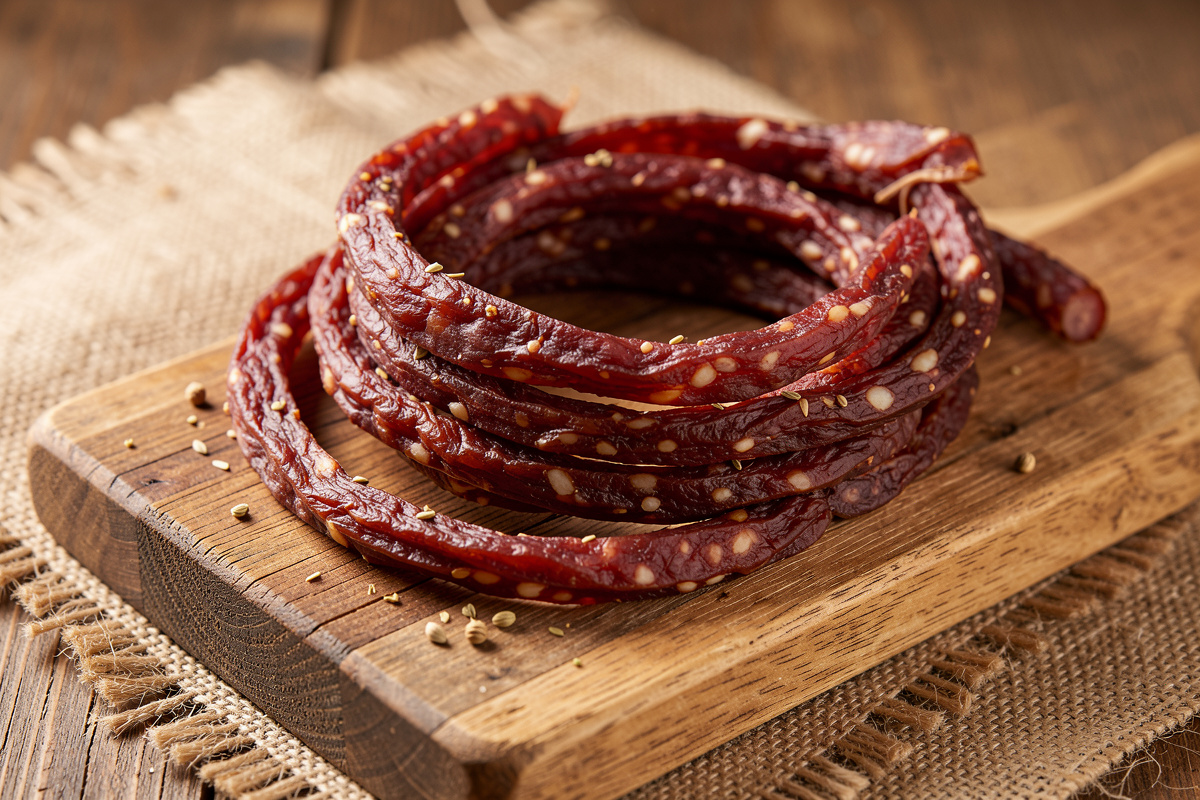

Droewors is biltong’s sausage cousin: a thin, coriander-spiced beef sausage stuffed into narrow casings and air-dried fast in the same warm, dry, breezy box. Because it is ground and cased, it carries more risk than a solid strip, so cure #1 goes in as a default — not an option — at 2.5 g per kilogram.
I treat droewors as the more demanding sibling of biltong. A whole strip of beef has one clean surface and a dense interior; ground meat in a casing has enormous internal surface area and any contamination gets mixed throughout. That is why I do not hand-wave the cure here the way tradition sometimes does with solid biltong. Done with respect for that difference, droewors is one of the fastest, most rewarding things you can dry — thin casings mean it is ready in days. This guide sits under the main biltong guide alongside the cure and box spokes.
What Droewors Is
Droewors — literally “dry sausage” — is a South African air-dried beef sausage flavoured with the same toasted coriander and pepper that defines biltong. It is traditionally thin, stuffed into narrow sheep casings so it dries quickly, and eaten as a snack like biltong rather than cooked. The thinness is the whole trick: a narrow sausage dries through in a day or two, which keeps it firmly in the fast-dry safety model rather than the slow-cure one.
This is the critical distinction. Droewors is a fast-dried sausage, not a fermented salami. If you want a fermented, slow-dried sausage you are in salami territory — starter cultures, a deliberate pH drop, and cure #2 for the long hang. Droewors skips all of that by drying fast and thin. Do not try to merge the two methods; pick one and follow it properly.
The Meat and Fat
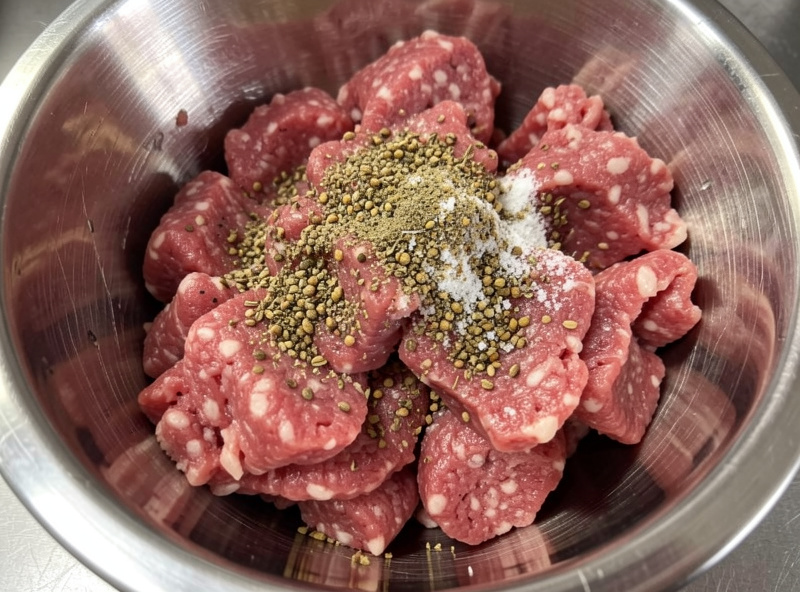
Use lean beef as the base — the same silverside or topside family works well. Traditional droewors often includes a portion of fat for richness, sometimes a little lamb fat, but keep it modest: too much fat smears during grinding and goes rancid faster on a dried snack. I keep everything cold through the grind — meat, grinder plates, and bowl all chilled — to get a clean cut rather than a smeared paste. This is the same discipline I apply when grinding for salami, and skipping it causes the same fat smear problem.
Grind through a coarse plate. Droewors is meant to have texture, not be a fine emulsion. A single coarse grind, kept cold, gives the rustic bite that suits it.
The Cure: Cure #1 Is Not Optional Here
On solid biltong, cure #1 is a margin you can choose to add. On droewors, I use it every time. Ground-and-cased meat has the surface area and the moisture pockets that Listeria and Staphylococcus exploit, and a thin sausage hanging in a warm box is exactly the kind of product where the small nitrite margin earns its keep. Use cure #1 at the standard 2.5 g per kilogram — that is cure #1 (sodium nitrite), not cure #2, because droewors dries fast and does not need slow-release nitrate.
The rest of the cure mirrors biltong: about 2% salt by weight, generous toasted and coarsely cracked coriander, cracked black pepper, and a vinegar wash mixed into the meat for acidification and flavour. A pinch of nutmeg or clove is a common traditional touch. Never use iodized table salt. The full reasoning on the spice ratios is in the cure and spice guide.
A Weighed Droewors Cure
Per kilogram of ground beef, scaled to your batch:
| Ingredient | Per 1 kg meat | Notes |
|---|---|---|
| Lean beef (coarse grind) | 1 kg | Keep cold through grinding |
| Cure #1 | 2.5 g | Default, not optional, for cased meat |
| Fine non-iodized salt | 20 g (2%) | Cure and savour |
| Toasted coriander, coarse | 15–20 g | Signature flavour |
| Black pepper, cracked | 5–8 g | Background heat |
| Brown vinegar | ~30–50 ml | Acidify, bind, flavour |
| Nutmeg or clove (optional) | Pinch | Traditional aromatic |
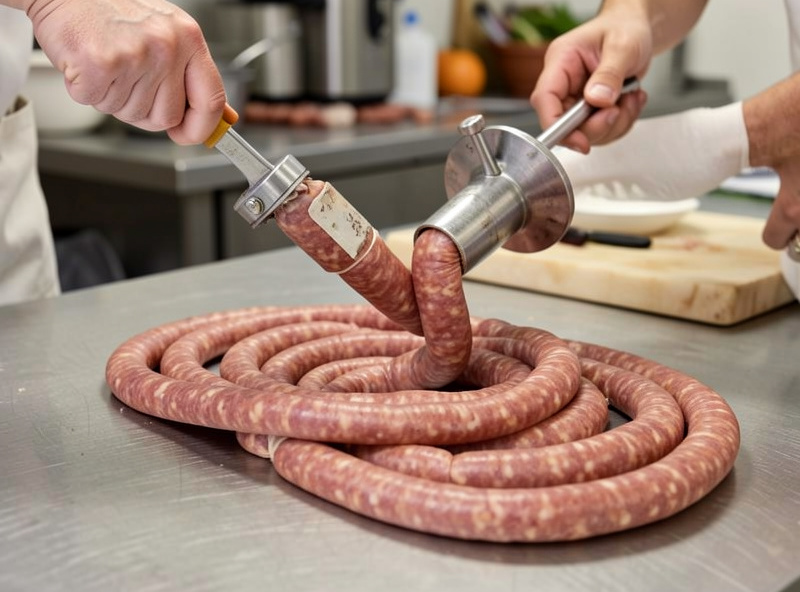
Mix everything thoroughly but briefly while cold so the fat stays intact, then chill the mix before stuffing. A sausage stuffer and narrow sheep casings make the thin format easy.
As an Amazon Associate I earn from qualifying purchases.
Stuffing and Hanging
Stuff into narrow casings — sheep casings are traditional and dry fastest — without packing too tightly, because air pockets and overstuffing both cause problems. Twist or tie into manageable lengths or coils, then hang them in the same warm, dry, breezy biltong box you would use for strips — mine holds around 25–28 °C on an Inkbird ITC-308 driving the bulb, with a 120 mm fan cycling five minutes on, twenty-five off, and a SensorPush HT.W logging the temperature — with space between coils so air reaches everything. Sheep casings are thin enough that the same casing logic from salami applies in miniature: narrower means faster drying.
Drying and Doneness
Thin droewors dries fast — often just 1 to 3 days in a properly warm, dry, breezy box, far quicker than solid biltong because the diameter is small. As with everything I make, I go by feel and weight rather than the clock: droewors is ready when it is firm with a slight give, not rock hard. If you prefer it drier and snappier, leave it longer. Watch for the same failure signs as biltong — surface mould means too humid or too crowded; a sour or slimy sausage means the cure was inadequate and it should be discarded. The general drying and moisture principles apply, just on a faster timeline.
Why Droewors Dries Faster Than Biltong
The single biggest difference in practice is speed, and it comes down to geometry. A thick biltong strip has to move moisture from a deep centre out through a small surface; a thin droewors sausage in a narrow casing is almost all surface, so water escapes quickly and the whole thing dries through in a day or two. That speed is an advantage for flavour and impatience alike, but it also means droewors can over-dry into something hard and brittle if you forget about it. I check mine by feel from the first day, where I might not even glance at a batch of biltong strips until day three.
The narrow format is also why the casing choice matters so much. Sheep casings give the classic thin droewors that dries fastest; a wider hog casing makes a fatter sausage that dries slower and behaves more like a small dry-cured salami, which then pushes you back toward needing the fermented, slow-dried approach and cure #2. Stay thin and you stay firmly in fast-dry territory.
Troubleshooting Droewors
The failure modes overlap with biltong but with a sausage twist. Smeared, greasy texture means the fat warmed and smeared during grinding or mixing — chill everything harder next time and grind in one quick pass, the same discipline I use to avoid fat smear in salami. Air pockets and uneven drying come from loose stuffing; keep the casing filled evenly without overpacking. Surface mould means the box ran too humid or the coils were crowded — give each coil air on all sides. And as with all of this, a sour or slimy sausage means the cure was inadequate and it should be discarded rather than tasted.
If a batch dries unevenly, with some coils done and others still soft, it is usually a spacing or airflow problem in the box rather than the recipe. Rotate the coils, thin the load, and make sure the fan is actually reaching the back of the box.
Flavour Variations and Serving
Droewors takes the same coriander-forward base as biltong and runs with it. A pinch of nutmeg or clove is the traditional warm note; some makers add a little dried chilli for heat, or a touch of brown sugar to round the salt. Because the spice is mixed all the way through ground meat rather than sitting on a surface, the seasoning reads more evenly than it does on a strip — so go slightly lighter on the salt and pepper than you might expect, and let the coriander lead. Serve it the way you would biltong: snapped into bite-sized lengths, eaten as a snack rather than cooked. A coil of homemade droewors next to a board of biltong is the most satisfying way I know to show off a working biltong box.
Scaling a Batch and Storing Droewors
Droewors scales easily because the cure is weighed per kilogram — double the meat, double every figure in the table, including the cure #1, and the ratios hold. The one thing that does not scale linearly is drying space: a bigger batch needs proportionally more room in the box so coils never touch, because crowding is the fastest route to mould. If your box is small, dry in two rounds rather than packing it.
Storage works the same as it does for biltong and depends on how dry you took it. Drier droewors keeps for weeks in a breathable container at cool room temperature; softer, fresher droewors should be refrigerated and eaten within a week. Avoid sealing not-fully-dry sausage in an airtight bag, where trapped moisture invites mould — paper or a loosely closed jar is safer. For long keeping, dry it properly, then vacuum-seal and freeze. As always, lower moisture means lower water activity, and once water activity falls below about 0.85 the pathogens that matter can no longer grow — a more forgiving shelf life.
Keep Building
Droewors is the natural next step once you have a biltong box running and a batch of strips under your belt. If you have not built the box yet, start with the box build; if you want to nail the flavour first, the cure and spice guide is the place to start, and the main biltong guide ties the whole cluster together. For the fermented, slow-dried direction instead, head over to salami fermentation.