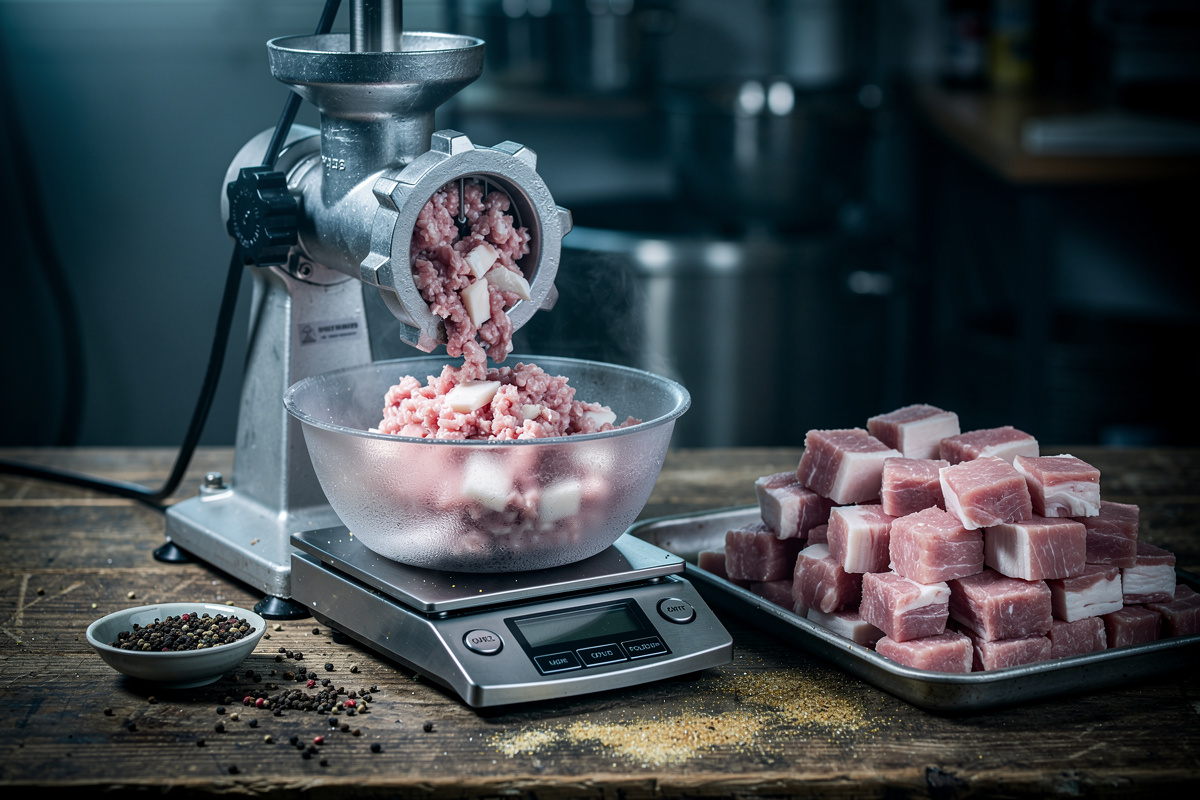

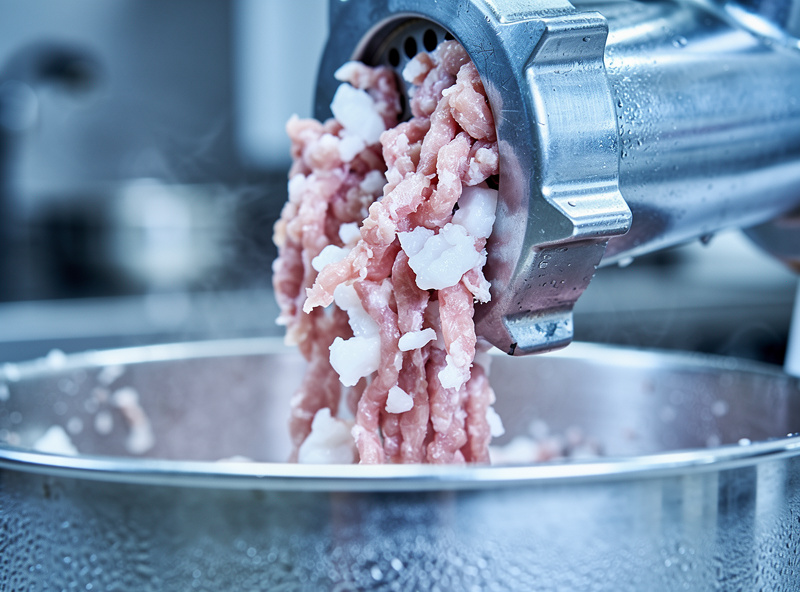
Grinding meat for salami comes down to three controls: keep everything near-frozen, match the plate size to the style, and build in 25-30% firm back fat. Cold meat and a sharp plate give clean, distinct flecks of fat and lean; warm meat or a dull blade smears the fat into a paste that blocks drying and ruins the cure.
The grind is where a salami is won or lost before it ever hangs. A clean grind sets the texture you slice months later and, more importantly, controls fat smear — the single most common reason a home salami dries wrong. Smeared fat coats the lean particles in grease, the moisture cannot migrate out, and you get a sour, slow-drying, case-hardened mess. Get the temperature and the plate right and the rest of the build is straightforward.
This guide covers the grinding temperature I hold, how to pick a plate for the salami you want, the fat ratio and which fat to use, and the cold-chain discipline that stops smear. The full salami method is on the home salami making hub and the fermentation side is on the pH guide; this is the grind layer specifically.
Temperature Is Everything: Grind Near-Frozen
Grind salami meat when it is partially frozen — firm to a hard pinch, roughly -2 to 0°C, with crystals just forming at the edges. At that temperature the fat shatters cleanly through the plate instead of squishing, and you get distinct white flecks instead of a smeared emulsion. Warm fat (above about 4°C) deforms and smears, which is the texture you are trying to avoid.
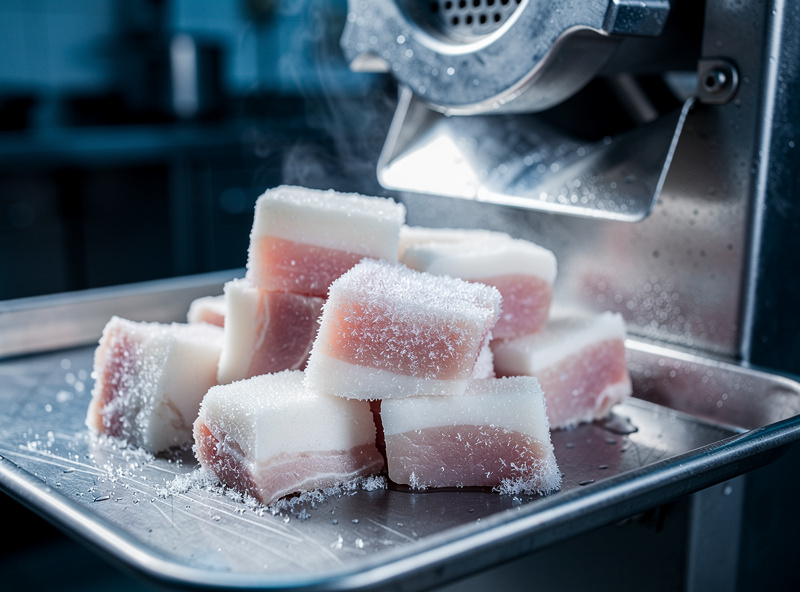
I cube the meat and fat, spread it on trays, and put it in the freezer for 45-90 minutes until the surfaces are stiff and the centres still yield slightly. I chill the grinder plates, knife, and auger in the freezer at the same time, because warm metal re-warms the meat as it passes through. The whole point is to keep the fat below the smear threshold for the entire trip from hopper to bowl. If I am grinding a big batch I work in stages, returning meat to the freezer between passes rather than letting a full tub sit out warming up. Cold is not a nicety here; it is the mechanism.
Plate Size: Matching the Grind to the Salami
Plate size sets the texture of the finished salami. A coarse 8-10mm plate gives the rustic, chunky cross-section of a soppressata or Genoa; a medium 6mm plate is a versatile all-rounder; a fine 4.5mm plate produces a tighter, more uniform paste used in finer-textured styles. Many classic salami use a double grind — fat coarse, lean fine, or a coarse first pass followed by a finer second.
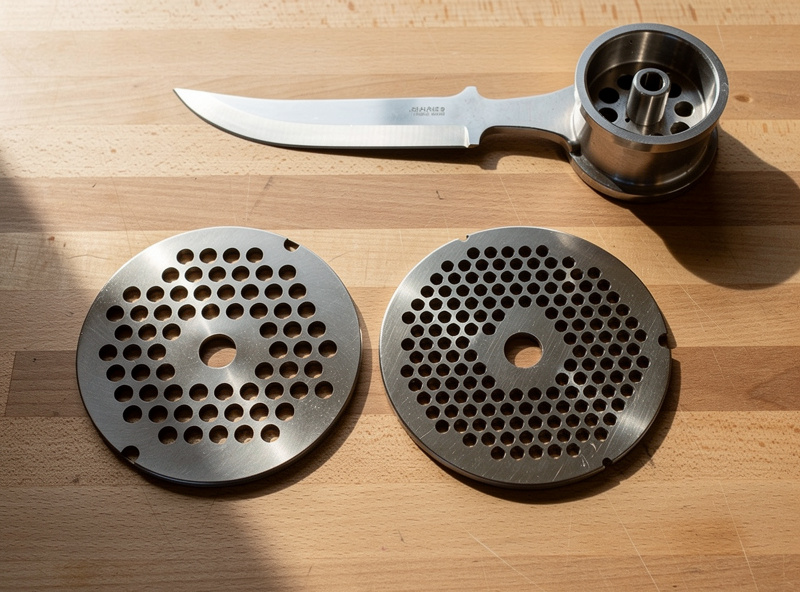
My default for a sliceable dry salami is a single coarse-to-medium grind that leaves visible fat definition, because that mosaic of white fat in red lean is both the look and the eating texture people want. For an emulsified or finer style I grind twice through a smaller plate. The one combination I avoid is forcing very cold, very firm meat through a tiny plate in one pass — that overworks the motor, heats the meat through friction, and ironically causes the smear the cold was meant to prevent. Match the plate to the meat’s firmness, and let coarser grinds do the heavy lifting first.
| Plate size | Grind texture | Typical styles | Notes |
|---|---|---|---|
| 10mm (coarse) | Chunky, rustic | Soppressata, coarse Genoa | Best fat definition; double-grind lean optional |
| 8mm (coarse-medium) | Defined flecks | Genoa, finocchiona | The all-round sliceable salami grind |
| 6mm (medium) | Even, moderate | Mixed-style salami | Versatile single-pass plate |
| 4.5mm (fine) | Tight, uniform | Finer-textured salami | Often a second pass after a coarse first |
| 3mm (very fine) | Paste-like | Emulsified / spreadable | Double grind; highest smear risk if warm |
The narrower the plate, the colder the meat has to be and the more smear punishes you, so I scale my freezer time to the plate. A coarse grind tolerates a slightly less-frozen state; a fine double grind demands the meat be properly stiff.
Fat Ratio and Type: 25-30% Firm Back Fat
Salami needs 25-30% fat by weight, and it should be firm pork back fat, not soft belly fat. Back fat is hard, holds its shape through the grind, and gives the clean white flecks that define a good slice. Soft fat smears more readily and goes greasy. Too little fat and the salami dries hard and crumbly; too much and it turns rancid faster and eats greasy.
I weigh the lean and the fat separately so the ratio is a number, not a guess: for a 1 kg batch that is roughly 700 g lean to 300 g back fat. Firm back fat is also the easiest to keep cold because it freezes harder than lean, so I sometimes grind the fat slightly colder than the lean, or partially freeze the fat harder than the meat, to guarantee it shatters cleanly. The fat is not filler — it carries flavour and aroma and keeps the finished salami from drying into jerky. Skimping on fat to make a “leaner” salami produces a worse, harder, less safe-drying product, not a healthier one.
Keeping the Cold Chain: How to Avoid Fat Smear
Fat smear is caused by warm fat, a dull plate/knife, or overworking the meat — usually all three together. The fix is cold meat, a sharp matched plate-and-knife set, and a grinder that is not struggling. A sharp knife sitting flush against a sharp plate cuts cleanly; a dull or mismatched pair tears and crushes the fat into grease.
I keep the grinder plate and knife as a matched, sharpened set and replace them when the cut goes ragged — a worn plate is a false economy that smears every batch. After grinding, the meat goes straight back cold for mixing with the salt, cure, dextrose, and rehydrated culture, kept below 4°C throughout so the fat stays firm right up to stuffing. If you ever see the grind coming out as a smeared, pinkish paste rather than distinct particles, stop, re-freeze, and check your blade — pushing on only bakes the problem into the batch. The downstream consequences of smear, and how to spot it in a finished salami, are covered on the curing chamber troubleshooting guide.
Mixing After the Grind: Building the Primary Bind
The grind is only half the texture; the mix is the other half. After grinding cold, mix the meat with the salt, cure, dextrose, and rehydrated culture until it turns tacky and the mass starts to cling to the side of the bowl and to itself. That stickiness is the salt-soluble protein (myosin) being drawn out of the lean — the “primary bind” that glues the particles into a cohesive salami rather than a crumbly one that falls apart when sliced.
The catch is that mixing generates friction and warmth, the enemy of the cold chain you just protected. So I mix only until the bind develops — usually a minute or two by hand or a short run in a stand mixer with the paddle — and I do it with the meat still near-freezing, sometimes setting the bowl in an ice bath. Under-mix and the salami crumbles; over-mix warm and you smear the fat at the finish line. The target is a cold, tacky mass with the fat flecks still distinct, ready to stuff straight away while everything is firm. Salt is what extracts the myosin, which is one more reason the salt, cure, and culture all go in at the mix and not before the grind.
Disclosure: CuringChamber is reader-supported. As an Amazon Associate I earn from qualifying purchases made through links in this article, at no extra cost to you. I only point to gear I actually use or would buy for my own chamber.
For grinding gear, the buys that actually matter are a decent electric meat grinder with the torque to handle cold meat, a grinder plate set in several hole sizes so you can match the grind to the style, and a set of stainless meat lugs to keep batches chilled through the workflow. Sharp matched plate-and-knife sets are the upgrade that pays for itself in clean grinds.
Frequently Asked Questions
How cold should meat be to grind for salami?
Grind meat partially frozen, roughly -2 to 0 degrees Celsius, firm to a hard pinch with crystals just forming at the edges. At that temperature fat shatters cleanly through the plate into distinct flecks instead of smearing into a greasy paste.
What plate size should I use to grind salami?
Use a coarse 8-10mm plate for rustic styles like soppressata and Genoa, a 6mm medium plate as an all-rounder, and a 4.5mm fine plate for tighter textures. Finer styles often use a double grind. Match plate size to meat firmness.
What fat ratio does salami need?
Salami needs 25-30 percent fat by weight, using firm pork back fat rather than soft belly fat. Too little fat dries hard and crumbly; too much goes greasy and rancid faster. For a 1kg batch that is about 700g lean to 300g back fat.
What causes fat smear in salami?
Fat smear is caused by warm fat, a dull or mismatched plate and knife, or overworking the meat, usually together. Smeared fat coats the lean and blocks moisture from leaving, causing slow drying and case-hardening. Keep meat near-frozen and the blade sharp.
Why use back fat instead of belly fat in salami?
Back fat is hard and holds its shape through the grind, giving clean white flecks and resisting smear. Soft belly fat deforms, smears more readily, and eats greasy. Firm back fat also freezes harder, so it shatters cleanly when partially frozen.
Should I grind salami meat twice?
Often, yes, for finer styles. A common approach is a coarse first pass for fat definition followed by a finer second pass for the lean, or grinding fat coarse and lean fine separately. Single coarse-to-medium grinds suit rustic sliceable salami.
Do I need to chill the grinder parts too?
Yes. Freeze the plates, knife, and auger along with the meat. Warm metal re-warms the meat as it passes through and triggers smear. Cold parts keep the fat below its smear threshold for the entire trip from hopper to bowl.