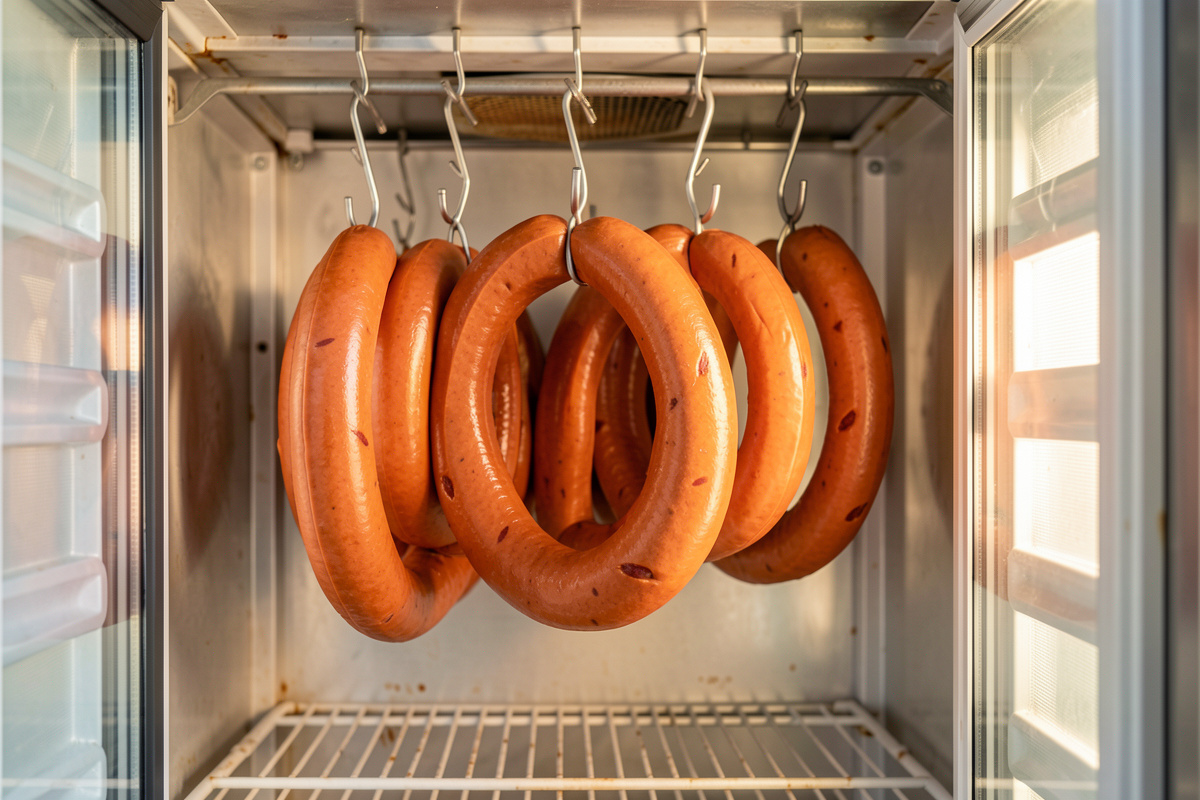

A cooked sausage is a forcemeat that’s been bound into a stable emulsion and then heat-set — poached, steamed, or smoked and then poached — to an internal temperature of at least 152 °F (66.7 °C), the threshold USDA FSIS treats as the Salmonella lethality standard for cooked, ready-to-eat meat. The craft is the bind, the temperature discipline, and the cure decision — everything else is seasoning.
I came to cooked sausage sideways, from dry-cured whole muscle and fermented salami. Those taught me patience and the weight log; cooked sausages taught me the opposite lesson — that heat and a stopwatch decide the result, and that you can ruin a perfect emulsion in the ninety seconds it takes a poaching pot to boil over. This guide is the chamber-side method I actually use for franks, bologna, bratwurst and weisswurst: the emulsion theory, the cure calls, the temperatures that matter, and the failures I have personally walked back off the edge of.
If you only take three numbers from this page, take these: hold your meat and fat at 40 °F (4 °C) or colder through the grind and the bind, never let the finished emulsion climb above 60 °F (15.6 °C), and poach to an internal of 152 °F minimum (I take franks to 155 °F / 68 °C). Get those right and the texture almost cannot fail you.
What Is a Cooked Sausage — and How Is It Different From Fresh or Dry-Cured?
A cooked sausage is any sausage whose doneness comes from heat applied after stuffing, not from fermentation or slow drying. Fresh sausage (the bratwurst you grill the same day) and dry-cured sausage (the salami that loses 35% of its weight over six weeks) sit on either side of it. A cooked sausage is the middle category: emulsified or coarsely ground, stuffed into a casing, and killed by cooking to a verified internal temperature so it is safe to eat fully cooked — hot dogs, bologna, weisswurst, knackwurst, and most of the smooth-textured sausages in a deli case.
The defining difference is not the grind. You can grind a frankfurter coarse or fine. The defining difference is that the bind has been heat-set. In a fresh sausage, salt-solubilised protein holds the meat together while it’s raw, and you cook it moments before eating. In a dry-cured sausage, salt and a pH drop and water loss hold it together over weeks. In a cooked sausage, you build the same protein bind, lock it in place with heat, and the sausage keeps that texture cold or reheated. That is why a cold bologna slice still holds together — the cook already did the structural work.
That also tells you where the risks live. Fresh sausage has one job: don’t leave it warm. Dry-cured sausage has a different job: manage water activity for weeks. Cooked sausage’s job is sharper: build a bind that survives a 140-degree swing without splitting its casing or going greasy, and get it through the danger zone (40–140 °F / 4.4–60 °C) fast enough that nothing dangerous grows on the way through. The whole technique is engineered around that transit.
It also tells you what the finished product is, structurally: a cooked sausage is a heat-set gel. The protein cage I describe below traps water and fat together, and when you apply heat the proteins denature and lock into a solid network — exactly what happens to a custard or a pâté. That is why a properly made bologna slices cold and holds its shape, and why an over-cooked one goes mealy: you crossed the line from a tender gel to a dry, over-set one. Once you start thinking of the emulsion as a gel you are setting, the temperature targets stop feeling arbitrary.
How Does a Meat Emulsion Actually Work?
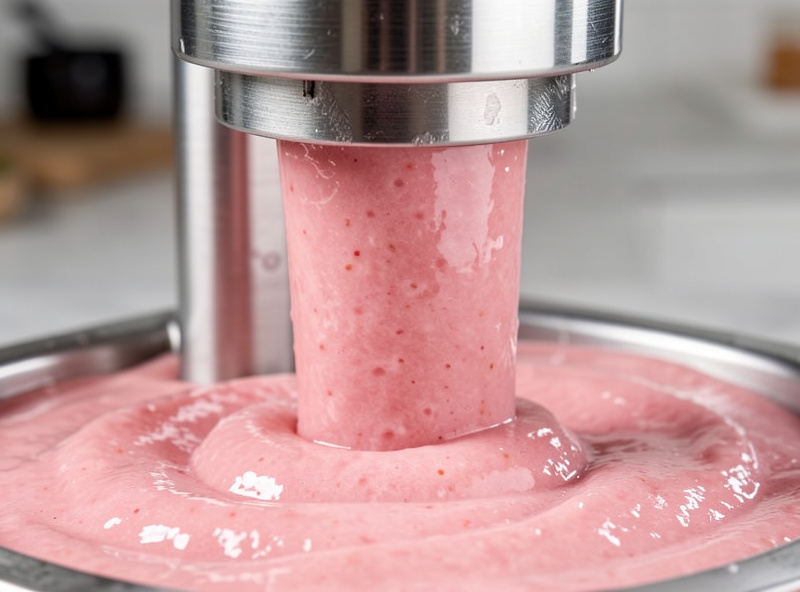
An emulsion sausage is a fat-in-protein matrix: salt-solubilised meat protein forms a film around thousands of tiny fat droplets, and ice-cold water is the bridge that lets lean protein and fat mix into one smooth paste. Get the temperature, the salt, and the order right and the fat stays trapped; let the paste warm past about 60 °F (15.6 °C) and the fat melts out of its protein cage and you have a greasy, broken batch. I have a whole guide to diagnosing and saving a broken meat emulsion — here is the short version of how a good one is built.
The salt is doing the real work, not the grinder. Salt at roughly 1.8–2.2% of meat weight dissolves the myosin out of the lean muscle, and myosin is the sticky protein that becomes the cage. That is why an emulsified sausage carries more salt than a fresh one tastes like it does — some of that salt is structural, locked into the bind, not floating free on your tongue. Under-salt and the cage never forms; you get a crumbly, weeping frank. This is the same reason salvaging under-salted charcuterie is so hard — salt is load-bearing.
The order is: lean and salt and ice first, fat last. You take your chilled lean meat (beef or pork trim, 90% lean or leaner), add the salt and Cure #1 if you’re using it, and grind or chop it cold until it turns glassy and sticky and starts climbing the blade. That is the primary bind. Only then do you add the colder-than-cold fat and the remaining ice water, and you cut just until the paste is smooth — never a second longer than it takes. The mistake that breaks more emulsions than any other is over-cutting warm fat, which I’ll come back to.
Temperature is the whole ballgame. I keep my grinder plates and blade in the freezer overnight, I cube the meat and fat and lay them on a sheet pan in the freezer until the edges are crunchy-stiff (about 30–40 minutes), and I never start the bind if the meat is above 40 °F. The finished emulsion should read 45–55 °F on a probe — if it’s climbing toward 60 °F I stop, because above that the fat smears instead of staying encapsulated, and a smeared emulsion gives you exactly the grainy, greasy mouthfeel people blame on the recipe.
Fat selection matters more than people credit, and it’s where a home batch quietly diverges from a deli product. You want firm, cold back-fat from the shoulder or the jowl, not soft belly fat or — worst of all — rendered-looking fat from near the kidney that’s already grainy. Firm back-fat holds its structure through the cut and traps cleanly inside the protein cage; soft fat smears on contact and leaks. I target roughly 25–30% fat by weight for an emulsified sausage, which is more than a fresh brat wants (20–25%) and less than a salami sometimes carries. Weigh the lean and the fat separately on a scale accurate to the gram — eyeballing “about a third fat” is the same error as eyeballing salt, and it produces the same variable result.
The water you add is not filler — it’s the second continuous phase of the gel. Added as crushed ice or ice water, usually 15–25% of meat weight, it dissolves the salt and myosin into a brine that can coat every fat droplet, and it buffers the temperature rise during cutting. Too little water and the paste is stiff and won’t stuff cleanly; too much and the finished sausage weeps and goes rubbery as the excess water stretches the protein network. This is why I weigh the ice water, not measure it in a cup — a cup of ice and a cup of water are not the same mass, and the difference shows up in the texture.
The crossover that made this click for me is fermentation chemistry. The pH drop that secures a salami is the same lactic-acid mechanism — but in a cooked sausage you don’t wait weeks for bacteria to acidify; you set the structure with heat in an hour. Different mechanism, same lesson: in charcuterie, something has to fix the structure, and it’s never just salt alone.
Do Cooked Sausages Need Cure #1?
Cure #1 belongs in any cooked sausage that spends time in the 40–140 °F danger zone before it’s cooked — which is nearly all of them once they’re smoked. The cure (6.25% sodium nitrite on a salt carrier) is what keeps Clostridium botulinum from producing toxin during a 3-hour, 130 °F smoke. A frankfurter you poach immediately and eat has a softer case for it; a frankfurter you smoke-warm for color and flavor before the poach absolutely needs it. The full decision tree is in my piece on when Cure #1 belongs in a cooked sausage, alongside the broader pink-salt and nitrate explainer.
The home measure I trust: one level teaspoon of Cure #1 per 5 lb of meat (about 4 oz per 100 lb), which lands near the 156 ppm ingoing nitrite that USDA allows in a comminuted product. That is the safe, standard rate — never exceed it, never substitute “natural, no-nitrate” celery juice as a free pass and pretend it’s chemically different, because the nitrite ends up in the meat either way. If you want the deep why on Prague Powder #1 versus #2, read my mixup guide — the short version is that cooked sausage wants #1 (nitrite only), because there is no long drying phase for nitrate to convert in.
What Internal Temperature Should I Cook a Sausage To?
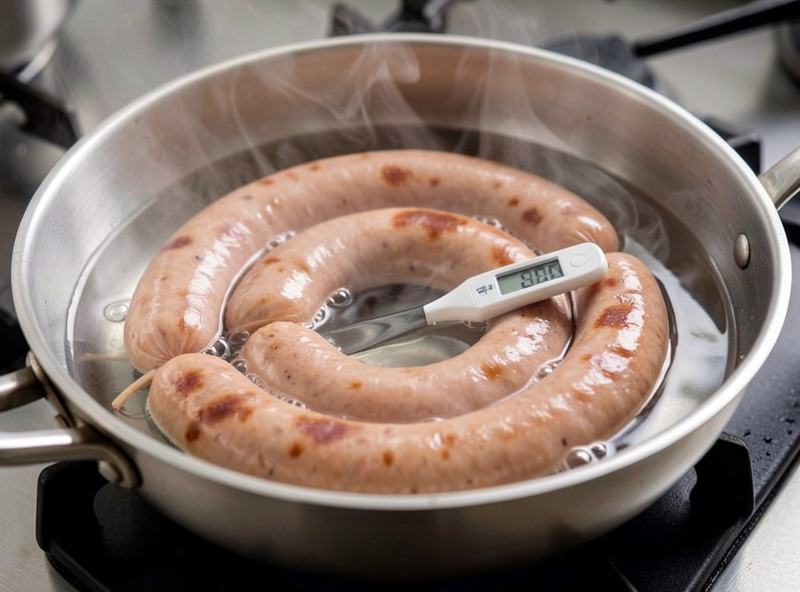
Poach or steam to an internal temperature of 152 °F (66.7 °C) minimum, held briefly, which is the FSIS lethality standard for cooked sausage; the USDA’s consumer-facing number is 160 °F (71 °C) if you want zero ambiguity at the dinner table. FSIS classifies these as cooked, ready-to-eat sausages and the regulatory temperature logic is built around that. I take franks and bologna to 155 °F because it gives me a couple of degrees of margin against a slow-reading probe and still leaves the texture tender. The poaching-water temperature that gets you there without splitting a casing is 170–180 °F (77–82 °C) — never a rolling boil.
The reason a boil splits casings is mechanical as much as thermal: water at 212 °F jostles the links, and steam pockets form under the casing faster than they can vent, so the casing ruptures along the weakest seam. At 175 °F the water is hot enough to cook the sausage through in 20–40 minutes (depending on diameter) but calm enough that the casing stays intact and the fat stays inside the bind. I cover the full method, including how I hold a steady poach without a sous-vide rig, in the poaching-temperature guide.
Two practical cautions that catch people. First, a 32 mm hog-casing frank and a 56 mm bologna reach target at very different times — go by internal probe, never by the clock. Second, pull the sausage the instant it hits temp and plunge it into cold water to stop the cook; a bologna left in hot water keeps climbing and the texture goes from silky to mealy. My charcuterie food-safety guide covers the danger-zone transit in more depth.
Why Do My Cooked Sausages Come Out Rubbery?
Rubbery, bouncy sausage is over-bound — too much protein extracted, too much salt pulling myosin out, or too much added water whipped in, so the final texture reads more like a rubber ball than a tender bite. The fix is almost never “add more fat”; it’s to cut the mixing shorter, back the salt down toward 1.8%, and stop adding ice water the moment the paste holds a peak. A crumbly, loose sausage is the opposite failure — under-bound — and the two are easy to misdiagnose. I walk through both in the rubbery-texture fix guide.
The single most common cause I see in home batches is over-mixing in the stand mixer with a paddle, on the theory that “more mixing means better bind.” It does not. Once the lean has gone glassy and sticky, the bind is formed; every additional minute is just extracting more protein and tightening the final texture until it bounces. The same logic applies to grinding — I run meat through the grinder once per plate, never twice on the same plate, because a second pass warms and over-shears the fat.
Salt and water compound it. Push salt past about 2.5% and the sausage reads tough and salty simultaneously; push added water past about 20% of meat weight and you’ve built a protein sponge that snaps back. The recipes that say “add a cup of ice water” without weighing it are the recipes that produce rubbery sausage, because nobody’s 5 lb batch is the same as the recipe author’s 5 lb batch once the water is uncontrolled.
Hot Dogs, Bologna, Weisswurst, Bratwurst — What’s the Difference?
These four are the gateway cooked sausages, and they sort cleanly by grind, meat, casing, and cook method. The table below is the cheat-sheet I wish someone had handed me before my first frank batch, when I conflated a fine emulsion with a coarse brat and ended up with something that was neither.
| Style | Grind / Texture | Typical Meat | Casing | Cook Method | Cure #1? | Target Internal |
|---|---|---|---|---|---|---|
| Frankfurter / Hot Dog | Fine emulsion | Beef + pork | Sheep or collagen | Smoke-warm then steam / poach | Yes | 152–155 °F |
| Bologna (ring or loaf) | Fine emulsion | Beef + pork, or all-beef | Beef bung / rounds, or none (loaf) | Smoke then steam | Yes | 155 °F |
| Weisswurst | Fine emulsion, with parsley | Veal + pork | Hog | Poach (no smoke) | Optional | 155 °F |
| Bratwurst | Medium to coarse | Pork (sometimes veal) | Hog | Poach then grill, or grill raw | No (fresh) | 160 °F |
| Knackwurst | Coarse emulsion | Beef + pork | Sheep or small hog | Smoke then poach | Yes | 155 °F |
| Fresh Italian / breakfast | Medium | Pork | Hog | Grill / pan-fry raw | No (fresh) | 160 °F |
Notice that “fresh” styles — bratwurst done raw, fresh Italian — carry no Cure #1 because they go straight from fridge to grill and never linger in the danger zone for a smoke. The emulsified, smoked styles do. If you want the side-by-side on the two German classics, my bratwurst versus weisswurst breakdown goes deeper than this table, including why weisswurst is traditionally poached rather than smoked.
The Cooked-Sausage Workflow From Raw to Finished Link
The full cooked-sausage sequence has seven stages, and each one has a single failure mode worth memorising. Here is the workflow I run, with the gotcha at each step.
1. Cube and chill. Cut lean and fat into 3/4-inch cubes, keep them on separate trays, and freeze-edge both for 30–40 minutes. The failure: skipping the chill and starting warm, which you can never recover from downstream.
2. Weigh salt and cure by gram. Salt at 1.8–2.2% of total meat+fat weight; Cure #1 at one level teaspoon per 5 lb if the sausage will be smoked. The failure: volumetric salt, which is how every over-salted batch I’ve ever eaten got that way.
3. Build the primary bind. Lean + salt + cure, chopped or ground cold until glassy and sticky. The failure: adding fat too early, so the fat gets coated in intact-muscle tissue instead of solubilised protein and the cage never forms.
4. Add fat and ice water; cut to a smooth paste. Fat goes in colder than the lean; cut just until smooth. The failure: over-cutting, which warms the paste past 60 °F and smears the fat — see the fat-smear discussion, the exact same defect in a different product.
5. Stuff and link under the casing’s tension. Stuff firmly but not bursting; twist links. The failure: loose stuffing, which leaves air pockets that fill with water and burst on the poach.
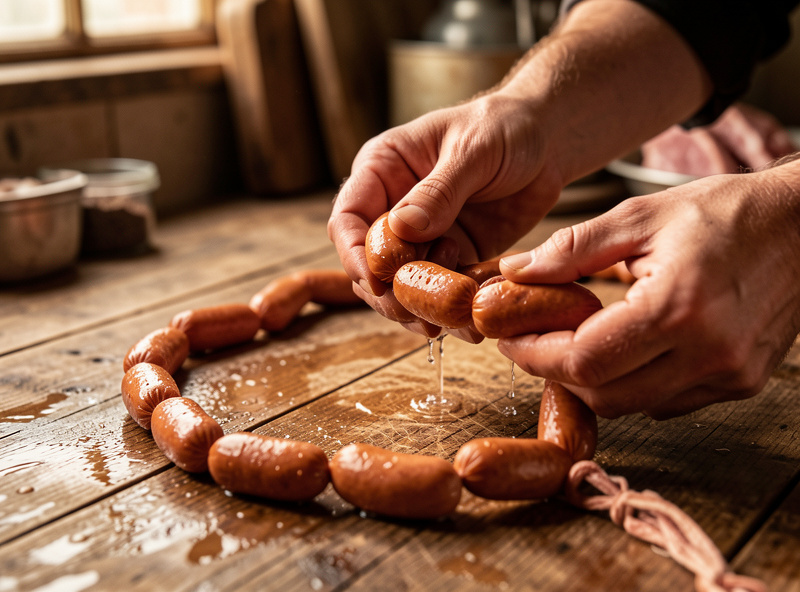
6. Smoke (if applicable). Cold- or warm-smoke at 110–140 °F for 2–4 hours with Cure #1 already in the meat — never smoke without it. The failure: smoking uncured sausage in the danger zone, which is the botulism window. (My cold-smoking guide and the wood-pairing guide cover the smoke step; the hot-smoking temperature reference is useful too.)
7. Poach or steam to internal, then shock cold. 170–180 °F water to 152–155 °F internal, then an ice bath to stop the cook. The failure: skipping the ice bath, so residual heat carries the sausage another 5–8 °F and the texture goes mealy.
This last step is where I slow down and pay attention, because it’s the moment you can read the result with your senses before any thermometer confirms it. A poaching frank that’s behaving right sinks, drifts up as it plumps, and the casing takes on a faint sheen; the water stays glassy-calm with only a thread of steam. When a link is in trouble you see it first — the casing blisters, or a greasy film blooms across the water, or the link floats early and rides high, which means the fat is already separating out and rising. I keep a slotted spoon and the probe in one hand and the ice bath next to the pot, and the moment the thickest link reads 155 °F everything comes out. The smell tells you the rest: a clean, warm-meat and faintly smoky aroma means the bind held; a flat, fatty, boiled-out smell means it didn’t, and that batch goes in the queue to be re-cut into a pasta sauce rather than sliced for a plate.
What Equipment Do You Actually Need?
You need a grinder, a way to stuff, a probe thermometer, and — if you want smoked styles — a smoke source. That’s the honest minimum. I run a #22 grinder with chilled plates and a separate 5 lb vertical stuffer (stuffing through the grinder auger is how people warm and over-work a batch), and the instant-read thermometer gets used more than the scale. If you’re shopping, a dedicated vertical stuffer and a fast instant-read thermometer are the two upgrades that change your results most; the grinder itself matters less than keeping its parts frozen.
The one piece of equipment that genuinely changes the texture ceiling is a bowl chopper (a commercial-style cutter that spins blades through a rotating bowl). It’s what gives franks and bologna their deli-smooth paste, and it’s the thing home setups most often substitute badly. I do not own one — most home charcuterie people don’t — so for fine emulsions I grind twice (first a 4.5 mm plate for the lean, then a 3 mm plate) and finish the bind in short, ice-cold pulses in a food processor, resting the workbowl on a bag of ice between bursts. It will never be quite as glassy as a true bowl-chopper batch, but it gets close enough that the difference only matters if you’re chasing commercial exactness.
For the climate around the work, the same chamber gear I use for dry-curing doubles up: an Inkbird ITC-308 holds my holding fridge at 38 °F, and a SensorPush HT.W on the shelf logs it so I can confirm the meat sat cold overnight before I started. You do not need a chamber to make cooked sausage — a fridge and a probe are enough — but the discipline of logging temperature is exactly what transfers. (The crossover I lean on: grinding meat for salami covers the plate-size and temperature rules that apply identically here.)
Casings are the one consumable people under-buy. Sheep casings for franks, hog casings for bratwurst and weisswurst, beef rounds or bung for bologna, and collagen as the no-soak fallback. My casing-types guide maps those out; collagen is fine for a cooked sausage in a way it isn’t always for a dry-cured one.
As an Amazon Associate I earn from qualifying purchases.
Common Cooked Sausage Mistakes — and How I Fix Them
The batch I remember most was my first emulsified frank: I had read that a food processor could replace a bowl chopper, so I ran the lean warm and then buzzed the fat in until the paste “looked right.” It looked like a smooth pink mayonnaise for about three minutes, then the fat melted out of suspension and I had a greasy puddle. That is a classic broken emulsion, and the lesson was simple — cold in, cold out, cut as little as possible. Every mistake below is one I have personally paid for.
The casing splits in the poach. The water was too hot (above 185 °F) or the sausage was over-stuffed. Drop the water to 175 °F and leave a little give in the casing.
The sausage is greasy on the tongue and there’s fat floating in the poach water. The emulsion broke — fat wasn’t encapsulated. Causes, in order of likelihood: starting too warm, over-cutting, or adding fat before the lean was solubilised. Next batch, chill harder and cut less.
The texture is bouncy and rubbery. Over-bound — too much mixing, too much salt, or too much water. Cut the mix shorter and weigh the water.
The sausage is crumbly and loose. Under-bound — not enough salt, lean wasn’t cut long enough to release myosin, or fat was too coarse. Grind finer and cut the lean longer before the fat goes in.
The color is grey-brown instead of pink. No cure, or cure omitted, or smoked without cure. If you smoked it without Cure #1, treat that as a safety question, not a color one — read the cure decision piece before eating it.
The pattern across all of them: cooked sausage punishes heat and time, not effort. The instinct to mix more, cut more, cook hotter and longer is the instinct that breaks it. Do less, colder, by weight and by thermometer, and the recipe mostly takes care of itself.
Where to Go Next From This Guide
This page is the hub for the cooked and emulsified family. If you have a specific sausage in mind, the spoke that matches it goes deeper than the summary above:
- How to make hot dogs at home — the emulsified frankfurter method, end to end.
- Fixing a broken meat emulsion — diagnose and rescue a batch that’s gone greasy.
- How to make bologna at home — fine-grind cooked sausage in a large casing or loaf.
- Bratwurst versus weisswurst — the two German classics, side by side.
- Poaching temperature for cooked sausage — hitting internal without splitting.
- Do cooked sausages need Cure #1? — when pink salt belongs in the bind.
- Why are my sausages rubbery? — fixing overworked, over-bound texture.
And if you’re coming at this from a different entry point — fresh sausage, the general homemade-sausage guide, or the whole-muscle side of the hobby — the techniques there share the same cold-and-by-weight backbone you just read. Cooked sausage is just the version where heat finishes what salt started.
Do cooked sausages need Cure #1?
Cure #1 belongs in any cooked sausage that is smoked or held in the 40 to 140 Fahrenheit danger zone before cooking, because the nitrite prevents botulinum toxin during a warm smoke. A frankfurter poached immediately and eaten has a softer case for it. Use one level teaspoon per 5 pounds of meat, never more.
What internal temperature is a cooked sausage done?
Poach or steam to a minimum internal of 152 Fahrenheit (66.7 Celsius), the FSIS lethality standard for cooked sausage. The USDA consumer guidance is 160 Fahrenheit (71 Celsius) for zero ambiguity. I take franks and bologna to 155 Fahrenheit for margin.
Why did my emulsion sausage turn out greasy?
The emulsion broke because the meat or fat got too warm during cutting, the fat was cut too long, or the fat was added before the lean was fully solubilised. Keep everything under 40 Fahrenheit going in and never let the finished paste exceed 60 Fahrenheit.
Can I use a food processor instead of a bowl chopper?
Yes, for small home batches, but only if the meat and fat are frozen-edged and you pulse briefly. A food processor warms the paste fast, so work in short bursts, rest the bowl on ice, and stop the instant the paste is smooth.
Do I need to smoke a cooked sausage?
No. Weisswurst and many bolognas are poached without smoke. Smoking adds color and flavor and is traditional for franks and knackwurst, but it also puts the sausage in the danger zone, which is exactly why those styles require Cure #1.
Why are my homemade sausages rubbery?
Rubbery texture is over-binding: too much mixing, salt above about 2.5 percent, or too much added water. Stop mixing the moment the lean turns glassy and sticky, weigh the water, and keep salt near 1.8 to 2 percent of meat weight.