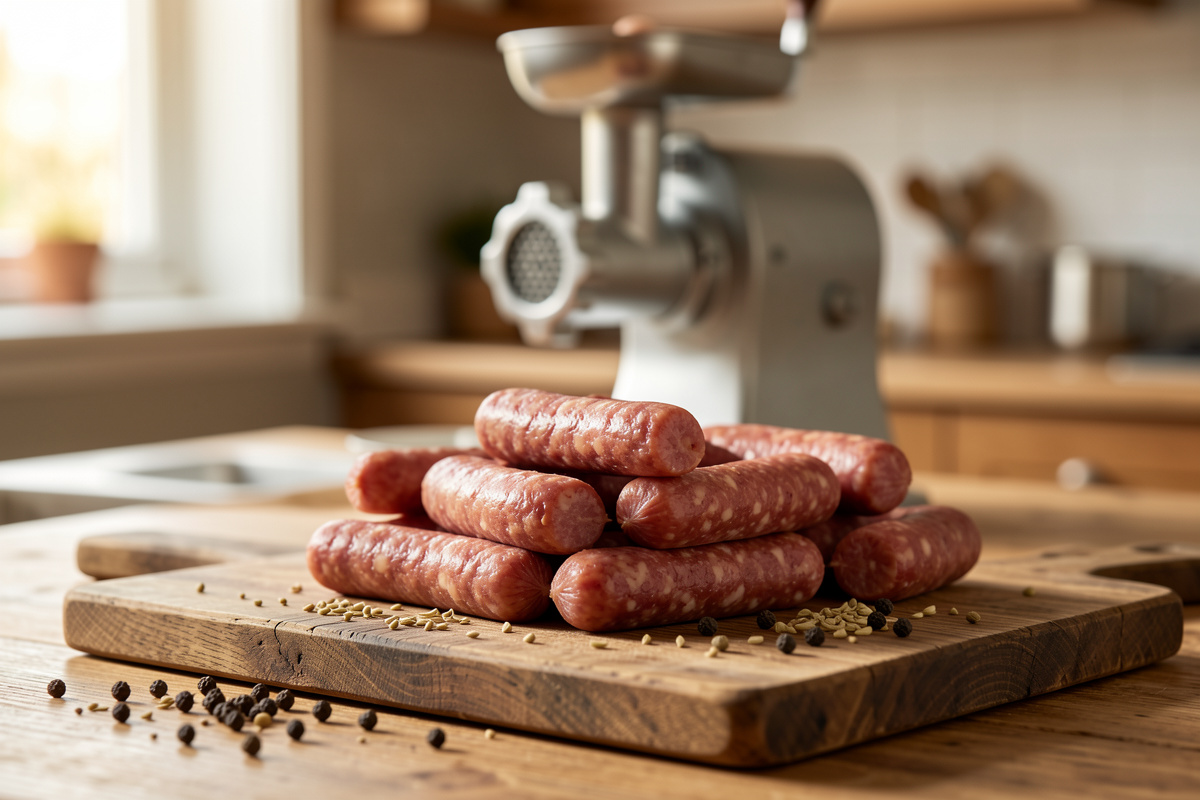

Homemade sausage is the fastest payoff in this entire hobby: grind good pork, salt it right, push it into a casing, and you eat it the same week. A fresh sausage is simply seasoned ground meat at roughly 70% lean to 30% fat, salted at 1.5–2% and cooked to 71 °C (160 °F) before eating — no curing salt, no chamber, no three-month wait.
I say that as someone whose other obsession is the slow end of this craft. I run converted-fridge curing chambers in Sweden and log the weight loss on every coppa and salami I hang. Fresh sausage is the opposite discipline: instead of patience and humidity, it rewards cold meat, the right salt percentage, and a clean bind. This guide is the map for the fresh-and-cooked side — the grinder, the stuffer, the casings, and the two recipes worth learning first — with each step linked out to its own deep dive.
Fresh Sausage vs Cured Sausage: Know Which You Are Making
The single most important decision happens before you touch a grinder: are you making a fresh sausage you will cook and eat, or a fermented dry sausage you will hang and age? Fresh sausage is cooked to temperature and treated like any ground meat. Fermented salami is preserved by acid, salt, water loss, and curing salt — a completely different safety model.
This guide covers only the fresh and cooked-then-smoked side. Anything you intend to hang and dry — soppressata, Genoa, finocchiona — belongs to the fermented world and needs Cure #2, a starter culture, and a controlled drop in pH. If that is your goal, start with my complete guide to home salami making instead; everything below assumes you are cooking the result, not ageing it.
The reason this line matters is botulism and the danger zone between 4 °C and 60 °C. A fresh sausage spends almost no time there because you cook it promptly. A fermented sausage spends weeks there, which is precisely why it needs nitrate, a fast pH drop, and weight-loss verification. Mixing up the two rulebooks is the one mistake in sausage making that actually hurts people.
The Three Tools That Define Sausage Making
You need exactly three pieces of hardware to make sausage at home: a grinder, a stuffer, and casings. A stand-mixer attachment can stand in for the first two when you start, but a dedicated stuffer changes the experience more than any other single upgrade — it turns a two-person wrestling match into a calm one-person job.
I learned the order of priority the hard way. The grinder you can compromise on early; a decent one costs little and the plates do most of the work. The stuffer is where cheap hurts: a grinder-mounted stuffing horn smears fat and traps air, while a vertical piston stuffer fills casings cleanly at the pace you choose. If you only upgrade one thing in your first year, make it the stuffer.
For the full reasoning on each, I have written dedicated guides: choosing a meat grinder for sausage making, the sausage stuffer guide and technique, and the sausage casing guide covering natural versus collagen. The sections below give you the working summary of each.
| Sausage Type | Curing Salt | Process | Storage / Doneness | Beginner Difficulty |
|---|---|---|---|---|
| Fresh (breakfast, Italian, bratwurst) | None | Grind, season, stuff, cook | Cook to 71 °C; fridge 2–3 days or freeze | Easy |
| Fresh, then hot-smoked & cooked | Cure #1 (optional, if smoked low/slow) | Grind, season, stuff, hot-smoke to temp | Cook to 71 °C; fridge 1 week | Moderate |
| Emulsified (hot dog, weisswurst) | Cure #1 (for pink colour/safety) | Grind fine, emulsify cold, poach | Poach to 68–71 °C; fridge 1 week | Moderate |
| Fermented dry (salami) | Cure #2 (required) | Ferment, then dry in chamber | ~35% weight loss; shelf-stable | Advanced |
Meat and Fat: The 70/30 Rule
Fresh sausage lives or dies on its fat ratio. Aim for about 30% fat to 70% lean by weight — roughly a 75/25 to 70/30 window. Below 20% fat the sausage cooks dry and crumbly; above 35% it weeps grease and the texture turns greasy-soft. Pork shoulder (Boston butt) sits naturally near 75/25, which is why it is the default sausage meat worldwide.
The fermenter in me thinks of fat as a structural ingredient, not a flavour bonus. In a fresh sausage the fat lubricates the bite and carries the spice; in a dried salami the fat has to stay distinct and not smear. Either way, the rule is the same: keep it cold. Warm fat smears into a paste that coats the lean and blocks the protein bind, and you taste it as a greasy, pasty mouthfeel. Pork back fat and shoulder fat both work; I prefer shoulder fat for fresh sausage because it carries more flavour.
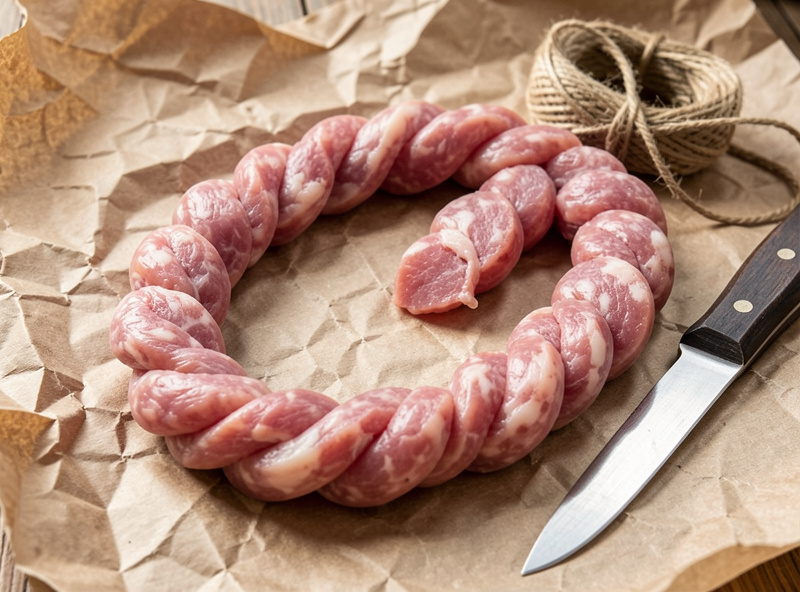
If you are working with very lean game or trim — venison, wild boar, lean beef — you must add fat back. I cut leaner mixes with pork back fat to reach roughly 25–30%, weighing it rather than guessing, the same discipline I bring to every cure.
Salt and Seasoning: The Numbers That Matter
Salt for fresh sausage runs 1.5–2.0% of the total meat weight — 15 to 20 grams per kilogram. That is the band where the sausage tastes seasoned, holds together, and stays safe in the fridge for its short life. I land most fresh batches at 1.7% (17 g/kg), which reads as well-seasoned without crossing into salty.
Use non-iodized salt — kosher or fine sea salt. Iodine carries a faint metallic note and, more importantly, it is a habit worth keeping because iodized salt actively interferes with the bacterial ferment if you ever cross over to salami. Weigh the salt; never measure it by volume, because flake size makes a teaspoon of one salt weigh nearly double another.
Salt does more than season. Dissolved in the cold meat it pulls out myosin, the sticky protein that binds the sausage into one cohesive mass rather than loose crumbles. This is the “primary bind,” and it is why salted, well-mixed sausage holds a slice while under-salted sausage falls apart. Spices — pepper, fennel, sage, paprika — are flavour only; the salt is doing the structural work.
Grinding: Cold Is the Whole Game
Grinding is where most home sausage goes wrong, and the cause is almost always temperature. Meat and fat should be near-frozen — 0 to 2 °C, with firm edges — when they hit the grinder. Cold meat shears cleanly through the plate; warm meat tears and smears, releasing fat that pastes the grind and ruins the texture.
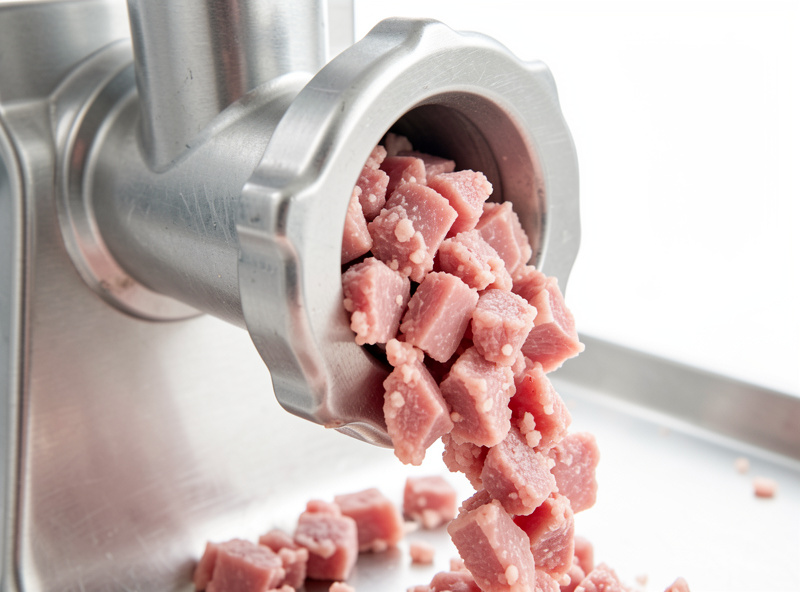
I cut the meat into strips, spread them on a tray, and put them in the freezer for 30–45 minutes until the surfaces are crusting with ice but the centres are still flexible. The grinder plates and auger go in the freezer too. A coarse plate (8–10 mm) suits most fresh sausage; for a finer breakfast texture, grind once coarse and once through a 4.5 mm plate. The full breakdown of plate sizes and temperature discipline lives in my meat grinder guide, and the parallel for salami is covered in grinding meat for salami.
If the grind starts looking smeary or the fat goes pale and greasy mid-batch, stop. Put everything — meat, grinder parts, the lot — back in the freezer for 20 minutes. A smeared grind cannot be rescued by mixing; you simply taste the smear in the finished sausage.
Mixing and the Bind Test
After grinding, add your salt and seasoning and mix until the meat turns visibly tacky and sticky — about 1 to 3 minutes by hand or 60–90 seconds on a stand mixer’s low speed. The mass should cling to your hand and pull away from the bowl in a sheet. That stickiness is extracted myosin, and it is what holds the sausage together.
The honest test, the one I trust, is the fry test: pinch off a small patty, cook it through, and taste it before you stuff a single link. This is your only chance to correct salt and spice. Too bland? Add salt in 0.2% steps and re-test. Too loose? Mix another minute. Keep the bulk meat in the fridge while the test patty cooks — warm meat between grinding and stuffing is the enemy.
Keep a little cold water on hand. Working 30–60 ml of ice water per kilogram into the mix helps the bind and makes stuffing smoother without making the sausage mushy. This is the same instinct I use weighing a cure: small, measured additions beat eyeballing.
Stuffing Into Casings
Stuffing is the step that separates a calm session from a frustrating one. A dedicated vertical stuffer presses the meat through the horn at a steady pace while you guide the casing — one person, full control. The grinder-as-stuffer method works but fights you: it re-grinds the meat, smears fat, and forces air into the links.
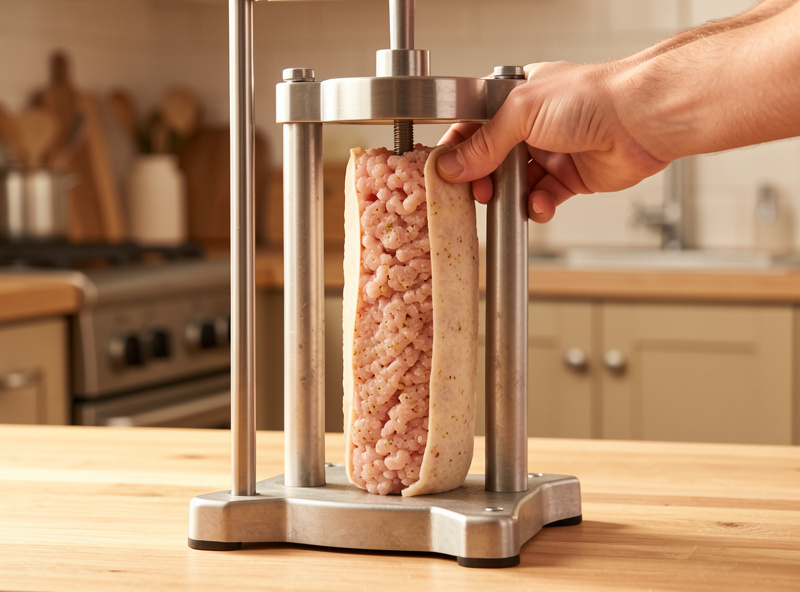
Soak natural casings in warm water, run water through them to find holes, and slide the whole length onto the horn before you start. Fill at a steady pace, support the emerging rope, and avoid overstuffing — a link packed drum-tight will burst when you twist it or split when it cooks. Twist into links in alternating directions every 12–15 cm so they do not unwind. The full technique, including how to clear air pockets and prevent blowouts, is in the sausage stuffer guide.
Casing choice shapes the result. Natural hog casings give the classic snap and breathe well; collagen casings are uniform, need no soaking, and suit straight cooking sausage. Which to pick, and why, is the whole subject of my casing guide on natural versus collagen, with the dry-cured equivalents covered in salami casing types.
Cooking, Smoking, and Food Safety
A fresh sausage is raw ground meat and must be treated as such: cook it to an internal 71 °C (160 °F) for pork and beef, or 74 °C (165 °F) for poultry, checked with an instant-read thermometer. Refrigerate uncooked fresh sausage no more than 2–3 days, or freeze it the day you make it. That is the entire safety model — no nitrite required, because the meat never lingers in the danger zone.
Curing salt enters the picture only when you cold- or low-temperature smoke, because then the meat sits warm for hours in the bacterial danger zone. For that, Cure #1 (6.25% sodium nitrite) is used at 2.5 g per kilogram of meat, delivering the standard ~156 ppm nitrite that suppresses Clostridium botulinum during the smoke. If you are simply grilling or pan-frying fresh sausage to temperature, you do not need it. The thermometer that lives in my chamber gets used here too — doneness is a number, not a guess.
If you want to add smoke flavour, my cold smoking guide explains when smoke is a finish on an already-safe product and when it becomes a safety step that demands curing salt. The short version: hot-smoking that takes the sausage to 71 °C cooks it; true cold smoking does not, and cold smoking raw fresh sausage without cure is a mistake.
Two Recipes Worth Learning First
The two fresh sausages I recommend starting with are breakfast sausage and Italian sausage, because between them they teach every fresh-sausage skill: the sage-and-pepper bulk style and the fennel-forward stuffed link. Master those two and you can adapt any fresh recipe.
Breakfast sausage can be made as loose bulk — no casing, no stuffer — which makes it the ideal first batch. My breakfast sausage recipe and method walks through the sage, thyme, and maple-or-not seasoning and the patty technique. When you are ready to stuff links, the Italian sausage recipe covers sweet versus hot, the fennel ratio, and how to twist a proper rope of links into hog casing.
Both recipes use the same backbone you have read here: 70/30 pork, 1.7% salt, cold grind, sticky bind, fry-test, stuff, cook to 71 °C. Once that backbone is second nature, sausage stops being a project and becomes a Sunday habit.
Troubleshooting Common Fresh-Sausage Faults
Most first-batch problems trace back to one of three causes: temperature, fat ratio, or bind. A greasy, pasty texture means the fat smeared during grinding — the meat was too warm. A dry, crumbly bite means too little fat or an under-mixed bind. Air pockets and grey patches inside cooked links mean the meat was overstuffed or not packed evenly. Each has a fix, and none requires starting over on the next batch.
Casing blowouts during cooking are the other classic complaint. They come from overstuffing, cooking too hot too fast, or twisting links too tight. Poach or grill fresh sausage gently — medium heat, turning often — and prick a stubborn air pocket with a fine pin rather than packing the casing drum-tight to begin with. A sausage cooked slowly to 71 °C stays juicy; one blasted over high heat splits and dries.
If the flavour is flat, the cause is almost always salt, not spice. Under-salted sausage tastes dull no matter how much pepper or fennel you add, because salt is what makes the other flavours read. This is why the fry test is non-negotiable: it is the one moment you can still fix the seasoning before committing the whole batch to casing. Adjust in small steps, re-test, and write down the percentage that worked so the next batch starts from data, not memory.
Where Fresh Sausage Meets the Chamber
There is a bridge between the two halves of this hobby. The pH drop that finishes a salami is the same lactic-acid chemistry that ferments a jar of sauerkraut — same bacteria family, different substrate — and the cold discipline that keeps a fresh-sausage grind clean is the same discipline that keeps a salami grind from smearing in the chamber. If a fresh batch ever tempts you toward hanging and drying it, stop and read the salami fermentation chemistry first; the fresh rulebook does not carry over.
Fresh sausage is the gateway. It teaches you the grinder, the stuffer, the casings, and the feel of a proper bind — every skill the chamber later demands — without asking you to wait three months or stake your safety on a number. Start here, get the backbone automatic, and the slow end of charcuterie will feel like the natural next step.
Frequently Asked Questions
Do I need curing salt to make fresh sausage?
No. Fresh sausage that you cook to 71 C and eat within a few days needs only regular non-iodized salt. Curing salt (Cure #1) is required only when you cold-smoke or low-temperature smoke the sausage, because then the meat sits in the bacterial danger zone for hours.
What is the best fat ratio for homemade sausage?
Aim for about 30% fat to 70% lean by weight, a 70/30 to 75/25 window. Below 20% fat the sausage cooks dry and crumbly; above 35% it weeps grease. Pork shoulder sits naturally near 75/25, which is why it is the standard sausage meat.
How much salt should I use in fresh sausage?
Use 1.5 to 2.0% of the meat weight, which is 15 to 20 grams per kilogram. Most fresh batches land well at 1.7% (17 g/kg). Always weigh the salt rather than measuring by volume, since flake size changes the weight of a spoonful dramatically.
Why does my homemade sausage turn out dry and crumbly?
Two usual causes: too little fat (under 20%) or a failed protein bind from under-mixing or warm meat. Keep the grind near-frozen, mix until the meat is visibly tacky, and hold the fat ratio near 30%. The fry test before stuffing catches both problems.
How long does fresh homemade sausage last?
Treat it like fresh ground meat: refrigerate uncooked fresh sausage for no more than 2 to 3 days, or freeze it the day you make it for up to about three months. Cooked sausage keeps three to four days in the fridge.
Can I make sausage without a stuffer?
Yes. Breakfast sausage works as loose bulk or patties with no casing at all, which makes it the ideal first batch. For links, a grinder stuffing horn works but smears fat and traps air; a dedicated vertical stuffer is the single best upgrade once you are committed.
Related Guides
- How to Make Fresh Sausage at Home
- Best Meat Grinder for Sausage Making
- Sausage Stuffer Guide and Technique
- Breakfast Sausage Recipe and Method
- Italian Sausage Recipe at Home
- Sausage Casing Guide: Natural vs Collagen