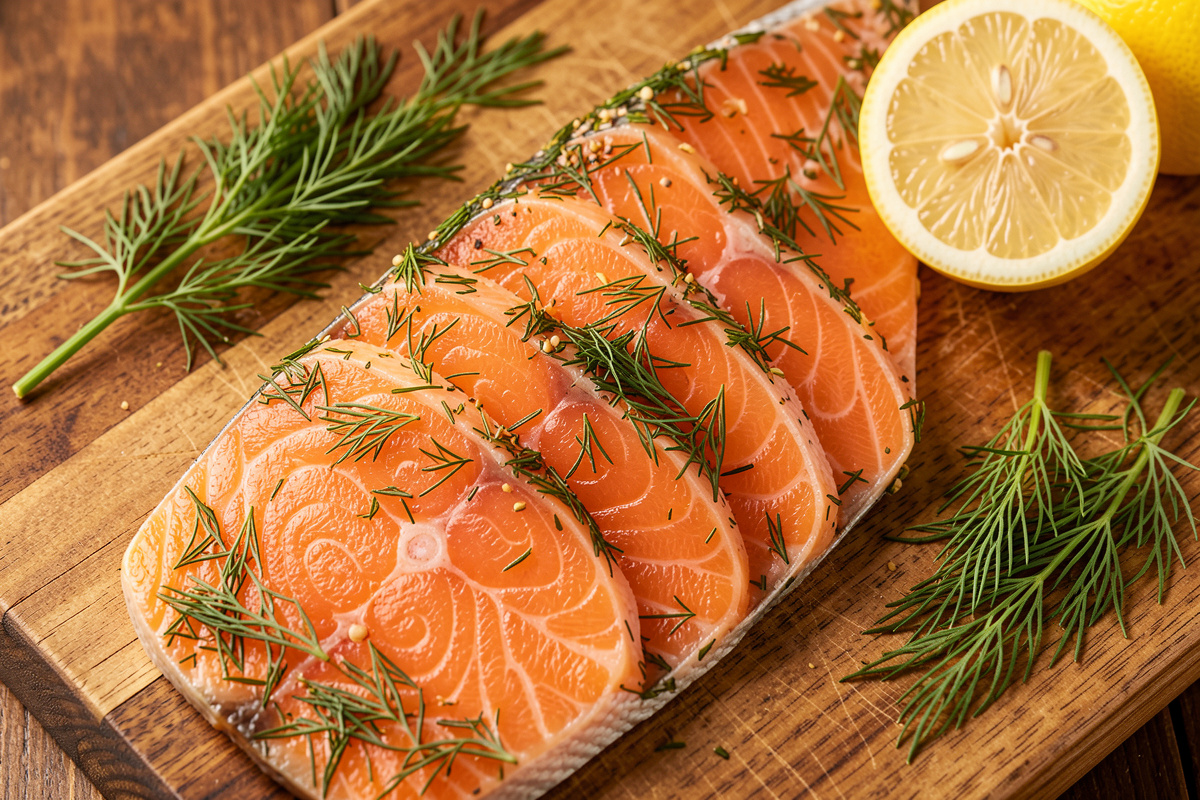

To make gravlax, you cure a fresh salmon fillet in a mix of salt, sugar, and dill for two to three days in the fridge, weighing the fish so the salt lands at about 3% of its weight. The fillet firms up, turns translucent, and loses roughly 8–12% of its weight — no heat, no smoke, just salt doing the work. It’s the single best first project in cured fish.
I make gravlax more than any other cured fish, because it delivers the same satisfaction as a three-month coppa on a three-day timeline. The chemistry is identical to what happens in my curing chamber — salt lowers water activity, the flesh firms, flavour concentrates — but on a fillet it happens fast enough to keep an impatient person interested. Here’s exactly how I do it, the ratios I trust, and the one step you can’t skip.
Freeze First: The Non-Negotiable Step
Before anything else: freeze your salmon before curing it if you’ll eat it raw. Gravlax is never cooked, so any parasites in the fish are still viable unless freezing has killed them. Salt firms the flesh and controls bacteria, but it does not reliably kill Anisakis worms. The FDA guideline is to freeze at −20 °C (−4 °F) for 7 days, or −35 °C (−31 °F) for about 15 hours.
Most home freezers hover around −18 °C, which is marginal, so I either buy fish already frozen to spec (much salmon is) or freeze my own for a full week to be safe. This one habit is the difference between a hobby you can be relaxed about and a genuine risk. I lay out the whole safety picture in is home-cured fish safe? — read it once and the freeze step becomes automatic.
The Equilibrium Cure: Ratios That Can’t Over-Salt
There are two ways to cure gravlax, and I use the equilibrium method because it’s nearly impossible to ruin. You weigh the trimmed fillet, then weigh out the cure as a percentage of that weight, and pack all of it onto the fish. Because the salt is limited to what you measured, the fillet reaches balance and simply stops getting saltier — leave it an extra half-day and nothing bad happens. This is the same precise-weight discipline behind equilibrium curing for whole muscle, just faster.
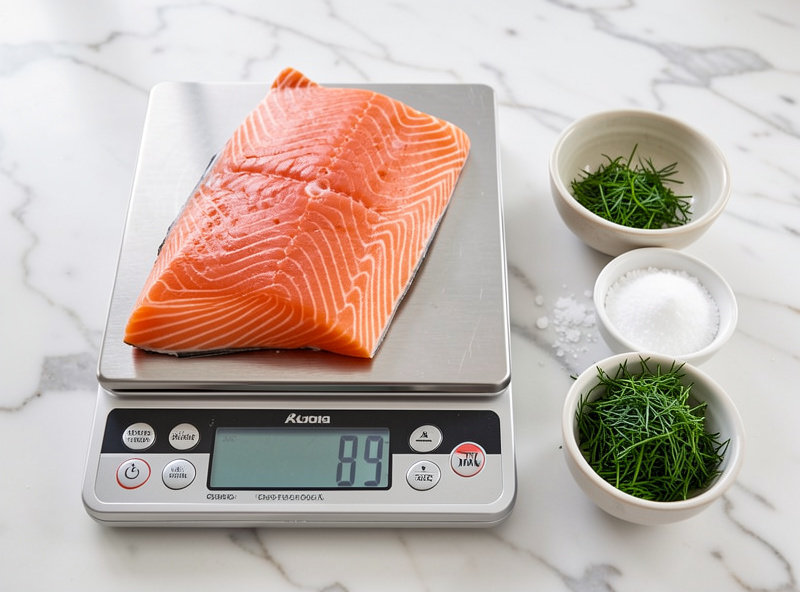
My standard cure per kilogram of fillet, weighed to the gram:
| Ingredient | Amount (per 1 kg fillet) | Purpose |
|---|---|---|
| Fine non-iodized salt | 30 g (3%) | The cure — draws water, firms flesh |
| Sugar | 25 g (2.5%) | Balances salt, softens texture |
| Fresh dill, chopped | 1 large bunch | Signature flavour |
| Coarse white pepper | 1 tsp, cracked | Aromatic warmth |
| Aquavit or vodka (optional) | 1 tbsp | Traditional Nordic note |
The salt grain size matters here: fine salt dissolves evenly into the flesh and weighs out precisely, which is exactly why I keep it separate from my coarse salt-box salt. If you want the full reasoning, it’s in best salt for curing fish. Never use iodized table salt — it throws a metallic edge and dulls the colour.
Step by Step: From Fillet to Slice
The method is simple, which is why the ratios matter so much. Start with a thawed, skin-on fillet, pin bones removed. Mix the salt and sugar. Lay a sheet of cling film in a dish, scatter a third of the cure and half the dill, set the fillet skin-side down, then pack the rest of the cure and dill over the top, pressing the pepper and any aquavit in as you go.
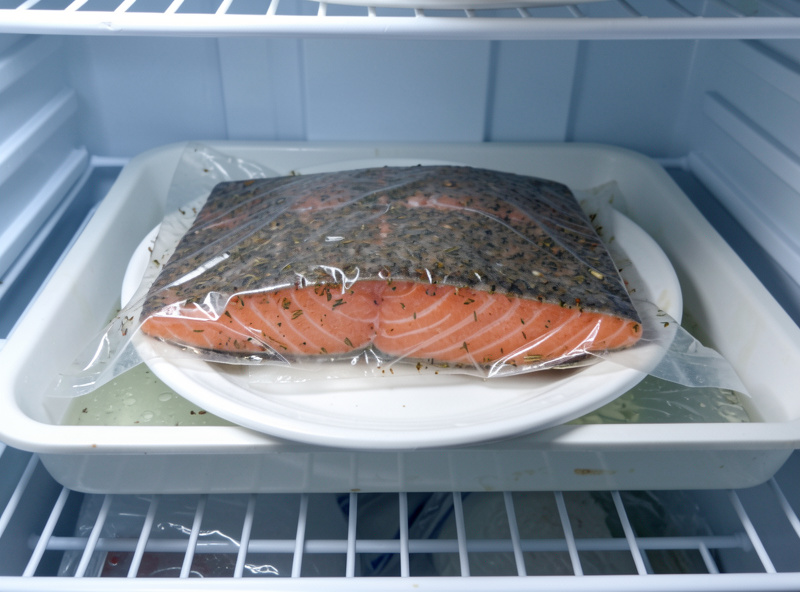
Wrap the fillet tightly in the film, set it in a tray to catch the liquid it will release, and put a light weight on top — a plate with a couple of tins works. Refrigerate at or below 4 °C. Every 12 hours, flip the parcel and pour off the accumulated brine; the fillet is releasing water, which is exactly what you want to see. After 48 hours for a thin fillet, up to 72 for a thick loin cut, unwrap, scrape off the dill and excess cure, pat dry, and slice thin on the bias, leaving the skin behind.
Weight Loss: How You Know It’s Done
I weigh the fillet before and after, the same reflex I apply to every piece in my chamber. A finished gravlax has lost roughly 8–12% of its starting weight — enough to firm the texture and concentrate flavour without drying it into something jerky. A fillet that’s lost only 4–5% needs more time; one past 15% is heading toward salty and stiff. The scale is more honest than the clock, because a thick loin and a thin tail piece cure at different speeds even under identical cure. This is the same principle I use to judge when whole-muscle charcuterie is done, and the same water-activity logic explained in water activity and food safety.
Gravlax vs Its Cousins
People constantly call gravlax “smoked salmon,” and it isn’t — gravlax never touches smoke. It’s a pure salt-sugar-dill cure, which is what keeps it soft, fresh-tasting, and quick. If you want the full comparison against lox and cold-smoked salmon, I broke it down in gravlax vs lox vs smoked salmon. And once it’s made, it doesn’t keep forever — see how long gravlax lasts and how to store it before you make a big batch. Gravlax is one branch of the wider unsmoked cure covered in my guide to curing fish at home.
One tool earns its place here: a digital scale that reads to the gram. Equilibrium curing is only as good as your measurement, and a cheap kitchen scale removes all the guesswork. A basic gram-accurate digital scale is the one bit of kit I’d insist on. As an Amazon Associate I earn from qualifying purchases.
Frequently Asked Questions
How long does gravlax take to cure?
Two to three days in the fridge. A thin fillet is ready in about 48 hours; a thick loin cut may need up to 72. The fish is done when it has lost roughly 8 to 12% of its starting weight and feels firm and translucent throughout.
Do I have to freeze salmon before making gravlax?
Yes, if you will eat it raw, which gravlax always is. Freezing at minus 20 C for 7 days kills parasites that salt does not reliably destroy. Buying fish already frozen to spec satisfies this. Skipping the freeze is the one real risk in home gravlax.
What is the ratio of salt to sugar for gravlax?
For an equilibrium cure, use about 3% salt and 2.5% sugar by weight of the fillet, so 30 g salt and 25 g sugar per kilogram. This balance firms the fish, seasons it, and cannot over-salt because the salt is limited to what you weighed out.
Can I make gravlax without sugar?
You can, but sugar does real work: it balances the salt and keeps the texture supple rather than hard. Cutting it entirely gives a firmer, saltier, more austere result. If you want less sweetness, reduce it to about 1.5% rather than removing it completely.
Why is my gravlax too salty?
Almost always because a salt-box cure was left too long, or too much cure was used. Switch to an equilibrium cure at 3% salt by weight, which self-limits and cannot over-salt. If a finished piece is too salty, a brief soak in cold water and a pat dry will pull some back.
Does gravlax need to be cooked?
No. Gravlax is a raw, cured product eaten as is, sliced thin. The salt cure and the pre-cure freeze make it safe to eat without heat. It should be kept refrigerated below 4 C throughout its life and eaten within about a week of curing.
Related Guides
- Curing Fish at Home: The Complete Salt-Cure Guide
- Gravlax vs Lox vs Smoked Salmon: What Actually Separates Them
- How Long Does Gravlax Last and How to Store It Properly
- Best Salt for Curing Fish: Coarse vs Fine and Why It Matters
- Is Home-Cured Fish Safe? Salt, Freezing, and the Parasite Rule