

Bacon is the cure I tell every beginner to start with, because it is forgiving in flavour and unforgiving in exactly the ways that teach you the craft. The honest answer to “how do I cure bacon?” is this: you apply a measured amount of salt and cure #1 (6.25% sodium nitrite) to a pork belly, hold it cold for roughly a week per inch of thickness, rinse, dry-form a pellicle, and then either fry it as-is or cold-smoke it under 30 °C. Do the salt maths by weight and bacon is one of the safest cures in the chamber. Guess at it, and it is one of the easiest to get wrong.
I have run pork belly through the chambers I keep in Sweden more times than any other cut, partly because bacon is the cure that pays you back fastest — you are eating it in two weeks, not waiting three months for a coppa. This guide is the map for the whole cluster: the two roads (dry-cure and wet-brine), the salt and nitrite numbers that actually keep you safe, how smoke fits in, and what to do when a belly goes sideways. Everything here is anchored to the way I weigh and log mine, and every safety number is the conservative one.
Bacon at a Glance: Two Methods, One Goal
There are two legitimate ways to cure a belly at home: a dry cure, where you rub a measured salt-and-cure mix directly onto the meat and let it draw moisture out over about a week; and a wet brine, where the belly sits submerged in a salt-and-cure solution. Both reach the same endpoint — a belly that has taken up enough salt and nitrite to be safe and to taste like bacon — but they get there with different textures, timelines, and failure modes. Dry-cured bacon is denser and more concentrated; wet-brined bacon is plumper and milder. Neither is “more authentic”; they are different tools.
The single decision that governs both is the same one that governs every cure in the chamber I run: weight. You weigh the belly, you weigh the salt and cure against it, and you weigh the finished piece to confirm what happened. The scale is the difference between bacon as a recipe and bacon as a controlled process. Once you treat it as a process, the romance falls away and the reliability shows up.
Choosing the Belly Before You Cure Anything
The bacon is made before the cure ever touches it — at the point you choose the belly. I look for a slab that is even in thickness across its length, because a belly that runs two inches at one end and three-quarters at the other cures unevenly no matter which method you use, leaving one end perfect and the other either bland or over-salted. A good meat-to-fat ratio for everyday bacon is roughly half and half by eye; leaner bellies make a chewier rasher, fattier ones render richer. I buy skin-off where I can, because the skin slows cure penetration and you only have to remove it later anyway.
Thickness drives your timeline directly: the working rule I use is about a week of cure per inch at the thickest point, which is why an even slab matters so much — it lets one timer cover the whole piece. Fresh is non-negotiable. The belly should smell clean and faintly sweet, feel firm rather than tacky, and have no grey edges. You are about to hold this meat at fridge temperature for a week or more, so it needs to start with a full shelf life ahead of it, not the last two days of one.
The Dry-Cure Road
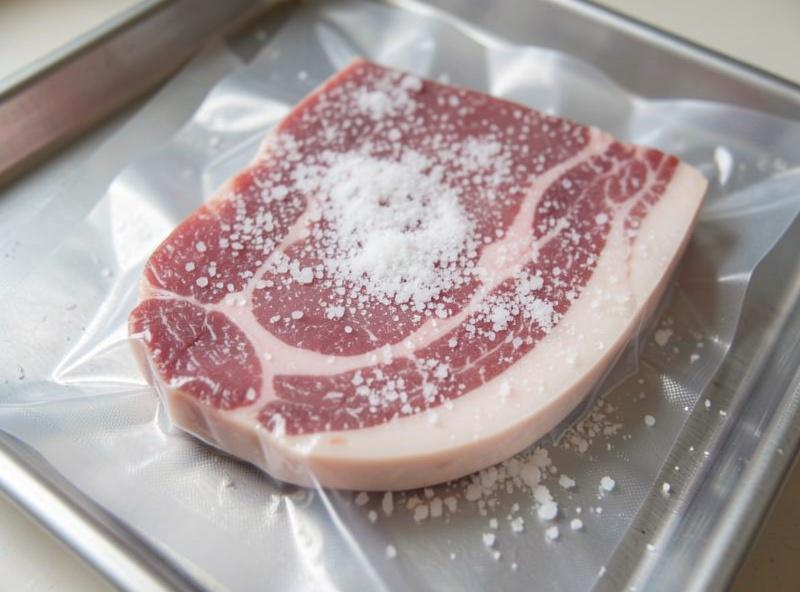
A dry cure is my default for belly bacon because it concentrates flavour and gives the cleanest control. You calculate salt as a percentage of the meat weight — I run 2.5% salt by weight as my standard, sometimes dropping to 2% for a milder result — and you add cure #1 at the rate the meat weight demands, then rub the whole lot onto the belly, bag it, and refrigerate. Every day or two you flip it and redistribute the liquid that pulls out. After about seven days the belly firms up noticeably; that firmness is the salt equalising through the muscle.
This is an equilibrium cure approach when you weigh the salt to a target percentage rather than burying the meat in a salt box. Equilibrium curing is more forgiving of timing — you cannot over-salt because the salt you added is all the salt there is — which is exactly why I steer beginners toward it. If you want the full arithmetic behind weighing salt to a percentage, I broke it down in how to calculate salt percentage for equilibrium curing, and the same logic underpins every dry-cured belly I hang. The deep dive lives in the dry-curing belly bacon guide.
The Wet-Brine Road
A wet brine dissolves salt, cure #1, and usually a little sugar into water, and the belly sits submerged for the cure to penetrate evenly. The headline advantage is uniformity: in a fully submerged brine every face of the belly sees the same concentration, which makes wet-brining the easier method for thick, irregular bellies that would cure unevenly under a rub. The headline cost is texture — wet-brined bacon carries more retained water, so it renders differently and can spit more in the pan unless you dry it properly first.
The safety arithmetic for a brine is a touch different because you are dosing the cure across the total weight of water plus meat for an immersion brine, not the meat alone. Getting that figure right is the whole game, and I walk through the immersion-cure nitrite calculation step by step in the wet-brining bacon guide. Done correctly, a brine is every bit as safe as a dry cure; done by eye, it is the easier of the two to underdose.
Two practical things decide whether a brine actually works as cleanly as the maths promises. First, keep the belly fully submerged — a piece that bobs up will cure on the wet face and oxidise grey on the dry one, so I weight mine down with a small plate or a zip bag of water until it sits under the surface the whole time. Second, hold the brine itself at fridge temperature for the same reason the dry cure needs cold: a warm brine is a culture broth, and you are trying to cure the belly, not incubate it. I make the brine, chill it fully before the meat ever goes in, and keep the container on the coldest shelf. The little sugar most brines carry — a percent or two by water weight — is there for flavour balance and a slightly softer cured colour, not for safety; the salt and the cure #1 do the safety work, and the sugar is the seasoning you can adjust to taste.
Dry Cure vs Wet Brine: How I Choose
I reach for a dry cure when I want concentrated flavour and a denser slice, and for a wet brine when I am curing a thick or awkwardly shaped belly and want guaranteed even penetration. The table below is the head-to-head I keep in my head when a fresh belly lands on the bench.
| Factor | Dry Cure | Wet Brine |
|---|---|---|
| Cure applied to | Meat weight only | Meat + water weight (immersion) |
| Typical salt target | 2–2.5% of meat weight | ~3.5–5% brine strength |
| Cure time (1-inch belly) | ~7 days | ~5–7 days, fully submerged |
| Texture | Denser, concentrated | Plumper, more retained water |
| Even penetration | Needs daily flipping | Naturally uniform |
| Fridge space | Bag, minimal | Container of liquid |
| Best for | Even, flat bellies; bold flavour | Thick/irregular bellies; mild result |
| Easiest mistake | Uneven rub coverage | Underdosing the cure across the water |
Cure #1, Salt, and the Numbers That Keep Bacon Safe
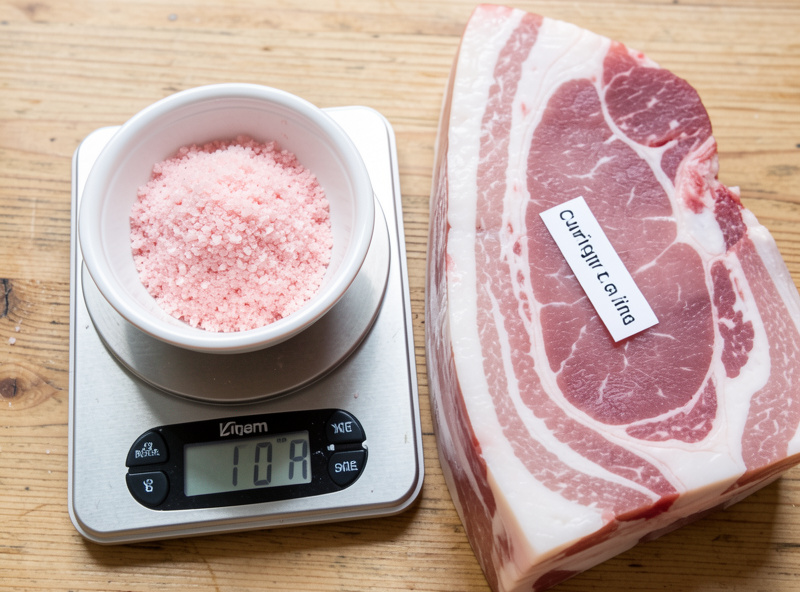
Bacon is cured with cure #1 — 6.25% sodium nitrite blended into salt, dyed pink so you never confuse it with table salt. Cure #1 is the correct curing salt for bacon because bacon is a short cure that gets cooked or cold-smoked and eaten relatively quickly; it does not need the slow-release nitrate of cure #2, which is reserved for long-dried whole muscle and fermented sausage. The standard, widely-cited dosing for cure #1 is 2.5 g per kilogram of meat (about 1 level teaspoon per 5 lb), which lands the finished product around 156 ppm ingoing nitrite — the conservative home-curing figure that sits at or below the regulatory ceiling commercial charcutiers work to.
That nitrite is not optional seasoning. It is what suppresses Clostridium botulinum during the days the belly spends in the danger window between fridge-cold and cooked, and it is what gives bacon its colour and tang. Never dry-cure or brine a belly without it, and never substitute a “natural, no-nitrate” celery-powder approach thinking it is nitrite-free — celery powder is a nitrite source, just an unmeasured one. The salt itself should be plain — never iodized — because the maths only works when the salt is salt. I keep the precise per-method ratios, conversions, and the immersion-vs-dry difference in one place in the bacon curing salt ratios guide, and the broader principle of weighing nitrite against meat carries straight over from the rest of the chamber’s whole-muscle work in the whole-muscle charcuterie guide.
After the Cure: Pellicle, Smoke, and Slicing
When the cure is complete — the belly is firm edge to centre — you rinse off the surface cure, pat it dry, and rest it uncovered in the fridge overnight to form a pellicle: a tacky, slightly glossy surface skin that smoke adheres to. Skipping the pellicle is the most common reason home-smoked bacon tastes harsh rather than sweet; smoke lands on a wet surface as acrid creosote and on a dry pellicle as clean flavour.
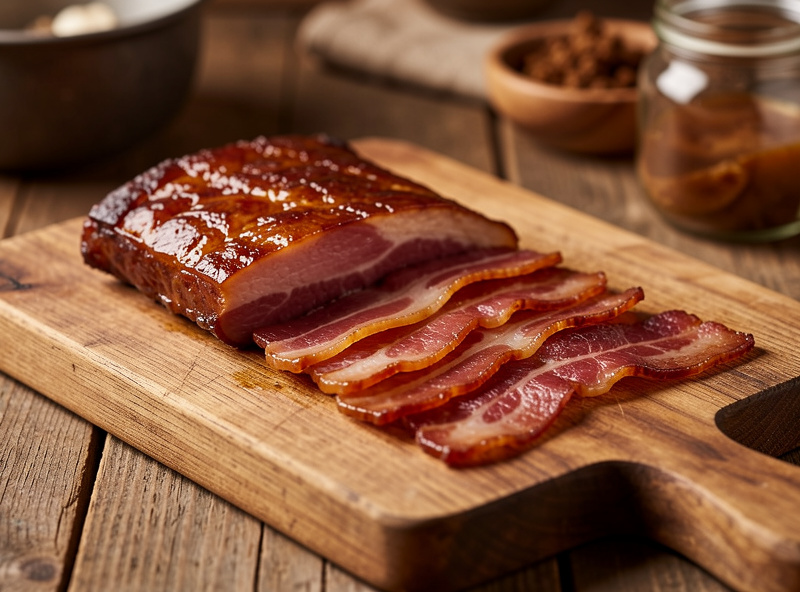
From there you have a choice. Unsmoked, this is green bacon — perfectly good fried straight away. Smoked, it becomes the bacon most people picture. The critical rule, the one I will not soften: bacon is cold-smoked, with the chamber held under about 30 °C / 86 °F so the smoke flavours without cooking, and the smoke is generated off-box and drifted in. Cold smoke is a flavour step layered on an already-cured, already-safe piece — it is never the thing that makes the bacon safe. The full method, wood choices, and how I keep a session cold live in the smoking cured bacon guide, and it sits inside everything I cover in the complete cold smoking guide.
Where Bacon Goes Wrong
Most bacon failures trace to one of four things: too little cure (underdosed salt or nitrite — a safety problem, not just a flavour one), an uneven cure (a rub that missed a face, leaving a soft under-salted patch), excessive saltiness (too long in too strong a brine), or harsh smoke (no pellicle, or smoke that ran too hot). Each has a specific fix, and most are preventable by weighing rather than eyeballing.
The texture problem people fear most — case hardening, where the surface dries into a hard shell that traps moisture inside — is less common with bacon than with long whole-muscle cures because bacon’s cure is short, but it can still bite you if you dry the pellicle too aggressively under a fan. I cover the chamber-side mechanics of that in case hardening in curing chambers. For the full diagnostic walk-through specific to bacon — slimy surface, off smell, too salty, won’t take smoke — work through diagnosing bacon curing problems. And the same climate discipline that governs every cure applies here: hold the envelope, and read the climate control guide if your fridge wanders.
Temperature, Time, and Why the Fridge Is Doing the Work
Every safe number on this page assumes one thing: the belly is held genuinely cold, in the 2–4 °C / 36–40 °F fridge band, for the whole cure. That is not a detail, it is the load-bearing condition. Cure #1 buys you safety against Clostridium botulinum, but it does that work while the salt and nitrite are still penetrating, and penetration is slow at fridge temperature. Let a belly drift up toward room temperature mid-cure and you have stacked an under-penetrated interior against a faster-growing bug — the exact situation the nitrite is there to prevent, now running a step behind.
In the chambers I run I log fridge temperature with a SensorPush HT.W sitting at shelf height, not because a curing bacon belly needs the tight 12–15 °C envelope a hanging coppa does — it does not, it just wants reliable fridge cold — but because a fridge that swings warm overnight is a fridge I want to know about before a week-long cure is sitting in it. The cheapest insurance in this whole hobby is a five-dollar Bluetooth logger that tells you your fridge actually holds the temperature its dial claims. Most do not, quite, and the ones that frost-cycle can swing several degrees on the door shelf.
Time works with temperature, not against it. The week-per-inch rule I keep coming back to is deliberately generous — a thin belly is fully cured before the seventh day, and leaving it an extra day or two in a weighed equilibrium cure does no harm because the salt cannot climb past what you weighed in. That forgiveness is the whole reason I start beginners on the dry equilibrium method: the timing window is wide, the only salt present is the salt you chose, and the cold fridge is doing the heavy lifting on safety while you get on with your week. Where people get burned is rushing — pulling a thick belly at day four because the surface firmed up, when the centre never saw enough cure. Trust the weight and the clock, not the squeeze test alone.
Storing and Keeping Your Bacon
Cured bacon is more stable than fresh pork belly because the salt and nitrite lower water activity and suppress spoilage organisms, but it is not shelf-stable like a long-dried salami — it still lives in the fridge. Sliced or whole, I keep finished bacon wrapped in the fridge and use it inside two to three weeks, the same window I would give any cured-but-not-dried product. Cold-smoking buys a little extra surface protection and a lot of flavour, but it does not turn bacon into a pantry item; treat smoke as flavour, not preservation.
For anything beyond a few weeks, freeze it. Bacon freezes superbly because the cure has already driven off some moisture and the salt depresses the freezing damage to texture; I portion mine into meal-sized stacks with parchment between rashers so I can peel off what I need. Frozen, it holds quality for a few months easily. The one habit I will not skip is labelling the cure date — when you are running several bellies through the chambers, the weight log and the date label are the only honest record of what is actually in the freezer.
Step One: How to Cure Your First Belly
If you have never done this, do not start with the brine maths or the smoker. Buy a flat slab of skinless pork belly, weigh it, dry-cure it at 2.5% salt with cure #1 at 2.5 g/kg, bag it, flip it daily for a week, rinse, dry, and fry a test slice. That single run teaches you more than any amount of reading, and it is genuinely hard to make unsafe if you weigh the cure. The complete beginner walk-through, with the exact sequence and timings, is how to cure bacon at home — that is the post I would hand a friend standing in my kitchen with their first belly.
As an Amazon Associate I earn from qualifying purchases. The one piece of kit I would not cure bacon without is a precise digital kitchen scale that reads to one gram — because every safe number on this page is a number you weigh, not estimate.
Frequently Asked Questions
More Bacon Cuts, Flavours & Finishing
Five spokes branch off into alternate cuts, flavours, and finishing:
- Buckboard Bacon — richer, cheaper bacon from pork shoulder instead of belly.
- Canadian Bacon — a leaner back-bacon cure from the loin.
- Flavored Bacon Cures — cure recipes beyond the basic dry cure.
- Bacon Without Nitrites — the ‘no-nitrite/uncured’ question, answered honestly.
- Slicing & Storing Bacon — cutting and keeping your finished slab.
Can I cure bacon without pink curing salt?
You should not dry-cure or brine a belly intended to be cold-smoked or held warm without cure number one. The nitrite in pink curing salt suppresses Clostridium botulinum during curing and gives bacon its colour and tang. Celery-powder so-called natural cures are still a nitrite source, just an unmeasured one. Plain uncured salt pork is a different product, eaten fresh and fully cooked, not held or smoked.
How long does it take to cure bacon?
A dry cure on a one-inch-thick belly takes about seven days in the fridge, flipped every day or two. A wet brine runs roughly five to seven days fully submerged. Thicker bellies need proportionally longer. Then add an overnight uncovered rest to form the pellicle before smoking. From fresh belly to sliced bacon is usually nine to ten days.
Do I have to smoke bacon?
No. Cured but unsmoked belly is green bacon and fries up perfectly well. Smoking is a flavour step, not a safety step. If you do smoke, it must be cold smoke under about thirty degrees Celsius so the fat never renders, applied to an already-cured piece with a dry pellicle. Smoke never makes bacon safe on its own.
How much cure number one do I use for bacon?
The standard home dose is 2.5 grams of cure number one per kilogram of meat, which is about one level teaspoon per five pounds. That lands the finished bacon near 156 ppm ingoing nitrite, the conservative figure at or below the commercial ceiling. Weigh it on a gram scale rather than estimating, because nitrite is the one ingredient you cannot afford to get wrong.
Is dry-cured or wet-brined bacon better?
Neither is better; they suit different bellies. Dry curing concentrates flavour and gives a denser slice, and it is hard to over-salt when you weigh to a percentage. Wet brining penetrates thick or irregular bellies more evenly and produces a milder, plumper bacon that holds more water. I dry-cure flat even bellies and brine the awkward ones.
Why is my homemade bacon too salty?
Usually the belly sat too long in too strong a brine, or a dry cure used a salt box instead of a weighed percentage. Equilibrium curing fixes this because the only salt present is the salt you weighed in, so it cannot keep climbing. If a finished piece is too salty, a cold-water soak for an hour or two before cooking pulls some back.