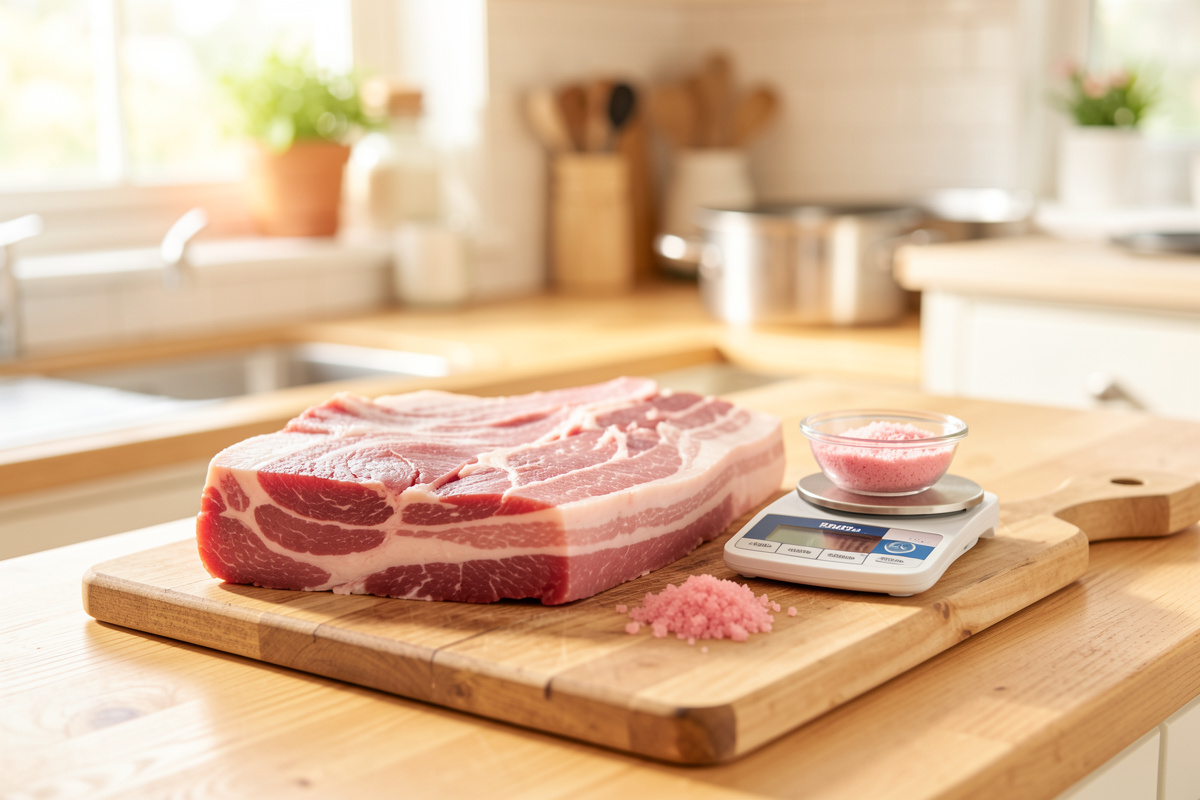

To cure bacon at home you weigh a pork belly, rub it with 2.5% salt by weight plus cure #1 at 2.5 g per kilogram, bag it, and refrigerate for about a week per inch of thickness, flipping every day or two. Then you rinse it, dry it overnight to form a pellicle, and fry it or cold-smoke it. That is the entire process — a fridge, a scale, a slab of belly, and pink curing salt. The first time I did it I could not believe something this good came out of something this simple.
This is the beginner walk-through I would give a friend standing in my kitchen with their first belly. It is the most forgiving cure in the chamber if you weigh your ingredients, and the easiest to mishandle if you eyeball them. I will take you from raw belly to sliced bacon step by step, and flag the two or three places where care actually matters.
What You Need Before You Start
The shopping list is short: a flat slab of skinless pork belly (a kilo or two is a sensible first run), fine sea salt or kosher salt that is not iodized, pink curing salt (cure #1), and optionally a little brown sugar and black pepper. The non-negotiable tool is a digital scale that reads to one gram, because cure #1 is dosed in grams and there is no safe way to estimate it. A zip-top bag or vacuum bag holds the belly during the cure. That is genuinely all the equipment a first batch needs — no chamber, no smoker, just the fridge.
Cure #1 is the part beginners hesitate over, and they shouldn’t. It is salt blended with 6.25% sodium nitrite, dyed pink so you never mistake it for table salt. The nitrite is what makes home bacon safe to cure cold and gives it the colour and tang you expect. You measure it precisely and it does its job invisibly. Skipping it does not make a “healthier” bacon; it makes an unsafe one. I keep the full reasoning in the cluster’s bacon curing guide.
Step 1: Weigh the Belly and the Cure
Put the belly on the scale and note its weight in grams. Salt at 2.5% means multiplying that weight by 0.025 — a 1,000 g belly gets 25 g of salt. Cure #1 is dosed separately at 2.5 g per kilogram of meat, so that same belly gets 2.5 g of cure #1. Add a little sugar if you like a touch of sweetness — I use about half the salt weight in brown sugar. Mix the salt, cure #1, and sugar together in a bowl so the tiny amount of cure #1 is evenly distributed through the salt before it touches the meat.
Step 2: Rub, Bag, and Refrigerate
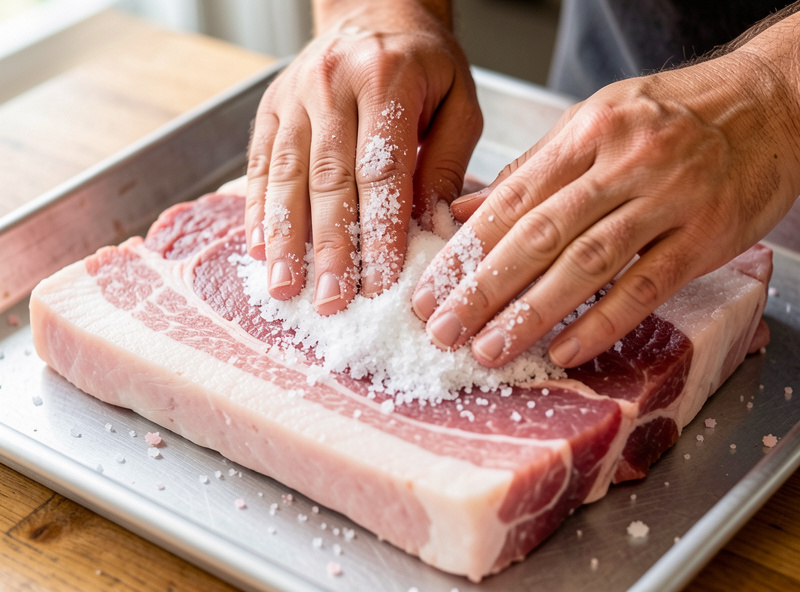
Rub the whole salt mixture over every surface of the belly — top, bottom, and all four edges. Every gram you measured goes onto the meat; this is an equilibrium cure, so the belly takes up exactly what you weighed and no more. Slide it into the bag, press out the air, seal it, and lay it flat in the fridge. The belly will start weeping liquid within a day; that brine is the cure working, so leave it in the bag. Flip the bag every day or two and massage the liquid back over the meat.
The cure runs at fridge temperature — around 3 °C / 38 °F — for roughly seven days per inch of thickness. A standard one-inch belly is done in about a week. You will know it is ready when the belly feels firm all the way through rather than squishy in the middle; that firmness is the salt having equalised across the whole muscle.
Step 3: Rinse, Dry, and Form the Pellicle
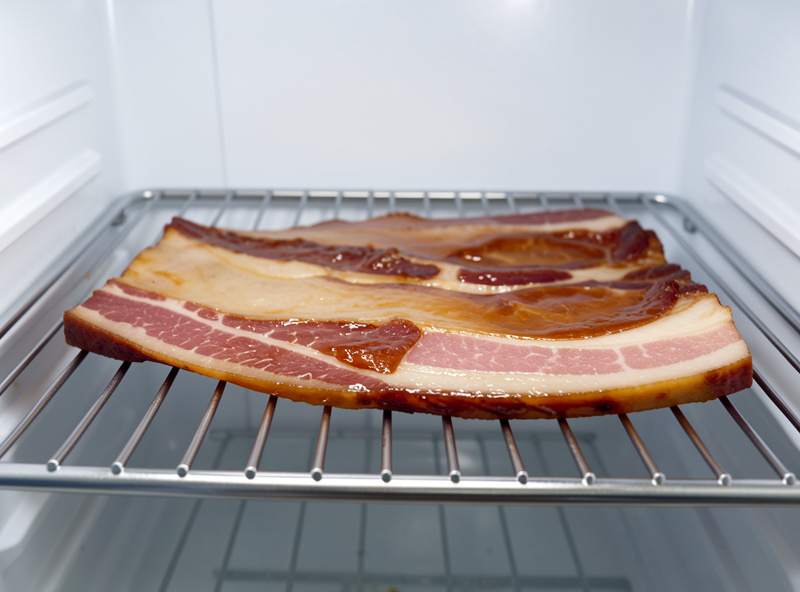
When the cure is complete, take the belly out, rinse off the surface cure under cold water, and pat it completely dry. Now rest it uncovered on a rack in the fridge overnight. This forms a pellicle — a slightly tacky, dry surface skin. If you plan to smoke, the pellicle is what smoke sticks to cleanly; skip it and smoke turns harsh. If you are not smoking, the overnight rest still firms the surface and improves slicing.
Step 4: Cook or Smoke, Then Slice
At this point you have green (unsmoked) bacon, which is ready to fry. Cut a thin test slice and cook it — that first rasher tells you whether the salt level is right for next time. To make smoked bacon, cold-smoke the pellicled belly with the chamber held under about 30 °C / 86 °F so the fat never renders; smoke is flavour, not cooking, and never the safety step. Once smoked (or not), chill the belly firm and slice it as thick or thin as you like. Partially freezing it for 30 minutes makes clean slicing far easier.
Store sliced bacon in the fridge and use it within two to three weeks, or freeze it in meal-sized portions with parchment between rashers. Always cook bacon before eating — home-cured bacon is a raw cured product, exactly like the bacon you buy, not a ready-to-eat charcuterie.
As an Amazon Associate I earn from qualifying purchases. If you are buying one thing for this, make it a one-gram digital kitchen scale — every safe number above depends on weighing, not guessing.
The Three Places a First Cure Actually Goes Wrong
A first bacon cure fails in one of three predictable spots, and all three are avoidable. The most common is guessing the cure #1 instead of weighing it — eyeballing “a pinch” of pink salt either underdoses the nitrite (a safety problem) or oversalts the meat past edible. There is no teaspoon shortcut that is safe here; the 2.5 g per kilogram figure is a weighed number or it is nothing. The second is pulling the belly too early because the surface firmed up while the centre stayed soft — trust the week-per-inch clock and the firm-all-the-way-through feel, not the squeeze on the outside. The third is skipping the pellicle and going straight to smoke, which lays acrid creosote on a wet surface instead of clean flavour on a dry one.
None of these is hard to dodge once you know they are there, which is exactly why I have you weigh everything and flip on a schedule rather than improvise. If you want to understand the salt arithmetic more deeply before your next batch — running 2% for a milder result, scaling to a bigger slab, or adjusting for a thicker belly — the full breakdown lives in the dry-curing belly bacon guide, and the precise per-method cure and salt figures are collected in the bacon curing salt ratios guide. Read those once and the numbers stop feeling like a leap of faith.
One last beginner reassurance: this cure is genuinely forgiving when you weigh it. Because it is an equilibrium cure, the salt and nitrite you measured in are all that exist — the belly cannot keep getting saltier the way a salt-box cure can, and a day or two extra in the fridge does no harm. That wide margin is why bacon is the cure I start everyone on. Get the scale right and the rest is patience.
Frequently Asked Questions
What kind of salt do I use to cure bacon?
Use plain fine sea salt or kosher salt that is not iodized, plus pink curing salt number one for the nitrite. Iodized salt can give off-flavours and interferes with curing. The pink cure is dosed separately and precisely at 2.5 grams per kilogram of meat; it is not interchangeable with table salt and must be weighed on a gram scale.
How thick should the pork belly be for bacon?
An even slab around one inch thick is ideal for a first cure because it cures in about a week and slices cleanly. Thicker bellies work but need proportionally longer, roughly a week per inch. Avoid bellies that taper badly in thickness, since the thin end over-cures while the thick end is still under-cured.
Do I need a smoker to make bacon at home?
No. Cured but unsmoked belly is green bacon and fries up perfectly in a pan. Smoking only adds flavour. If you do smoke, it must be cold smoke under about thirty degrees Celsius applied to a dry pellicle, and it does not replace cooking. You still cook home-cured bacon before eating it.
How do I know when the bacon cure is finished?
The belly is cured when it feels firm all the way through rather than soft or squishy in the centre. For a one-inch belly that is about seven days in the fridge. The firmness shows the salt has equalised through the muscle. If the middle still feels soft, give it another day or two before rinsing.
Is home-cured bacon safe to eat?
Yes, when you weigh the salt and cure number one correctly, keep the belly cold throughout the cure, and cook the bacon before eating. The nitrite in cure number one suppresses Clostridium botulinum during the cure. The risk comes from skipping the cure, guessing the amounts, or eating it raw. Cured bacon is not ready-to-eat charcuterie.