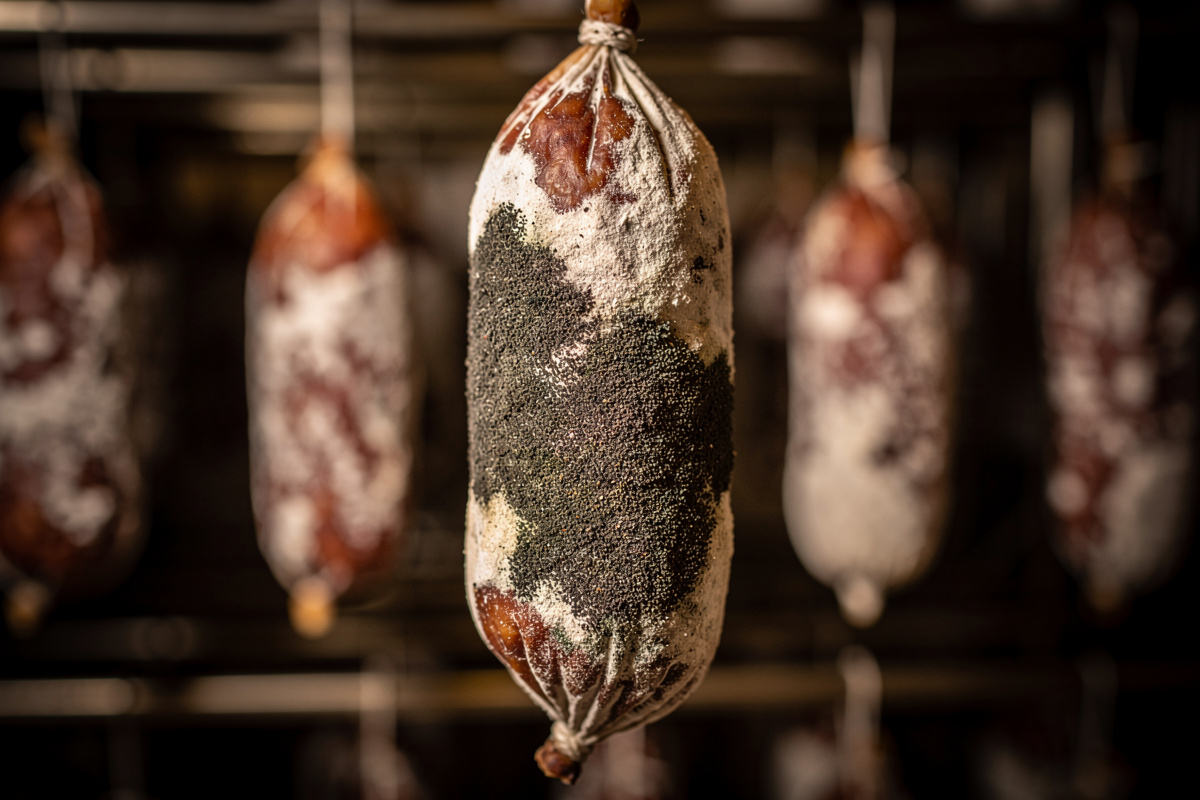

I have wiped Aspergillus niger off the casing of more than one of my own salami chubs over the last 18 months, and almost every case was cosmetic — a 50/50 white-vinegar wipe and a re-spray with Bactoferm Mold-600 brought the casing back to a clean white bloom within 72 hours.
The exception was a coppa where the black streaks went all the way through on cross-section; that one went in the bin without negotiation. Surface black mold on charcuterie is almost always salvageable; black mold inside the meat is not.
Most “black mold” on charcuterie is actually dark Aspergillus or Cladosporium — usually safe to wipe off with vinegar, but a sign your humidity, airflow, or starter culture is off. Truly dangerous black mold (Stachybotrys, certain Penicillium toxin-producers) is rare on cured meat because the salt-and-low-water environment is hostile to those species. Black mold on the surface usually means salvage with a vinegar wipe; black mold inside the meat means toss the entire piece. The full symptom-to-fix decision tree for the seven most common chamber problems lives in curing chamber troubleshooting: the complete guide.
The decision tree is simple: surface black spots that wipe off with white vinegar are almost always cosmetic and the salami is fine to eat. Black streaks that go through the meat when you cut into it (visible on the cross-section) mean fungal contamination has penetrated the cure layer and the entire piece needs to go. Most home charcuterie failures fall into the first category and are recoverable.
What “Black Mold” Usually Actually Is
Three different fungi commonly produce dark growth on charcuterie surfaces, and only one is genuinely dangerous. Aspergillus niger (the dominant black mold on fermented meats) produces dry powdery dark spots that don’t penetrate the casing. It’s the same species used to make citric acid commercially and shows up on grapes for raisin production — dietary exposure is normal and not toxic at the levels found on home charcuterie.
Cladosporium species produce darker olive-to-black spots with a slightly fuzzy texture, common in chambers with intermittent humidity (humidity spikes above 85% and drops to 60% repeatedly). It’s allergenic for sensitive individuals but not toxin-producing. Wipe off and adjust humidity stability.
The actually-dangerous black mold most people fear — Stachybotrys chartarum, the household “toxic black mold” — does not grow on cured meat. Its growth requires a minimum water activity around 0.94, optimal above 0.98, on cellulose-rich substrates like drywall, according to public-health mold-fact-sheet data from the Institut national de santé publique du Québec — properly cured charcuterie sits at roughly 0.85 to 0.92, below the threshold that species needs to establish. That doesn’t mean every dark spot on a casing is automatically harmless, though. Some Aspergillus species that turn up on dry-cured meat surfaces, including some A. niger strains, are documented ochratoxin A producers, and a 2022 review of ochratoxin A in dry-cured ham found the toxin can migrate below the surface layer rather than staying put on top of it. That’s why I don’t treat a vinegar wipe as a blanket fix for any dark spot — it’s for isolated, dry, powdery surface spotting caught early on a piece that smells and feels normal underneath; heavier or repeated growth, or anything paired with off-smells or softness, goes in the bin instead of getting scrubbed and re-hung. Nitrate and nitrite levels in properly cured charcuterie are a separate concern for some people — the cured meat headache and nitrates guide explains the physiology and what actually causes the reaction.
The Visual ID Test
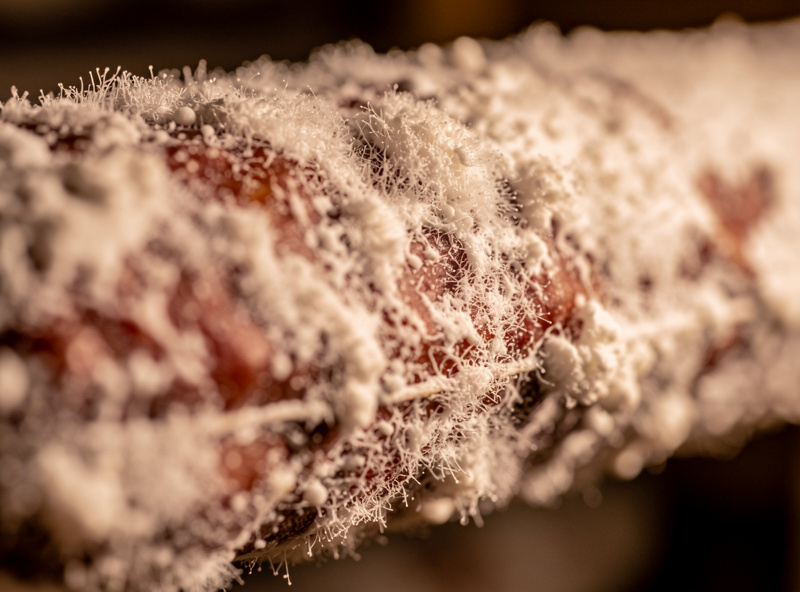
Healthy white mold (Penicillium nalgiovense) is fluffy, flowering, and bright white-to-gray. It grows in an even film across the entire casing surface and is what most modern charcuterie makers actively encourage with starter culture inoculation. White mold is good — it competes with bad fungi for surface real estate and contributes to flavor development.
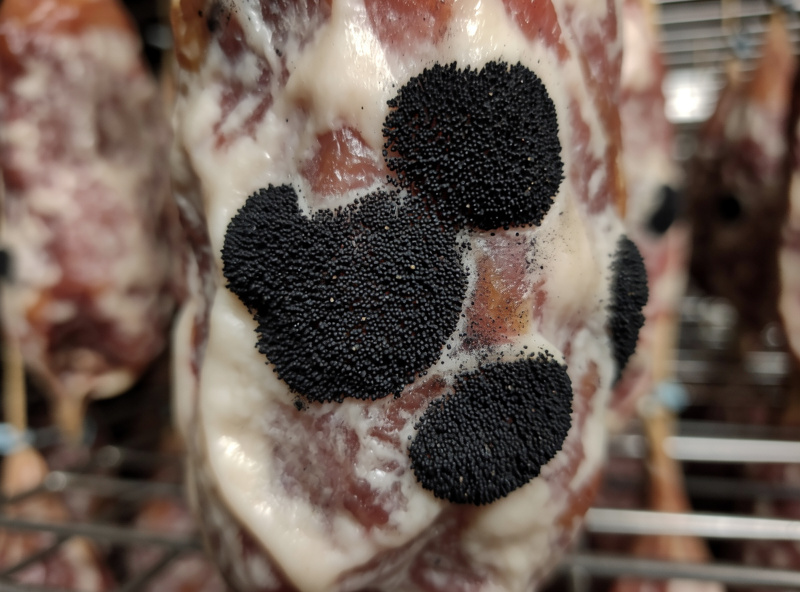
Aspergillus niger black mold is dry, powdery, and shows up in distinct spots or patches rather than even coverage. It’s typically isolated to a few areas of the casing rather than spreading uniformly. The texture is closer to coffee grounds than cotton. This is the “wipe with vinegar, no harm done” category.
Truly dangerous black mold (the rare cases) appears as dark veining inside the meat itself, visible only when you cut a cross-section. It often comes with off-smells (sour, ammonia-like, or solvent-like) and a softer texture in the affected area. Surface mold that wipes off doesn’t qualify — only mold that penetrates the cure layer does. The curing chamber troubleshooting covers cross-section evaluation in detail.
The Vinegar-Wipe Rescue
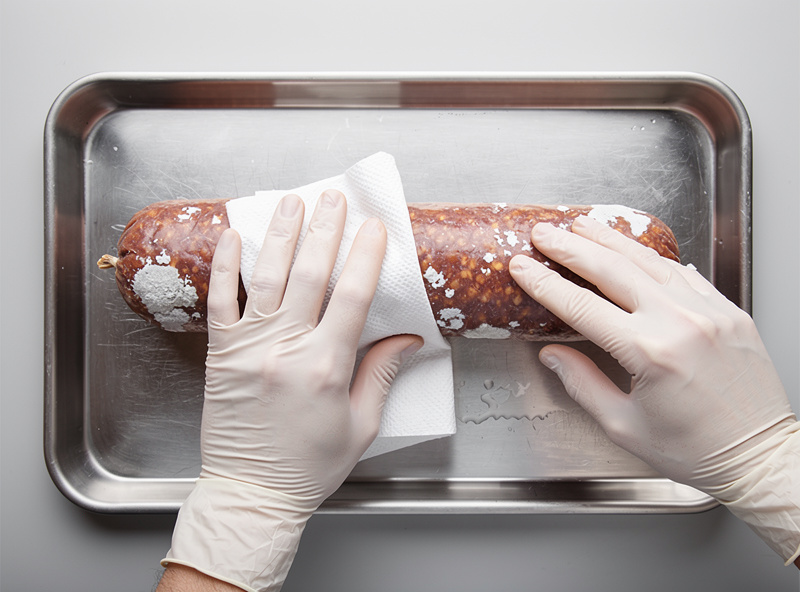
For surface black mold, mix 50/50 white vinegar and water in a small spray bottle. Saturate a clean cloth with the mix, wring out excess, and wipe the affected casing area firmly. The vinegar’s acetic acid kills the mold spores on contact and the wipe physically removes the fungal mass. Repeat once or twice if the area is large.
After wiping, hang the meat back in the chamber but at slightly higher airflow for 24 to 48 hours to dry the casing surface. Damp casings invite mold to return. If your chamber has a fan, increase its run time by 25% during this recovery period. Don’t increase fan speed — increase fan run time.
Re-inoculate with white mold starter culture (Bactoferm Mold-600 or equivalent) after the vinegar dries. I keep a 25 g packet in the chamber-side cabinet — it’s meant to be hydrated and diluted out to about 10 liters of spray solution, so it stretches across several rescues — and the dry powder stays viable for about 18 months refrigerated. Using the correct cure salt is equally important — a Prague Powder 1 vs 2 mixup is one of the most dangerous mistakes in home charcuterie, since the two cures are not interchangeable between short and long cures. Spray a thin layer across the cleaned area; the white mold will reestablish dominance within 48 to 72 hours and outcompete returning Aspergillus. Without re-inoculation, the cleaned surface is a blank canvas for whatever spores happen to land first.
When to Toss Instead of Rescue
Toss the entire piece if any of these appear: black veining visible inside the meat on cross-section, soft mushy patches under the casing (not just the natural softness of fresh charcuterie), strong off-smells (ammonia, solvent, sour-rotten), slimy texture beneath the surface mold, or discoloration that goes more than 1 mm into the meat itself. Off-smells that are more rancid-fat than mold-adjacent are a separate failure mode — the rancid cured meat prevention guide covers the fat oxidation pathway and how to distinguish it from mold-generated off-aromas.
Toss specifically if the mold growth followed visible casing damage (a tear, a slice, or a stitch line) — damaged casings let surface mold penetrate into the meat below, and once it’s inside the cure layer there’s no way to remove it. Salt and nitrates inhibit but don’t kill fungal growth that’s already established inside the meat. Low salt concentration is a separate failure that worsens your position — an undersalted charcuterie fix walks through recalculating cure ratios when the salt dose falls short.
Don’t try to rescue a piece that’s been hanging more than 48 hours with active black mold growth covering more than 30% of the casing surface. Heavy mold coverage suggests the chamber environment failed (humidity too high, airflow too low, or no white mold competition) and the piece is at much higher risk of toxin development than a piece with isolated spotting. High chamber temperature during early fermentation produces a related but distinct defect — fat smear in salami — where the fat network breaks down before the myosin gel sets, yielding a greasy, soft salami with no bind.
Black Mold Cause Diagnosis
| What Caused It | How to Recognize | Chamber Fix |
|---|---|---|
| Humidity spikes above 85% | Mold blooms after 1 to 3 days of high RH | Add salt-saturated tray to buffer humidity |
| Stagnant air pockets | Mold grows on hidden side facing the wall | Add small fan, rotate pieces weekly |
| No starter culture white mold | Black/green mold dominates without competition | Spray with Bactoferm Mold-600 on day 2 |
| Contaminated chamber | Black mold returns within days of cleaning | Empty, scrub with bleach 1:10, dry, re-inoculate |
| Casing damage during stuffing | Mold concentrated at one spot or stitch line | Tighter stuffing, repair tears with cotton thread |
| Starter culture underdosed or stale | Black/dark mold outcompetes despite spraying | Use a fresh packet at full label dose; don’t stretch one packet across too many batches |
| Drying too slow | Surface stays damp days into the cure | Increase airflow first 5 days; reduce after |
Why White Mold Prevents Black Mold
Penicillium nalgiovense (the white mold deliberately inoculated on commercial salami like Genoa, Soppressata, and most European charcuterie) physically occupies the casing surface and chemically inhibits competing fungi through metabolites it secretes. A casing well-colonized with P. nalgiovense within the first 5 days of curing out-competes black mold dramatically — in my own side-by-side batches, inoculated vs. skipped, the uninoculated casings are the ones that reliably spot up while the seeded ones basically don’t.
The starter culture protocol: hydrate Bactoferm Mold-600 in cool dechlorinated water, then dilute out to roughly 2.5 grams per liter of final spray solution (a 25 g packet diluted to about 10 liters is the standard commercial ratio), spray-coat the casing surface within 2 hours of stuffing, then hang at fermentation temperature (65 to 75°F) for 12 to 24 hours before moving to the curing chamber. The white mold establishes during fermentation and continues through the cure.
Skipping the starter culture relies on whatever spores happen to land on the casing first — which is roughly random and includes whatever’s airborne in your kitchen and basement. In my experience that gamble comes up black-spotted more often than not on unprotected batches; colonize early with a starter culture and I rarely see black mold appear at all. The home salami making covers starter culture timing.
What Black Mold Tells You About the Chamber
Black mold is almost always a chamber-environment signal, not an ingredient or recipe problem. The most common chamber issues that produce black mold: humidity spikes (sudden jumps from 70% to 90% RH overnight when the humidifier overshoots), air stagnation in pockets behind hanging meat, and chamber surfaces that haven’t been cleaned and are seeded with spores from previous batches.
Fix the chamber and black mold incidents drop dramatically. Fix the recipe but not the chamber and you’ll keep seeing black mold. Running dedicated feedback controllers — I use an Inkbird ITC-308 on the compressor side for temperature and an Inkbird IHC-200 for humidify/dehumidify — makes humidity stability much easier than running a plug-in humidifier with no feedback loop at all. The curing chamber climate control covers controller setup.
Also clean the chamber between batches. After each batch hangs to completion, empty the chamber, wipe all interior surfaces with a 1:10 bleach solution, rinse with clean water, dry thoroughly, then re-spray with Mold-600 inoculant before hanging the next batch. I skipped this step exactly once, between a salami batch and a duck breast, and the duck breast came out with three Aspergillus spots that traced back to dried mineral residue on the back wall the bleach would have removed. Now I do the bleach-and-rinse before every batch, no exceptions. This sets up a “clean room” with the right mold dominance from day 1 of the new batch. A related but visually distinct problem that appears on the cut face of dry-cured sausage is a green ring in dry-cured sausage — a thin discolored band just inside the casing that looks alarming but has a specific and different cause from surface mold.
Frequently Asked Questions
Is black mold on charcuterie dangerous?
Surface black mold (usually Aspergillus niger) is almost always cosmetic — wipe with 50/50 white vinegar and water and the meat is fine. Black mold inside the meat (visible on cross-section) means toss the entire piece. Truly toxic black mold like Stachybotrys does not grow on cured meat because the salt environment is hostile.
How do I tell black mold from healthy white mold on salami?
Healthy white mold is fluffy, flowering, and covers the casing evenly in white-to-gray. Black mold appears as distinct dark spots or patches with dry powdery texture. White is good and protective; isolated black spots can be wiped off; widespread black means chamber environment failed.
Can I save a salami with black mold by wiping it off?
Yes for surface mold. Mix 50/50 white vinegar and water, wipe affected areas firmly with a clean cloth, dry the casing with 24 to 48 hours of higher airflow, then re-inoculate with Bactoferm Mold-600 starter culture. The salami is safe to eat after this rescue.
Why does black mold keep coming back in my curing chamber?
The chamber is contaminated with spores from previous batches. Empty completely, wipe all surfaces with 1:10 bleach, rinse, dry thoroughly, and spray fresh Mold-600 inoculant before hanging the next batch. Also check humidity stability — spikes above 85 percent invite black mold.
Should I use a white mold starter culture?
Yes — Bactoferm Mold-600 (or equivalent Penicillium nalgiovense culture) reduces black mold incidence from 30 to 50 percent down to 2 to 5 percent. Spray-coat casings within 2 hours of stuffing, then ferment 12 to 24 hours at 65 to 75 degrees F before moving to the curing chamber.
What does black mold inside the meat look like?
Dark veining or streaks visible only when you cut a cross-section, often accompanied by soft mushy texture, off-smells (ammonia or sour-rotten), or discoloration extending more than 1 mm into the meat. Surface mold that wipes off does not count — only mold that penetrates the cure layer requires tossing the entire piece.
Related Articles
- Curing Chamber Troubleshooting: The Complete Guide
- Salami Casing Mold: Good White vs Dangerous Black/Green
- Penicillium Cultures for Salami
- Case Hardening in Curing Chambers
- Curing Chamber Too Humid: How to Fix Oversaturation Fast