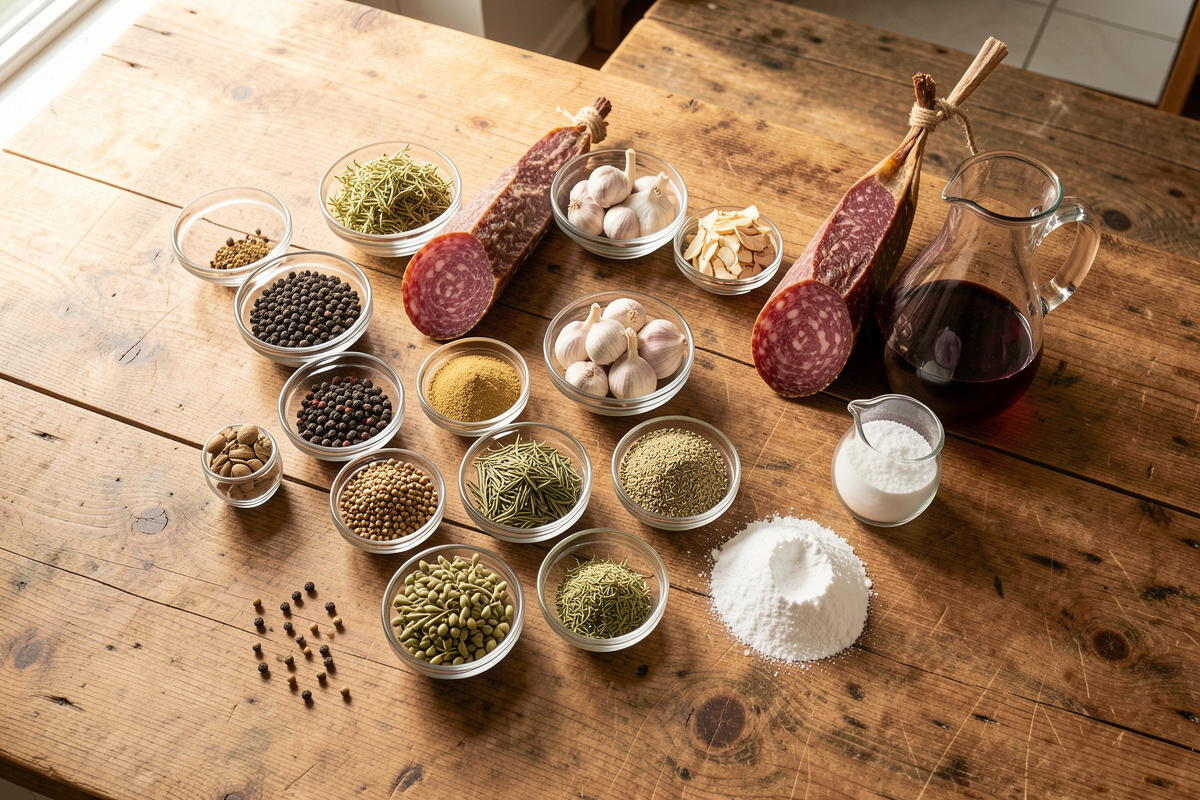

A charcuterie spice blend is a weighed system, not a sprinkle. It runs in layers — salt and cure for safety, sugar to feed the ferment, whole spices for aroma, sometimes wine and a binder — and every layer is measured against the meat weight in grams. Get the salt and cure right and the spice becomes decoration. Get them wrong and no amount of fennel saves the batch.
I have been dialing in seasoning across the chambers I run in Sweden for years, and the single biggest shift in my own results came when I stopped thinking about “a spice mix” and started thinking about a stack of independent decisions. The salt percentage is one decision. Whether the piece needs cure #1 or cure #2 is a second, non-negotiable one. Dextrose to drive the pH drop is a third. Only after those are locked do I get to play with pepper and juniper. This guide is the map of that stack, and every branch of it opens into a deeper article so you can go as far down any one rabbit hole as you want.
Here is the cost of getting the order wrong: the prettiest coppa I ever seasoned — toasted coriander, cracked pepper, a whisper of cinnamon — case-hardened on me because I fussed the spice and ignored the humidity math. Beautiful crust, raw grey core. The spice was perfect. It didn’t matter. That is why this hub puts the safety layer first and the aroma layer last.
What Actually Goes Into a Charcuterie Spice Blend?
A complete blend has up to seven layers, and only three of them are about flavor. The rest do structural or microbial work. Weigh everything as a percentage of the green (raw) meat weight — grams per kilogram — because that is the only unit that survives scaling from a 1 kg test batch to a 5 kg run without drifting.
The layers, in the order I add them to the bowl, look like this:
| Layer | Typical amount | Job | Skip it? |
|---|---|---|---|
| Salt | 25–30 g/kg (2.5–3%) | Water activity, flavor, texture | Never |
| Cure (#1 or #2) | 2.5 g/kg | Nitrite/nitrate — botulism and color safety | Never on dry-cure/ferment |
| Dextrose/sugar | 2–10 g/kg | Feeds lactic bacteria, drops pH | Only on unfermented cures |
| Starter culture | Per manufacturer | Controlled fermentation | Only on whole muscle |
| Whole spices | 3–12 g/kg total | Aroma and flavor | Yes, to taste |
| Wine | 30–50 ml/kg | Flavor, mild acidity, moisture | Yes |
| Binder (milk/soy) | 0–20 g/kg | Water/fat retention (mostly fresh & cooked) | Usually, on dry-cure |
Notice that the two “never skip” rows are the ones with no flavor payload. That is the whole philosophy of this site: the boring layers keep you safe, the fun layers make it yours. If you only read one row of that table, read the cure row — and then read how to scale a charcuterie spice recipe by meat weight so those grams-per-kilo figures actually land on your scale correctly.
How Much Salt and Cure Go In Before You Reach the Spices?
Salt sits at 2.5–3% of green weight for most dry-cured work, and curing salt goes in at a flat 2.5 g per kilogram. That 2.5 g figure yields roughly 156 ppm of ingoing sodium nitrite — the ceiling U.S. regulators set — which is why you never eyeball it. Weigh cure to 0.1 g on a jeweler’s scale.
The one decision you cannot get wrong is which cure. Cure #1 (6.25% sodium nitrite) is for short cures and anything you will cook or hot-smoke — bacon, fresh cured sausage, pancetta you’ll pan-fry. Cure #2 adds sodium nitrate, which converts slowly to nitrite over weeks, and it is the only correct choice for fermented and long-dried sausage and whole muscle: salami, coppa, bresaola, lonzino. Anything hanging longer than about three weeks needs #2. This is not a flavor preference; it is the difference between a safe cure and a gamble with Clostridium botulinum. The U.S. Department of Agriculture’s Food Safety and Inspection Service publishes the ingoing-nitrite limits, and every serious calculator (including the widely used one at diggingdogfarm) is built on those numbers — I keep both open when I mix.
Use non-iodized salt only. Iodine inhibits the lactic bacteria you are about to spend money culturing, and it can throw a metallic note. I run plain fine sea salt for the cure mix and keep flaky salt for the table, nowhere near the chamber.
One honest boundary: I write from the home-chamber side, not the commercial one. Commercial charcutiers and the plants regulators inspect work to jurisdiction-specific rules — ingoing-nitrite ceilings, mandatory pH-and-drop time tables, and lethality validations that vary between the U.S. and the EU. The 2.5 g/kg and sub-5.3 pH figures I use are the conservative home-scale practice that sits safely inside those commercial limits, but if you ever cross into selling, the trade rules become your source of truth and they are stricter than anything on this page. For a home batch you eat and share, weigh the cure, drive the pH down with a culture, and hit your weight-loss target, and you are on solid ground.
How Do You Build Real Flavor With Whole Spices?
Whole spices beat pre-ground on every axis that matters: aroma intensity, shelf life, and control over texture. Ground spice starts losing its volatile oils the moment it is milled; a jar of pre-ground pepper on the shelf for a year is mostly dust. Buy whole, toast where it helps, and grind to order.
Black pepper is the backbone of most salami, and how you cut it changes the whole eating experience — whole peppercorns give bursts, cracked gives structure, ground gives an even background heat. I cover the exact grams and the visual difference in how much black pepper in salami, because “some pepper” is how you end up with a bland batch or a fiery one. As a baseline I run about 3 g/kg of coarsely cracked pepper in a classic salami and adjust from there.
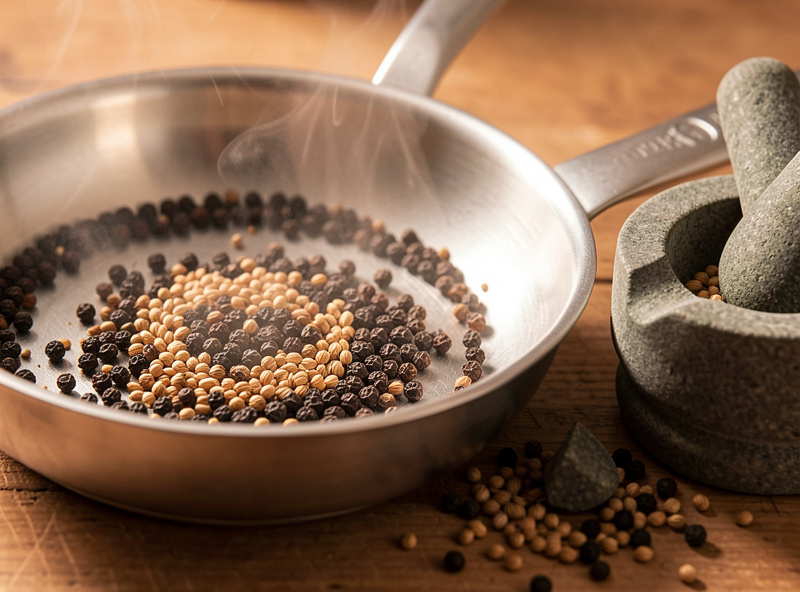
Toasting is the free upgrade almost everyone skips. Thirty seconds in a dry pan until the coriander smells like orange peel and the fennel turns nutty roughly doubles the aromatic punch you get per gram. But toasting has rules — over-toast and you get acrid, toast pre-ground and you scorch it — so I broke the method out into toasting and grinding spices for charcuterie. The short version: toast whole, cool completely, then grind.
Here are the spices I keep on the charcuterie shelf and the doses I actually weigh, so you have a starting grid rather than a vague “season to taste”:
| Spice | Typical dose (g/kg) | Best form | What it brings | Toast? |
|---|---|---|---|---|
| Black pepper | 2–4 | Cracked | Backbone heat, structure | Optional |
| Fennel seed | 2–4 | Whole or cracked | Sweet anise, classic finocchiona | Yes |
| Coriander seed | 1–3 | Ground fresh | Citrus, warmth | Yes |
| Garlic (fresh) | 3–8 | Paste | Savory depth | No |
| Juniper | 1–2 | Cracked | Piney, gin-like (great on game) | Light |
| Nutmeg/mace | 0.2–0.5 | Grated fresh | Rounding warmth | No |
| Paprika (sweet) | 3–10 | Ground | Color, mild sweetness | No |
| Chili flake | 1–6 | Flake | Heat (soppressata, ‘nduja) | No |
Those doses are ranges because heat tolerance and cut matter, but the ratios between them are what make a blend read as “finocchiona” versus “soppressata.” Get the base grid on your scale first, then push one lever at a time.
Why Does Sugar Belong in a Cured Sausage?
Sugar in fermented salami is not for sweetness — it is bacteria food. The lactic acid bacteria in your starter culture eat simple sugar and excrete lactic acid, which drops the pH, tightens the texture, and adds the tang that defines a good salami. No sugar, no reliable pH drop; no pH drop, no safe, sour, sliceable salami.
Dextrose is the standard because it is a simple sugar the bacteria metabolize fast and completely, giving a clean, predictable fermentation. Table sugar (sucrose) works more slowly and less completely. I run dextrose at roughly 3–10 g/kg depending on how much acidity I want, and I explain the trade-offs — fast tang versus slow depth — in dextrose vs sugar in cured sausage. The chemistry here is the same lactic-acid drop that ferments a jar of sauerkraut in my other kitchen — same bacteria family, different substrate, and if you want that parallel spelled out, my notes on fermentation pH and lactic bacteria at Ferment Foundry come at it from the vegetable side.
The critical safety point: a warm, humid fermentation hold without a culture and a sugar to drive acidification is exactly the window botulism likes. You never let ground meat sit warm and “ferment naturally” and hope. You inoculate, you feed, you watch the pH fall below 5.3, and you move to the drying phase. That sequence is what makes the warmth safe.
What Does Wine Actually Do in Salami?
Wine adds three things: flavor compounds you can’t get from dry spice, a touch of acidity that supports the ferment, and a little moisture that helps distribute the cure evenly through the mince. A dry red in a Tuscan-style salame, a crisp white with fennel and garlic — the pairing is real, not decorative.
The amount is small and it matters: too much wine and you slow your drying and dilute the flavor; too little and you can’t taste it. I land around 30–50 ml per kilogram and chill it first so it doesn’t warm the mince. Red versus white, how much, and why you reduce some styles first are all in wine in salami: how much, red vs white, and what it does. One habit worth stealing: I freeze the wine into a slush before it goes in, because keeping the mince below about 2°C protects the fat smear.
Do You Need a Binder Like Milk Powder or Soy?
For fresh and cooked sausage, a binder like non-fat dry milk or soy protein helps hold water and fat so the links stay juicy and don’t weep. For dry-cured and fermented salami, the answer is usually no — and often “actively unhelpful,” because the entire point of dry-curing is to lose water, and a binder fights that.
This is one of the most misunderstood corners of the craft, because a technique that is standard in a breakfast banger is wrong in a finocchiona. I lay out when a binder earns its place, at what percentage, and why most traditional dry salami skips it entirely in should you add milk powder or soy to sausage? binders explained. If you take one rule from it: binders belong to the cooked-and-eaten-soon world, not the hang-for-three-months world.
What Grinder Do You Need to Grind Spices Right?
A dedicated spice grinder is the cheapest upgrade with the biggest flavor return in this whole hobby. Pre-ground spice is stale spice; a blade or burr grinder lets you toast whole and grind to order, and it costs less than a single failed batch of meat. The trick is matching grind consistency to the job — a coarse crack for pepper studding a salami, a fine even powder for a cure rub that needs to distribute.
I run a cheap dedicated blade grinder for coarse work and reach for a burr mill when I want a truly uniform powder, and I keep it separate from the coffee grinder for obvious reasons. Which machine suits whole-muscle rubs versus sausage blends, and where a mortar and pestle still wins, is in best spice grinder for whole-muscle and sausage cures. If you are buying one thing this month, make it this — you can compare current dedicated spice grinders on Amazon to see the blade-versus-burr split.
As an Amazon Associate I earn from qualifying purchases.
How Do You Scale a Blend to Your Meat Weight?
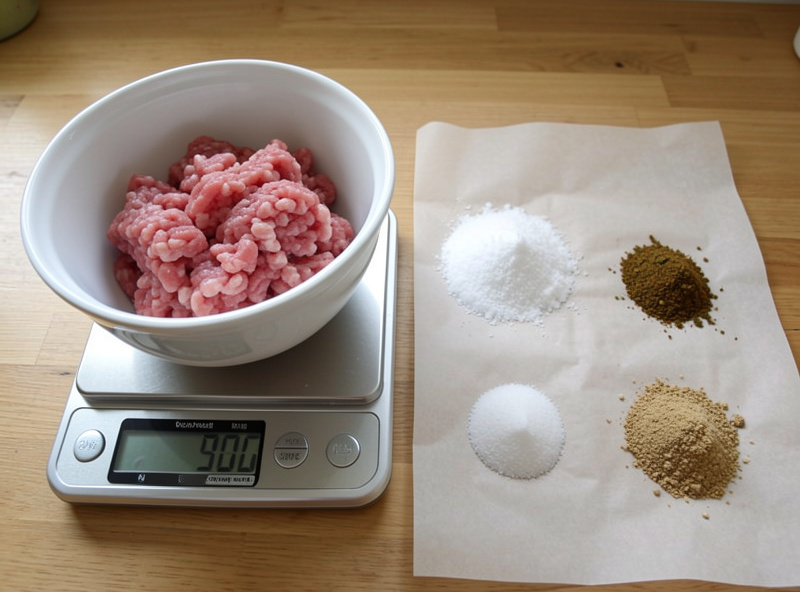
Every recipe on this site is written in grams per kilogram of meat, and scaling is just multiplication — multiply each ingredient’s per-kilo figure by your green weight in kilos. Weigh the meat first, then everything else follows. This is why you never scale by “a teaspoon per pound”: teaspoon-to-gram varies wildly by spice, and the cure is the one line where a rounding error is a safety error.
The method — weigh green, calculate salt and cure to 0.1 g, batch the spice mix separately — plus the printable worksheet I use is in how to scale a charcuterie spice recipe by meat weight. Master this and you can take any blend in the world, written for any batch size, and land it exactly on your own scale.
My Three Baseline Blends to Start From
To make all of this concrete, here are three blends I return to, written per kilogram of green meat. They assume you have already added salt at 2.75% and cure #2 at 2.5 g/kg. Toast the seeds where the spice article says to, grind fresh, and treat these as a floor to build on, not a ceiling.
- Classic Italian salame: 3 g cracked black pepper, 4 g fennel seed (toasted), 5 g fresh garlic paste, 5 g dextrose, 40 ml red wine.
- Fennel-forward finocchiona: 6 g fennel seed (toasted, mixed whole and cracked), 2 g black pepper, 4 g garlic, 4 g dextrose, 30 ml white wine.
- Spicy soppressata: 4 g cracked black pepper, 6 g chili flake, 8 g sweet paprika, 4 g garlic, 6 g dextrose, 40 ml red wine.
Each of those is a doorway into the deeper articles above. Change the pepper cut and you are into the black pepper guide; change the sugar and you are into the dextrose guide; scale it up for a party and you are into scaling by meat weight.
How Is a Whole-Muscle Rub Different From a Sausage Blend?
A whole-muscle rub sits on the outside of an intact piece and has to migrate inward over weeks, so it works differently from a sausage blend that is mixed evenly through the mince. With whole muscle — coppa, lonzino, bresaola, guanciale — the cure and spice make contact only with the surface, then diffuse. That changes both the salt strategy and the spice choice.
For whole muscle I strongly favor an equilibrium cure: I weigh the meat, calculate exactly 2.75% salt and 2.5 g/kg of cure #2, mix that with the spice, and rub the whole lot on in a vacuum bag for a week or two so every gram gets absorbed and nothing is thrown away. A salt-box cover cure — burying the piece in excess salt — is faster and traditional, but it is a guess on final salinity, and the equilibrium method is why my last coppa came out at exactly the seasoning I planned rather than the seasoning the salt box decided. Because the spice has to travel inward on whole muscle, I lean on ingredients that migrate and coat well: cracked pepper, garlic, juniper, a little sugar to round the salt. A finely ground spice bloom on the outside of a coppa mostly makes a pretty crust; the flavor that reaches the center is the coarse, aromatic stuff.
A workhorse coppa rub I return to, per kilogram of green weight: 27.5 g fine sea salt, 2.5 g cure #2, 3 g cracked black pepper, 2 g juniper (cracked), 1 g nutmeg, 4 g garlic paste, 2 g dextrose. Vacuum-cure two weeks, flipping every couple of days, then case and hang to 35% weight loss. Notice the cure line is identical to the salami baseline — the safety math does not care whether the meat is ground or whole.
Where Do Fresh Herbs, Citrus Zest and Smoke Fit In?
Beyond the dry-seed backbone, three flavor tools change a blend without touching the safety math: fresh herbs, citrus zest, and smoke. Each is a surface or top-note layer that rides on top of an already-correct cure, and each has a catch worth knowing before you reach for it.
Fresh herbs — rosemary, thyme, bay — bring resiny, green notes that suit whole muscle better than fermented sausage, because their moisture and their own microflora are less of a gamble on the outside of a coppa than mixed through raw mince. I bruise a little rosemary into a lonzino rub and keep it there. Citrus zest, especially orange, is the classic partner to fennel in some Italian salami; use only the colored zest, never the pith, and only a gram or two per kilo because it fades over the long dry. Smoke is the one people most often misunderstand. In the chambers I run I treat cold smoke purely as a flavor finish layered onto a piece that is already cured to a safe water activity with cure #1 or #2 — I generate the smoke off-box with a pellet maze, keep the chamber under about 30°C so the meat never sees heat, and let it drift over already-safe salami or a finished bacon. Cold smoke tastes like preservation history, but it does not preserve anything on its own; the salt and the cure did that first. Never treat smoke as the safety step.
How Does Seasoning Change Over the Hang?
Spice does not taste the same on day one as it does at 35% weight loss, and if you season for the raw mince you will over-season the finished product. As the piece loses water, everything concentrates — salt, spice, and the tang of the ferment all intensify because the same flavor compounds sit in less mass. A blend that tastes mild in the stuffing bowl can read sharp after three months in the chamber I run.
The fermentation phase changes it again. Once the lactic bacteria drop the pH and the meat sours, pepper reads hotter and garlic reads sharper against the acid backdrop, while sweeter notes like fennel and paprika mellow. This is why I season to about 80% of what tastes “right” raw — the drying and the pH drop finish the job. It is also why the honest doneness signal on this site is always weight loss, not time: two identical salami hung in two different corners of the chamber will hit 35% loss on different days, and the one that got there is the one that is ready, spice and all.
Garlic deserves a specific warning here. Raw garlic in a long-fermented salami can throw a green, almost soapy note as it ages if you overdo it, and it is a low-acid ingredient going into a low-acid environment before the pH drops — another reason the culture and dextrose need to do their job promptly. I keep fresh garlic at or below 8 g/kg and lean on granulated garlic when I want the flavor without the moisture and the fermentation risk.
How Do I Taste a Blend Before Committing a Whole Batch?
The fry test is the cheapest insurance in charcuterie: pinch off a little of the seasoned mince, flatten it into a tiny patty, and fry it through before you stuff anything. You cannot judge a raw cured blend by smell alone, and you certainly cannot taste raw fermented mince safely, so you cook a sample. It takes two minutes and it has saved me from more than one under-salted or over-peppered batch.
What the fry test tells you and what it hides is worth understanding. It shows you salt level, pepper heat, garlic balance, and whether the spice ratio reads the way you meant — adjust and re-test before stuffing. What it cannot show you is how the ferment and the three-month dry will shift things, which is why I mentally add “and this will get saltier and tangier” to every fry-test verdict. I keep a notebook line for every batch: the blend in grams per kilo, the fry-test note, and the finished note at target weight loss. Over a few years that log has become the most valuable spice reference I own, worth more than any single recipe, because it is calibrated to my chambers, my scale, and my palate.
What Seasoning Mistakes Cost Me the Most Batches?
The three seasoning errors that have burned me are all about respecting the non-flavor layers, and I have made each of them more than once. They are worth naming so you can skip the tuition.
First: eyeballing the cure to chase a spice idea. Early on I got excited about a wine-and-juniper coppa and scooped the cure #2 by feel instead of weighing it. It came out edible but I had no idea what the actual nitrite level was, and “edible but unknown” is a failure in this hobby. Now the cure gets weighed to 0.1 g before I am allowed to think about spice. Second: pre-ground everything. My first year I bought a big tub of pre-ground pepper and pre-ground fennel to save time, and the salami came out flat and dusty-tasting no matter how much I added. Whole spice, toasted and ground fresh, fixed it overnight — and it is the reason a dedicated spice grinder is the first tool I tell beginners to buy. Third: seasoning for the raw taste. I once salted a batch to taste perfect in the bowl, and after 35% weight loss it was aggressively salty — a good lesson in seasoning to 80% and letting the dry finish it.
None of those mistakes were about flavor creativity. They were about skipping the discipline that makes the flavor safe to eat and consistent to repeat. That is the whole game: the spice is the fun part precisely because the boring part is nailed down.
Do you weigh spices before or after grinding?
Weigh whole, before grinding. You lose a little to the grinder and to volatile oils once ground, so weighing whole and grinding to order gives you the most consistent dose and the most aroma. It also lets you toast the whole seed first.
Can I skip the cure and just use salt and spices?
Not for dry-cured or fermented charcuterie. Salt lowers water activity but does not protect against Clostridium botulinum during a long hang. Cure #2 is required for fermented and long-dried sausage and whole muscle. Only fresh sausage cooked and eaten promptly can skip curing salt.
How much total spice goes into a typical salami?
Most classic salami run 8 to 15 grams of total spice per kilogram of meat, not counting salt, cure and sugar. Black pepper and fennel make up the bulk in Italian styles. Start at the lower end and adjust on your next batch, since spice reads stronger after the pH drop.
Why grams per kilogram instead of teaspoons?
Because a teaspoon of whole fennel and a teaspoon of ground pepper weigh very different amounts, and because curing salt has to be exact to the tenth of a gram for safety. Grams per kilogram of meat is the only unit that scales cleanly from a test batch to a full run.
Does toasting spices make a real difference?
Yes. Thirty seconds in a dry pan drives off surface moisture and blooms the volatile oils, roughly doubling the aromatic punch per gram in seeds like coriander and fennel. Always toast whole and cool fully before grinding so you do not scorch the powder.
Keep Building
The seasoning layer rewards the same patience the chamber does — one lever at a time, logged, repeated. Start with whichever of these is your weakest link:
- How Much Black Pepper in Salami: Whole vs Cracked vs Ground
- Toasting and Grinding Spices for Charcuterie
- Wine in Salami: How Much, Red vs White, and What It Does
- Dextrose vs Sugar in Cured Sausage: Feeding the Ferment
- Should You Add Milk Powder or Soy to Sausage?
- Best Spice Grinder for Whole-Muscle and Sausage Cures
- How to Scale a Charcuterie Spice Recipe by Meat Weight