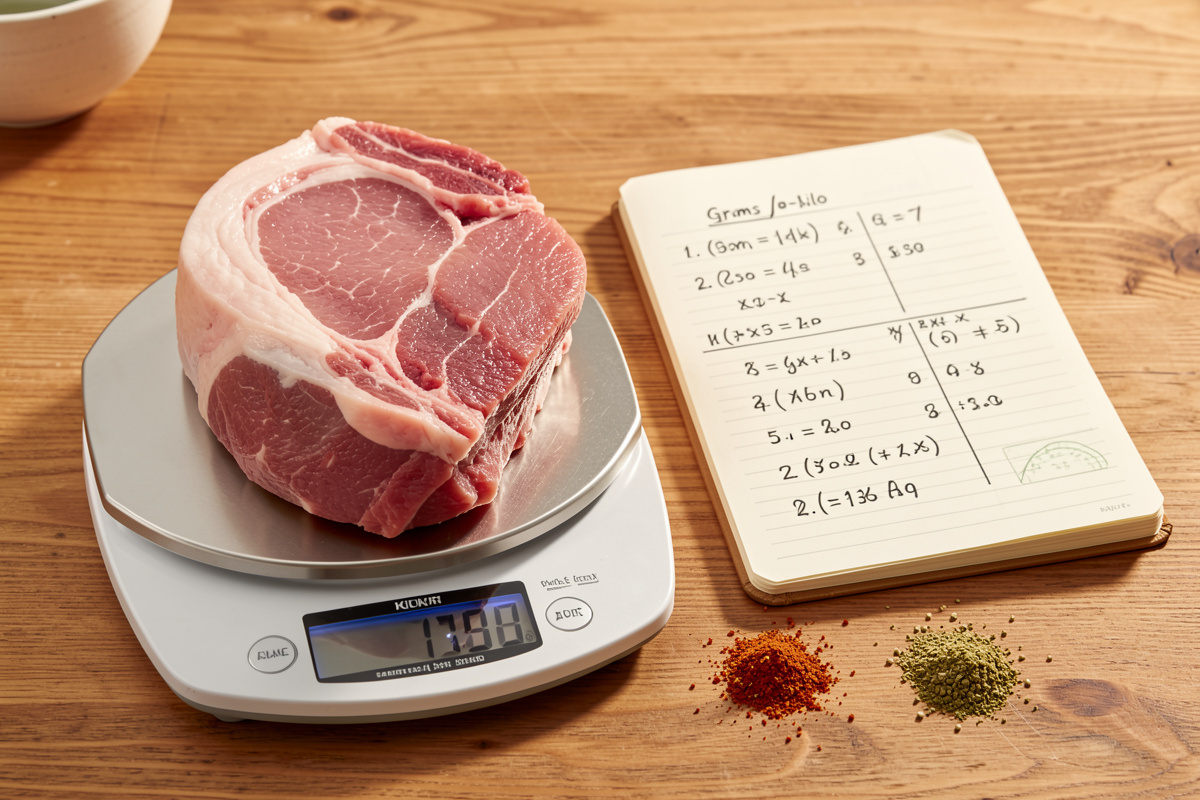

To scale a charcuterie recipe, weigh your meat in kilograms, then multiply each ingredient’s per-kilogram figure by that weight. A recipe written in grams per kilogram scales by simple multiplication: 2.5 g/kg of cure #2 for 3.2 kg of meat is 2.5 × 3.2 = 8 g. Weigh the meat first; everything else follows from it. This is why every recipe on this site is written per kilo — it is the only unit that scales cleanly and safely.
Get this one skill down and you can take any blend in the world, written for any batch size, and land it exactly on your own scale. Fumble it — scale by “a teaspoon per pound,” or round the cure carelessly — and you get an inconsistent salame at best and a genuine safety error at worst, because the cure is the one line where a rounding mistake is a nitrite mistake. Here is the method I use for every batch across the chambers I run, plus a worked example and the conversions that turn an old imperial recipe into clean metric ratios.
How Do You Scale a Charcuterie Recipe by Meat Weight?
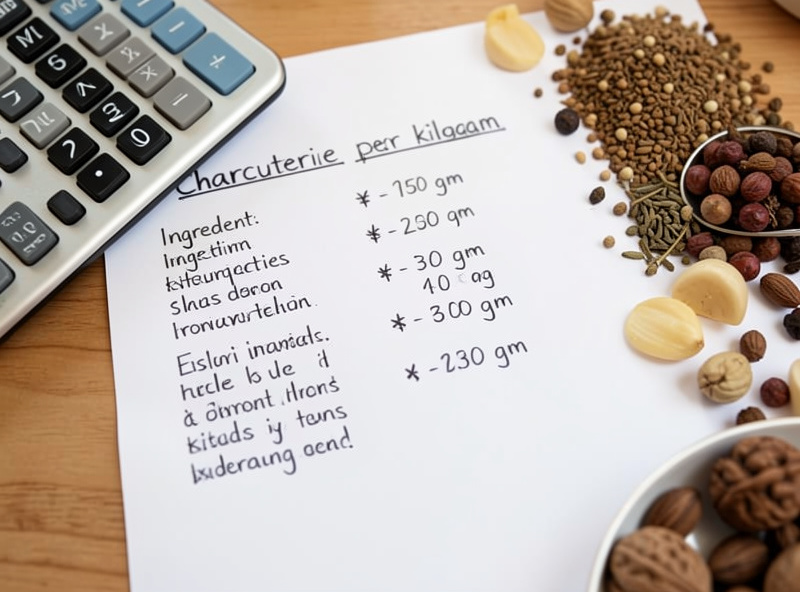
Weigh the green (raw) meat, note the weight in kilograms, and multiply every per-kilogram ingredient by that number. That is the whole method. If your recipe says 27.5 g/kg salt, 2.5 g/kg cure #2, 3 g/kg pepper and 5 g/kg dextrose, and you have 2.4 kg of meat, you multiply each by 2.4: 66 g salt, 6 g cure, 7.2 g pepper, 12 g dextrose. Weigh each on a gram scale and you have a perfectly scaled batch.
The meat weight is the anchor, so weigh it accurately after trimming and before adding anything. I weigh the trimmed, cubed meat-and-fat together as it will go into the grinder, because the salt and cure percentages are calculated on that total green weight. This per-kilo discipline is the backbone of the entire charcuterie seasoning system — once every ingredient lives as a gram-per-kilo figure, scaling up for a big run or down for a test batch is a thirty-second calculation, not a guess. A cheap gram scale for the bulk ingredients and a 0.1 g jeweler’s scale for the cure are the only tools you need.
Why Grams Per Kilogram Instead of Teaspoons or Percentages?
Grams per kilogram of meat is the only unit that stays accurate across batch sizes and across different spices, because volume measures like teaspoons vary wildly by ingredient and percentages still require you to weigh. A teaspoon of whole fennel seed and a teaspoon of fine ground pepper weigh completely different amounts, so a recipe in teaspoons falls apart the moment you change the spice form or the batch size. Weight is unambiguous; volume is not.
The safety dimension makes this non-negotiable for the cure. Curing salt has to be dosed precisely — 2.5 g/kg of cure #1 or #2 yields roughly 156 ppm of ingoing nitrite, the regulatory ceiling — and you cannot hit that reliably with a measuring spoon. The cure-calculation logic that every serious home charcutier relies on, including the widely used calculator at diggingdogfarm, is built entirely on weight ratios. Percentages (2.75% salt) and grams-per-kilo (27.5 g/kg) are the same thing expressed two ways; I think in grams per kilo because it multiplies straight against the meat weight with no extra step.
A Worked Example: Scaling a Salame From 1 kg to 3.2 kg
Say you have a trusted 1 kg salame recipe and you have just brought home 3.2 kg of trimmed pork and fat. You multiply every ingredient by 3.2. Here is the full scale-up laid out so you can see how each line moves:
| Ingredient | Per kg | × 3.2 kg | Notes |
|---|---|---|---|
| Salt (2.75%) | 27.5 g | 88 g | Non-iodized |
| Cure #2 | 2.5 g | 8 g | Weigh to 0.1 g |
| Dextrose | 5 g | 16 g | Feeds the ferment |
| Black pepper (cracked) | 3 g | 9.6 g | Round to 10 g, flexible |
| Fennel seed (toasted) | 4 g | 12.8 g | Round to 13 g, flexible |
| Garlic (fresh) | 5 g | 16 g | To taste |
| Red wine | 40 ml | 128 ml | Chill first |
| Starter culture | per maker | per maker | Follow the packet dose |
Notice which lines I round and which I do not. The pepper and fennel can round to a whole gram — 9.6 g of pepper becomes 10 g and nobody will ever know. The cure gets weighed to exactly 8.0 g, no rounding, because that is the safety line. The starter culture follows its own packet dosing rather than a per-kilo figure, since manufacturers specify it their own way. This is the pattern for every scale-up: exact where it matters, sensible rounding where it does not. The tang lever here is the dextrose, covered in dextrose vs sugar in cured sausage, and the pepper in the black pepper guide.
How Do You Convert an Old Recipe in Teaspoons and Pounds?
Convert an imperial recipe by first turning the meat weight into kilograms (1 lb = 0.454 kg), then weighing the actual ingredients if you can, or using approximate gram weights for common spices if you must. The cleanest approach: if the old recipe gives salt and cure by weight, convert those directly and recalculate as a percentage of the meat to check they land in the safe range (salt around 2.5–3%, cure at 2.5 g/kg). If the cure is given in teaspoons, stop and recalculate it by weight from scratch — never trust a volume measure for curing salt.
For spices, rough conversions help you get in the ballpark before you weigh: a teaspoon of cracked black pepper is roughly 2.5 g, a teaspoon of fennel seed roughly 2 g, a teaspoon of fine salt roughly 6 g. But these are starting points, not gospel — the honest move is to weigh. Once you have converted a recipe to grams per kilo, write it down that way permanently so you never have to do it again. I keep a notebook of every blend in per-kilo form, and it has become the most valuable spice reference I own, calibrated to my scale and my palate over years of batches. When in doubt on the cure math, cross-check against a weight-based calculator and the USDA’s FSIS guidance rather than converting a teaspoon.
Which Ingredients Need Exact Scaling and Which Are Flexible?
Scale the cure exactly and never round it; salt should stay close but tolerates a gram or two; spices, wine and garlic are flexible and can be rounded or adjusted to taste. This hierarchy is the key to scaling with confidence. The cure is a safety and regulatory figure — 2.5 g/kg, weighed to 0.1 g — and it scales linearly with zero rounding. Salt sets both flavor and water activity, so keep it in the 2.5–3% band, but a gram of drift on a 3 kg batch will not hurt you.
Everything downstream of the cure and salt is a flavor decision you own. Pepper, fennel, coriander, garlic, wine, dextrose — round these to convenient numbers and adjust them batch to batch as your palate develops. The mistake I made early was treating all ingredients as equally sacred and fussing the pepper to the decigram while being casual with the cure — exactly backwards. Now I weigh the cure like a pharmacist and the spices like a cook. Dextrose sits in an interesting middle: it is a flavor lever, but keep it at or above about 3 g/kg on a fermented sausage so the ferment has enough fuel to drop the pH safely.
Should You Batch the Spice Mix Separately?
Yes — for anything beyond a single small batch, weigh and mix your dry spice blend separately, then add it to the meat, so you can check the blend, split it across sub-batches, and catch a mistake before it hits the meat. Mixing the spice blend in its own bowl lets you smell and eyeball it, and if you are stuffing several salami of different styles from one grind, you can portion a base blend and then customize each. It also means a miscount is a bowl of spice you can re-do, not a ruined batch of seasoned meat.
I weigh the salt, cure and dextrose together as the “safety mix” and the spices as the “flavor mix,” keeping them mentally separate right up until they go into the meat. That habit came from a batch where I lost track mid-mix and could not remember whether the cure had gone in — a genuinely frightening moment with a safety ingredient, and one I never wanted to repeat. Now the safety mix is weighed, checked, and added first and deliberately, and the flavor mix follows. Run a fry test on a pinch of the finished seasoned mince before stuffing, and you have caught almost anything that could go wrong. The full flavor framework behind those blends is in the seasoning and binder guide.
What Scale Do You Actually Need to Get This Right?
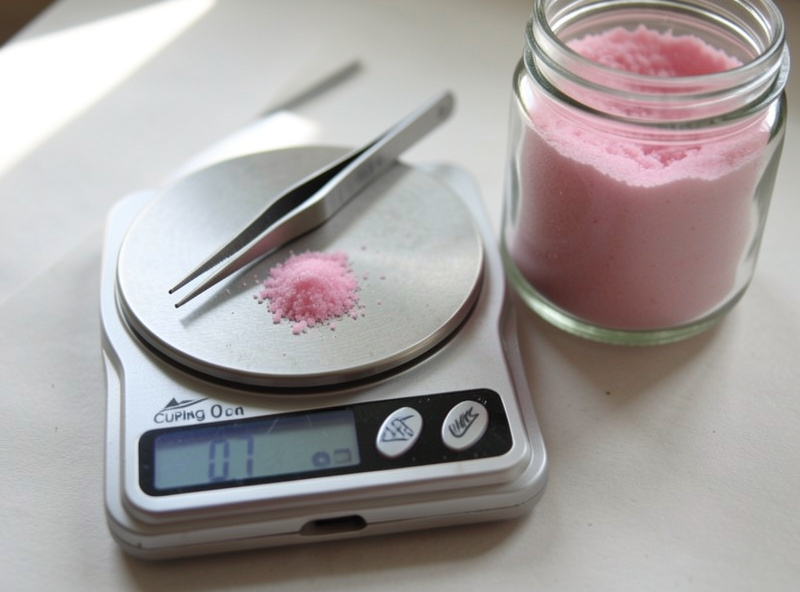
You need two scales: a standard kitchen gram scale (accurate to 1 g, capacity a few kilos) for the meat, salt and spices, and a small precision jeweler’s scale accurate to 0.1 g for the cure. The cheap two-scale setup costs very little and it is the difference between guessing your nitrite level and knowing it. A single 1 g-resolution scale cannot weigh 6 g of cure accurately enough, because a 1 g error on a small cure dose is a meaningful percentage swing in nitrite.
The bulk scale handles everything measured in tens or hundreds of grams — the meat, the salt, the dextrose, the spices — where a gram of resolution is plenty. The 0.1 g scale is reserved for the cure and for tiny spice doses like nutmeg where you might be weighing half a gram. Calibrate both occasionally with a known weight; a cheap scale can drift, and a drifting scale weighing your cure is exactly the failure you do not want. I keep my 0.1 g scale in a drawer with a calibration weight and check it before any batch where the cure math matters — which is all of them. Precision here is not fussiness; it is the same competence that keeps every ratio on this site safe.
How do you scale a charcuterie recipe by meat weight?
Weigh the trimmed green meat in kilograms, then multiply each ingredient’s per-kilogram figure by that weight. For example, 2.5 grams per kilo of cure for 3.2 kilograms of meat is 8 grams. Weigh the meat first and every other ingredient follows from it by simple multiplication.
Why are charcuterie recipes written in grams per kilogram?
Because grams per kilogram of meat is the only unit that scales accurately across batch sizes and across different spices. Teaspoons vary by ingredient and form, and curing salt must be dosed by weight for safety. Per-kilo figures multiply straight against the meat weight with no guesswork.
How do you convert a recipe in teaspoons to grams?
Turn the meat weight into kilograms, then weigh the ingredients rather than trusting spoons. Rough guides help you start: a teaspoon of cracked pepper is about 2.5 grams and a teaspoon of fine salt about 6 grams. Always recalculate curing salt by weight from scratch, never from a teaspoon.
Which ingredients must be scaled exactly?
Scale the curing salt exactly and weigh it to a tenth of a gram, since it is a safety and regulatory figure at 2.5 grams per kilo. Keep salt within the 2.5 to 3 percent band. Spices, wine, garlic and dextrose are flexible and can be rounded or adjusted to taste within sensible limits.
Should you mix the spice blend separately from the meat?
Yes, for anything beyond a single small batch. Weighing and mixing the dry blend separately lets you check it, split it across sub-batches, and catch a mistake before it reaches the meat. Weigh the salt, cure and dextrose as a safety mix and the spices as a flavor mix, then combine.
Further Reading
- The Charcuterie Spice, Seasoning & Binder Guide
- Dextrose vs Sugar in Cured Sausage: Feeding the Ferment
- How Much Black Pepper in Salami: Whole vs Cracked vs Ground
- Wine in Salami: How Much, Red vs White, and What It Does