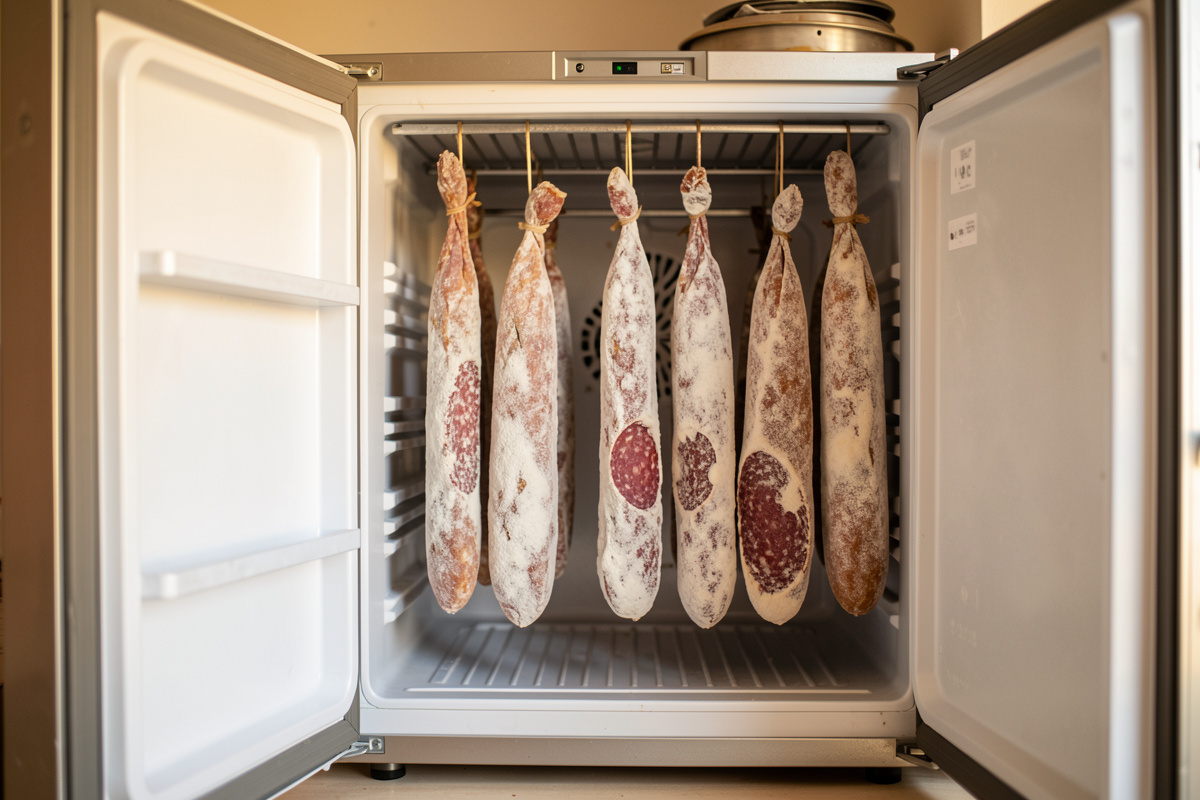

Managing mold in a curing chamber is not a one-time spray-and-forget job — it is an ongoing balancing act between the white mold you want covering your salami and the green, grey, and black molds you do not. Hold the chamber at roughly 12–15 °C and 80–85% RH early on, seed the good mold deliberately, and it will out-compete almost everything else. Get lazy about it and the biome tips the wrong way fast.
I have run converted-fridge chambers in a damp Swedish basement for years now, and the single biggest shift in my results came the season I stopped treating mold as decoration and started treating it as a live culture I was farming. A salami’s white coat is not there to look rustic. That Penicillium nalgiovense bloom lowers surface oxygen, evens the drying so the outside doesn’t case-harden ahead of the core, and physically crowds out the spoilage molds that would otherwise colonize a bare, humid casing. Skip the management and you are gambling every batch on whatever spores happen to be floating in your house that week.
This guide is the map for the whole discipline. Each section below links to a deeper how-to, because “manage your mold” breaks down into a handful of distinct skills: seeding it evenly, stopping the bad stuff from spreading, wiping off what you don’t want without wrecking the cure, reusing a good culture, coaxing a stubborn chamber into blooming, resetting between batches, and knowing when patchy coverage is fine versus a warning sign.
What Does a Healthy Curing-Chamber Biome Actually Look Like?
A healthy chamber grows an even, powdery, chalk-white to faintly grey-white coat over the casings within 5 to 9 days of hanging, with no sour ammonia smell and no fuzzy raised patches. That coat is Penicillium nalgiovense (or a close cousin), the same genus behind the rind on a good salami and conceptually the same tool a cheesemaker uses on a bloomy rind.
Think of the chamber as a small ecosystem, not a sterile box. The air carries spores. The meat surface offers water and protein. Temperature and humidity decide which organisms win the race for that surface. When conditions favor Penicillium — cool, humid, gentle air exchange — the white mold germinates first, blankets the casing, and locks out the latecomers. When conditions drift dry, or too warm, or the air goes stagnant and wet, you hand the advantage to whatever else is in the room: green penicilliums, grey “spider” molds, and in the worst case slimy bacterial films.
In my primary chamber — a full-height larder fridge run on an Inkbird ITC-308 for temperature and an Inkbird IHC-200 for humidity — I watch two numbers on a SensorPush HT.W sitting at meat-shelf height. If RH sits in the low 80s and the coil zone isn’t dumping condensation, the white mold shows up on schedule and the batch essentially manages itself. Establishing that baseline is what makes everything downstream easy. If you are still fighting to hold the envelope, my multi-zone curing setup and the chamber upgrade checklist are the place to start before you worry about mold at all.
Why White Mold Is a Feature, Not a Problem
White mold on dry-cured salami is protective, not spoilage. The bloom consumes surface oxygen, buffers the drying rate so the casing doesn’t seal shut and trap a wet core, and contributes subtle flavor as it works — a faint mushroomy, nutty note that a bare salami never develops. Commercial charcutiers seed it on purpose for exactly these reasons; the USDA’s food-safety guidance on molds distinguishes clearly between the cultured molds used deliberately in cured products and the spoilage molds you should never eat around.
The mechanism that matters most to me is drying control. Case-hardening — a dry, sealed outer shell over a still-wet interior — kills more of my pieces than bad mold ever has. A white coat slows surface evaporation just enough to keep the moisture gradient gentle. On two otherwise identical soppressata batches one winter, the well-bloomed one lost weight in a smooth curve to 36% and sliced clean; the bare one I’d rushed developed a hard rind ring and a soft center I ended up discarding. That failure taught me to treat the bloom as part of the drying system, not a garnish.
There is a safety layer too, but be precise about it: the mold is a helper, not the preservation step. What actually makes a fermented salami safe is the combination of the correct curing salt (cure #2 for anything long-dried), a proper fermentation that drops pH toward 4.6–5.2, and drying to roughly 30–40% weight loss so water activity falls below about 0.89. The white mold rides on top of that safe foundation. It never substitutes for it. Anyone telling you a “natural” no-nitrate salami is safe because it grew a nice coat is dangerously wrong.
How Do I Get White Mold to Bloom on My Salami?
You get a reliable bloom by spraying an activated Penicillium nalgiovense culture onto the casing within a day of stuffing, then holding the chamber humid (85%+ RH) and cool (around 15 °C) for the first several days while the spores germinate. Rehydrate the culture in non-chlorinated water — chlorine kills the spores outright — and give it a few hours to wake up before it touches the meat.
I use a Bactoferm Mold-600 type culture, rehydrated in distilled or dechlorinated water because my tap water is chlorinated enough to blank a whole batch. The application itself is where most people go wrong: too little culture, uneven passes, or a chamber that’s too dry for the spores to take. I cover the full method — dilution, sprayer choice, coverage pattern, and how to fix bald spots — in how to spray Penicillium mold culture on salami for even coverage. If you have sprayed correctly and still get nothing, the problem is almost always environmental; work through why white mold won’t grow in your chamber, which walks the humidity, water, and residual-sanitizer culprits in order.
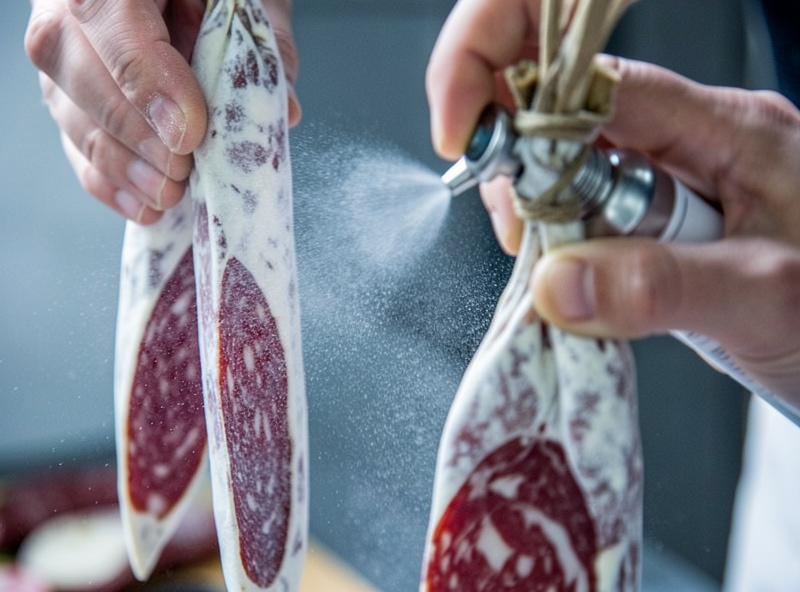
Once you have seen a good bloom take hold, you can also stop buying culture every time. A finished salami’s coat is itself a viable inoculum — you can slurry a piece of the rind and spray the next batch with it. That is a real technique with a real caveat, and I lay out both in reusing mold from a finished salami to inoculate the next batch.
Will Mold Spread Between Pieces in the Same Chamber?
Yes — mold spreads readily between pieces in a shared chamber, and that is mostly good news. A strong white bloom on one salami will happily colonize its neighbors through the shared air, which is exactly how a “house culture” establishes itself over successive batches. The flip side is that a bad mold on one neglected piece can also seed the others, so the same airflow that spreads the good stuff spreads the bad.
The practical rule I follow: never hang a fresh, unbloomed batch in a chamber that has a piece going wrong in it. Deal with the problem piece first — wipe it, or pull it entirely — before the new casings offer a fresh surface for the wrong spores. The full picture of how spores travel, whether whole-muscle pieces and salami cross-seed each other, and how competitive exclusion actually works is in will mold spread between pieces in the same chamber. This is also why cleaning discipline between batches matters so much — a chamber carrying a bad-mold load will re-infect everything you hang next.
Good Mold vs Bad Mold: A Field Guide You Can Trust
The single most useful skill in this whole discipline is reading a mold at a glance. Powdery and white or grey-white is almost always fine. Fuzzy, raised, colored, or slimy is a stop sign. Here is the field guide I actually use standing in front of the chamber, refined over more batches than I can count and cross-checked against the USDA and home-preservation guidance.
| What you see | Texture | Likely identity | Verdict & action |
|---|---|---|---|
| Chalk-white to grey-white, even | Powdery, flat, dry | Penicillium nalgiovense (good) | Keep. This is the coat you want. |
| White but fuzzy and raised, “hairy” | Cottony, standing up off the casing | Aggressive early Penicillium or Mucor (“spider”) | Wipe back with brine or vinegar; usually cosmetic if caught early. |
| Green or blue-green pockets | Powdery to slightly fuzzy | Wild green Penicillium | Wipe off; common and manageable, don’t let it dominate. |
| Black, fuzzy, spreading | Fuzzy, sometimes damp | Spoilage mold (e.g. Aspergillus/Cladosporium) | Discard the piece. Do not eat around it. |
| Pink, red, or orange | Slimy or wet-looking | Bacterial/yeast overgrowth | Discard. This is a wet-chamber failure. |
| Any mold + sour ammonia smell | Slimy or sticky | Spoilage in progress | Discard the piece; check and reset the chamber. |
Two honest caveats. First, color alone isn’t gospel — a healthy white coat can grey with age and that’s fine, while a bad mold caught in its first day can look almost white. Texture and smell are the tiebreakers: good mold is dry, flat, and smells faintly of mushrooms; bad mold stands up, spreads, and smells sour or sharp. Second, when you genuinely cannot tell, throw it out. A single salami is not worth a gamble against the organisms this niche can grow. I have binned pieces I was 80% sure were fine, and I have never once regretted it.
How Do I Wipe Off Mold I Don’t Want?
You remove unwanted mold by wiping the casing with a cloth dampened in a saturated salt brine or a 1:1 vinegar-water solution, going gently so you scuff the surface film without gouging into the meat. This knocks back green and fuzzy patches without killing the cure underneath and without needing anything harsh like bleach on food.
The reason brine and vinegar work is that both create a surface environment the spoilage molds hate — high salt or low pH — while doing nothing to the salt-and-nitrite cure already locked into the meat. I keep a jar of saturated brine and a spray bottle of white vinegar on the chamber shelf for exactly this. The technique matters, though: wipe in one direction, rinse the cloth often so you’re not smearing spores around, and never soak the casing. The complete method — including when a wipe is enough versus when the piece is too far gone — is in how to wipe off unwanted mold without killing the cure. If a good white coat regrows over the wiped area within a few days, you made the right call.
Patchy or Full Bloom: Does Uneven Coverage Matter?
Patchy white mold is usually cosmetic, not a defect — the protective effect scales with coverage, so 60% coverage still helps, it just helps less than a full coat. Uneven bloom becomes a problem only when the bald areas invite other molds or when the patchiness signals a real environmental fault like a dry spot or poor air circulation.
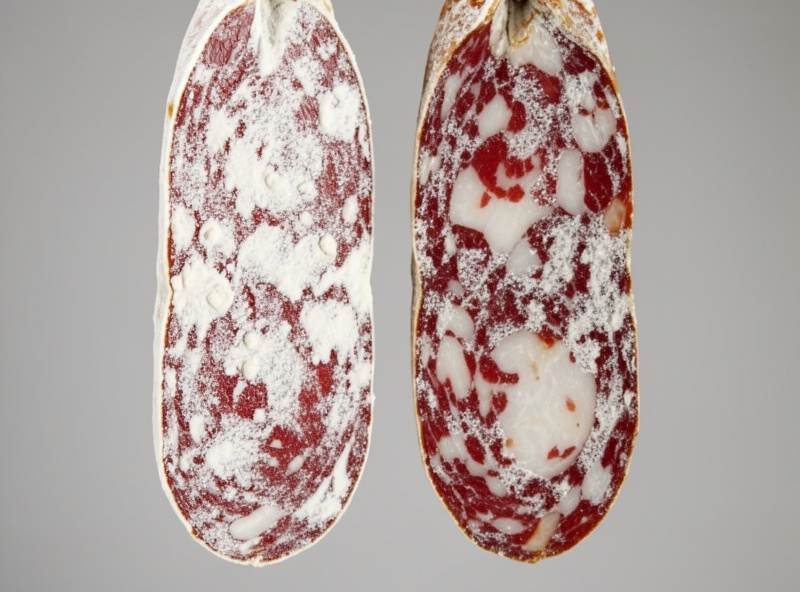
The diagnostic question is why it’s patchy. A salami that’s bald on one side often just hung against another piece or the chamber wall, blocking spores and airflow — rotate it and the bloom fills in. But if the whole batch is coming in blotchy, look at your spray coverage and your humidity uniformity. I sort out the difference between harmless patchiness and a warning sign in patchy vs full mold bloom: is uneven coverage a problem. Nine times out of ten, patchy is fine and full is prettier; the tenth time it’s telling you the chamber has a dead spot.
Can I Reuse Mold From the Last Batch?
Yes, you can reuse mold from a finished salami to seed the next batch, and once your house culture is stable it’s how I skip buying commercial culture for most runs. Cut a coin of well-bloomed casing from a clean finished piece, blend it into a little dechlorinated water to release the spores, strain, and spray that slurry onto the fresh batch the way you’d apply a bought culture.
The one real caveat is purity. A commercial Penicillium nalgiovense culture is a single known strain; your reused slurry carries whatever else grew on that rind, too. If the source piece was clean and white, that risk is small and the results are excellent — the house strain that establishes itself is often more vigorous than the bought one because it’s already adapted to your chamber. If the source had any green or off patches, don’t reuse it; start fresh from culture. The full process, the sanitation rules, and how to keep a house culture going across many batches are in reusing mold from a finished salami. This is the same competitive-exclusion logic that makes a well-established chamber almost self-seeding over time.
How Do I Clean and Reset the Chamber Between Batches?
Between batches you strip the chamber, remove all debris and drips, wash surfaces with a mild detergent, sanitize with a food-safe sanitizer, and let it dry fully before the next hang — but you stop short of nuking every last spore if you want to keep your house culture. The goal is to remove spoilage loads and organic gunk, not to sterilize the box into a blank slate every time.

This is the balance that trips people up. Sanitize too aggressively — bleach everything, run a strong quat sanitizer over every shelf — and you strip out the good Penicillium you spent batches establishing, so the next run struggles to bloom. Under-clean, and you carry forward whatever bad mold or bacterial film ended the last batch. The right cadence depends on why the last batch ended: a clean, fully-bloomed run needs only a light wipe-down, while a batch that went sour or grew black mold needs a full strip and sanitize before anything else hangs. I lay out both routines — the light reset and the deep reset — plus what to do with the fan, the humidifier reservoir, and the door gasket in how to clean and reset a chamber between batches.
What Does Ongoing Mold Management Actually Look Like Day to Day?
Day to day, mold management is a two-minute glance and a weekly touch. I open the chamber, look at every piece for color and texture, sniff for anything sour, check the SensorPush reading against the Inkbird setpoints, and top up the humidifier reservoir. Once a week I rotate pieces so no side stays pressed against a neighbor, and I wipe back any green or fuzzy spot before it establishes. That is the entire routine, and it’s what keeps a batch on the rails.
The mindset shift is treating the chamber like a slow ferment you’re tending rather than an appliance you load and forget. The pH drop that finishes a salami is the same lactic-acid chemistry that ferments a jar of sauerkraut — same bacteria family, different substrate — and the mold coat is a live culture in exactly the same way. When you start reading the biome instead of just reading a recipe, the failures get rare. My fan runs on a 5-minute-on/25-off cycle for gentle air exchange, my compressor and humidifier sit on smart plugs with schedules through Home Assistant, and the whole thing largely runs itself between my daily looks. The National Center for Home Food Preservation is a solid external reference for the underlying salt, acidity, and safety principles if you want to go deeper on the science beneath the biome.
A note on feeding the ferment, since it’s upstream of a good bloom: a salami that fermented properly and dried on a smooth curve grows better mold than one that stalled, because a healthy surface pH and moisture profile is exactly what Penicillium wants. If your ferments are inconsistent, sort that out first — my notes on dextrose vs sugar in cured sausage cover feeding the culture, and the ‘nduja method and cold smoking safety pages tie the mold work back into complete, safe builds. Cheese-side, the blue cheese mould and aging guide shows the same Penicillium logic on a different substrate.
If you buy your first culture and a decent mist sprayer online, an activated white-mold culture and a fine-mist continuous spray bottle are the only two things you truly need to start managing your chamber’s biome on purpose.
As an Amazon Associate I earn from qualifying purchases.
Is white mold on my salami safe to eat?
Yes, an even powdery white or grey-white coat is Penicillium nalgiovense, the cultured mold used deliberately on dry-cured salami. It is protective, not spoilage. What makes the salami itself safe is the correct cure #2, a proper fermentation dropping pH toward 4.6 to 5.2, and drying to 30 to 40 percent weight loss. The mold rides on top of that safe foundation and never replaces it.
How do I tell good mold from bad mold?
Good mold is powdery, flat, dry, white to grey-white, and smells faintly of mushrooms. Bad mold is fuzzy and raised, or colored green, black, pink, or red, and often smells sour or sharp. Texture and smell are more reliable than color alone. When you genuinely cannot tell, throw the piece out.
Will bad mold on one salami spread to the others?
It can, because the same shared air that spreads a good white bloom between pieces also spreads spoilage molds. The practical rule is to deal with any problem piece, by wiping or removing it, before hanging a fresh unbloomed batch that offers a clean surface for the wrong spores.
Do I have to buy mold culture every time?
No. Once you have a clean white bloom established, you can cut a coin of well-bloomed casing from a finished piece, blend it in dechlorinated water to release the spores, strain, and spray that slurry on the next batch. Only reuse from a clean, fully white source. If the source had green or off patches, start fresh from commercial culture.
Why won’t any white mold grow in my chamber?
The usual culprits are chlorinated water killing the spores when you rehydrate the culture, humidity too low for germination, residual sanitizer on the surfaces, or a chamber running too warm or too dry in the first days. Rehydrate in distilled or dechlorinated water, hold 85 percent RH and around 15 degrees C for the first several days, and avoid over-sanitizing before a hang.
Does patchy mold coverage ruin the salami?
Usually not. The protective effect scales with coverage, so partial bloom still helps, just less than a full coat. Patchiness is only a problem when bald areas invite other molds or when it signals a dead spot in the chamber. A piece bald on one side often just hung against a neighbor or wall, so rotate it and the bloom fills in.
Keep Building
- How to Spray Penicillium Mold Culture on Salami for Even Coverage
- Will Mold Spread Between Pieces in the Same Chamber?
- How to Wipe Off Unwanted Mold Without Killing the Cure
- Reusing Mold From a Finished Salami to Inoculate the Next Batch
- Why Won’t White Mold Grow in My Chamber? Humidity and Spore Fixes
- How to Clean and Reset a Chamber Between Batches
- Patchy vs Full Mold Bloom: Is Uneven Coverage a Problem?