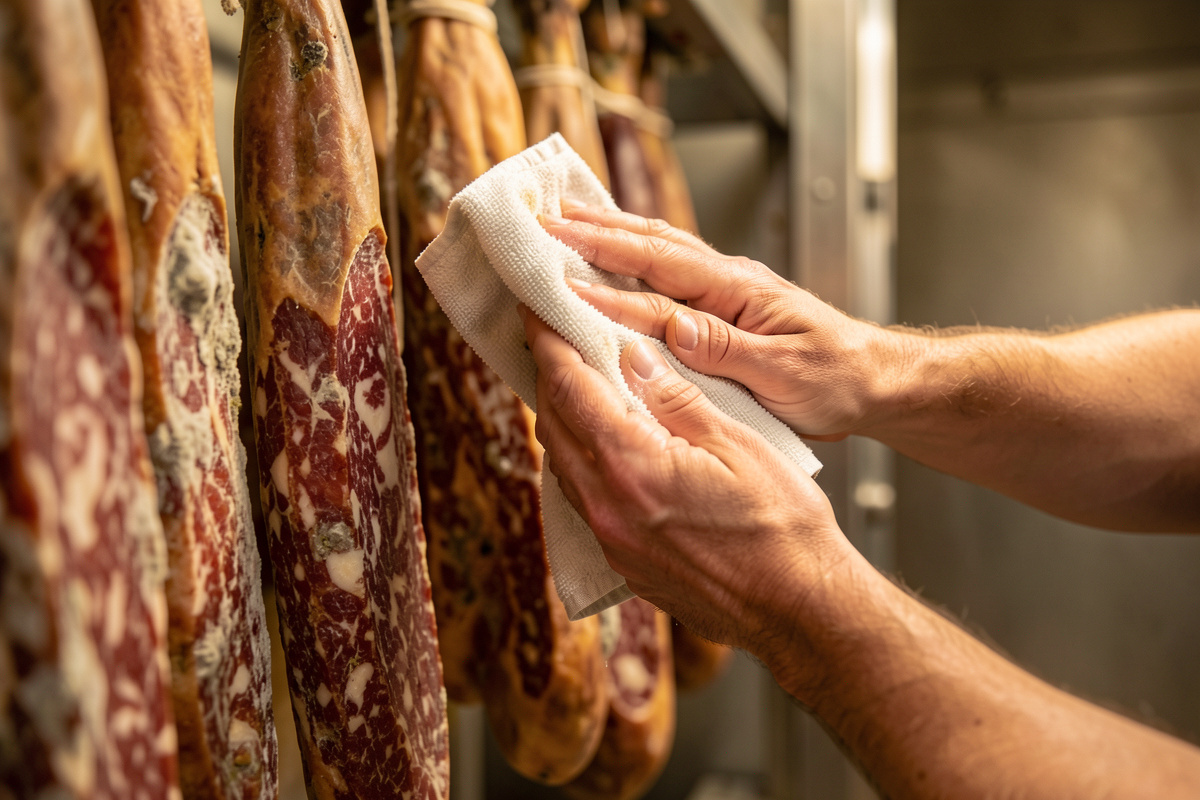

To wipe unwanted mold off a salami without killing the cure, dampen a cloth in saturated salt brine or a 1:1 white-vinegar-and-water solution, and wipe the casing gently in one direction until the patch lifts. The cure lives inside the meat — the salt and nitrite locked in during curing — so scrubbing a surface film off the outside does nothing to the preservation underneath. What you’re removing is unwanted growth on the casing, not the cure itself.
This trips up a lot of home curers who think any intervention will “ruin” a piece. It won’t. I wipe pieces routinely — a green speck here, a fuzzy patch there — and they carry on drying to a clean finish. The mistake I made early on was the opposite: I got aggressive with a scrubbing pad on a bresaola, gouged through the surface into the meat, and created a raw spot that then dried unevenly and hard. Gentle is the whole trick. You’re wiping a chalkboard, not sanding a deck.
Knowing what to wipe versus what to bin is a core skill in managing mold in your curing chamber, and it pairs directly with understanding how mold spreads between pieces — wiping early is often what stops a small problem from seeding the whole rack.
What Should I Wipe Mold Off With?
Use saturated salt brine or a 1:1 white vinegar and water solution — both create a surface the spoilage molds hate without touching the cure. Brine works by high salt; vinegar works by low pH. Either one dampens the growth, lifts it off, and leaves behind a surface that discourages the same mold from immediately returning.
I keep a small jar of saturated brine (salt stirred into water until no more dissolves) and a spray bottle of plain white vinegar on the chamber shelf, because the moment you spot a patch is the moment to deal with it. Between the two, I reach for vinegar on green and fuzzy patches and brine when I want to knock something back without adding acidity near a piece that’s close to done. Both are food-safe and neither leaves a residue that hurts the eventual white bloom.
What you should not use is bleach or any harsh chemical sanitizer directly on the meat. Bleach has no place touching food you’re going to eat, it can penetrate the casing, and it’ll wreck any chance of the good white mold re-establishing on that spot. Save sanitizers for the empty chamber between batches, never for a hanging piece. Plain kitchen ingredients — salt and vinegar — are all you need on the meat itself.
Why Doesn’t Wiping Kill the Cure?
Wiping doesn’t kill the cure because curing is an internal chemical process, not a surface coating. During curing, salt and — for anything long-dried — cure #2 (nitrite plus nitrate) penetrate the whole piece, drawing out water, lowering water activity, and protecting against the organisms that matter. That protection is diffused through the meat. A cloth on the outside can’t reach it.
Think about where the safety actually comes from on a dry-cured piece: the correct cure salt, a fermentation that drops pH toward 4.6–5.2 on salami, and drying to 30–40% weight loss so water activity falls below roughly 0.89. Every one of those is a bulk property of the meat, established before the piece ever grew mold. The surface mold — good or bad — is a separate, later layer. Removing bad surface mold is housekeeping; it doesn’t unwind any of the chemistry that made the piece safe. This is exactly why you can wipe a green patch off with confidence and keep drying the piece.
The one thing wiping can affect is the drying surface. If you soak a casing repeatedly you locally rehydrate it, which can slow drying at that spot. That’s why the method is a damp cloth, wrung out, not a wet sponge dripping down the piece. Damp, gentle, and done.
How Do I Wipe Without Damaging the Casing?
Wipe gently in a single direction with a well-wrung cloth, rinsing the cloth often so you’re lifting spores away rather than smearing them around. Never scrub back and forth with pressure — that pills the casing, can tear a natural gut, and in the worst case gouges into the meat like I once did to that bresaola. Let the brine or vinegar do the chemical work; your hand just guides it.
My routine when I spot a patch: wet the cloth, wring it until it’s barely damp, wipe the affected area in one slow pass away from the clean casing so I’m not dragging the mold across good territory, then flip to a clean part of the cloth and do it once more. If the patch is stubborn I let the vinegar sit on it for a minute to soften the growth before the second pass, rather than pressing harder. The casing should feel intact under your fingers afterward — a little damp, maybe slightly discolored where the mold was, but not scuffed raw. If you feel the surface pilling or see the meat underneath, you’re pressing far too hard.
Work over a surface you can wipe down after, because you’re moving live spores around. I wipe pieces right in the chamber but clean the shelf below afterward, since anything that drops is just re-seeding the box. That housekeeping habit is part of the broader chamber mold discipline.
Which Molds Can I Wipe and Which Mean Discard?
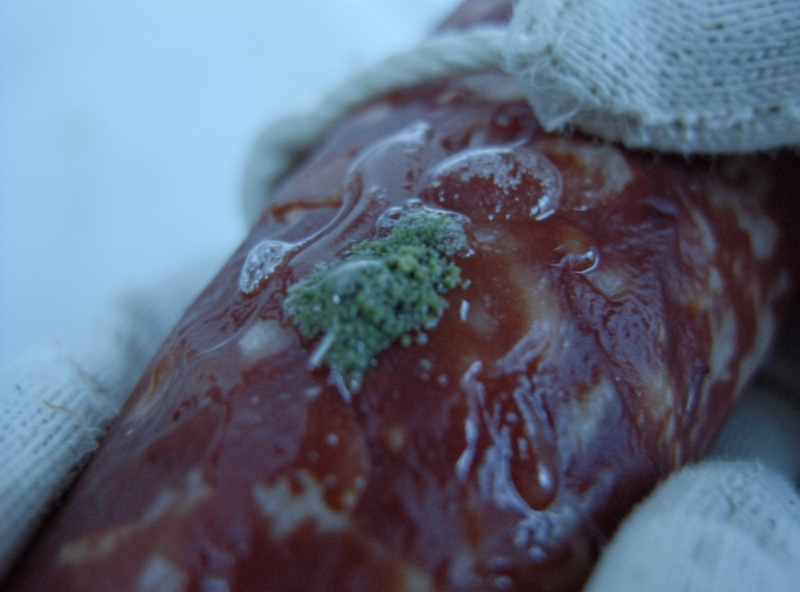
You can wipe green, blue-green, and early fuzzy white or grey patches — these are common, superficial, and manageable. You must discard the piece for black fuzzy mold, pink or red slime, or any growth accompanied by a sour ammonia smell — these signal spoilage that has likely penetrated below the surface. The dividing line is roughly: superficial and dry, wipe it; penetrating, colored-dark, or slimy, bin it.
| Cleaning approach | How it works | Best on | Notes |
|---|---|---|---|
| Saturated salt brine | High salt suppresses mold | General wiping, near-finished pieces | No added acidity; leaves a curing-friendly surface |
| 1:1 vinegar and water | Low pH suppresses mold | Green and fuzzy patches | Let it sit a minute on stubborn spots |
| Dry soft brush | Physical removal only | Light powdery excess | Doesn’t discourage regrowth; use with brine |
| Bleach / harsh sanitizer | — | Never on the meat | Banned on hanging pieces; empty chamber only |
Two honest caveats on the “wipe it” side. First, if green mold keeps coming back aggressively after two or three wipes, that’s your chamber telling you the good white culture isn’t dominant enough — the fix is upstream, in seeding and humidity, not endless wiping. Second, and I can’t say this strongly enough: when you genuinely can’t tell whether a piece is wipe-able or spoiled, throw it out. This niche can grow organisms that make people sick. A single salami is never worth eating around a mold you’re unsure about — the USDA’s own guidance on molds in high-moisture foods lands in the same place.
Will White Mold Grow Back After I Wipe?
Yes — if your chamber conditions favor Penicillium, a good white coat will regrow over the wiped area within a few days, and that’s the sign you made the right call. You’ve cleared the bad growth and handed the surface back to the good mold, which recolonizes from the spores already in the chamber air.
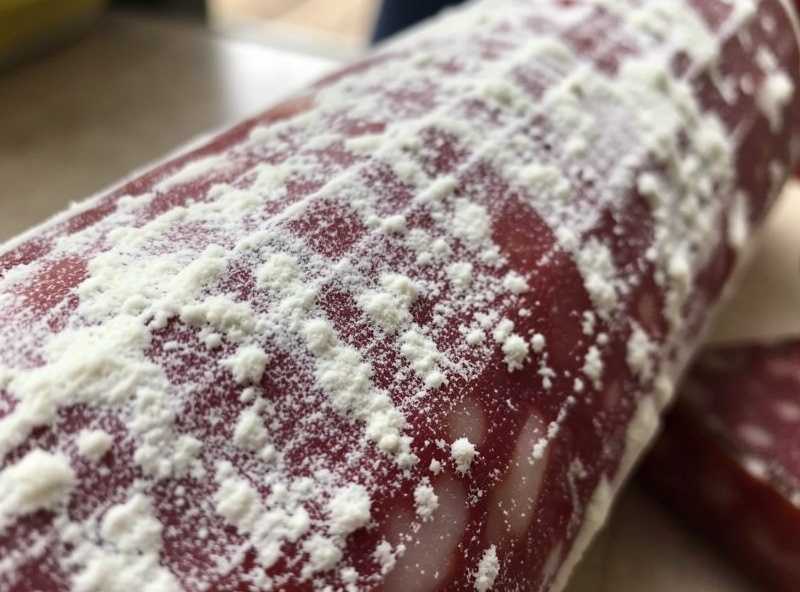
In an established chamber with a resident house culture, regrowth is automatic — I’ve wiped a green patch off a coppa and watched clean white fill back in within four or five days without doing anything else. In a newer chamber you may want to re-mist that spot with a little culture after wiping, especially if it was a large area. Either way, the return of an even white coat over wiped territory is the confirmation that the piece is fine and the balance has tipped back the right way. If white mold isn’t returning anywhere, that’s a separate diagnosis about your chamber’s humidity and spores rather than a wiping problem. Keep the drying envelope in its window — around 12–15 °C and 80% RH — and the good mold does the rest.
Does wiping mold off ruin the cure?
No. Curing is an internal process, with salt and cure #2 penetrated all through the meat, so wiping a surface mold film off the outside does nothing to the preservation underneath. The safety of a dry-cured piece comes from the cure salt, the fermentation pH drop, and drying to 30 to 40 percent weight loss, all bulk properties established before the piece grew any mold.
What should I wipe mold off a salami with?
Use saturated salt brine or a 1:1 white vinegar and water solution on a well-wrung cloth. Brine suppresses mold with high salt, vinegar with low pH, and neither harms the cure or blocks the good white mold from returning. Never use bleach or harsh sanitizer on a hanging piece; save those for the empty chamber between batches.
Which molds can I wipe off and which mean I should throw the piece out?
You can wipe green, blue-green, and early fuzzy white or grey patches, which are superficial and common. Discard the whole piece for black fuzzy mold, pink or red slime, or any growth with a sour ammonia smell, since these signal spoilage that has likely gone below the surface. When you genuinely cannot tell, throw it out.
How hard should I scrub the mold?
Very gently, in a single direction, letting the brine or vinegar do the chemical work. Never scrub back and forth with pressure, which pills the casing, can tear a natural gut, and may gouge into the meat. The casing should feel intact afterward, only slightly damp, not scuffed raw.
Will white mold grow back after I wipe a spot?
Yes, if your chamber favors Penicillium the good white coat regrows over the wiped area within a few days, recolonizing from spores already in the chamber air. In an established chamber this is automatic. In a newer chamber you may want to re-mist the spot with a little culture after wiping a large area.
Keep Building
- Managing Mold in Your Curing Chamber: The Complete Guide
- Will Mold Spread Between Pieces in the Same Chamber?
- How to Spray Penicillium Mold Culture on Salami
- Multi-Zone Curing Setup: Ferment and Dry at Once