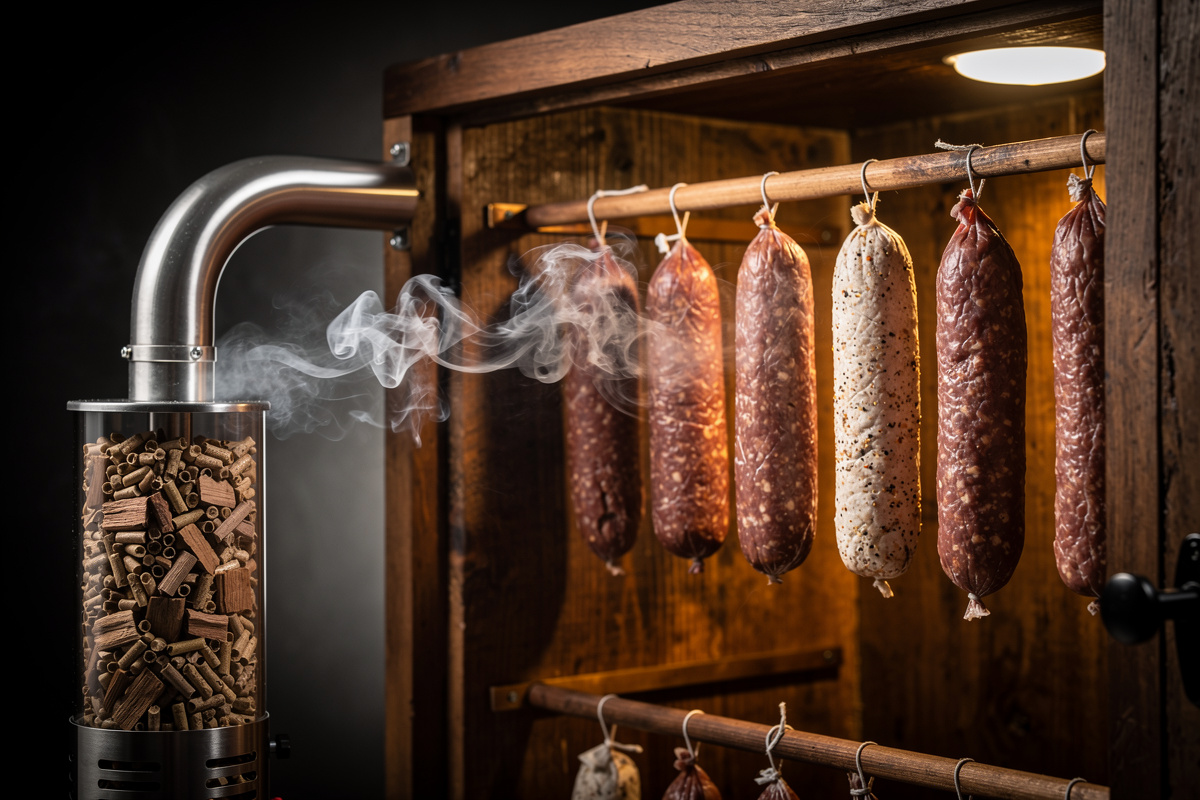

I add cold smoke to my salami in two 4-hour sessions on days 3 and 5 of the cure, after the LAB pH drop has finished and before the chubs go into long-term hang at 55°F.
As an Amazon Associate I earn from qualifying purchases.
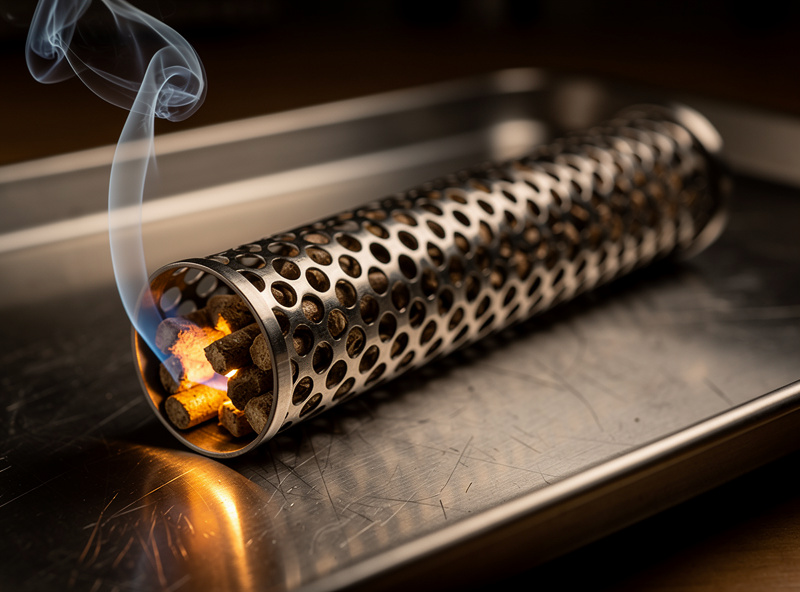
The chamber air temperature during the smoke sessions stays at 65 to 70°F in my basement — never above 75°F — using an A-MAZE-N 12-inch pellet tube and apple-wood pellets. Add cold smoke to salami after fermentation is complete (typically days 2 to 4) and before the salami enters the long-cure chamber. Smoke at chamber air temperature 60 to 75°F maximum — never higher. Two to four 4-hour smoke sessions across 2 to 3 days is the production-style schedule that gives noticeable smoke flavor without crossing into hot-smoke territory or damaging the cure microbiology. The broader context — generators, woods, schedules, other foods that take cold smoke — is in cold smoking at home: the complete guide.
The temperature ceiling is critical, and it’s not just about protecting the ferment. By the time salami reaches the smoke window it’s already fermented and cured with pink salt #2 — nitrite is doing real protective work — but nitrite alone doesn’t make a warm afternoon safe. Peer-reviewed research on nitrite-treated meat held under temperature abuse found C. botulinum spores germinating within 3 days at 81°F even with nitrite present (cited in full below); nitrite lowers the odds, it doesn’t eliminate them at warm temperatures. That’s why 80°F is a hard ceiling during the smoke sessions, and above 90°F you also start to render fat, which destroys salami texture permanently and can’t be undone. I learned the ceiling the hard way: my third cold-smoke attempt I ran the A-MAZE-N tube too close to the chamber on a 78°F summer afternoon, and the chamber air climbed to 86°F for about 90 minutes before I noticed. The Soppressata-style chubs from that batch had a slightly tacky surface that never developed the right white bloom. Now I run the smoke generator outside the chamber and pipe smoke in via a 1-inch food-grade silicone tube to keep the heat out — the tube itself produces smoke at 70 to 100°F at the source, and it needs to cool to at or below ambient chamber temperature by the time it reaches the salami. This guide covers when in the cure to add smoke, how much smoke to add, hardware options, and the four common mistakes that ruin the result.
Why Cold Smoke and Salami Aren’t Standard Together
Most traditional Italian and Spanish salami is not smoked — it depends on white mold and air-drying alone for surface protection and flavor. Smoked salami is a Northern European tradition (German Landjäger, Swiss Cervelat, Polish Kabanos) and a defining feature of American craft charcuterie since the 2010s. Both are correct; they’re just different traditions.
The reason to smoke at all: smoke compounds add flavor depth, contribute antimicrobial properties (phenols and aldehydes inhibit unwanted surface bacteria and molds), and produce the dark amber casing color associated with traditional smoked sausages. For chubs that won’t develop white mold (because smoke inhibits it), smoke is the substitute protective layer.
Skip smoking if you want traditional Italian-style salami with white mold. Add smoking if you want Eastern European or American craft style. The decision happens at the recipe-design stage, not partway through the cure. The home salami making covers tradition-by-tradition recipe families.
The Temperature Ceiling: Why 80°F Matters
By the time smoke goes on (days 2 to 4, after fermentation is finished — see the schedule below), the lactic acid bacteria have already dropped pH from roughly 6.2 down to 5.0 and pink salt #2 is already doing its job. The 80°F ceiling at this stage isn’t about protecting the ferment — that’s done — it’s about not re-opening a temperature-abuse window on cured meat. Research on nitrite-treated meat held under temperature abuse found C. botulinum spores germinating within 3 days at 81°F even with nitrite present in the product. If you smoke before fermentation is actually complete, that’s a separate and worse mistake: an unfinished pH drop stacked on top of a temperature excursion.
Above 90°F, the fat in the salami begins to render and migrate. This destroys the meat-to-fat structure that defines salami texture — finished pieces have a greasy mouth-feel and may show visible fat pooling at the bottom of the casing. The damage is permanent.
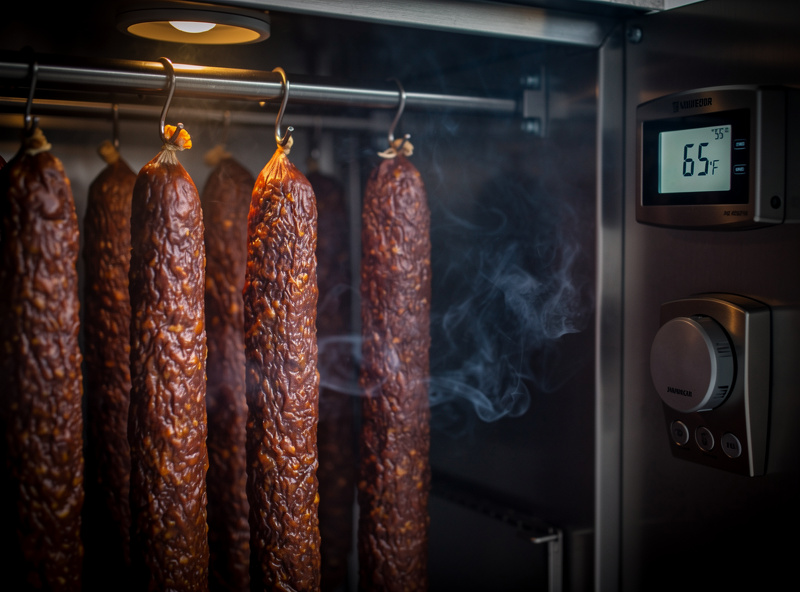
The safe smoking temperature window for salami is 60 to 75°F chamber air temperature. Most cold smoke generators produce smoke at 70 to 100°F at the source — the smoke cools to ambient by the time it diffuses through the chamber. Use a digital thermometer probe inside the smoking chamber to verify; never trust the smoke generator’s stated temperature alone.
When in the Cure to Add Smoke
Day 0 (stuffing day): No smoke. The fresh salami is too wet to absorb smoke compounds usefully, and smoke at this stage interferes with starter culture establishment.
Days 1 to 2 (fermentation phase): No smoke. The LAB are actively dropping pH at this stage and need 65 to 75°F warm temperature plus high humidity (90%+) to work. Adding smoke here can suppress LAB activity and risk fermentation failure.
Days 2 to 4 (post-fermentation, pre-cure): Add smoke. The LAB have completed pH drop, the casing has dried slightly so it absorbs smoke compounds well, and the chamber temperature can drop from 70°F (fermentation) toward 55°F (cure) over a 2-day window. This is the smoke window: 2 to 4 sessions of 4 hours each across 2 to 3 days.
Day 4+ (long cure phase): No additional smoke. The salami has developed enough surface dryness that additional smoke compounds don’t penetrate well, and the chamber temperature is now too low for safe smoke generation. Any smoke adjustments happen in the post-fermentation window.
Cold Smoke Generator Options
| Equipment | Cost | Smoke Duration per Fill | Best Wood Format | Pros | Cons |
|---|---|---|---|---|---|
| A-MAZE-N pellet maze (12 inch) | $25 to $35 | 10 to 12 hours | Hardwood pellets | Cheap, reliable, low-tech | Inconsistent burn rate |
| ProQ Cold Smoke Generator | $45 to $65 | 10 to 12 hours | Sawdust | Even burn, refillable | Sawdust can be hard to source |
| Smoke Daddy Big Kahuna | $120 to $160 | 4 to 8 hours per fill | Wood chips | Air-pump driven, very controllable | Requires aquarium air pump |
| Ceramic cold smoke unit | $80 to $150 | Varies, 6 to 12 hours | Pellets or chips | Dedicated for cold smoke only | Limited brand availability |
| DIY soldering-iron-and-can | $10 to $20 | Continuous with refills | Sawdust or pellets | Cheapest possible | Fire risk, requires constant attention |
For starting out, the A-MAZE-N pellet maze ($30) is the right balance of cost, reliability, and low maintenance. Light one end with a torch, wait for it to ignite a 1-inch zone, blow out the flame, and let the pellets smolder. A 12-inch maze produces 10-12 hours of cold smoke from one fill — enough for two 4-hour smoking sessions on the same fill.
Hardwood Selection
Apple wood: The most forgiving for salami. Mild sweet smoke flavor, doesn’t overpower the meat. Best choice for first-time smoking experiments.
Hickory: Stronger smoke flavor, classic American craft salami profile. Use hickory in moderation — over-smoking with hickory creates a harsh acidic edge in the finished salami.
Oak (white or red): Medium smoke flavor with a slightly tannic note. The traditional choice for European-style smoked salami like Cervelat.
Beech: Light smoke with very subtle floral notes. Best for delicate-flavor salami where you want detectable but not dominant smoke.
Avoid cherry, mesquite, and pecan for first attempts — they’re stronger or more particular flavors that work well in experienced hands but can ruin a beginner batch by overpowering the cured meat character. Avoid any softwoods (pine, cedar, fir) entirely — softwood smoke is unpalatable and contains compounds that can cause health issues.
The 2-3 Day Smoke Schedule
Day 2 (post-fermentation, evening): Set up the cold smoke generator outside the chamber or in an attached smoke box. Light the pellets, generate smoke. Move salami chubs to the smoking chamber (still hanging on the same hooks). Smoke for 4 hours at 60 to 70°F. After 4 hours, return the salami to the curing chamber for the night.
Day 3 (morning): Repeat the 4-hour smoke session. Total smoke exposure now 8 hours.
Day 3 (evening): Optional third 4-hour session if you want pronounced smoke flavor. Most beginners stop at 8 hours total because additional smoke doesn’t add proportional flavor.
Day 4 (morning): Optional fourth session. Stop at 16 hours maximum lifetime smoke exposure for any single batch — past that point smoke compounds saturate the casing and additional smoking is wasted.
After the smoke schedule completes, the salami enters the long-cure phase at 55°F and 75% humidity for the standard 4 to 8 weeks (depending on chub size). The smoked salami will show a distinct amber color across the casing — this is normal and indicates the smoke has done its work.
Common Cold-Smoking Mistakes
Mistake 1: Smoking before fermentation completes. Adding smoke during the 2-day fermentation window can suppress LAB activity and prevent the pH drop required for safe shelf-stable salami. Always confirm pH drop (with a pH meter) or visible signs of fermentation (slight tang smell, casing tightening) before introducing smoke.
Mistake 2: Chamber temperature above 80°F. Use a digital probe in the smoking chamber to verify air temperature. The smoke generator’s stated temperature is misleading — air temperature in the chamber is what matters. If chamber temperature exceeds 75°F, increase ventilation or move the smoke generator further from the chamber.
Mistake 3: Continuous smoking instead of sessions. Continuous 24+ hour smoking saturates the casing with smoke compounds beyond the point where they add flavor. Sessions of 4 hours separated by 8 to 16 hour rests give better flavor development and let smoke compounds penetrate more deeply.
Mistake 4: Wrong wood. Pine, cedar, or other softwoods produce unpalatable and potentially harmful smoke. Use only hardwoods specifically sold for food smoking. The curing chamber troubleshooting covers smoke flavor diagnosis when results disappoint.
Smoke Chamber vs Cure Chamber: Same or Separate?
The cleanest setup is a separate smoke chamber. A cardboard box with a stovepipe inlet for smoke and a small air vent at the top is enough for a beginner. This keeps smoke compounds out of your long-cure chamber where they could affect later batches and lets you control smoking temperature independently.
The shared-chamber approach: place the smoke generator inside the cure chamber for the smoking sessions. Works for occasional smoking but the chamber walls absorb smoke compounds permanently and every future batch will have a faint smoke note. Acceptable if you only ever make smoked salami; problematic if you also make non-smoked Italian-style.
Best home setup: a $30 to $50 used wine cooler converted to a smoke chamber with a hole drilled in the side for the smoke inlet. Total cost about $80 with the smoke generator. The cure chamber stays clean and the smoke chamber can run cold smoke any time without affecting anything else. The curing chamber build cost guide covers the dual-chamber economics.
Frequently Asked Questions
At what temperature should I cold smoke salami?
60 to 75 degrees F chamber air temperature, never above 80 degrees F. By the time you’re smoking, fermentation is already done, so the 80-degree ceiling is about not re-opening a temperature-abuse window on cured meat, not about protecting the ferment – nitrite lowers botulism risk, it does not eliminate it at warm temperatures. Above 90 the fat begins to render and destroy salami texture. Use a digital probe in the chamber to verify air temperature, not the smoke generator’s stated output.
When should I add cold smoke to salami?
After fermentation completes (typically days 2 to 4 from stuffing). The LAB have finished dropping pH, the casing is slightly dry and ready to absorb smoke compounds, and chamber temperature can drop from 70 degrees F (fermentation) toward 55 degrees F (cure) during the smoke window.
How many cold smoke sessions does salami need?
Two to four 4-hour sessions across 2 to 3 days, totaling 8 to 16 hours of smoke exposure. Past 16 hours, smoke compounds saturate the casing and additional smoking is wasted. Most beginners stop at 8 to 12 hours for noticeable but not overpowering smoke flavor.
What wood for cold smoking salami?
Apple is the most forgiving for first attempts (mild sweet smoke). Oak is the traditional European choice (medium smoke, slightly tannic). Hickory works for American craft style but use moderation. Avoid all softwoods (pine, cedar) — they produce unpalatable smoke and contain harmful compounds.
Can I cold smoke and air-cure salami in the same chamber?
Possible but not ideal — the chamber walls absorb smoke compounds permanently and every future batch will have a faint smoke note. Better to use a separate smoke chamber (a $30 used wine cooler with a smoke inlet works) so the cure chamber stays clean for non-smoked batches.
What is the difference between cold smoking and hot smoking salami?
Cold smoking happens at chamber air temperature 60 to 75 degrees F and adds flavor without cooking the meat — used for shelf-stable dry-cured salami. Hot smoking happens at 165 to 225 degrees F and cooks the meat fully — used for fresh sausages and bacon, not for dry-cured salami.
Related Articles
- Cold Smoking at Home: The Complete Guide
- DIY Cold Smoke Generator: Build a Maze From Scratch
- Home Salami Making: The Complete Guide
- How to Make Genoa Salami Step by Step
- Salami Fermentation Chemistry: pH Drop and LAB Science