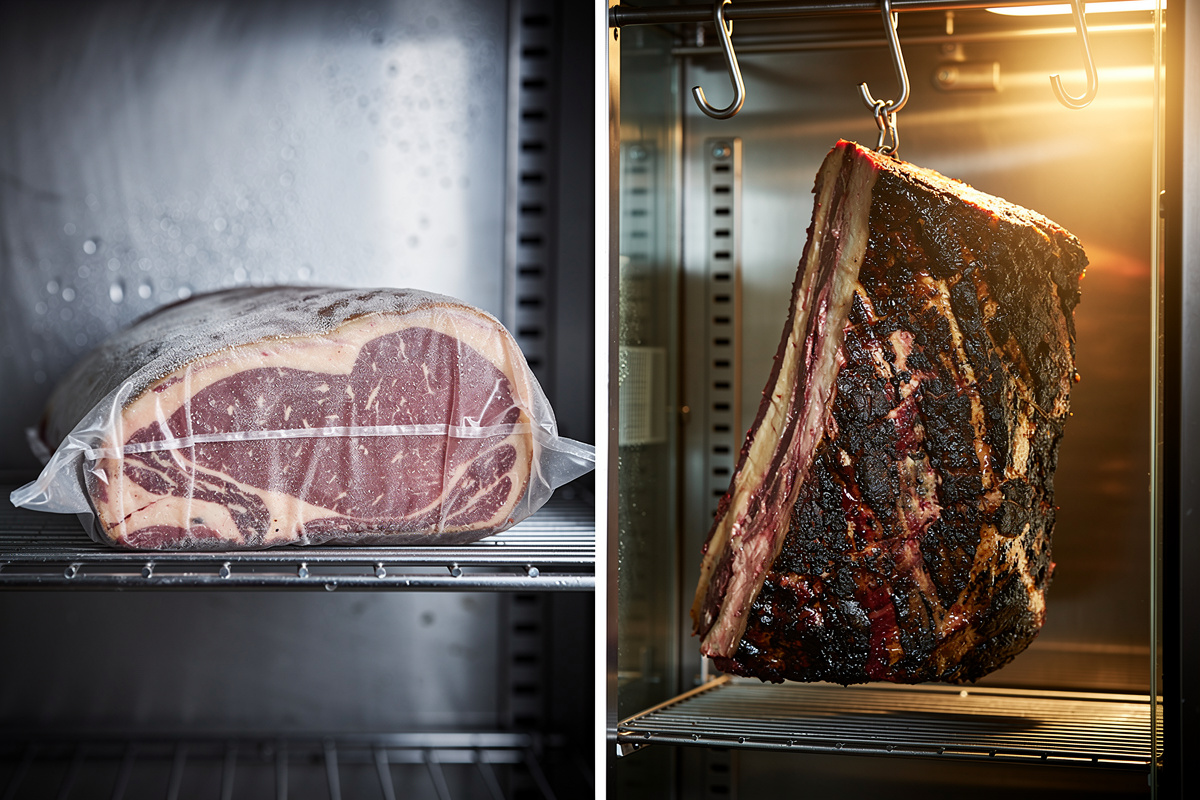

A dry-aging bag and open-air aging both dry-age beef, but the bag is a permeable membrane that works in any kitchen fridge with a modest yield edge (roughly 60-70% versus open air’s 50-55%) and milder funk, while open-air aging in a dedicated chamber gives the deepest flavor at the cost of more trim and far more management. The bag is the safer, easier route; open air is the connoisseur’s.
This is a method question, not a brand question — if you want the head-to-head of UMAi versus SteakAger versus DryBagSteak, that lives in best dry aging bags tested. Here I am comparing the two ways to dry-age at home: sealed in a breathable bag versus hung naked in moving cold air. I have run both, and they produce genuinely different steaks.
How the Two Methods Work
Both methods evaporate water and tenderize beef at 32-39°F (0-4°C) and 75-85% relative humidity, but they control the surface differently. A dry-aging bag bonds to the meat and lets moisture pass out while sealing contamination off. Open-air aging exposes the surface fully to cold, moving air and the airborne flora that build deep funk.
The dry-aging bag is a clever piece of materials science. It is a permeable membrane that adheres tightly to the meat surface, so water vapor migrates out through the film while bacteria and stray airborne mold cannot get in. That means you can dry-age inside an ordinary kitchen refrigerator, surrounded by other food, without a dedicated chamber. Open-air aging is the traditional method: the subprimal hangs or sits on a rack in a climate-controlled chamber with gentle air movement, every surface exposed, and published research on the method puts total shrinkage plus trim loss well into the 45-50% range for a typical age2. The exposure is the point — it lets a colony of beneficial mold and yeast establish on the bark, and that colony is what produces the strongest nutty, blue-cheese funk. The bag trades a little of that flavor ceiling for enormous convenience and safety margin.
The Dry-Aging Bag Method
A dry-aging bag delivers true dry-aged flavor in a normal fridge with a modest yield edge over open air. You vacuum-seal the cut into the membrane, set it on a rack in the fridge, and wait. It is the best entry point: beginner-friendly, contamination-resistant, and forgiving of a fridge that is too dry for open-air aging.
The bag’s biggest advantage after convenience is yield, though it is a real edge, not the dramatic one it sometimes gets credited with. UMAi Dry, the flagship bag brand, states on its own site that combined trim loss and moisture concentration “can add up to as much as 40%” even on a bagged cut, and independent user-reported yields on forums cluster around 55-70% after trim1 — so plan on roughly 60-70% for a well-sized bagged subprimal, better than open air’s 50-55% but not the near-lossless outcome some marketing implies. Because the membrane still limits how hard and deep the bark forms, you do trim away noticeably less than an open-air cut. That makes the bag the smart choice for small or premium cuts where every ounce counts — a Wagyu strip end or a picanha goes in a bag, never on an open shelf. The trade-offs are real but minor: you need a vacuum sealer to draw the bag down properly, a bad seal can spoil the cut, and the flavor tops out a notch below a long open-air age because the membrane limits surface colonization. For 21 to 45 days, most people cannot tell a bagged ribeye from an open-air one; past 45 days, open air pulls ahead on funk.
The Open-Air Method
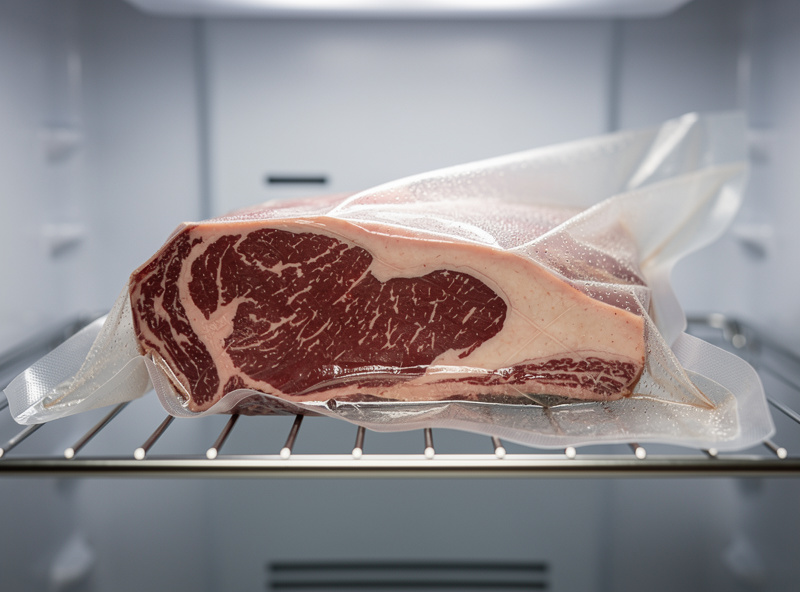
Open-air aging produces the deepest, funkiest flavor but demands a dedicated chamber and constant attention. The fully exposed surface develops the richest mold colony and the most pronounced bark, which is why steakhouses age this way — at the cost of lower yield, climate babysitting, and a chamber that can do nothing else during the run.
This is the method for flavor maximalists. With the whole surface exposed to gently moving air, the beneficial surface flora colonize fully and the bark develops its characteristic hardness, and that is what pushes a 45 or 60-day age into the intense, cheesy territory a bag cannot quite reach. The price is management. You need a chamber holding 32-39°F and 75-85% RH with drift under 3°F and 5% RH, plus gentle air exchange — a fan cycling roughly five minutes on and twenty-five off, never blowing directly at the meat. You cannot share the chamber with cheese or salami during a run because of cross-contamination at the bark, and the yield is lower because the harder bark means more aggressive trimming. Open air rewards the work, but it is work, and it has a practical home ceiling: past 60 days a converted fridge is operating without the UV air treatment commercial 90+ day rooms use, so push much beyond that and the risk profile changes, not just the flavor — the full breakdown is in how long to dry age beef. The chamber build itself is covered in dry aging beef at home.
Bag vs Open Air Compared
Here is the head-to-head on the factors that actually decide which method fits your kitchen, your patience, and the cut you bought. The honest summary: the bag wins on everything except peak flavor at long ages.
| Factor | Dry-Aging Bag | Open Air |
|---|---|---|
| Equipment | Bag, vacuum sealer, any fridge | Dedicated chamber or beverage cooler |
| Usable yield | ~60-70% | ~50-55% |
| Flavor depth | True dry-age, milder funk | Deepest, strongest funk |
| Best age range | 21-45 days | 28-60 days (home ceiling) |
| Contamination risk | Low (sealed membrane) | Higher (open surface) |
| Management effort | Minimal | Constant climate control |
| Best for | Beginners, small/premium cuts | Maximum flavor, long ages |
Notice how the two columns barely diverge until the bottom rows. For a first age, a small cut, or anyone without a spare fridge to dedicate, the bag is simply the better tool. Open air earns its place only when you specifically want the deepest funk and are willing to run a chamber that does nothing else for a month or more.
The Safety Picture for Each
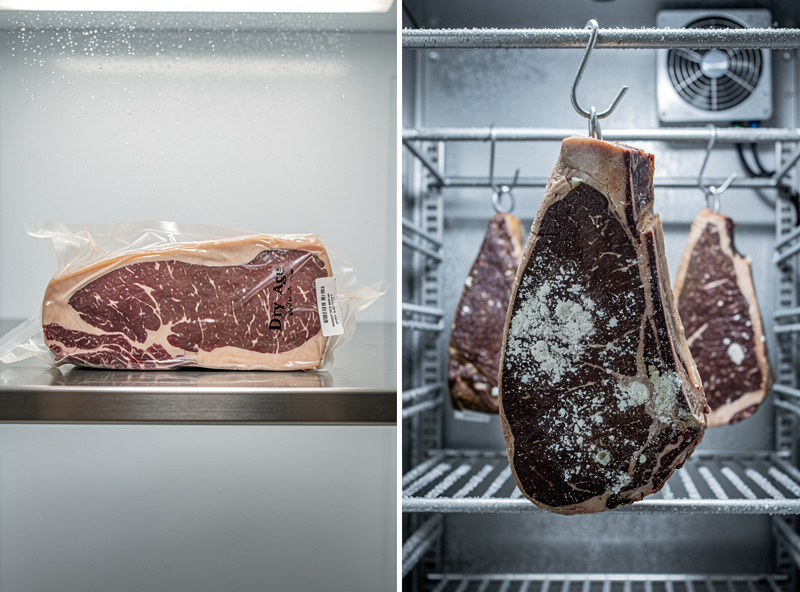
Both methods are safe at 32-39°F, but they fail differently. The bag’s sealed membrane keeps contamination out, so its main risk is a failed seal — a bag that loses its bond should be discarded. Open air depends on climate stability and airflow; a stalled fan or a humidity spike can grow the wrong surface mold.
For the bag, draw a proper vacuum so the film bonds fully to the meat — gaps trap air and moisture where spoilage can start. If a bag balloons, loses its seal, or smells off on opening, do not push on; discard the cut. For open air, your safeguards are a steady climate and gentle, constant air exchange to keep the boundary layer moving, because a still chamber grows colonies that are not the helpful kind, and a home chamber pushed past its 60-day practical ceiling is operating without the UV air treatment that makes deeper commercial ages predictable, so treat that as a deliberate-risk decision rather than a routine extension. In both cases the white or pale-blue surface mold is normal and good; black, green, pink, or fuzzy growth is not, and smell is your warning system either way — the full diagnosis is in dry aging smell: what is normal vs what means trouble. When a piece smells sharply of ammonia or anything rotten past the bark, the conservative call holds: throw it out.
Which Method Should You Use?
Choose the bag for your first ages, for small or expensive cuts, and whenever you lack a dedicated fridge; choose open air only when you want the deepest funk and can commit a chamber for weeks. Most home agers should start with the bag and graduate to open air if the hobby sticks.
I still reach for bags constantly — they are the right tool for any cut I cannot afford to lose to bark, and for ages in the 21-45 day sweet spot where the flavor difference is negligible. I reserve the open chamber for showpiece ribeyes I want to push to 45 or 60 days. Match the method to the cut using the yield logic in best beef cuts for dry aging, and the age window in how long to dry age beef. If you are deciding between dry-aging at all and just wet-aging, that is a different comparison covered in dry aging vs wet aging beef. Practically, a box of dry aging bags and a vacuum sealer get you started for under the cost of one restaurant steak; a dedicated aging refrigerator is the upgrade for open-air runs.
As an Amazon Associate I earn from qualifying purchases.
Frequently Asked Questions
What is the difference between a dry-aging bag and open-air aging?
A dry-aging bag is a permeable membrane that bonds to the meat and lets moisture out while sealing contamination off, so it works in any kitchen fridge at a modest yield edge (roughly 60-70%). Open-air aging exposes the whole surface in a dedicated chamber for the deepest funk, at a lower 50-55% yield with far more management.
Does a dry-aging bag taste as good as open-air aging?
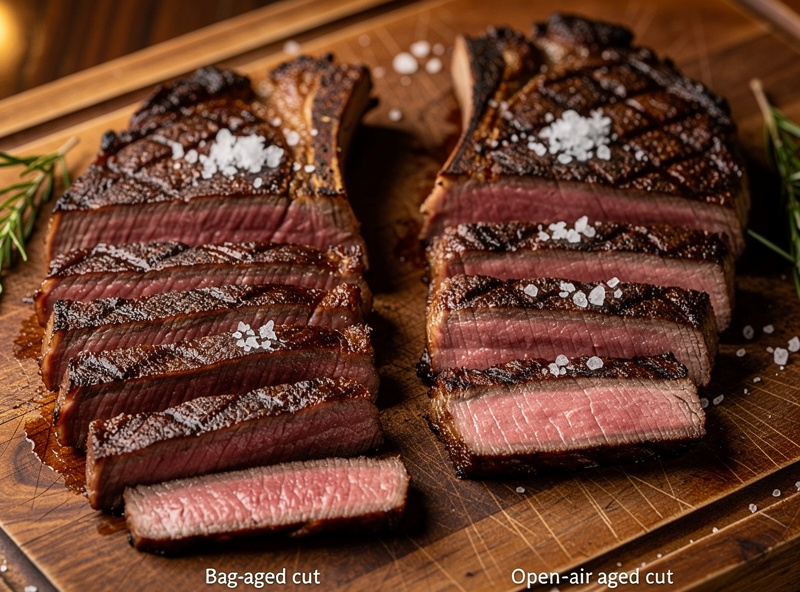
At 21 to 45 days, most people cannot tell a bagged ribeye from an open-air one. Past 45 days, open air pulls ahead because the fully exposed surface develops a richer mold colony and stronger funk. For everyday ages the bag matches open air; only long, deep ages reveal a flavor gap.
Which method gives a better yield?
The bag, but the edge is real rather than dramatic. UMAi Dry’s own site notes combined trim and moisture loss can run as much as 40% even in a bag, and independent user-reported yields cluster around 55-70% after trim, so plan on roughly 60-70% for a well-sized bagged subprimal versus about 50-55% for open air. For small or premium cuts the bag still wastes noticeably less.
Do I need a special fridge for dry-aging bags?
No. The whole advantage of the bag is that it works in an ordinary kitchen refrigerator alongside other food, because the membrane seals out contamination. You do need a vacuum sealer to draw the bag tight against the meat. Open-air aging is what requires a dedicated, climate-controlled chamber.
Is open-air dry aging more dangerous than bag aging?
It carries more risk because the surface is exposed, so a stalled fan or humidity spike can grow the wrong mold, and pushing a home chamber past its roughly 60-day ceiling means running without the UV air treatment that makes deeper commercial ages predictable. Bag aging seals contamination out, leaving a failed seal as its main hazard. Both are safe at 32 to 39 degrees F when managed well; the bag simply has a wider safety margin for beginners.
Can you age longer than 45 days in a bag?
You can, but the bag’s flavor advantage narrows past 45 days while open air keeps building funk. For ages beyond 45 to 60 days, the fully exposed open-air surface develops the intense, cheesy character a sealed membrane limits. Reserve the long, deep ages for an open chamber rather than a bag.
Which method should a beginner choose?
Start with the dry-aging bag. It is beginner-friendly, contamination-resistant, works in your existing fridge, and keeps far more usable meat if your first trim is timid. Graduate to open-air aging in a dedicated chamber only once you want the deepest funk and are ready to manage climate for weeks.
Related Articles
- Best Dry Aging Bags: Umai vs SteakAger vs DryBagSteak Tested — once you choose the bag method, which brand to buy.
- Dry Aging Beef at Home: The Complete Guide — the full chamber-build and climate framework for open air.
- Dry Aging vs Wet Aging Beef: A Side-by-Side Taste Test — the bigger fork before you even pick a dry-age method.
- Best Beef Cuts for Dry Aging: Ribeye vs Striploin vs Sirloin — which cuts suit a bag versus an open chamber.
- How Long to Dry Age Beef: 21 vs 35 vs 60 vs 100 Days — where the bag and open air start to diverge.