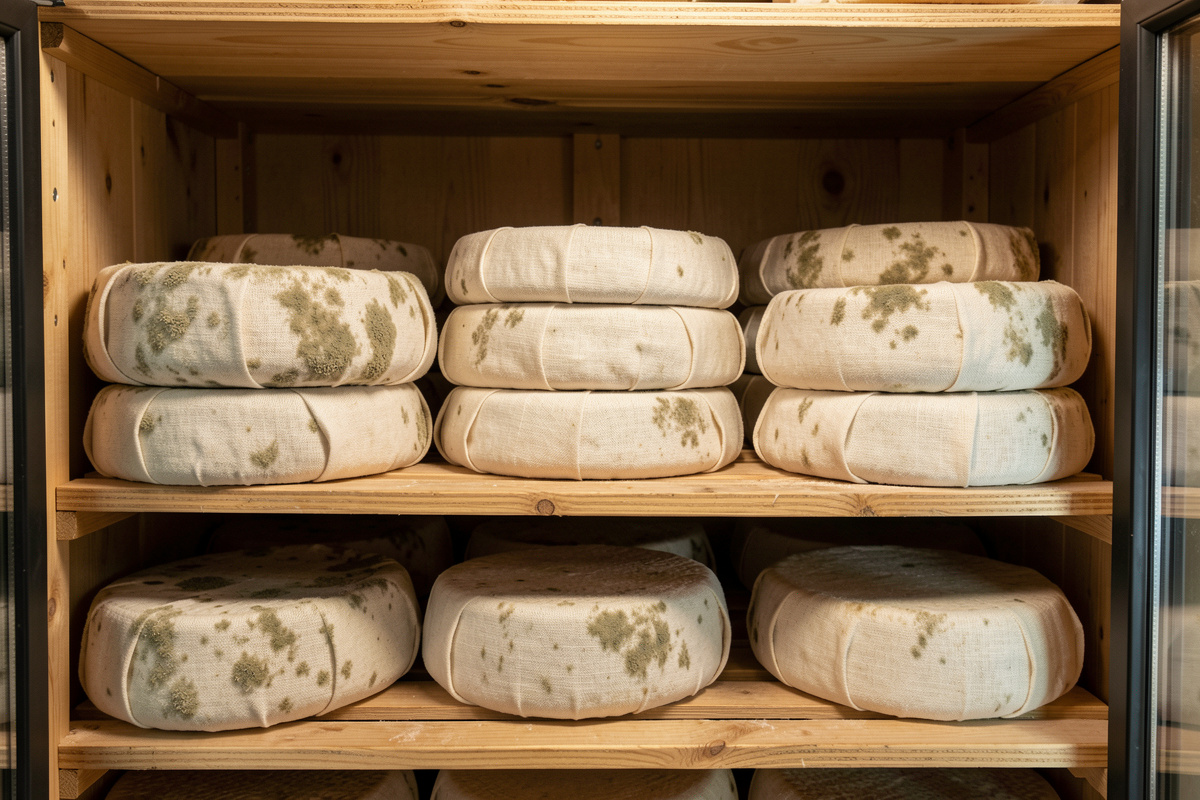

Bandaged cheddar — the traditional clothbound method — means wrapping a pressed wheel in lard-rubbed muslin and aging it at 11–13 °C and 80–85% RH for six to eighteen months, letting it breathe and lose 10–15% of its weight through the cloth. That weight loss, logged wheel by wheel, is what turns a mild young cheddar into the dry, earthy, crumbly-sharp cheese that waxing simply cannot produce.
I run my chamber on charcuterie instincts, and bandaging is the cheese technique that rewards them most. A clothbound wheel is, functionally, a slow dry-cure: a breathable skin over a substrate that gives up moisture on a controlled curve while the rind develops character. If you have read my guide to aging cheddar and hard cheese, this is the deep-dive on the one method there worth the extra effort. Everything below assumes you already have a pressed, salted wheel ready to dress.
Why bandage instead of wax?
Waxing seals a wheel airtight: no moisture leaves, no rind forms, almost no flavour development beyond what the interior cultures manage on their own. Bandaging does the opposite. The cloth, bonded to the wheel with fat, holds a protective microclimate against the paste while still letting water vapour escape and air reach the surface. The result is concentrated flavour, a genuine rustic rind, and the crumbly texture of a proper farmhouse cheddar.
The trade-off is honest work. A bandaged wheel loses real weight, needs a steady chamber, and grows mould on its cloth that you have to manage. If your chamber drifts dry the wheel case-hardens under the cloth; if it drifts wet the cloth can go slimy. I compare the full set of options in natural rind vs waxed vs vacuum and the quick mechanics of sealing in how to wax cheese for aging — bandaging sits between them in both effort and reward.
The fat that binds the cloth
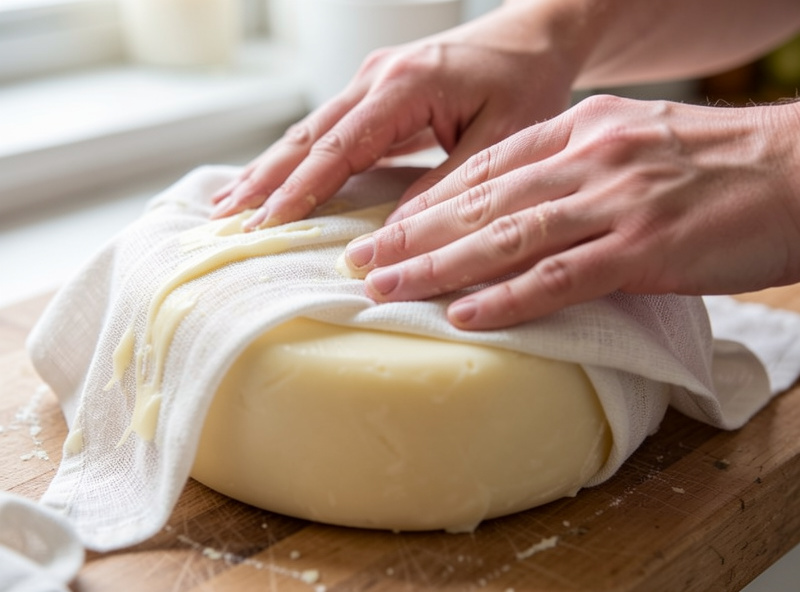
The cloth has to bond to the wheel with no trapped air, and the binding fat is what does it. Traditionally that is rendered lard, and it is still what I reach for — leaf lard, gently warmed to soft but not liquid. The fat does two jobs: it glues the muslin down and it seals the weave just enough to slow moisture loss without making the wheel airtight. Some makers use softened butter, vegetable shortening, or refined coconut oil; each changes how the rind reads.
| Binding fat | Bond strength | Rind character | Notes |
|---|---|---|---|
| Rendered lard | Excellent | Classic earthy, traditional | My default; stays workable, bonds cleanly |
| Softened butter | Good | Slightly richer rind | Can go rancid faster on a long age |
| Vegetable shortening | Good | Neutral | Vegetarian option, stable |
| Refined coconut oil | Fair | Neutral, firmer at cellar temp | Sets hard below ~24 °C; warm it well |
Whatever fat you choose, use food-grade product and enough of it that the cloth goes translucent against the cheese — dry patches are where air pockets hide, and air pockets are where the wrong moulds set up.
Dressing the wheel, step by step
Let the pressed wheel air-dry on a mat until the surface is touch-dry — usually a day or two in the chamber. Cut your muslin: two circles for the faces, sized a little larger than the wheel, and one or two strips for the side wall. Warm the lard to soft. Rub a thin coat of fat over the whole wheel, lay a cloth circle on top and smooth it down with more fat from the centre outward so no air is trapped, then do the bottom, then wrap the side strip and overlap it onto the faces. Press every seam down with fat until the muslin is bonded flat and slightly see-through. The wheel should look shrink-wrapped in cloth, not bandaged in loose folds.
From there it goes onto the shelf. I weigh it the moment it is dressed, tag it with the gram weight and date, and that number becomes the reference for everything that follows.
Holding the chamber for a clothbound age
Clothbound cheddar wants the same envelope as any hard cheese — about 11 °C and 80–85% RH — held steady for months. Steadiness matters more than hitting an exact figure: a chamber that swings between 70% and 90% will case-harden and then re-wet the rind in cycles, and the cloth telegraphs every one of those swings. I hold mine on an Inkbird ITC-308 for temperature and an IHC-200 for humidity, cross-check a SensorPush HT.W at wheel height against an Inkbird IBS-TH3 lower down, and log both through Home Assistant so an out-of-band RH pings me before the rind ever notices.
If you are still building, my cheese cave fridge conversion covers the controller wiring, and the cheese aging temperature and humidity chart places clothbound cheddar against every other style. A 120mm fan cycling five minutes on, twenty-five off keeps the air just moving — enough to keep the cloth from sweating, not so much that it dries the wheel.
Tending the cloth while it ages
Mould will grow on the cloth — that is the method working, not failing. A felt of grey, white, or pale blue-green growth on the muslin is normal; I brush it back with a dry brush every couple of weeks and turn the wheel each time so no face stays damp against the mat. What I do not want is anything fuzzy and black, anything bright orange or pink, or a musty ammonia smell when I lean in — those say the chamber is wrong or the wheel is failing. Fine brown dust at the base means mites have found the cloth; I keep that fix in cheese mites on aged cheese, and the short version is cold knock-back plus brushing plus airflow.
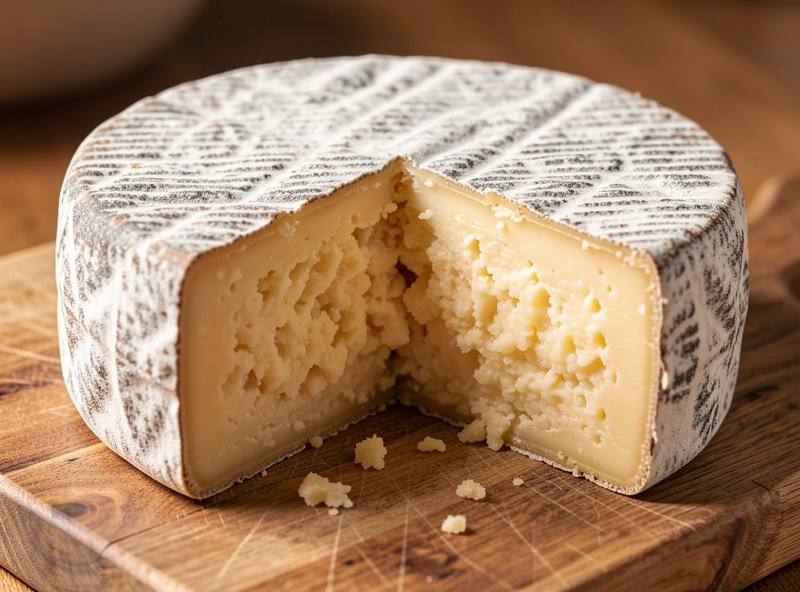
The weight log tells you the rest. A clothbound cheddar that has shed 10–15% of its dressed weight is concentrated into proper sharp-cheddar territory; I have let a few run past 18% for a drier, more crystalline wheel. Time alone is a poor guide — I trust the scale and a plug pulled with a trier far more than the calendar, which is the whole argument of when is aged cheese ready. This article sits under the complete home cheese aging guide if you want the wider map.
A realistic clothbound timeline
Clothbound cheddar is a patience cheese, and the curve is gradual rather than dramatic. Through the first month the cloth bonds tight and a light surface mould begins to felt across the muslin; the wheel is still bland inside. By three months the paste has firmed and the first real cheddar tang shows, though it is young and one-note. Six months is where most home clothbound wheels become genuinely good — the sharpness rounds out, the texture starts to crumble at the edge of a cut, and the rind smells earthy rather than just cheesy. Nine to twelve months gives you the dry, complex, almost crystalline wheel that justifies the whole exercise, and I have run a couple past eighteen months for a wheel that crumbles to dust and floors anyone who tastes it. None of those numbers are hands-on time; they are chamber-stable time, which is exactly why a controller-held chamber beats a wine fridge you open daily. If you would rather not wait, that is an argument for waxing a younger wheel, not for rushing a clothbound one.
Three clothbound failures and how to read them
The first is case-hardening — a hard, sometimes cracked shell under the cloth with a softer interior, caused by humidity drifting too low. You catch it on the weight log first: a wheel shedding weight far faster than its neighbours is drying its surface ahead of its core. Raise and steady the RH, and on a young wheel the paste can re-equilibrate. The second is a slimy or sour-smelling cloth, which is the wet-end failure — RH sitting too high with too little air exchange, letting unwanted bacteria take the damp surface. More airflow and a touch less humidity usually arrests it; a wheel that has gone genuinely slimy and ammoniated underneath, though, is one I cut my losses on. The third is poor cloth adhesion: lift a corner and there is a dry air pocket with the wrong mould colonising it. That one traces back to dressing day — not enough fat, or fat applied too cool — and it is the reason I labour the point about working the lard until the muslin goes translucent. Read against a steady weight log, all three of these announce themselves early enough to act on.
What I would tell a first-timer
Bandage one wheel, not four. Pick a four-to-six pound cheddar, dress it carefully enough that the cloth disappears into the fat, and then leave it alone except to turn it, brush it, and weigh it. The single most common beginner failure is not mould — it is a chamber that drifts dry and case-hardens the wheel under the cloth, so spend your attention on humidity stability before you spend it on anything else. Six months later you will pull a wheel that tastes like the cheese you were trying to buy, and the weight log will tell you exactly how you got there. If you want to keep one purchase simple, a length of unbleached cheese muslin and a tub of food-grade lard is the whole shopping list. As an Amazon Associate I earn from qualifying purchases.
Related Reading
- Home Cheese Aging: The Complete Guide
- Aging Cheddar and Hard Cheese at Home
- How to Wax Cheese for Aging
- Cheese Aging Temperature and Humidity Chart by Type
- Cheese Mites on Aged Cheese: Control and Removal