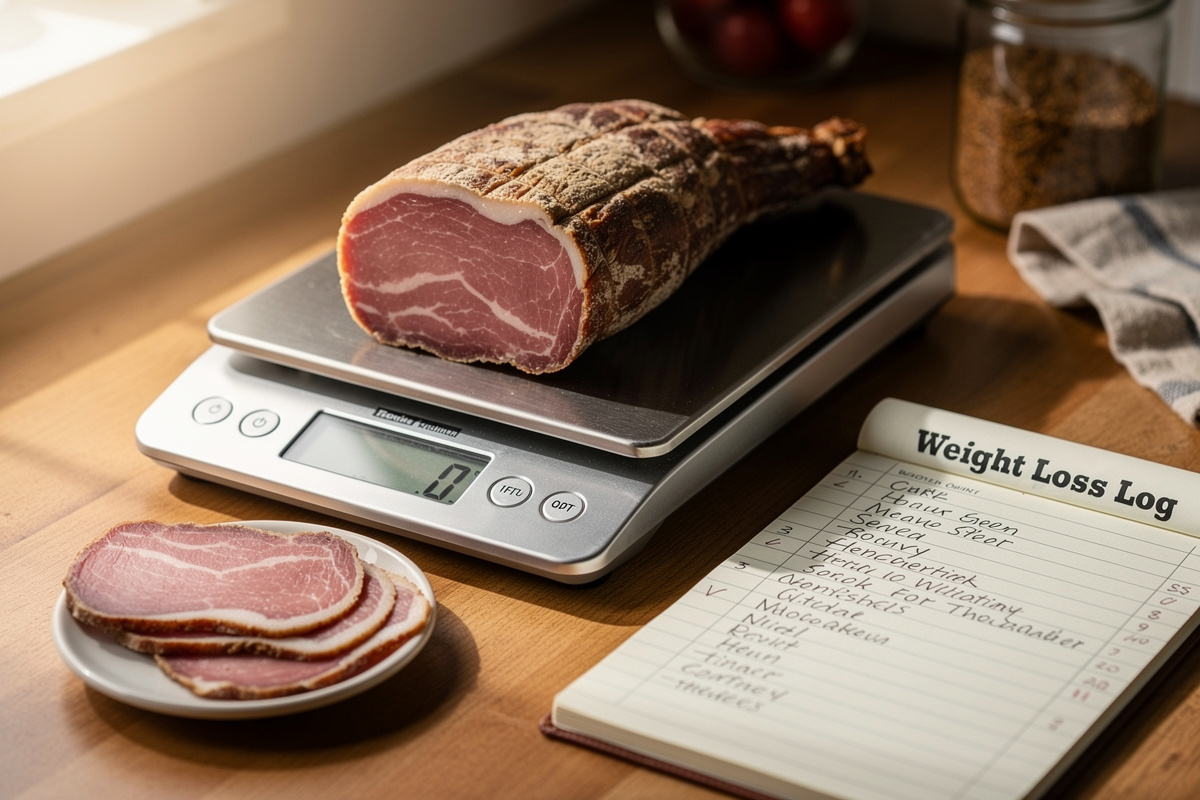

The single question that separates people who finish good charcuterie from people who ruin it is “is it done yet,” and there are only two ways to answer it: the scale and the squeeze. After years of logging every piece across the chambers I run, my answer is unambiguous, weight loss is the honest signal and feel is the cross-check, never the other way around. A piece that feels firm can still be wet inside; a piece that has hit its weight-loss target essentially never is. This is the doneness logic that applies to every whole muscle in the chamber, from a fatty coppa to a lean bresaola, and getting it right is what keeps the hobby safe as well as good.
It deserves its own guide because doneness is where beginners guess and guessing is dangerous on a product eaten raw. The numbers are not arbitrary; they correspond to how much water has to leave the meat to make it safe and sliceable. The whole muscle charcuterie hub covers the individual cuts; this is the doneness layer that sits across all of them.
Why Weight Loss Is the Real Signal
Curing works by removing water. The salt and the dry both pull moisture out of the meat, and as the water leaves, two things happen: the meat firms up enough to slice, and the water activity drops low enough that pathogens and spoilage organisms cannot grow. Weight loss is a direct, measurable proxy for how much water has gone. That is why it is the signal: it measures the thing that actually makes the meat done, rather than a surface impression that can lie.
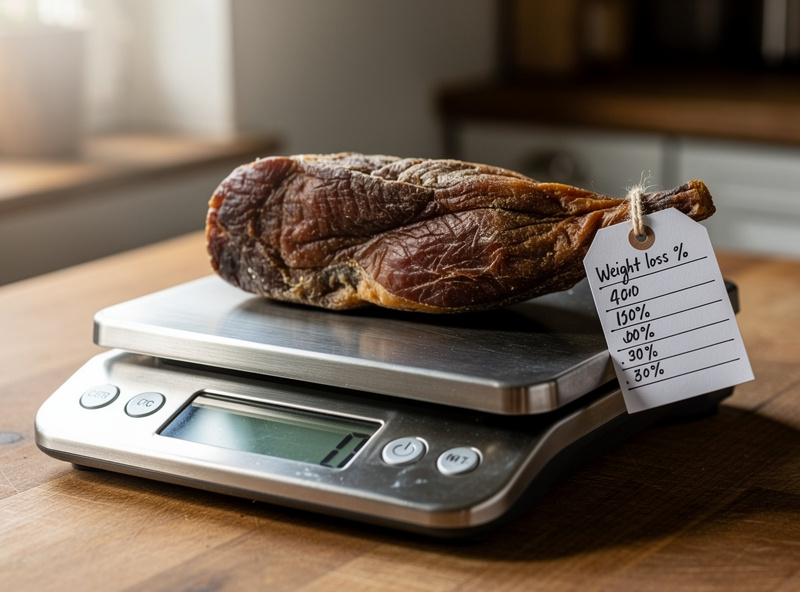
The discipline is simple and non-negotiable: weigh every piece the moment it goes into the cure, write that green weight on a tag tied to the piece, and weigh it periodically as it dries. The target is a percentage of that starting weight. Skip the green weigh-in and you have thrown away your only objective measure, and you are back to guessing. I keep the tag with the piece its whole life in the chamber so the number is never lost.
The Targets by Cut
The honest finished range for whole-muscle charcuterie is roughly 30% to 40% weight loss, and where a given cut lands inside that band depends on its fat content. Fattier cuts finish toward the lower end because the fat keeps them supple and you do not need as much water gone; leaner cuts need to go higher to firm up and concentrate. These are the targets I pull mine at, and they are consistent with how I run every piece.
| Cut | Target weight loss | Why |
|---|---|---|
| Guanciale (jowl) | ~30% | Very fatty, stays supple |
| Pancetta tesa | ~25–30% | Cooked before eating |
| Coppa (collar) | ~35% | Marbled, eaten raw |
| Lomo / lonzino (loin) | ~35% | Lean, eaten raw |
| Bresaola (eye of round) | ~35–40% | Leanest, no fat to soften |
| Salami (finished) | ~30–40% | Fermented then dried |
The pattern is consistent: the leaner the cut, the higher the weight loss before it is right, because there is no fat to keep a lean muscle pliable. A coppa at 35% is supple from its fat seams; a bresaola at 35% is only just firm enough and often wants the full 40%. That is why a single number across all cuts does not work and why the cut-specific targets matter.
The Feel: A Cross-Check, Not a Verdict
Feel has a real role, but a subordinate one. A properly finished whole muscle is uniformly firm, with a little give, like pressing a ripe avocado through its skin, and crucially has no soft, squishy zone. That soft zone, usually at the thick centre, is the tell that the inside is still wet even when the surface feels done. I press the thickest part with my thumb; if it dents and stays soft while the rest is firm, it is not done no matter what day it is.
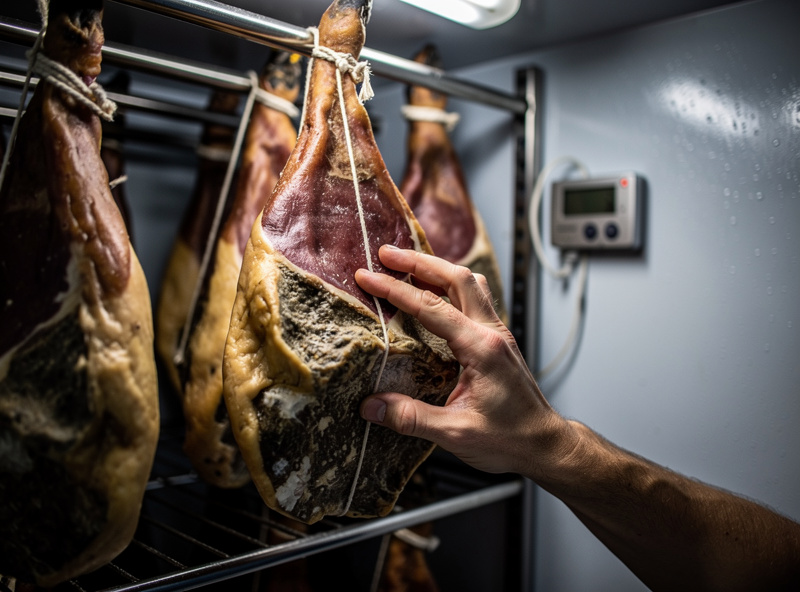
The reason feel cannot be the verdict on its own is that fat fools your fingers. A fatty coppa or goose breast can feel soft and underdone when the scale says it is at target, because the fat itself is yielding. Conversely a case-hardened piece feels firm, even hard, on the outside while hiding a wet core, which is the most dangerous false positive of all. So I use feel to catch problems, a soft centre, an unevenly hard shell, but I use the scale to call it done. When the two disagree, the scale wins and I investigate why the feel is off, often it is case hardening.
Patience and the Slow Finish
The hardest part of doneness is resisting the urge to call it early. A piece that looks beautiful and feels firm at three weeks but has only lost 22% of its weight is not done; it is a wet piece with a dry face. Pulling it then gives you a soft, under-concentrated, potentially unsafe slice. The chamber rewards patience, and the scale is what gives you the discipline to wait, because it turns “it looks ready” into “it has lost 28%, give it another week.” This is the hobby that teaches patience to people who have none, and the weight log is the teacher.
Drying also slows as a piece approaches its target, because the easy surface water has gone and the remaining moisture migrates out more slowly. That tapering is normal and is one more reason to track the curve rather than count days: the last 5% of weight loss takes proportionally longer than the first, so a calendar estimate made early will always run short. Hold the chamber envelope steady, around 12 to 15°C and 75 to 80% RH, and let the curve finish, which is what a chamber built for stable climate control makes possible.
As an Amazon Associate I earn from qualifying purchases.
Doneness is a measurement problem, so the two tools that matter are a reliable scale and a way to log the numbers. I weigh every piece on a flat digital kitchen scale that reads in grams and holds zero, and I keep a chamber digital hygrometer and thermometer running so I can correlate a stalled weight curve with a humidity or temperature drift. The scale tells you when it is done; the hygrometer tells you why it is taking the time it is.
A Note on Water Activity
For the truly precise, water activity (aw) is the underlying quantity weight loss is standing in for; commercial producers measure it directly with a meter to certify safety. At home, weight loss to the cut-specific target is the practical, reliable proxy that home charcutiers have used for generations, and it is what I rely on. I mention aw only so you know the weight-loss target is not folklore, it tracks a real measurable property of the meat. You do not need an aw meter at home; you need the discipline to weigh in, tag, and weigh out to target.
Frequently Asked Questions
How do you know when charcuterie is done?
By weight loss, cross-checked with feel. Weigh the piece when it goes into the cure, tag that green weight, and weigh periodically. Whole-muscle charcuterie is done at roughly 30 to 40 percent weight loss depending on the cut. The piece should also be uniformly firm with give and no soft, squishy centre. When weight loss and feel disagree, trust the scale.
What weight loss percentage means charcuterie is finished?
Whole-muscle cures finish at roughly 30 to 40 percent weight loss. Fattier cuts like guanciale finish around 30 percent because the fat keeps them supple; leaner cuts like bresaola need 35 to 40 percent to firm up and concentrate. The exact target depends on the cut’s fat content, which is why a single number across all cuts does not work.
Can I tell charcuterie is done just by feel?
No, feel is a cross-check, not a verdict. Fat can make a finished piece feel soft, while case hardening can make an underdone piece feel firm or even hard on the outside while hiding a wet core. Use feel to catch problems like a soft centre or an uneven shell, but use the scale to actually call a piece done.
Why does drying slow down near the end?
As a piece approaches its target, the easy surface water has already left and the remaining moisture migrates out from the centre more slowly. The last few percent of weight loss therefore takes proportionally longer than the first. This is why tracking the weight curve beats counting days, since a calendar estimate made early always runs short.
Do I need a water activity meter at home?
No. Water activity is the underlying property that weight loss stands in for, and commercial producers measure it directly to certify safety. At home, weight loss to the cut-specific target is a reliable, generations-old proxy. You need a gram scale and the discipline to weigh the piece in, tag it, and weigh it out to its target, not a water activity meter.
More From the Whole Muscle Chamber
- Whole Muscle Charcuterie: The Complete Guide
- Case Hardening: Causes, Prevention, and Fixes
- Curing Chamber Climate Control Guide
- Bresaola Recipe at Home: Air-Dried Beef
- Homemade Coppa (Capocollo): Cured Pork Collar