Mold Science Cross-Training: What Mushroom Cultivation Teaches About Charcuterie Cleanliness
May 12, 2026

Penicillium nalgiovense is the white mold you want on salami. Trichoderma is the green mold that ruins mushrooms. Same kingdom, same conditions — 55–65°F, 75–85% RH. Different outcome. Mushrooms teach charcuterie mold management faster than any salami book.
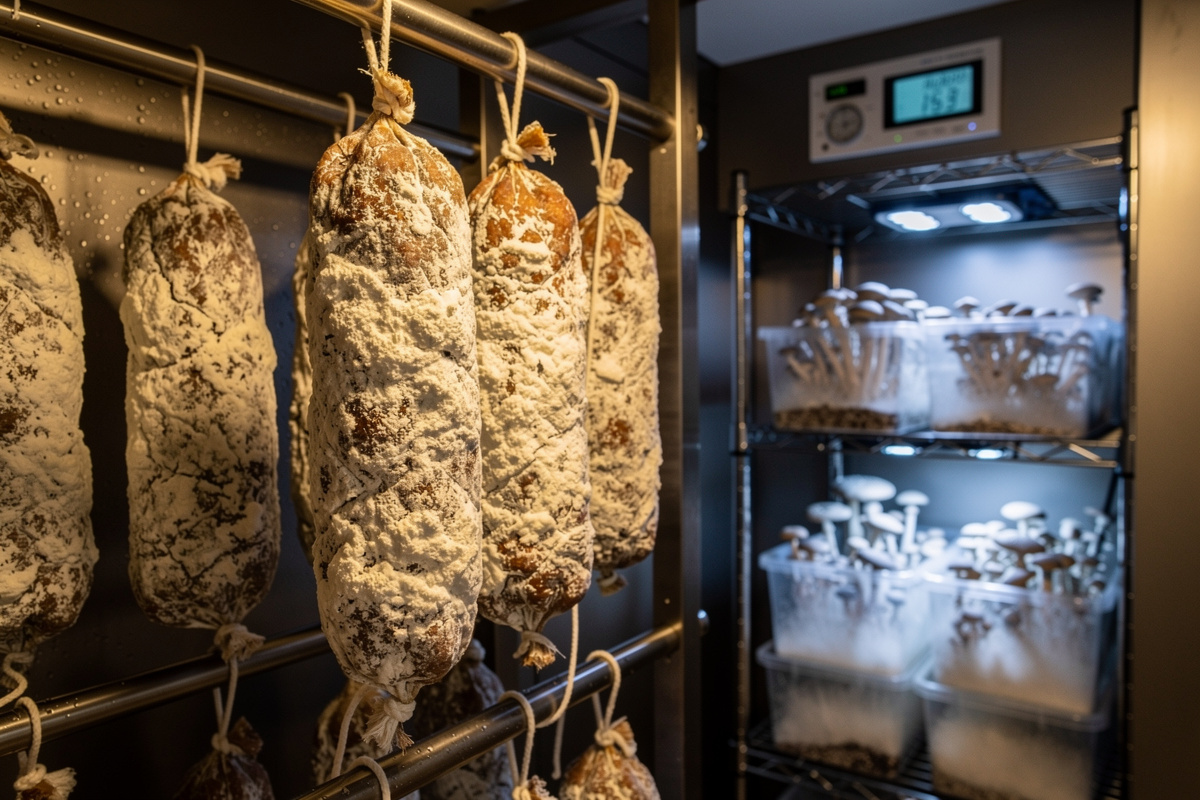
I run both hobbies — the curing chamber in the basement and the mushroom fruiting chamber in the spare room — and the crossover knowledge is deeper than most people expect. The way mycelium colonizes a grain jar before pinning is the same biological pattern as Penicillium colonizing a salami casing before sporulating. The way Trichoderma appears as a bright green patch on a substrate that was too wet is the same visual signature as the green mold that appears on a salami that was cased too moist. This article covers the mold-science crossover. The mushroom-specific cultivation details live on mycomansion.com’s contamination guide, where green mold, cobweb, and bacterial contamination identification are covered in detail.
The Good Mold, the Bad Mold, and Surface pH
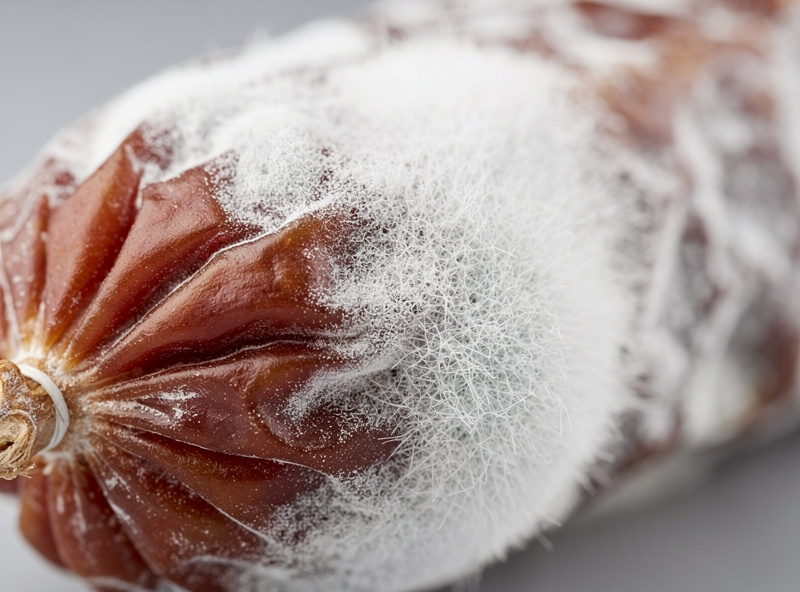
Penicillium nalgiovense grows on salami because the meat surface has a pH of 5.0–5.3 after fermentation — acidic enough to suppress most spoilage organisms but comfortable for Penicillium. The mechanics of how that drop happens — lactic-acid bacteria, dextrose feed rate, the 24–72 hour fermentation window — I cover in detail in my salami fermentation chemistry breakdown. Trichoderma grows on mushroom substrates because the substrate is pasteurized but not sterilized, and the residual bacteria and competing fungi were killed by heat, leaving a vacant ecological niche with abundant cellulose and a near-neutral pH of 6.5–7.0. The takeaway for the curing chamber is that surface pH is your mold-selectivity switch: if you let the salami pH drop to 5.2 or below during fermentation, Penicillium outcompetes wild molds. If pH stays above 5.5, wild molds (including Aspergillus and Penicillium species you did not inoculate) have an opening. I keep Easy@Home pH strips on the workbench to spot-check casing surface pH at day 3 and day 7 — cheap, fast, accurate enough to catch a stuck fermentation before it costs me a 1.5 kg sausage.
The second variable is surface moisture. Both Penicillium and Trichoderma colonize fastest when the surface is slightly damp — 75–85% relative humidity is ideal for both. The difference is that Penicillium on salami is helped by the salt content of the meat (3–4% by weight), which suppresses bacteria and non-salt-tolerant molds but does not bother Penicillium. Trichoderma on mushroom substrates has no such chemical ally — it competes against mycelium on an equal playing field and wins when the substrate is too wet or the spawn rate was too low. In a curing chamber, the equivalent rule is: if the salami surface stays wet beyond the first 48 hours, wild mold gets a foothold before the inoculated Penicillium can dominate. My Govee H5179 hygrometers log RH at 1-minute intervals so I can see the exact hour humidity drifted above 85 percent and correlate it to any contamination event days later.
Reading Contamination by Color, Smell, and Texture
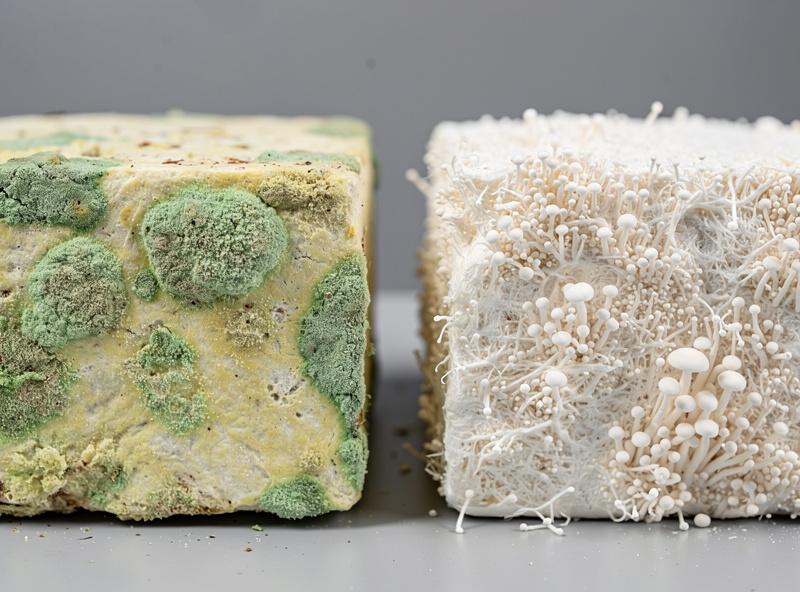
Diagnosing a fungal patch in the field is a three-sense exercise: look, smell, touch. I learned this on mushroom substrates first, where a green patch the size of a thumbnail tells you to bin the jar immediately. The same diagnostic ladder applies to salami casings, and the side-by-side reads almost identically.
Color. On a mushroom substrate, white-with-yellow-tint is usually healthy mycelium reacting to bruising. White-and-fluffy-but-fast is cobweb (Dactylium) and means high humidity in the fruiting tent. Bright green is Trichoderma and means game over. On a salami casing, chalk-white powder distributed evenly is Penicillium nalgiovense doing its job. Yellow-brown blotches mean Mucor — not always fatal, wipe with vinegar. Forest-green or black-green patches are Aspergillus or Penicillium expansum — toss the sausage.
Smell. Healthy mycelium smells faintly of fresh mushroom. Trichoderma smells damp and earthy in a way that is wrong — closer to wet basement than forest floor. Healthy Penicillium on salami smells like a Camembert rind: nutty, faintly cheesy, agreeable. Bad mold on salami smells ammoniac, sour, or musty.
Texture. Mycelium is dense and stringy. Cobweb is loose and falls apart when you touch it. Trichoderma is powdery — green dust comes off on the glove. Penicillium nalgiovense is dry, chalky, and adheres to the casing. If you rub a patch and it smears wet, you have a Mucor or bacterial contamination, not a Penicillium colony. For deeper visual reference on the salami side, I cross-check against my good-vs-bad casing mold visual guide — same color logic, real photos.
Sterile Technique That Transfers Between Hobbies
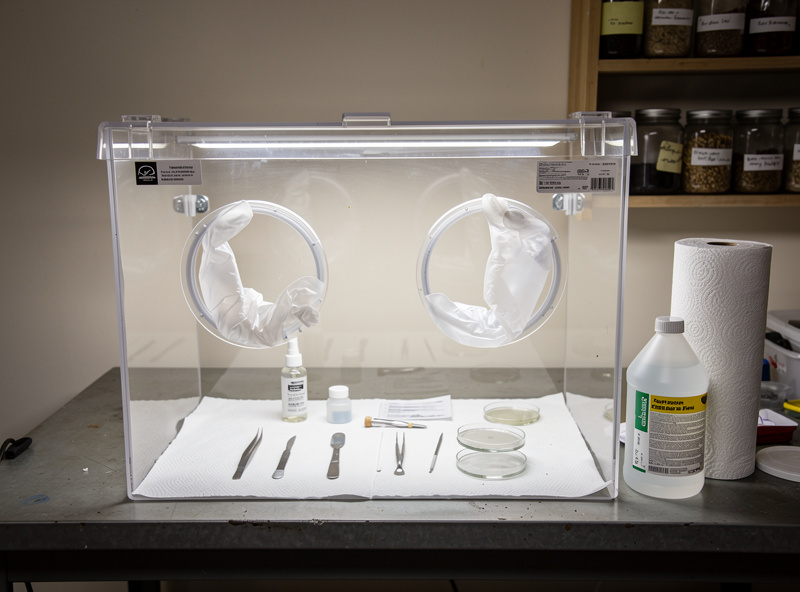
Mushroom cultivation teaches sterile technique as a non-negotiable. The still air box, the alcohol-flamed scalpel, the glove change between agar plates — these habits transfer directly to charcuterie. When I handle salami casings after fermentation, I treat them with the same contamination awareness that I bring to grain-spawn inoculation: clean gloves, 70 percent isopropanol on the work surface, no reaching over open product. The curing-chamber workflow adds salt and pH as additional barriers, but the baseline sterility discipline is the same.
Gear matters here. I run an Inkbird ITC-308 dual-stage controller on the fridge compressor and an Inkbird IHC-200 humidity controller on the ultrasonic mister — both let me set hysteresis bands tight enough that surface RH never spikes past 86 percent. (I’ve bench-tested an Auber Instruments PID controller against the IHC-200 for humidity duty; it holds its own but the IHC-200 is what’s actually running the chamber day to day.) On the mushroom side, Pamtree spawn bags with 0.2-micron filter patches keep airborne Trichoderma spores out during incubation, and a Bluelab pH probe verifies substrate pH on every batch. If you are choosing strain cultures for the chamber, my guide to Penicillium cultures for casings walks through the Bactoferm Mold-600 versus Mold-PV decision I made for my own batches.
The contamination notebook is another transferable habit. In mushroom growing, I log every contamination event — what it looked like, what the substrate conditions were, what stage it appeared at. In the curing chamber, I log every mold event — color, texture, timing, chamber humidity and temperature at the time. The batch I lost was a 1.2 kg fennel salami where I broke the glove protocol once — went from grinding meat to opening the mushroom fruiting tent without changing gloves; five days later white-gray-green Trichoderma asexual sporing on the casing, full batch tossed. The notebook entry from that day reads “humidity 84%, no glove change, fennel batch 03.” I never break glove protocol now. One mistake costs you forty bucks of pork and three weeks.
Authority Sources and Regulatory Backing
The home-curing crowd sometimes treats federal food-safety documents as overkill. They are not. The FDA Bad Bug Book chapters on Listeria monocytogenes and Clostridium botulinum spell out the exact growth thresholds — Listeria proliferates at refrigeration temperatures down to 31°F, and C. botulinum requires a water-activity (aW) of at least 0.93 to produce toxin, which is why your finished salami target is aW ≤ 0.91. The USDA FSIS Compliance Guideline for Dry Fermented and Salt-Cured Pork Products spells out the 5-log pathogen reduction expected through the combined hurdles of nitrite, salt, pH drop, and water-activity reduction. And 21 CFR Part 117 — Current Good Manufacturing Practice for human food — is the framework I borrow even though my chamber is hobbyist scale: separate raw and finished zones, document temperature logs, sanitize contact surfaces before each batch. Read them once. They make the sensory checks above feel less like superstition and more like layered defense.
What I’d Do If Starting Both Hobbies Today
If I were starting both hobbies from zero tomorrow, I would not buy the controllers first. I would buy a $4 notebook and a pen. The single most-transferable practice between mushroom growing and curing is the contamination log — date, color, texture, smell, RH, temperature, what I touched before I touched the product. Within six months that log becomes a personal field guide that outperforms anything you can read. The Inkbird and the Auber and the Bluelab probe all help, but they record numbers; the notebook records what your eyes saw. For the mushroom-side science behind the contamination patterns — spore biology, agar work, the deeper reason Trichoderma wins on wet substrates — mycomansion.com’s contamination guide is where I send people next.
Frequently Asked Questions
Is the white mold on salami the same as the white mold on mushroom substrates?
No. The white mold on salami is Penicillium nalgiovense, an intentionally inoculated food-grade culture. White mold on mushroom substrates is usually mycelium (healthy) or occasionally cobweb mold (Dactylium, a contaminant). The two look similar — white and fluffy — but salami mold smells earthy and pleasant, while cobweb mold grows faster, is grayer, and smells musty.
Can I use a mushroom still air box for salami inoculation?
Yes. A still air box provides the same sterile workspace for inoculating salami with starter cultures as it does for inoculating grain jars with mushroom spawn. Wipe down with 70 percent isopropanol, work with clean gloves, and keep movements slow to avoid stirring airborne contaminants. The SAB is the most cost-effective sterile workspace for both hobbies.
What temperature kills Penicillium nalgiovense on salami?
Penicillium nalgiovense stops growing below 41°F (5°C) and is killed above 115°F (46°C). Normal drying-chamber temperatures of 50–60°F are within its ideal range. If you need to kill surface mold on a finished product before vacuum-sealing, a brief wipe with white vinegar (acetic acid) removes the mold and drops surface pH to prevent regrowth.
How do I know if the mold on my salami is safe or dangerous?
White, powdery, evenly distributed mold that smells earthy and mushroom-like is safe Penicillium nalgiovense. Mold that is green, black, pink, or fuzzy and localized in patches is contamination. The most common dangerous molds on salami are Aspergillus (black or green, powdery) and Mucor (gray, fuzzy, fast-growing). When in doubt, wipe a suspect spot with vinegar — if it comes back green or black, the batch is lost.
Can I use a wine fridge for both mushroom fruiting and salami curing?
Not at the same time, and not without thorough decontamination between uses. A wine fridge holds 55–60°F comfortably which suits both, but cross-contamination is the killer: Trichoderma spores from a fruiting cycle settle into the door seal and condensate tray, then bloom on salami casings when humidity climbs. If you must share one unit, run dedicated cycles, wipe the entire interior with 70 percent isopropanol between uses, and replace the door gasket every 12 months. Two cheap used fridges beats one shared fridge.
What’s the lowest-cost way to monitor mold growth without a microscope?
A phone with a macro clip-on lens (around 15 dollars) plus a daily photo log. Shoot every salami and every mushroom jar from the same angle under the same light each morning; mold colony spread becomes obvious in 24-hour increments when frames are compared side by side. Pair the photo log with Easy@Home pH strips for salami surface checks and a Govee hygrometer logging RH. Total monitoring kit under 60 dollars and it catches contamination 2–3 days earlier than eyeballing once a week.
Related Articles
- Salami Fermentation Chemistry: pH Drop and Lactic Bacteria
- Curing Chamber Climate Control Guide
- Curing Chamber Troubleshooting Guide
- Home Salami Making Guide
- How to Build a Curing Chamber Guide