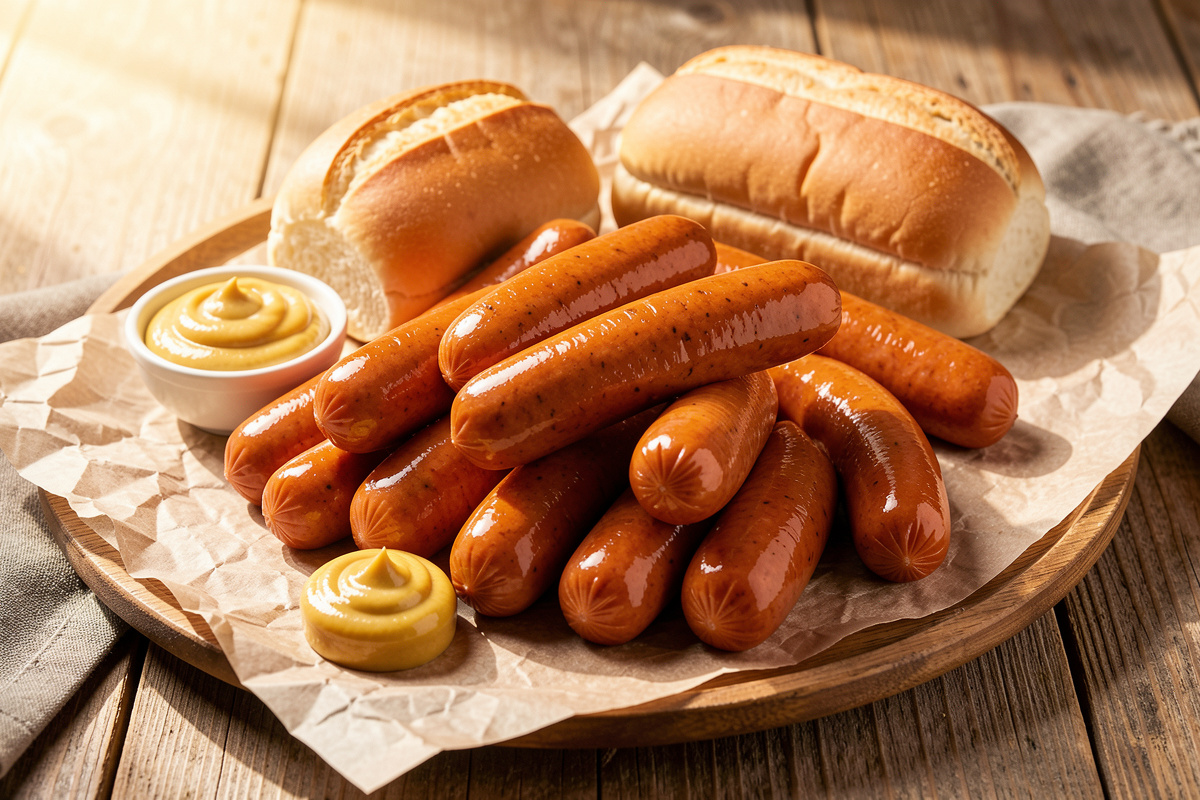

Making hot dogs at home means building a fine emulsion of beef and pork — roughly 70% lean, 30% firm back-fat, salted at about 2% and bound with ice-cold water — then stuffing it into a sheep or collagen casing, smoking it warm at 120–140 °F, and poaching it to a 155 °F (68 °C) internal. The pay-off is the snap of a real casing and a frankfurter that tastes of meat and smoke, not filler. Here is the method I run, end to end.
This is the cooked-sausage family at its most demanding: a frankfurter is an emulsion with no place to hide, so if the bind is off or the fat smears, every single link on the string shows it. I came to it after years of coarser sausages, and it humbled me inside one batch — my first frank dough broke into a greasy puddle because I’d buzzed warm fat in a food processor “until it looked right.” Treat the temperature discipline in this guide as non-negotiable and the recipe as the easy part. The full family overview is in my cooked sausage making guide; this page is the deep dive on the frankfurter specifically.
What Makes a Hot Dog Different From a Regular Sausage?
A hot dog is a fine emulsion sausage that’s been smoked and cooked to ready-to-eat, whereas most sausages you make at home are either fresh (grilled raw, like a bratwurst) or ground coarse. The texture — that smooth, almost paste-like bite — comes from cutting lean and fat together with salt and ice until the protein forms a film around every droplet of fat, so the two phases become one continuous paste. That’s the emulsion, and it’s what separates a frankfurter from everything coarser.
The other difference is that a frankfurter is fully cooked in the making. A fresh sausage you cook at the grill; a frankfurter is smoked and poached in your kitchen, then reheated (or eaten cold). That changes the safety math, because the sausage has to transit the danger zone on its way to cooked, which is exactly why Cure #1 enters the conversation. It also changes the equipment math — you need a way to smoke and a way to poach, not just a grill.
What Meat Ratio Should I Use for Homemade Hot Dogs?
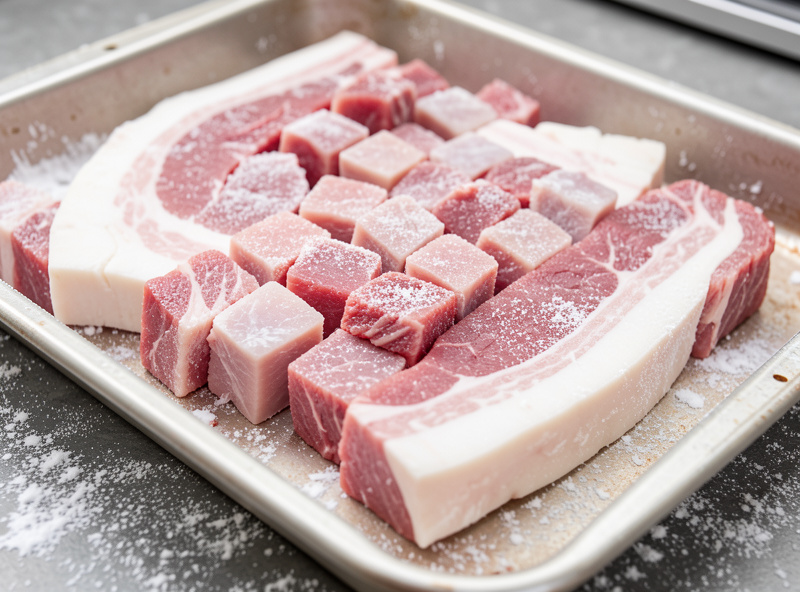
I run a 50/50 beef-and-pork blend by weight of lean, with firm back-fat bringing the total fat to about 30% of the batch — so for a 5 lb (2.27 kg) batch I’ll use roughly 1.7 lb lean beef (chuck or eye of round), 1.7 lb lean pork (shoulder), and 1.6 lb cold back-fat. That 30% fat target is the texture you recognise as a frankfurter; drop it to 20% and you’ve made a firmer, leaner sausage that bites more like a banger than a hot dog. Weigh the lean and the fat separately on a gram-accurate scale — the difference between 28% and 33% fat is audible in the mouth.
Beef gives the frank its color and structure; pork gives it richness and softness. All-beef franks (the kosher-style deli dog) are wonderful but leaner and tighter — they want a slightly longer cut on the lean to get enough bind, and they read as a different product. I keep both the standard blend and an occasional all-beef batch in rotation, and I treat the all-beef version as the harder of the two to get tender. Whatever blend you choose, the fat must be firm, cold back-fat from the shoulder or jowl — soft belly fat smears on contact and breaks the emulsion.
How Do I Build the Frankfurter Emulsion Without Breaking It?
Build the emulsion cold, in order, and stop the instant it’s smooth: grind the lean fine and chop it with the salt and Cure #1 until it turns glassy and sticky (that’s myosin releasing), then add the colder-than-cold fat and ice water and cut only until the paste is uniform — never longer. The finished paste should read 45–55 °F (7–13 °C) on a probe. Above about 60 °F (15.6 °C) the fat melts out of its protein cage and the batch is gone; there’s no walking it back, only starting over.
I grind the lean through a 4.5 mm plate and the fat separately through a 3 mm plate, both chilled to near-freezing, then finish the bind in short pulses in a food processor with the workbowl resting on a bag of ice. The meat-grinding rules are the same as for salami — keep the blade and plate frozen, grind once per plate, never let the auger warm the meat. The mistake I made once and will not repeat: re-grinding the fat to “make it smoother.” A second pass through a warm grinder is the fastest way to smear fat in a home setup. If you want it smoother, cut it colder in the processor, don’t grind it twice.
Salt is structural here, not just seasoning. At 2% of meat-and-fat weight it dissolves the myosin that becomes the cage; below about 1.6% the cage is weak and the frank weeps; above 2.5% it reads tough and rubbery. The ice water — about 20% of meat weight, added as crushed ice or ice water — is the second phase that lets the salt reach every fibre and buffers the temperature rise during cutting. Weigh both, by gram.
Do Homemade Hot Dogs Need Cure #1?
Yes — because a frankfurter is smoked warm before it’s poached, which means it sits for hours in the 40–140 °F danger zone where Clostridium botulinum can produce toxin, and Cure #1 (6.25% sodium nitrite on salt) is what prevents that. Use one level teaspoon of Cure #1 per 5 lb of meat, which lands near the 156 ppm ingoing nitrite USDA allows in a comminuted product. Never smoke a frank without it; “natural, no-nitrate” is not a free pass on a warm-smoked sausage — the nitrite ends up in the meat either way.
If you’re dead set on skipping the smoke and poaching immediately, you can argue the cure is optional — but I don’t, because a frankfurter without smoke isn’t really a frankfurter, and the moment you reintroduce smoke you reintroduce the danger-zone transit. The Cure #1 versus Cure #2 distinction matters here too: a frank wants #1 (nitrite only), because there’s no long drying phase for the nitrate in #2 to convert. Keep the cure measured by gram or level teaspoon, never by the “pinch,” and never exceed the rate.
How Do I Smoke and Poach Hot Dogs at Home?
Smoke the linked franks at 120–140 °F (49–60 °C) for 2–4 hours with Cure #1 already in the meat, then poach them in 170–180 °F (77–82 °C) water to a 155 °F internal and shock them cold in an ice bath. The smoke is generated off the meat and drifted in so the franks never see direct heat; I run a ProQ-style pellet maze for this and track chamber temp on my SensorPush HT.W to be sure it stays under 140 °F. If your ambient won’t cooperate (a Swedish summer afternoon, say), wait for a cold morning or smoke in shorter sessions with the door cracked.
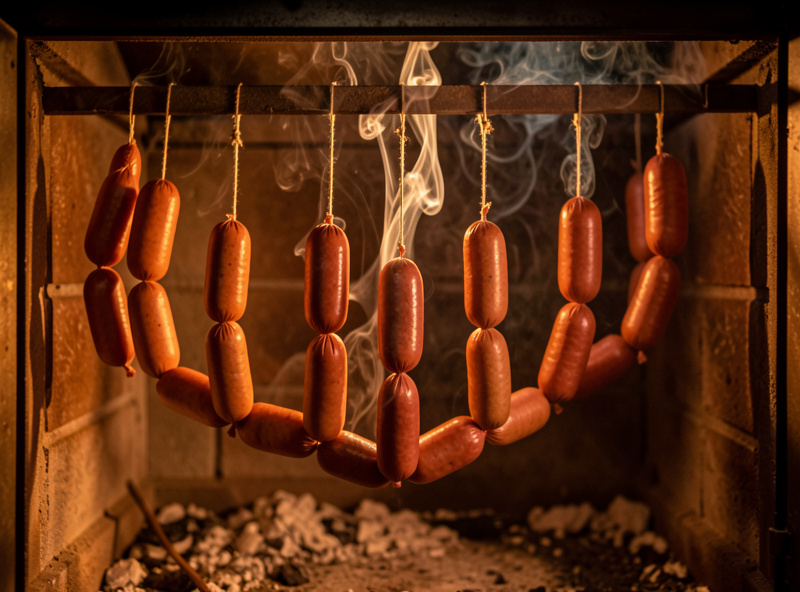
Wood choice is mild. Beech is the classic European frank wood — clean, almost sweet — and a light hickory or apple works if you want a more American grocery-dog character. I keep a full wood-pairing reference, but for franks the rule is light: two hours of beech reads as smoke, four hours of hickory reads as barbecue, and there’s no rescuing an over-smoked frank. The cold-smoking principles apply even though a frank is technically warm-smoked — the point is smoke without cooking, then finish with the poach.
The poach is the cook. Bring a wide pot of water to 175 °F, drop the linked string in (or individual links if your casings are long), and probe the thickest frank every few minutes. At 175 °F a 22 mm sheep-casing frank reaches 155 °F internal in roughly 20–30 minutes. The instant it does, lift the string and plunge it into an ice-water bath to stop the carryover cook — without that, the residual heat pushes the internal another 5–8 °F and the texture goes from tender to mealy. Move the finished franks through the danger zone quickly on the way to the fridge.
What Temperature Is a Hot Dog Fully Cooked?
A hot dog is fully cooked at a 155 °F (68 °C) internal — I aim there for texture and margin — though the USDA consumer guidance for ground-meat sausages is 160 °F (71 °C) if you want zero ambiguity. FSIS treats the frank as a cooked, ready-to-eat sausage under its lethality standard, which a 152–155 °F poach held briefly satisfies; the 160 °F number is the home-kitchen simplification of that standard. Whichever you target, go by probe, never by time, because a 22 mm sheep casing and a 28 mm collagen casing cook at very different rates.
After the poach and ice bath, let the franks bloom at room temperature for an hour — you’ll watch the color deepen from a cooked grey-pink to the familiar frankfurter rosy as the nitrite sets. Then refrigerate overnight before eating; the texture firms up and the snap develops as the gel fully sets cold. They keep a week in the fridge and freeze well for months.
Casings, Stuffing, and the Final Snap
Sheep casings (22–24 mm) give the classic thin frank and the snap that makes a homemade dog worth the work; collagen casings in a similar caliber are the no-soak fallback and behave more consistently for a beginner, though they lack the bite. My casing-types guide maps the options; for franks, buy the smallest-caliber sheep casings you can find and soak them in warm water with a rinse-through before stuffing.
Stuff firmly — a slack frank holds air pockets that fill with poach water and burst — and link by twisting alternate directions down the string so the links don’t unravel. I use a separate 5 lb vertical stuffer rather than the grinder’s stuffing tube, because pushing emulsion through a warming grinder auger is the second-most-common way a home frank batch goes wrong (after warm fat). If you’re shopping, a dedicated vertical stuffer and a fast instant-read thermometer are the two upgrades that change franks most.
As an Amazon Associate I earn from qualifying purchases.
The Batch I Remember, and What It Taught Me
The first frank batch I’m proud of was my fourth — the first three taught me the three ways a frank fails. Batch one broke because the fat was warm. Batch two was rubbery because I over-mixed chasing smoothness. Batch three split in the poach because the water was at a rolling boil and I’d stuffed to bursting. Batch four I treated like a chemistry practical: meat frozen-edged, fat colder than the lean, salt weighed, ice water weighed, smoke under 140 °F, poach at 175 °F, ice bath waiting. The snap on that first good link — the audible crack of a sheep casing under a knife, then the clean pink cross-section — is the reason I still make them.
If you take one thing from this, take the cold rule. Everything else — the ratio, the wood, the spice blend — you can tune to taste. The temperature window you cannot negotiate with, and the frank will tell you, loudly, the moment you try.
Related Guides for the Cooked-Sausage Family
- Fixing a broken meat emulsion — exactly what to do when the frank paste goes greasy mid-batch.
- How to make bologna at home — the same fine-emulsion method in a larger casing or loaf.
- Poaching temperature for cooked sausage — hitting the 155 °F internal without splitting the casing.
- Do cooked sausages need Cure #1? — the full cure decision for a warm-smoked frank.
Can I make hot dogs without a smoker?
Yes. You can skip the smoke and poach the franks directly to a 155 Fahrenheit internal, which gives you a cooked frank without the smoked flavor. Without the warm-smoke step the Cure #1 is less critical, but most people find an unsmoked frank tastes like a mild bologna rather than a hot dog.
What size casing is best for homemade hot dogs?
Sheep casings at 22 to 24 millimeters give the classic thin frank and the snap. Collagen casings in a similar caliber are an easier no-soak fallback but lack the bite. Avoid hog casings, which are too wide and read as a bratwurst rather than a frankfurter.
How much Cure #1 do I use in hot dogs?
One level teaspoon of Cure #1 per 5 pounds of meat, or about 4 ounces per 100 pounds, which lands near the 156 ppm ingoing nitrite USDA allows in a comminuted product. Never exceed it, weigh or level-measure it, and never smoke a frank without it.
Why do my homemade hot dogs split in the poach?
The poaching water was too hot, above about 185 Fahrenheit, or the casings were over-stuffed. Hold the water at 170 to 180 Fahrenheit and leave a little give in the casing so steam can vent. A rolling boil will split almost every link.
How long do homemade hot dogs keep?
About a week refrigerated and several months frozen, because they are fully cooked and cured. Cool them fast through the danger zone after the poach, refrigerate overnight so the texture sets, and vacuum-seal before freezing for the best snap on reheat.