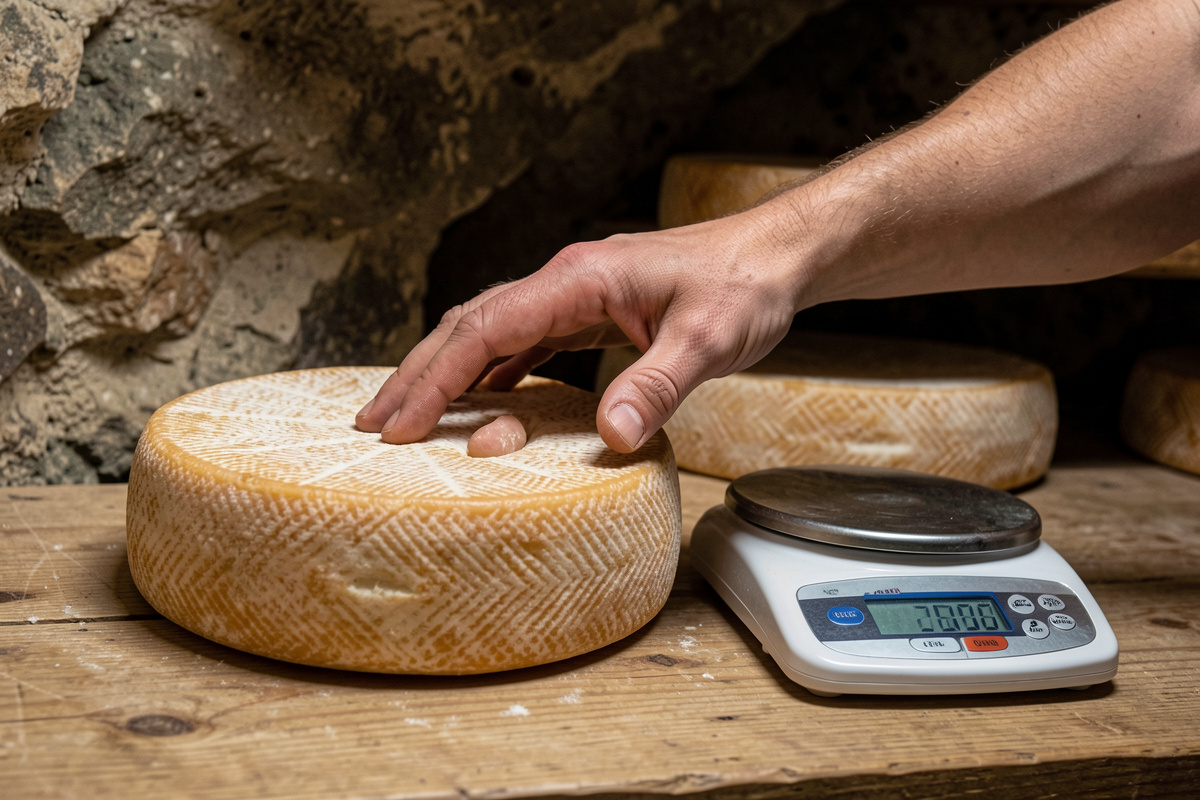

Aged cheese is ready when it has lost the right amount of weight, feels firm to the press, and tastes the way you want it — not when a calendar date arrives. The most reliable single signal is weight loss: most hard aging cheeses are ready around 30–40% loss from their fresh weight, the same honest yardstick I use on every dry-cured piece in my chambers. Time is only a rough guide; the wheel itself tells you when it is done.
“Ready” is also partly a matter of taste, because a cheddar at three months and the same cheddar at twelve are both perfectly good — just different. The point of knowing the signals is so you can decide deliberately rather than guessing, and so you never cut into a wheel that is genuinely underdone or, worse, eat one that has gone wrong. Here is how to read a cheese the way the weight log, your hands, and your nose let you.
Weight Loss: The Honest Doneness Signal
Weigh the wheel fresh, log it, and weigh it again as it ages — when a hard cheese has lost 30–40% of its starting weight, it has concentrated to roughly the right point and is ready to evaluate. This is the number I trust above all others because it can’t be fooled the way a calendar can.
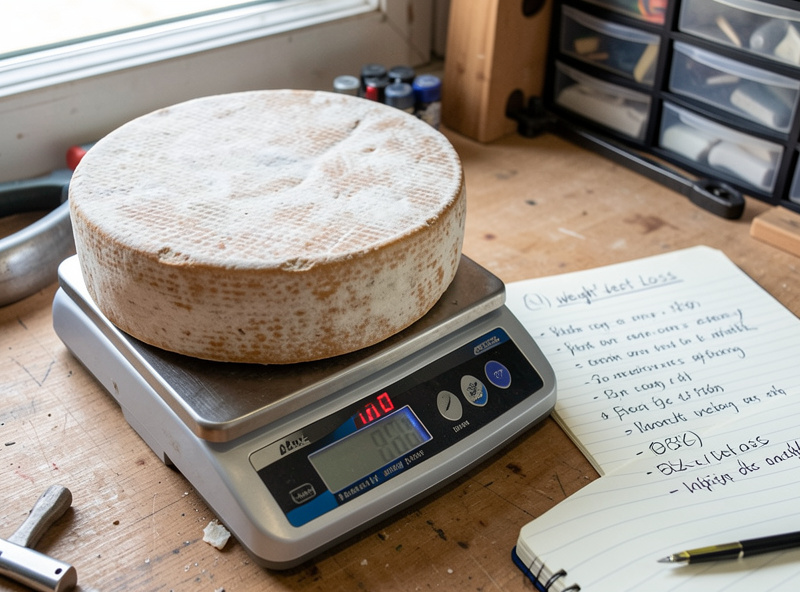
A cheese loses weight as it loses moisture, and that moisture loss is exactly what firms the paste and concentrates the flavor. A wheel that has only dropped 10% is still young and moist no matter how many weeks have passed; one nearing 40% is firm and mature. The exact target varies by style — a moist young Gouda might be lovely at 20–25% loss while a hard alpine wheel keeps improving past 35% — but logging the curve tells you where each wheel sits far better than the date on the label. If you take nothing else from this, take the scale: weigh every wheel, every time.
To turn the percentage into a number you can act on, do the arithmetic up front. A wheel that started at 1,000 g is ready to evaluate when it reads roughly 600–700 g, having shed 300–400 g of water. Write that target weight on the wheel’s tag the day you make it, so every weekly weigh is just a glance against a goal rather than a calculation. This is the exact discipline I carry over from curing meat, where a coppa or bresaola is called done at about 35% loss — cheese borrows the same logic because the underlying physics is identical: controlled water removal concentrating flavor and dropping water activity. A cheese that refuses to reach its target weight is telling you the chamber is too humid or the rind has sealed; one that blows past it too fast is drying out and wants more humidity and less airflow.
Aging Time as a Rough Starting Point
Time still matters as a guide to when to start checking, even if it doesn’t decide readiness on its own. Different styles ripen on wildly different clocks, so knowing the rough window stops you cutting a wheel three months too early or forgetting one for a year past its peak.
A young Gouda or quick cheddar reaches a genuinely good place in roughly six to twelve weeks; a traditional cheddar wants six months to two years; hard alpine wheels like Gruyère run a year or more; bloomy cheeses like Brie are ready in just four to six weeks and then go over fast. Feta is firm and sharp in its brine within one to four weeks. The pattern: the harder, denser, and drier the cheese, the longer it takes, because moisture has to leave slowly through a low-permeability paste. Use these windows to know when to put the cheese on the scale and start tasting — not as the finish line itself. I note the expected window next to the start weight in my log so I know roughly when to begin paying close attention to each wheel.
How Often Should You Check?
Weigh a wheel weekly for the first month, then every week or two after, and otherwise leave it alone. Over-handling and constant door-opening do more harm than infrequent checks — every time you open the chamber you spike its humidity and temperature and disturb the rind. A quick weekly weigh-and-look is plenty.
The weekly weigh is the single most informative check because it shows the trend: a wheel losing weight steadily is ripening correctly, a wheel that has stopped losing weight has either case-hardened or stalled, and a wheel losing weight too fast is drying out and heading for a brittle rind. Note the number, glance at the rind for anything sticky or wrongly coloured, turn the wheel so it ages evenly, and close the door. That two-minute routine, repeated, builds the weight-loss curve that tells you everything — and it’s far more useful than cutting into the cheese to peek.
Reading Waxed and Vacuum Cheeses Differently
Waxed and vacuum-sealed cheeses don’t give you the same external signals, because they barely lose weight and show no living rind. For these, time and taste replace the weight curve and the rind feel — you judge readiness by the calendar window for the style and by tasting a sample when that window arrives.
A waxed cheddar won’t drop much weight at all since the wax stops evaporation, so the 30–40% rule doesn’t apply; you simply give it its expected age — say three to six months for a young cheddar — then unwax a portion and taste. A vacuum-sealed wheel is the same: no moisture loss, no rind, so you open a bag at the lower end of its window and judge purely by flavor and texture. This is one reason natural-rind aging is more readable than the sealed methods — the wheel is constantly broadcasting its state through weight and surface, where a sealed cheese keeps its progress hidden until you open it.
What It Should Feel and Look Like
A ready hard cheese feels firm and springy under thumb pressure with no soft or sunken spots, and shows an even, intact rind. A wheel that still gives like fresh dough in the centre needs more time; one that has gone rock-hard on the outside but stayed wet inside has case-hardened and stalled.

Press the wheel gently at the centre and the edge. It should feel uniformly firm — a dense, resistant give, not a wet squish and not a brittle crack. The rind should be even and dry to the touch, dusted with the normal grey-white or brown molds of a natural rind, with no sticky or slimy patches. A bulging spot, a soft pocket, or a crack weeping moisture all say something has gone wrong inside. Colour and rind character that match the style you’re making — a clean wax coat, a dusty tomme rind, a firm cheddar crust — are the visual confirmation that the cheese aged the way it should.
Taste: The Final Call
Once the weight and feel say a cheese is in range, taste decides. Cut a thin sample from a wheel you intend to open anyway, and judge it against the style — sharp enough, nutty enough, complex enough for what you wanted. If it’s close but a touch young, the rest of the wheel can keep aging; if it’s where you want it, it’s done.
Don’t crack open every wheel “just to check,” because each cut into a natural-rind cheese exposes fresh surface and resets a little of the protection the rind gives. Sample strategically — open the one you’re ready to eat and let the others keep going. Cheese is forgiving of patience in a way meat sometimes isn’t: a wheel left a few extra weeks past your first taste usually just deepens. The skill is learning your own preference and reading the weight curve so you know when the wheel is in the window where taste becomes the only question left.
When a Cheese Is Not Ready — It’s Spoiled
The flip side of “ready” is recognising a wheel that has gone wrong, because the stakes are real. Normal natural-rind molds are grey, white, blue-grey, and powdery, and they brush back with a brine-dampened cloth. Trouble looks and smells different: fuzzy black or bright pink growth, slimy or sticky patches, or a sharp ammoniated or genuinely rotten smell are not signs of readiness, they’re signs to stop.
A firm wheel with a clean rind and a normal cheesy-to-sharp aroma is doing fine. A wheel that has slimed, smells of ammonia far beyond a faint whiff, or has grown fuzzy coloured mold that goes deep rather than wiping off has failed, and rindless or soft cheese in that state should be thrown out — when you are genuinely unsure whether a cheese is safe, bin it rather than gamble. A cheese is “ready” only when it is both properly aged and unmistakably sound; the two conditions are not separable, and the nose is your last and most honest check.
So the answer to “when is it ready” is really three readings taken together: the scale showing 30–40% weight loss, the firm even feel of a sound wheel under your thumb, and a taste that matches the style you set out to make — all on a cheese that looks and smells clean. Master those and you’ll stop counting days and start reading the cheese itself. If you want the upstream picture of how the whole age works, start with my complete guide to home cheese aging, see which wheels reward a short window in the fast-aging cheeses guide, and dial your chamber with the temperature and humidity chart. The beginner cheese list is the easiest place to start a first wheel you can actually read.