Prague Powder #1 vs #2 Mixup: How to Tell and What to Do
June 17, 2026

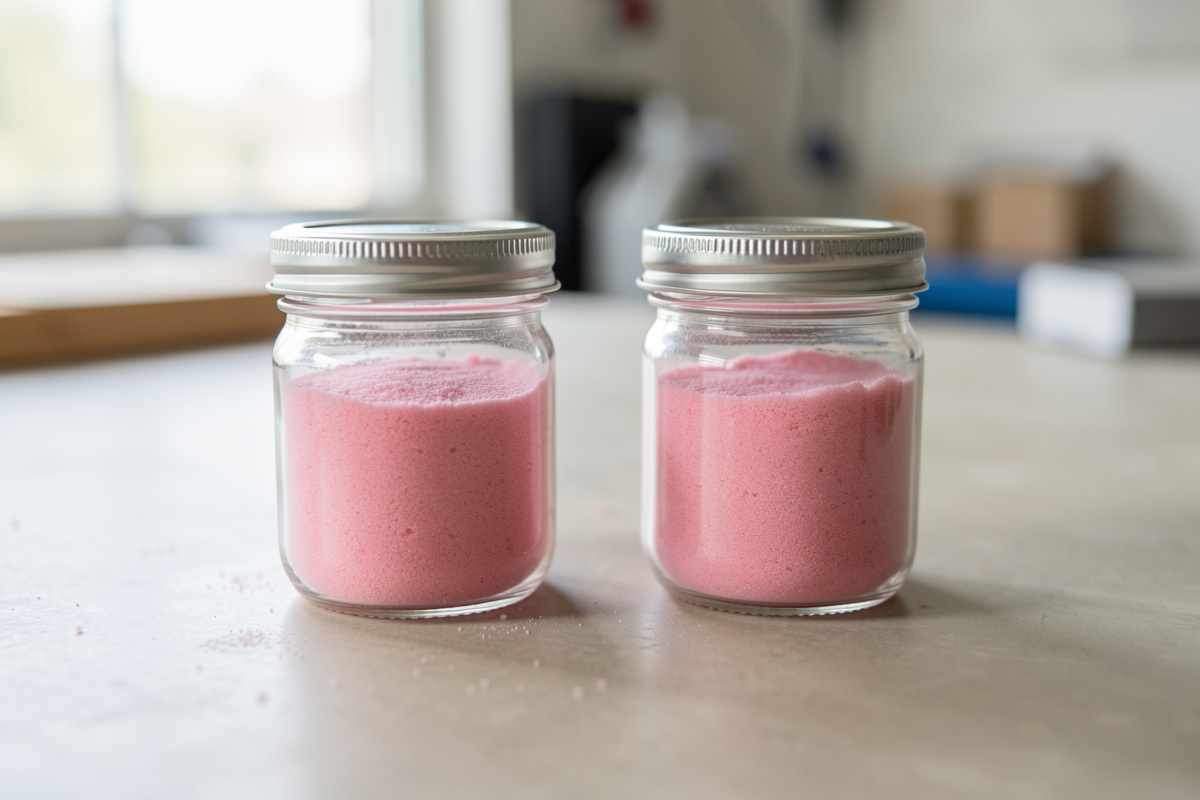
Two small bags of pink salt sit on my cure shelf. One is Prague Powder #1, one is Prague Powder #2. They are the same colour, the same texture, and they smell the same. The only thing that tells them apart is the label — and the day a label rubs off, or you decant a bag into an unmarked jar, you have a genuine safety question on your hands, not a cosmetic one. This is one of the few mixups in charcuterie that actually matters.
You cannot tell Prague Powder #1 from #2 by sight, taste, or smell — both are dyed pink and look identical. The only reliable identifier is the label. If a curing salt is unlabelled, you must discard it or re-source from a marked container; never guess. Use #1 for short and cooked cures, #2 for long air-dried and fermented work.
Why these two get confused in the first place
The confusion is built into the product. Both Prague Powder #1 and #2 are dyed the same pink so you never mistake either for plain table salt — but that dye does nothing to distinguish the two cures from each other. In my setup they live in separate sealed containers precisely because once they are out of the original bag they are indistinguishable. There is no taste test, no smell test, no float test. The pink is a warning colour, not an ID code.
It gets worse with the nicknames. Prague Powder #1 is also sold as Insta Cure #1, Pink Curing Salt #1, and “pink salt.” Prague Powder #2 turns up as Insta Cure #2 and Pink Curing Salt #2. When two products share a colour, a texture, and half a dozen names, a tired curer at the end of a stuffing session decants the wrong one. I have seen it happen on my own bench in the early years, which is exactly why my labelling is now obsessive.
What each cure actually does
Prague Powder #1 is 6.25% sodium nitrite and 93.75% salt. The nitrite is the active part: it does the colour fixing, the flavour, and — the reason it exists — it suppresses Clostridium botulinum. Nitrite acts fast, which is why #1 is the right tool for short cures and for anything that will be cooked or hot-smoked, where the meat reaches a safe temperature within hours or days, per food-science guidance from the meat-curing science literature.
Prague Powder #2 contains sodium nitrite and sodium nitrate, plus salt. The nitrate is the clever part: it is a slow-release reservoir. Over the weeks and months of a long dry cure or a fermented salami, the nitrate gradually breaks down into nitrite, keeping protection alive across the whole age. That slow conversion is exactly why #2 is required for long air-dried whole muscle and for fermented sausage — and exactly why it is pointless in a cooked product that is finished in a day.
How much, and why I weigh it
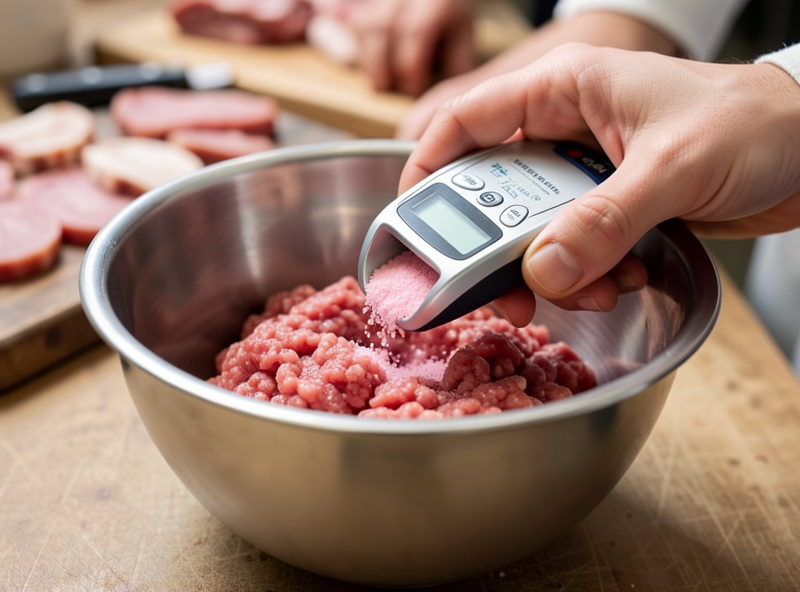
Both cures use the same dosing rate: about 2.5 g per 1 kg (2.2 lb) of meat. That is the classic “1 level teaspoon per 5 lb” guideline, and at that rate you land around 156 ppm ingoing nitrite — the regulatory maximum the USDA Food Safety and Inspection Service sets for most cured products. I do not trust the teaspoon. Measuring spoons vary by as much as 20%, and nitrite overdose is acutely toxic, so I weigh every dose on a gram-accurate jeweller’s scale. Curing salt is the one ingredient where “a pinch” is a genuinely dangerous instruction.
Prague Powder #1 vs #2 at a glance
Here is the whole decision in one table — composition, what each is for, the dose, and what goes wrong if you reach for the wrong tin.
| Prague Powder #1 | Prague Powder #2 | |
|---|---|---|
| Composition | 6.25% sodium nitrite + 93.75% salt (dyed pink) | Sodium nitrite + sodium nitrate + salt (dyed pink) |
| How it protects | Nitrite acts fast, then dissipates | Nitrate slowly converts to nitrite over weeks/months |
| Use for | Short cures; anything cooked or hot-smoked (bacon, cooked sausage, brined-then-cooked) | Long air-dried and fermented (salami, pancetta, coppa, bresaola, long whole muscle) |
| Dosing | ~2.5 g/kg of meat (≈156 ppm ingoing nitrite) | ~2.5 g/kg of meat (≈156 ppm ingoing nitrite) |
| If you use it on the wrong job | On a long dry cure: no nitrate reservoir for the long age — a real safety gap | On a quick/cooked product: residual nitrate with no benefit; unnecessary nitrate |
What actually happens if you use the wrong one
The two mistakes are not equally serious, and the honest answer matters here. They sit on opposite ends of the risk scale, so I treat them very differently when one happens in my chamber.
Cure #1 used on a long dry cure or fermented sausage
This is the dangerous direction. A long air-dried coppa or a fermented salami spends weeks or months at chamber temperature. Cure #1 has only fast-acting nitrite and no nitrate reservoir, so its protection fades early in an age that needs it sustained the whole way through. You have removed the slow-release safety net from exactly the product that depends on it — across the long drying window where C. botulinum and other pathogens are the concern. This is the misuse that worries a real charcutier.
Cure #2 used on a cooked or quick product
This is the harmless-but-wasteful direction. A product that is cooked or finished in a day or two never gives the nitrate in #2 time to convert, so you simply carry residual nitrate that did no work. There is no safety benefit and no need for the extra nitrate in a quick cure. It is a mistake worth avoiding, but it is not the one that ends a piece.
What to do if you already used the wrong cure
If you reached for the wrong tin and only realised afterwards, work the case on its specifics rather than panicking — the safe call depends entirely on which direction the mistake went and how far the cure has progressed.
Cooked or quick product made with #2 instead of #1: this is the recoverable case. Provided your weight of cure was correct (2.5 g/kg), you have the right nitrite level for the job and merely some unconverted nitrate along for the ride. A bacon or a cooked sausage made this way is, in practice, fine to eat — the error was using a more elaborate cure than the product needed, not an unsafe one. Next time, grab #1.
Long air-dried or fermented product made with #1 instead of #2: this is the case to take seriously. You have aged a product for weeks without the nitrate reservoir it needed across that long window. I will be blunt because this is a safety topic and not a place for optimism: a long-dried or fermented piece cured with #1 where #2 was required is one I err toward not eating. The drying window where you needed sustained protection is exactly the window it lacked, and there is no way to add it back after the fact. Throwing out a coppa hurts; a foodborne-illness gamble on a home-cured product is not a trade I make. When a long cure was protected by the wrong salt, the safe call is to discard it.
The labelling system that stops this happening
Because the two salts are physically indistinguishable, the entire defence is organisational, and it has to be boring and rigid to work. The way I run mine, prevention is a fixed routine, not a judgement call I make under fatigue.
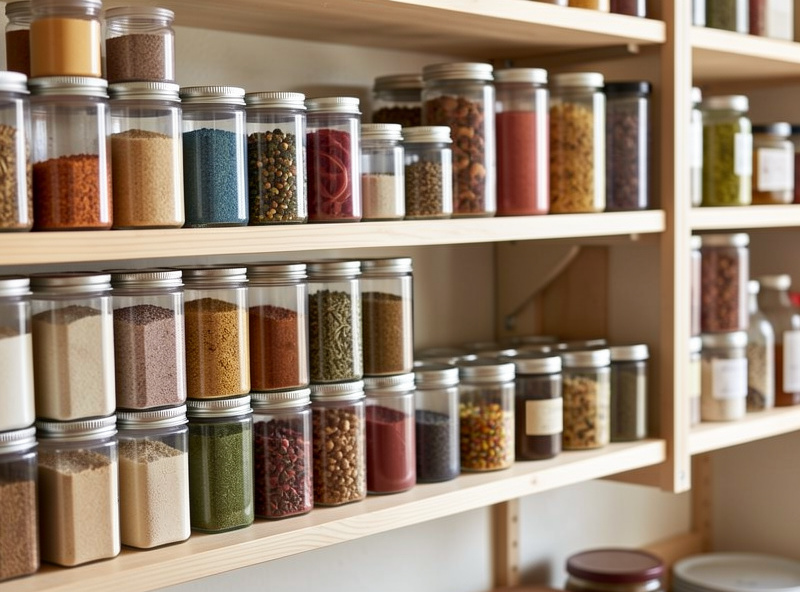
Each cure lives in its own sealed, clearly labelled container — name, type number, and the date I opened it, in permanent marker, not a sticky note that peels in a humid workshop. I never decant either cure into an unmarked jar, ever; an unlabelled pink salt is treated as unknown and discarded, no exceptions and no sniff-test rescue attempts. The gram scale lives on the same shelf so dosing and identity are one motion. And #1 and #2 are stored apart from each other and well apart from any plain or flavoured salt, so a half-asleep reach lands on the right tin by position alone.
A note on the “natural, no-nitrate” myth
While we are talking about which pink salt is which, it is worth clearing up the cousin of this confusion: the celery-powder “uncured” label. Products sold as “uncured” or “no nitrates added” are very often cured with nitrite derived from celery or other vegetable concentrates — the chemistry your body sees is the same nitrite, just from a plant source. “Natural” is not the same as “nitrite-free,” and a genuinely nitrate-free long dry cure is not a safe substitute for using cure #2 on the job that needs it. On a long age, the correct curing salt is the safety system, whatever the marketing says.
Keep Building
- Curing Chamber Troubleshooting: the complete guide — the hub for diagnosing what went wrong, from humidity drift to mold ID.
- Home salami making, start to finish — where cure #2, the ferment, and the pH drop all come together in one build.
- Choosing a salami starter culture — the LAB blends that drop pH and partner with cure #2 on a fermented sausage.
- Homemade coppa (capocollo) — a long whole-muscle cure that genuinely needs the nitrate reservoir in #2.
- Dry aging pork at home: safe limits — where the line sits between dry-aging and dry-curing, and why it matters for safety.
- Best beef cuts for dry aging — picking the cut before you ever reach for a cure.