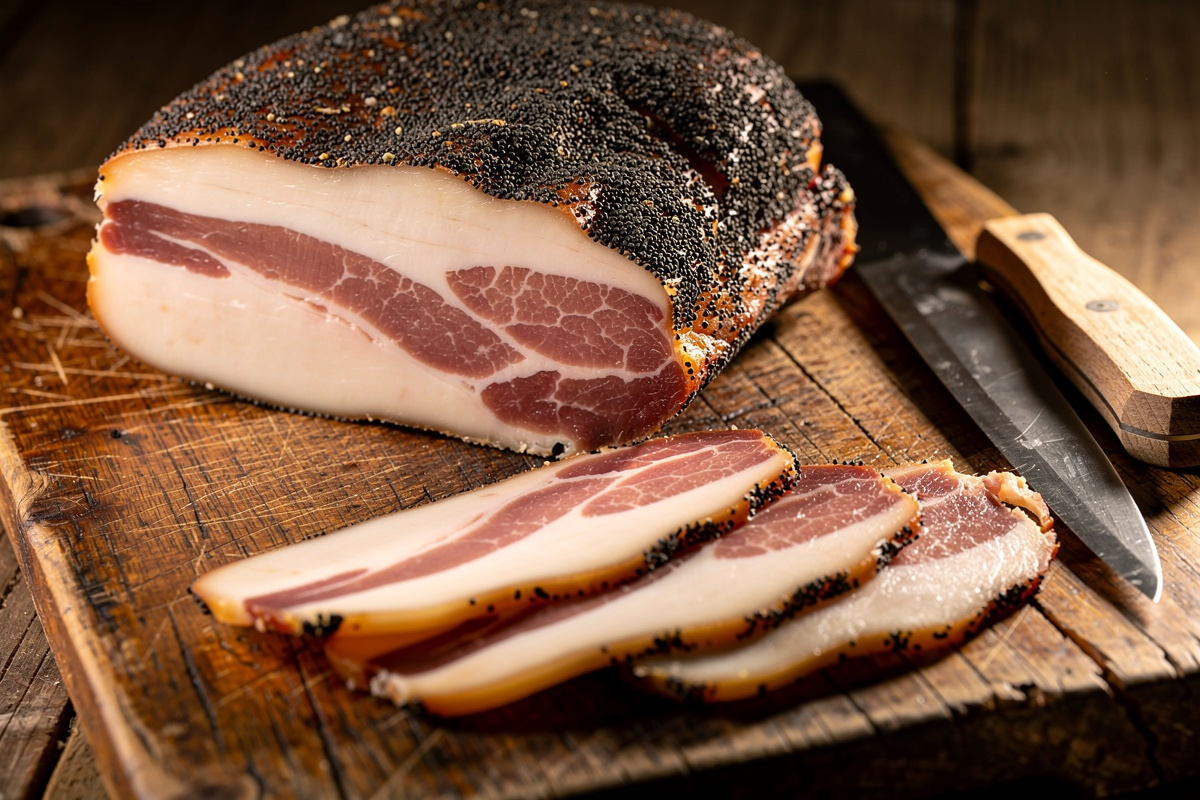

Guanciale is cured pork jowl, and it is the cut that converts people to whole-muscle curing. The jowl is fattier and more marbled than belly, the muscle threads are finer, and the rendered fat has a depth that pancetta cannot touch. It is also one of the simplest cures in the chamber: no rolling, no casing, just a salted slab of jowl hung until the scale says it is done. After years of running jowls alongside bellies, guanciale is the piece I tell people to cure if they want the fastest possible proof that this hobby is worth the wait.
It earns a dedicated build because the jowl behaves differently from the belly. The fat-to-lean ratio is higher, the shape is irregular, and the gland and any stray lymph tissue have to come out before curing. Get those handling details right and the cure itself is forgiving. The whole muscle charcuterie hub places guanciale in the family; this is the jowl-specific method I run.
Sourcing and Trimming the Jowl
A good guanciale starts with a clean jowl, skin on, with the gland removed. Pork jowl is not a supermarket cut in most places, so it comes from a butcher or a whole-head order, and it arrives with a bit of work to do. There is a salivary gland and sometimes a lymph node buried in the fat near the thick end; I cut those out and discard them, because they will not cure and they taste wrong. I leave the skin on for the cure and trim it off only at slicing, because skin protects the fat face during drying.
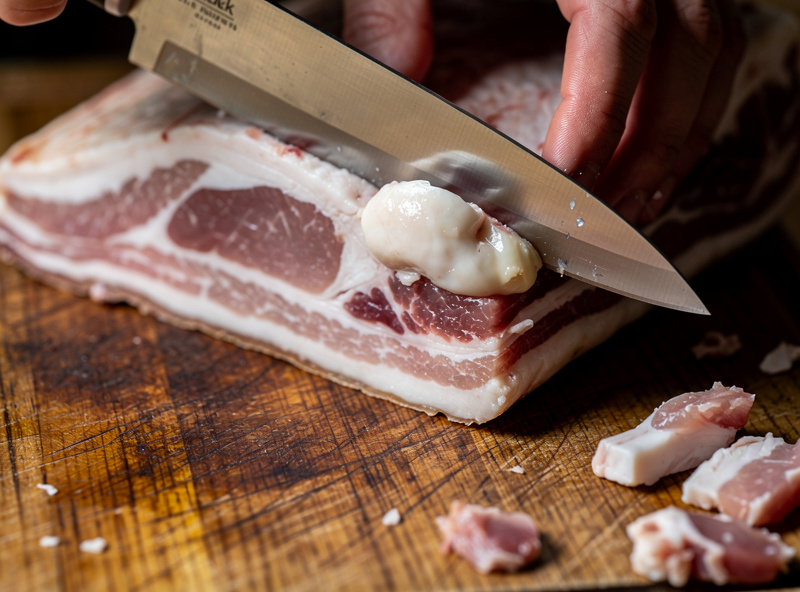
I square the jowl up so it dries evenly, taking off any thin ragged flaps that would dry to leather before the body of the piece is done. A jowl that finishes around 700 grams to a kilo after trimming is an ideal home size: big enough to be worth the wait, small enough to cure through cleanly. Weigh it now and write that green weight on the tag, because everything downstream is measured against it.
The Equilibrium Cure
I cure guanciale by equilibrium, the same as belly: salt weighed to the meat, not buried in a box. The baseline is 2.5% to 3% fine non-iodised salt by green weight. Because guanciale is a short-to-medium cure that I usually finish in the three-to-five-week range, I use Cure #2 at 0.25% of meat weight as my default, which carries the nitrate reservoir for the longer end of that window and removes any guesswork about whether the piece outran Cure #1. Cure #1 at 0.25% is acceptable if you are certain you will finish and refrigerate inside two weeks, but I lean to Cure #2 on jowl because the irregular shape makes the dry time less predictable.
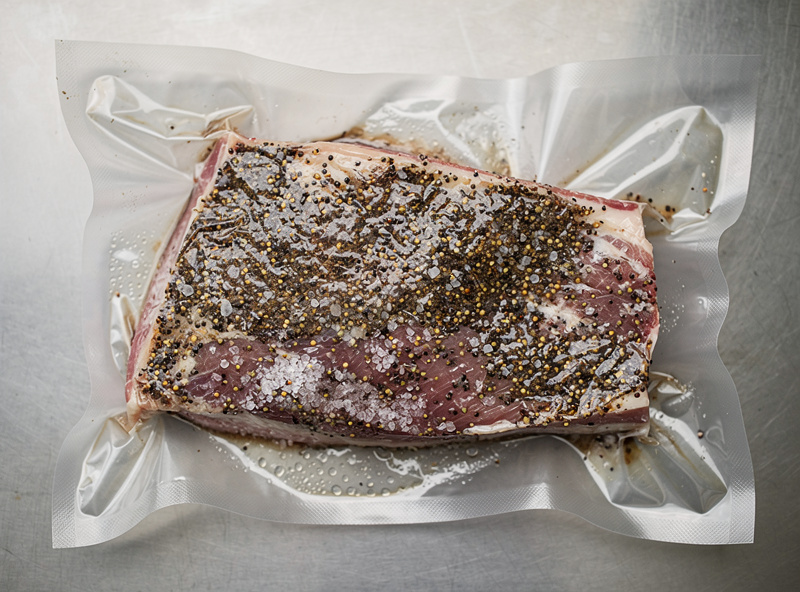
For seasoning, guanciale is traditionally a peppery cure: a heavy hand of cracked black pepper, plus a little garlic, bay, and sometimes a pinch of chilli or fennel. The pepper crust is part of the identity of the cut. I rub the salt, cure salt, and spice over the whole jowl, vacuum or zip bag it, and equilibrium-cure in the fridge for about a week to ten days depending on thickness, flipping and massaging daily. The arithmetic for the salt weight is the same as every other equilibrium cure, worked through on the salt percentage calculator.
| Parameter | Guanciale (jowl) | Why it differs from belly |
|---|---|---|
| Salt | 2.5–3% by weight | Same equilibrium baseline |
| Cure salt | Cure #2 default, 0.25% | Irregular shape, less predictable dry time |
| Cure days (bag) | ~7–10 days | Thicker fat than belly slab |
| Target weight loss | ~30% | Fattier, so loss reads slower |
Drying the Jowl
After the bag cure, I rinse the jowl lightly, pat it bone dry, and string it through the thick end to hang. It dries in the standard chamber envelope: roughly 12 to 15°C and 75 to 80% relative humidity with gentle, cycled air exchange. In my primary chamber the temperature runs off the dual-stage controller and humidity off the humidity controller, with the low-speed fan on its five-on, twenty-five-off cycle so the surface never gets a constant draft.
Because guanciale is so fatty, it is more forgiving of humidity swings than a leaner cut like bresaola, but it is not immune to case hardening. A jowl dried too hard and too fast will seal a leathery skin over fat that is still soft underneath, and you will not know until you cut it. If the surface stiffens unevenly, I bump RH up a few points and ease the fan, the same correction as any chamber drying too aggressively. The full rescue is on the case hardening guide, and holding the envelope steady in the first place is what the climate control guide is built around.
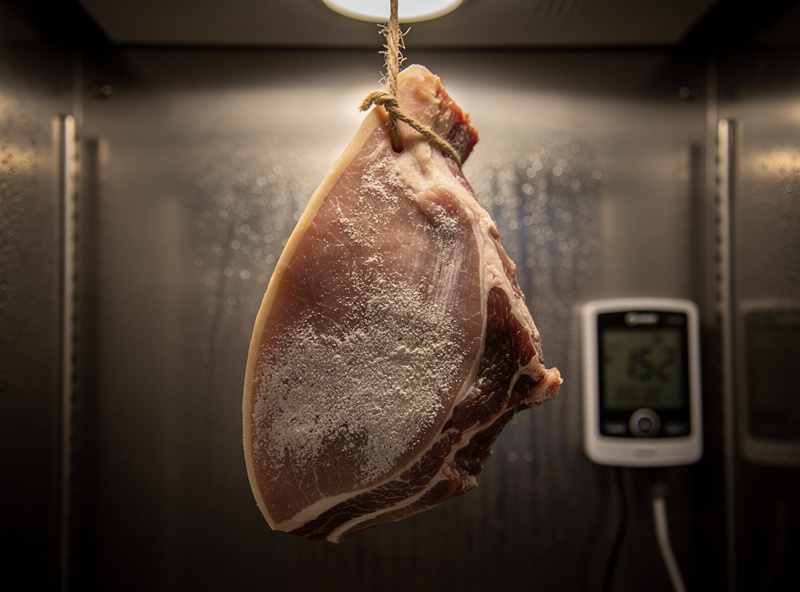
White Penicillium mould on the surface is normal and welcome on guanciale; it is part of how the piece protects itself during the dry. Fuzzy black or green growth is not, and a slimy surface means the humidity ran too high. Knowing which is which is non-negotiable on any cured meat, and the breakdown is on the good mould vs dangerous mould guide.
When Is Guanciale Done?
Guanciale is done at around 30% weight loss, and the scale is the honest signal. Because the jowl is so fatty, the weight loss reads slower than a leaner cut, and the piece firms up gradually rather than going hard. I pull mine at roughly 30%, when the lean threads are firm and the fat has tightened but is still supple. Pushed much further it gets dry and waxy; pulled too early it is soft and the cure has not concentrated. The feel I am after is a piece that is firm at the thick end with no soft, squishy core.
Unlike pancetta, guanciale is essentially always cooked before eating: it is rendered into pasta sauces, where its fat is the entire point. That cooking step gives a little latitude, but it is not licence to skip the cure salt or pull the piece wet. Guanciale that has lost a third of its weight is dense, keeps for weeks in the fridge wrapped in paper, and freezes well portioned. I vacuum-seal what I am not using inside a month so the fat does not go rancid.
As an Amazon Associate I earn from qualifying purchases.
Two things make jowl curing easier. The first is a tenth-of-a-gram scale for the cure salt, because 0.25% of a 900-gram jowl is just over two grams and that is not a measurement to eyeball; I use a 0.1g precision scale for every cure-salt weigh-out. The second is a decent boning knife to lift the gland out cleanly, and I keep a flexible boning knife for exactly that trimming work.
Guanciale vs Pancetta: When to Reach for Each
Guanciale and pancetta are cousins, both dry-cured pork, but they are not interchangeable in the pan. Guanciale is fattier, with a deeper, almost gamey pork richness from the jowl, and it renders into a silkier fat; it is the correct cut for a true carbonara or amatriciana. Pancetta is leaner and milder, more all-purpose, and easier to source. If you can only cure one jowl a year, make it guanciale and save it for the dishes that show it off. The belly build is on the pancetta guide for when you want the everyday cut.
Frequently Asked Questions
What cut is guanciale made from?
Guanciale is cured pork jowl, the cheek and throat of the pig. It is fattier and more marbled than belly, with finer muscle threads and a richer rendered fat. The skin is usually left on through the cure and removed at slicing. A trimmed home jowl finishing around 700 grams to a kilo is an ideal size.
Do I need Cure 2 for guanciale?
Cure 2 at 0.25 percent of meat weight is the safer default because the jowl’s irregular shape makes the dry time less predictable and a jowl often hangs three to five weeks. Cure 1 at 0.25 percent is acceptable only if you are certain you will finish and refrigerate within about two weeks. Curing without the correct curing salt is not a safe substitute for a dry-cure.
How long does guanciale take to cure?
Plan on roughly a week to ten days in the bag for the equilibrium cure, then around three to five weeks hanging in the chamber. The real signal is weight loss, not days. Pull guanciale at about 30 percent weight loss from its trimmed green weight, when the lean is firm and the fat has tightened but is still supple.
Can you eat guanciale raw?
Guanciale is almost always cooked, rendered into pasta sauces where its fat is the point. While a fully cured, Cure 2 finished jowl at proper weight loss is technically a dry-cured product, the cut shines cooked and that is how it is traditionally used. Do not skip the curing salt or pull the piece while it is still soft and wet inside.
Why is the white mould on my guanciale a good thing?
A powdery white coat of Penicillium mould is normal and protective; it helps regulate moisture loss at the surface during drying. Fuzzy black or green growth or a slimy surface is not normal and signals a humidity problem. When in doubt about a mould, wipe a small white patch back with a vinegar cloth, but discard any piece with black, green or slimy growth you cannot identify.
What is the difference between guanciale and pancetta?
Guanciale is cured jowl, pancetta is cured belly. Guanciale is fattier with a deeper pork richness and renders into a silkier fat, which is why it is the correct cut for carbonara and amatriciana. Pancetta is leaner, milder and more all-purpose. The cure method is similar but the cuts and the rendered fat behave differently in the pan.
More From the Whole Muscle Chamber
- Whole Muscle Charcuterie: The Complete Guide
- Homemade Pancetta: Arrotolata vs Tesa
- How to Calculate Salt Percentage for Equilibrium Curing
- Case Hardening: Causes, Prevention, and Fixes
- Curing Chamber Climate Control Guide