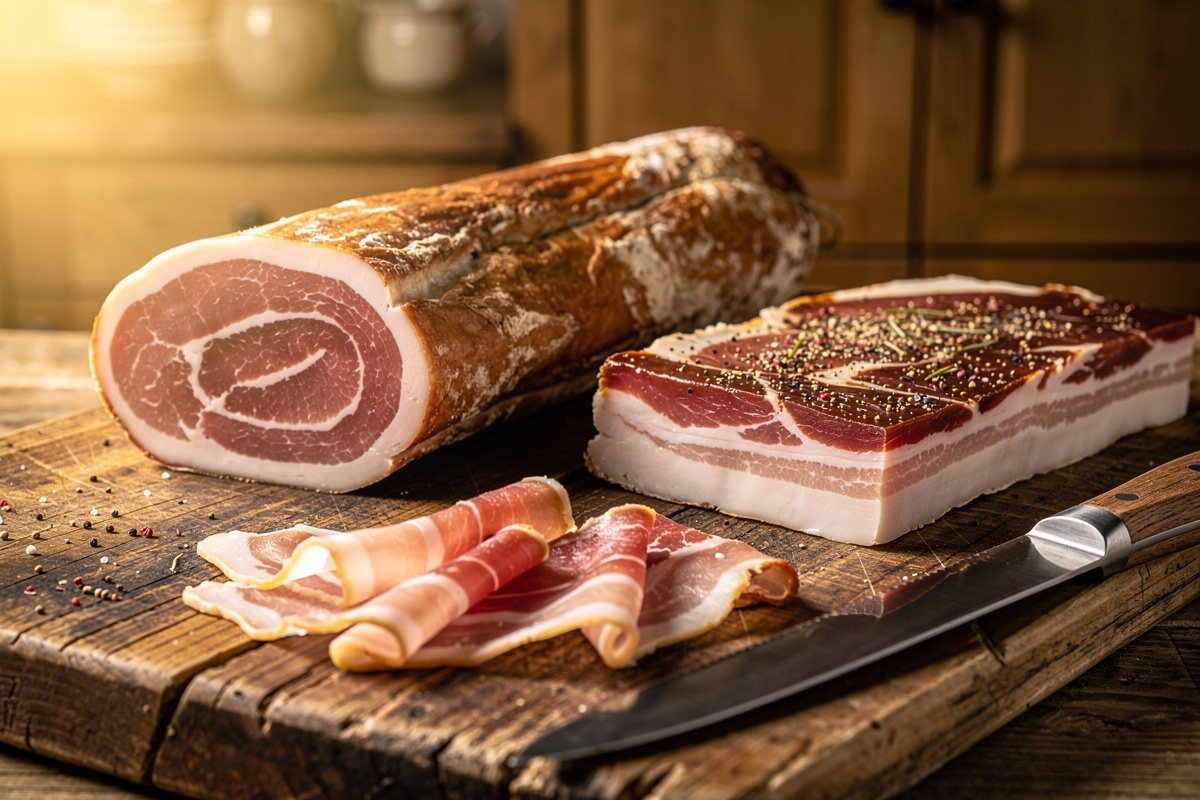

Pancetta is salt-cured pork belly, dry-cured rather than smoked, and it splits into two builds the moment you decide how to shape it: arrotolata, rolled into a tight cylinder, or tesa, left flat as a slab. They use the same cure and the same chemistry. They behave completely differently in the chamber, and after years of running both on the belly I keep buying, I reach for one or the other depending on what I actually want to cook with it.
This is the build I run most often, because pork belly is forgiving, the cure window is short by charcuterie standards, and a finished pancetta earns its keep in everything from carbonara to a lentil pot. It is also the cleanest possible introduction to equilibrium curing whole muscle: a flat, even cut, a precise salt weight, and a chamber that holds its envelope. Get pancetta right and coppa and bresaola are the same logic on harder geometry. The hub on whole muscle charcuterie covers where pancetta sits in the wider family; this is the belly-specific build.
Arrotolata vs Tesa: Which Build to Run
The choice is geometry, and geometry decides drying behaviour. Tesa is a flat slab: maximum surface area, fast even drying, and a piece you can render lardons from or slice into rashers. Arrotolata is the same belly rolled tight and tied into a salami-shaped cylinder, then cased or netted: slower drying, a denser bite, and the cross-section spiral that looks the part on a board. I run tesa when I want cooking fat and lardons, arrotolata when I want something sliceable to eat closer to raw.
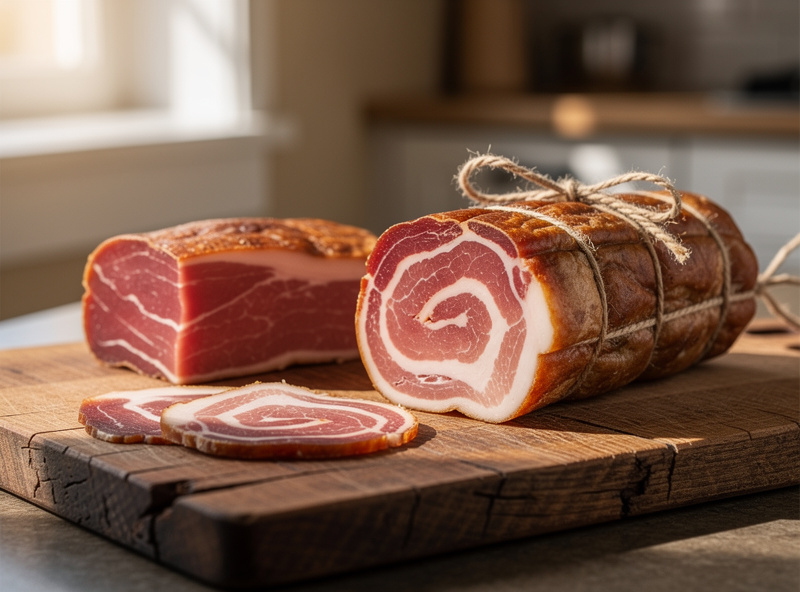
There is a real safety wrinkle that pushes my default toward tesa for anyone starting out. A rolled arrotolata traps the outer surface, with its handled, salted exterior, in the centre of the roll where it dries slowest and where any bacteria from handling end up sealed in. That is exactly why I treat arrotolata as a Cure #2 build, not a Cure #1 one, and why I am fussy about rolling clean. Tesa dries from both faces and never buries its surface, so it is the more forgiving slab to learn on. If you have never cured a belly before, run a tesa first.
| Build | Shape | Drying speed | Cure choice | Best use |
|---|---|---|---|---|
| Pancetta tesa | Flat slab | Faster, even from both faces | Cure #1 (short) or #2 (longer hang) | Lardons, rashers, cooking fat |
| Pancetta arrotolata | Rolled cylinder | Slower, dense centre | Cure #2 (surface buried in centre) | Thin slices eaten closer to raw |
The Cure: Equilibrium Salt, Cure Salt, and Why the Weight Matters
I cure pancetta by equilibrium, weighing the salt to the meat rather than burying it in a salt box, because a slab of belly is easy to weigh and equilibrium curing makes the salt level a number you control instead of a guess. The baseline I run is 2.5% to 3% fine non-iodised salt by green weight, plus the curing salt for the method, plus whatever sugar and spice the style calls for. Weigh the belly, multiply, and that is your salt. There is no over-salting and no leaching, because the meat absorbs exactly what you added.
The curing salt is not optional and the choice depends on how long the piece hangs. For a tesa slab cured and used within a couple of weeks, Cure #1 at 0.25% of meat weight covers the short window. For arrotolata, or any belly I intend to hang past about three weeks, I use Cure #2 at 0.25% because the nitrate reservoir in Cure #2 protects across the longer dry where botulinum spores would otherwise have time to matter. Never iodised table salt for any of it; the iodine and the anti-caking agents do nothing good for a cure. The arithmetic behind the salt percentage lives on the equilibrium curing salt calculator if you want to see it worked.
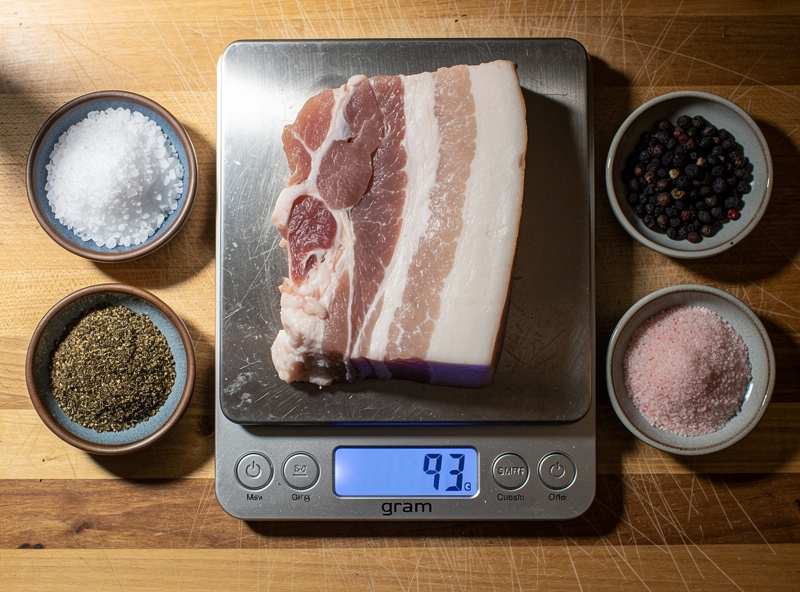
For seasoning I keep it classic: cracked black pepper, juniper, bay, a little garlic, and a pinch of sugar to round the salt. The spice goes on at the same time as the cure. I rub the mix evenly over the whole belly, bag it in a vacuum or zip bag, and equilibrium-cure it flat in the fridge for roughly a week to ten days, flipping daily and massaging the bag so the cure redistributes. The belly comes out firm and noticeably stiffer at the edges. That firmness is the cure penetrating; a still-floppy, wet belly means it needs more time in the bag.
Rolling Arrotolata Without Trapping Trouble
If you are going for arrotolata, the cure-then-roll sequence matters. I cure the belly flat first so the salt and nitrite reach the whole surface evenly, then rinse lightly, pat bone dry, and only then roll. Rolling tight is the whole game: any air pocket inside the roll is a place moisture and the wrong bacteria can sit, and a loose roll dries hollow. I roll along the grain into the tightest cylinder the belly allows, then truss it hard with curing twine or pull it into a netting, every couple of centimetres, squeezing air out as I go.
A skin-on belly rolled with the skin out gives the neatest cylinder but dries slower; skin-off rolls faster and is easier to slice later. I net rather than case the roll most of the time so I can watch the surface and wipe back any unwanted mould. This is the build where good white Penicillium mould on the outside is a feature, not a flaw, and where you have to know the difference, which the guide on good white mould vs dangerous black or green covers in detail.
Drying: Chamber Envelope and Air Exchange
Pancetta dries in the same envelope I run everything else at: roughly 12 to 15°C and 75 to 80% relative humidity, with gentle air exchange. In the primary chamber I run the temperature off the dual-stage controller, humidity off the humidity controller, and a low-speed 120mm fan on a five-minutes-on, twenty-five-off cycle so there is air movement without a constant draft drying the surface too hard. A constant blast is how you case-harden a belly: the outside seals into a dry shell while the inside stays wet and never finishes.
Case hardening is the failure that catches more pieces than mould ever does, and it is entirely a humidity-and-airflow problem. If the surface goes leathery and stiff while the centre stays soft, the humidity is too low or the air is moving too hard. I walk it back by nudging RH up a few points and easing the fan cycle, and the shell rehydrates over a few days. The full diagnosis and rescue is on the case hardening guide. The honest target for a chamber that holds is dialled-in stability, which is what the climate control guide walks through building.
When Is Pancetta Done? The Weight Log
Pancetta is done on weight loss, not the calendar. I weigh every piece in and write the green weight on a tag, then weigh periodically. Tesa I pull at around 25% to 30% weight loss; it firms up but stays pliable enough to slice and renders beautifully. Arrotolata I take further, to roughly 30% to 35%, because a rolled cylinder eaten closer to raw wants to be firm all the way through. A belly that has lost a third of its weight has lost enough water that it is dense, salty-sweet, and keeps well.
Tesa for cooking is the most forgiving piece in the chamber: even at 20% loss it is usable as lardons because you are going to render it. Arrotolata for slicing is stricter, because you are eating it without a cooking step, so I hold to the full weight loss and a firm, uniform feel before slicing into it. There is no shortcut here; the scale is the doneness signal, and a piece that looks done but is still heavy is still wet inside.
As an Amazon Associate I earn from qualifying purchases.
The two pieces of equipment that move the needle on a belly cure are a scale that reads in tenths of a gram for the cure salt, and curing twine or netting for the roll. I weigh the curing salt on a 0.1g precision scale because 0.25% of a kilo of belly is two and a half grams and you do not eyeball nitrite. For arrotolata I truss with meat curing netting rather than tying by hand, because it squeezes the roll evenly and I can see the surface through it.
Slicing, Cooking, and Storing
Tesa slices into rashers or batons straight off the slab with a sharp knife; it does not need a slicer because you want chunkier lardons anyway. Arrotolata I chill hard, almost to freezing, then slice as thin as the knife allows to show the spiral. Either way, finished pancetta keeps for weeks wrapped in paper in the fridge and freezes well if you portion it first. The fat will eventually go rancid given enough time and air, so I vacuum-seal anything I am not using inside a month.
In the kitchen, tesa renders down for carbonara, ragù, and anything that wants pork fat as a base; arrotolata gets eaten thin on a board or laid over roasting cuts. Neither is bacon: there is no smoke and no cooking step built in, so cook tesa before eating it, and only eat arrotolata raw-thin if it has hit full weight loss and you cured it with Cure #2. That is the line I do not cross, and it is the whole reason the cure salt choice up top matters.
Frequently Asked Questions
Do I need curing salt to make pancetta?
Yes. For a short-cured tesa slab used within a couple of weeks, Cure #1 at 0.25% of meat weight is correct. For arrotolata or any belly hanging longer than about three weeks, use Cure #2 at 0.25% because the nitrate reservoir protects across the longer dry. Curing a belly with plain salt alone is not a safe substitute for a long dry-cure.
How long does pancetta take to dry?
Dry to weight loss, not the calendar. A flat tesa slab usually reaches 25 to 30 percent weight loss in roughly two to four weeks depending on thickness and chamber stability. A rolled arrotolata is denser and slower, often a few weeks longer to reach 30 to 35 percent. Weigh the green belly and track the loss rather than counting days.
What is the difference between pancetta and bacon?
Pancetta is dry-cured pork belly that is air-dried and never smoked; bacon is cured belly that is smoked or cooked. Pancetta tesa still needs cooking before eating, while a properly Cure 2 finished arrotolata can be eaten sliced thin without cooking. The cure base is similar but the finish and the smoke are what separate them.
Why is my pancetta hard on the outside but soft inside?
That is case hardening: the surface has dried too fast and sealed, trapping moisture inside. It is caused by humidity that is too low or airflow that is too aggressive. Nudge the chamber relative humidity up a few points toward 80 percent and ease the fan cycle, and the leathery shell will rehydrate over several days so drying can finish evenly.
Can I cure pancetta in a normal fridge without a chamber?
The equilibrium cure phase happens in a normal fridge in a bag. The drying phase needs the higher humidity and milder temperature of a curing chamber; a frost-free fridge is too dry and too cold and will case-harden the belly. A converted-fridge chamber holding about 12 to 15 Celsius and 75 to 80 percent humidity is what the drying phase needs.
More From the Whole Muscle Chamber
- Whole Muscle Charcuterie: The Complete Guide
- How to Calculate Salt Percentage for Equilibrium Curing
- Case Hardening: Causes, Prevention, and Fixes
- Good White Mould vs Dangerous Black or Green
- Curing Chamber Climate Control Guide