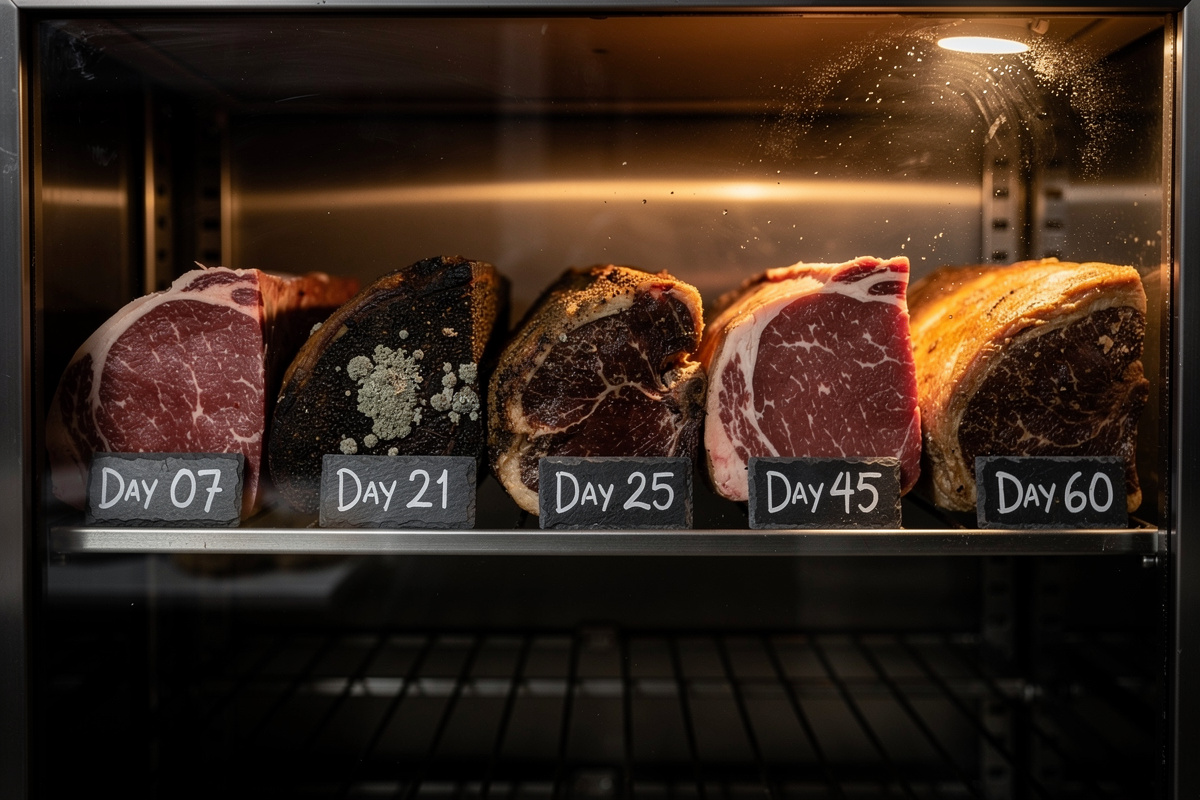

Dry age beef for 21 days for a clean first result, 28 days for the classic steakhouse profile, 35-45 days for pronounced blue-cheese funk, and 60-100 days only as an expert project. There is no single right number — each window produces a recognizably different steak.
I have pulled cuts at every one of these marks and weighed them through the whole run, and the honest answer to “how long” is “how funky do you want it, and how airtight is your climate?” Here is exactly what each window gives you and where the diminishing returns and the real risks begin.
What Actually Changes Over Time
Three processes run in parallel the entire age, and time controls how far each goes. Enzymes tenderize the muscle, evaporation concentrates flavor, and surface flora build the funk. The longer the age, the more pronounced all three — and the more your climate has to stay flawless to keep spoilage out.
Endogenous enzymes (cathepsins and calpains) break down muscle proteins from the inside, and most of that tenderizing happens in the first three to four weeks. Evaporation runs the whole time — published dry-aging research puts cumulative loss at roughly 10% by day 21 and 15% by day 30, climbing to around 23% by day 50 and 35% by day 1201 — which is why deep ages cost so much in yield. The surface mold and yeast colony grows slowly, and it is the funk-builder: the nutty, blue-cheese-adjacent notes that define long-aged beef are mostly a product of weeks five through twelve. None of this is safe to push without holding 32-39°F (0-4°C) and 75-85% relative humidity, target around 80%, with drift under 3°F and 5% RH the entire time. Time amplifies whatever your climate is doing — good or bad.
21 Days: The Flavor Inflection Point
Twenty-one days is where dry aging starts to taste like dry aging. Tenderness has improved markedly, and the first buttery, faintly nutty notes appear over the still-recognizable fresh-beef base. The bark is firm but not yet rock-hard, so trim losses are moderate. This is the window I recommend for a first run, whether you use a converted chamber or the best dry aging bags in a standard fridge.
At three weeks you get most of the tenderizing payoff — the enzymes have done their heaviest work — with only a gentle introduction to the funk. For someone who has never eaten properly dry-aged beef, 21 days is the sweet spot to calibrate your palate before chasing the stronger profiles. It is also the safest window for a new chamber operator: three weeks gives less time for a climate wobble to turn into a spoilage problem than five or twelve weeks does. A well-marbled striploin or ribeye at 21 days is a genuinely excellent steak, and you have given up only moderate yield to get there.
28 Days: The Steakhouse Standard
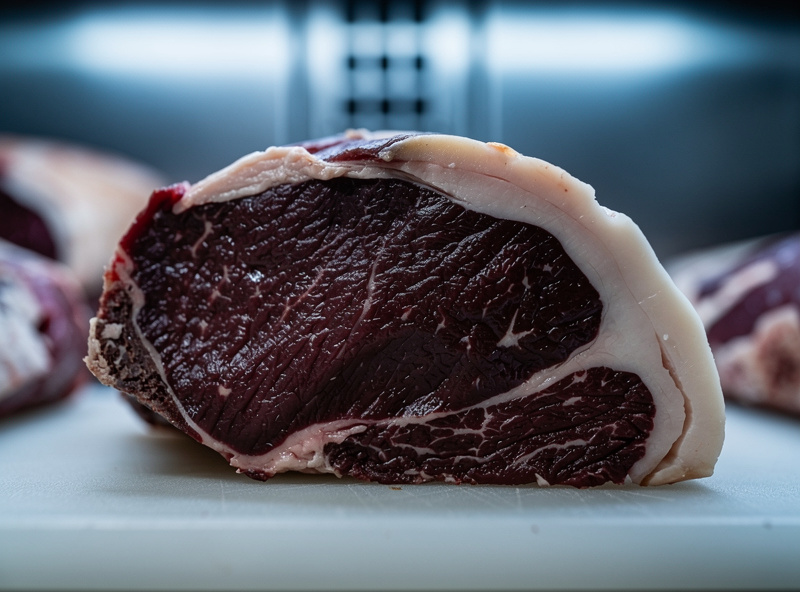
Twenty-eight days is the target most steakhouses age to, and for good reason. The nutty, savory funk is well-developed, the tenderness gain is substantial, and the flavor is rich without crossing into the polarizing territory of longer ages. Bark is hard now and trim losses peak around here.
If 21 days is the introduction, 28 days is the classic. This is the profile most people picture when they imagine dry-aged steak: deeply beefy, distinctly nutty, with enough funk to be obviously different from a fresh steak but not so much that it divides the table. The trade-off is yield — by four weeks you have lost roughly 13-14% of the starting weight to evaporation, and the hardened bark you trim away brings the usable yield down to roughly 50-55% of where you started. For most home agers this is the best balance of flavor payoff against cost per pound, and it is where I age the majority of my showpiece ribeyes.
35-45 Days: Pronounced Funk
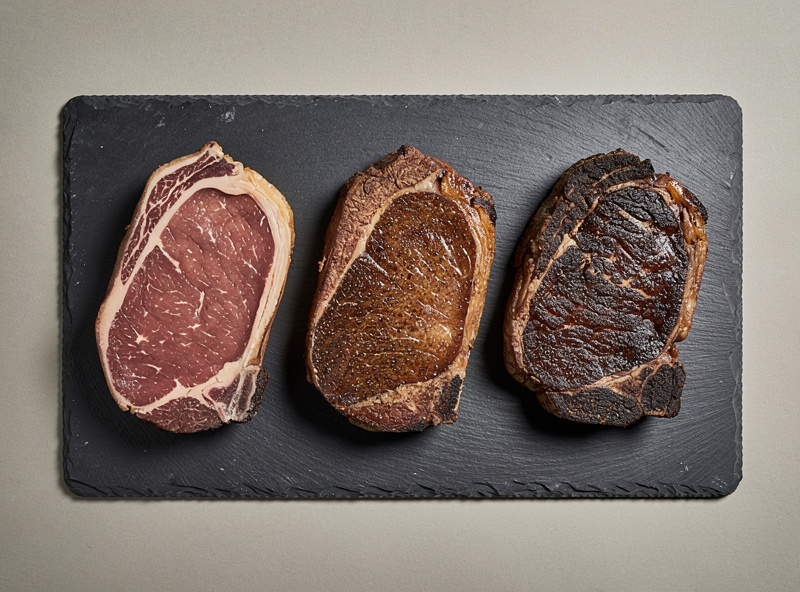
At 35 to 45 days the steak crosses into serious funk territory. Blue-cheese, mushroom, and strong umami notes dominate, and the texture continues to soften. This is the range that dry-age enthusiasts chase, but it is also where climate mistakes start showing up as off-flavors rather than just lost yield.
This window is polarizing on purpose. The funk is no longer a background note — it is the headline, and people either love it or push their plate away. Texturally the meat is exceptionally tender and dense. The catch is that every extra week magnifies any imperfection in your chamber: a humidity spike that would have been harmless at day 14 can seed the wrong surface growth by day 40. This is the stage where smell becomes your most important tool. A deepening nutty-funky aroma is normal and good; a sharp ammonia note, a sour-vinegar smell, or anything rotten or sulfurous means stop and inspect. Reading those signals correctly is its own skill, covered in dry aging smell: what is normal vs what means trouble.
60 to 100 Days: Specialty and Experimental
Sixty days and beyond is specialty territory, and past 60 days in a home setup the risk profile genuinely changes, not just the flavor. Commercial 90 to 120-day programs run in rooms that use UV light to decontaminate recirculated air and filter or UV-treat the air in contact with the beef2 — equipment a converted fridge, however well-sealed, does not have. Without it, pushing a home chamber past 60 days trades a known, well-characterized flavor gain for a materially higher and less predictable spoilage/proteolysis risk than the same days in a commercial room. At home the climate-control demands and the yield losses make this rarely worthwhile unless you are doing it for the education or the bragging rights, and only with the understanding that you are operating outside the equipment envelope that makes commercial deep-aging predictable.
I ran one experimental ribeye to 90 days in a beef-only chamber I was watching daily, photographing it every Sunday, and it taught me more about what each week contributes than any shorter run — but I also went in accepting I might have to bin it, precisely because I don’t have UV or forced-air filtration and was pushing well past my normal 45-60 day ceiling. The funk peaked at a Stilton-cellar intensity around week twelve and then edged toward ammonia at the very end, which is exactly the kind of drift that a no-UV home setup is more exposed to over that many weeks. By 100 days you are managing a piece that has lost a large share of its mass to evaporation and whose far surface is right at the line between “magnificent” and “gone.” You cannot run this in a multi-purpose chamber: it has to be a beef-only space with rock-steady climate, because three months gives every flaw three months to express itself, and without the equipment a commercial room has, a wobble is more likely to cross into genuinely-spoiled rather than just funky. Treat 60-100 days as a deliberate experiment on a cut you can afford to lose, not as a routine target, and if the smell ever moves past deep funk into sharp ammonia or rot, discard rather than push through it. A dedicated, well-sealed chamber is the minimum starting point, and the build logic is in how to build a curing chamber with the setpoint dropped to 36°F.
Dry Aging Timeline Compared
Here is each window side by side — the flavor it produces, the texture, the approximate evaporation loss, the risk level, and who it suits. Use it to pick a target before you start, then let smell confirm you are on track.
| Age | Flavor Profile | Texture | Approx. Evaporation Loss | Risk Level | Best For |
|---|---|---|---|---|---|
| 14 days | Subtle, fresh-beef base | Noticeably more tender | ~7-9% | Low | First-ever age; minimal funk |
| 21 days | Buttery, lightly nutty | Markedly tender | ~10% | Low | Best starting target |
| 28 days | Nutty, savory funk | Very tender | ~13-14% | Moderate | Classic steakhouse profile |
| 35-45 days | Blue cheese, mushroom, umami | Dense, soft | ~16-20% | Higher | Funk enthusiasts |
| 60-100 days | Intense, cheesy, near-ammonia | Pronounced softness | ~24-32% | High (no-UV home setup) | Expert experiments only |
Note how the risk and the loss climb together past 28 days while the flavor change becomes more a matter of taste than of universal improvement. That is the core decision: 21-28 days is where almost everyone should live, and the longer ages are a personal expedition, not a better steak by default.
Weight Loss Is the Honest Clock
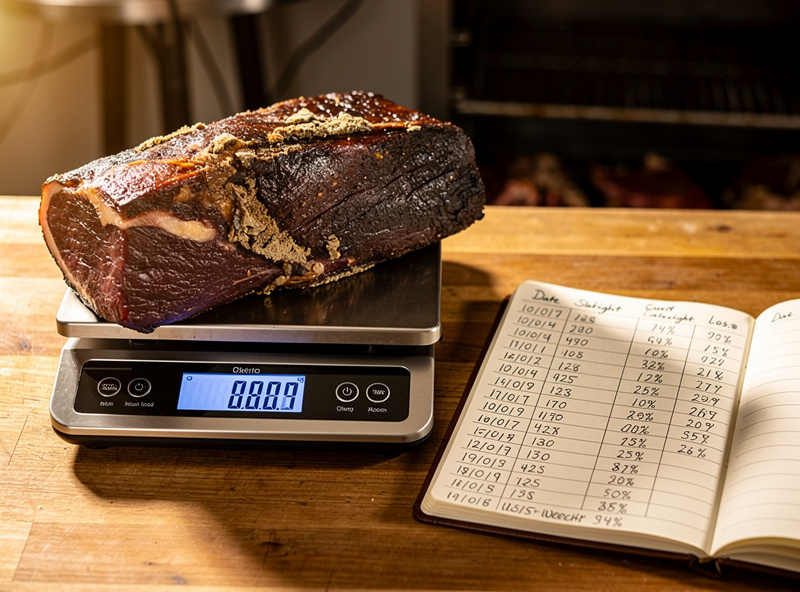
Days on the calendar are a rough guide; weight loss is the real measure. The same cut in a slightly warmer or drier chamber ages faster, so I track the percentage lost rather than trusting the date alone. A subprimal hitting roughly 13-14% loss is in 28-day territory regardless of what the calendar says.
I weigh every piece going in and check it periodically, the same obsessive logging I bring to whole-muscle charcuterie. For dry-aged beef the evaporation percentage tells you how far concentration has gone: single digits is early, roughly 10-14% is steakhouse range, and 24%-plus means you are deep into experimental territory. Pairing the weight log with smell gives you two independent read-outs, which is far safer than guessing from days alone. A reliable wireless hygrometer and thermometer lets you watch the climate that drives that loss without opening the door and disturbing it.
As an Amazon Associate I earn from qualifying purchases.
Choosing Your Number
Pick your age from three inputs: how strong you want the funk, how good your climate control is, and what cut you bought. A first-timer with a well-marbled ribeye and a stable chamber should target 28 days; a budget sirloin should stop at 14-21; and 45-plus days belongs to people whose chambers never drift.
The cut sets a ceiling. Lean cuts like sirloin dry out and over-trim if you push them long, so they belong in the 14-21 day window — the cut-by-cut guidance is in best beef cuts for dry aging. Your equipment sets the other ceiling: an open chamber that holds climate to within a couple of degrees can chase the long ages, but a kitchen fridge cannot, which is where the bag method earns its place for controlled multi-week ages — see best dry aging bags tested. And humidity matters more the longer you go; the why is in ideal humidity for dry aging beef vs charcuterie. To run any of the longer windows reliably, a dedicated dry aging refrigerator or, for kitchen-fridge ages, a box of dry aging bags takes most of the climate gamble out of the equation.
Frequently Asked Questions
How long should you dry age beef at home?
Target 21 days for a clean first result, 28 days for the classic steakhouse profile, and 35 to 45 days for pronounced blue-cheese funk. Ages of 60 to 100 days are expert-only experiments. For most home agers, 21 to 28 days is the best balance of flavor against yield and risk.
What happens at 28 days versus 45 days of dry aging?
At 28 days the steak has well-developed nutty, savory funk and substantial tenderness — the classic steakhouse profile. At 45 days the funk becomes pronounced, with blue cheese and mushroom notes that divide opinion, the texture grows denser, and the climate must stay flawless because off-flavor risk and yield loss both climb sharply.
Can you dry age beef for 100 days?
Only as an expert experiment in a dedicated, rock-steady chamber, and only accepting materially higher risk than shorter ages. Commercial 90 to 120-day programs use UV air treatment a converted fridge lacks, so at home you are pushing past the equipment envelope that makes deep aging predictable. By 100 days the flavor is intense and cheesy, edging toward ammonia at the far surface, and the cut has lost roughly a quarter to a third of its weight to evaporation. It demands flawless climate control and a cut you can afford to lose.
Is longer dry aging always better?
No. Tenderness gains mostly finish by three to four weeks, and past 28 days the flavor change is a matter of personal taste rather than universal improvement. Longer ages also raise spoilage risk and cut yield. The funk at 45-plus days polarizes; many people prefer the cleaner profile of a 21 to 28 day age.
How do you know when dry-aged beef is done?
Use weight loss and smell together rather than the calendar alone. Roughly 10 percent loss is 21-day territory and 13 to 14 percent is 28-day range. A deepening nutty, funky aroma is good; sharp ammonia, sour vinegar, or rotten notes mean stop and inspect. Weighing in and out gives an objective read.
Does the cut change how long I should age?
Yes. Well-marbled ribeye tolerates 28 to 45 days because its fat protects the interior. Striploin ages cleanly at 21 to 35 days. Lean top sirloin dries out and over-trims past about 21 days, so keep it short. Match the age window to the cut’s fat cap, not to a single fixed number.
Why does my dry-aged beef smell like ammonia?
A faint sharpening of aroma is normal at very long ages, but a clear ammonia smell signals the meat is at or past its safe limit, usually from too-long aging or climate drift. Trim and inspect the interior immediately; if the smell is strong and penetrates past the bark, the cut should be discarded.
Related Articles
- Dry Aging Beef at Home: The Complete Guide — the full climate, cut, and yield framework behind these timelines.
- Best Beef Cuts for Dry Aging: Ribeye vs Striploin vs Sirloin — which cuts tolerate the long ages.
- Dry Aging Smell: What Is Normal vs What Means Trouble — your most important progress tool past 35 days.
- Best Dry Aging Bags: Umai vs SteakAger vs DryBagSteak Tested — controlled multi-week ages without a chamber.
- Ideal Humidity for Dry Aging Beef vs Charcuterie — why humidity matters more the longer you go.