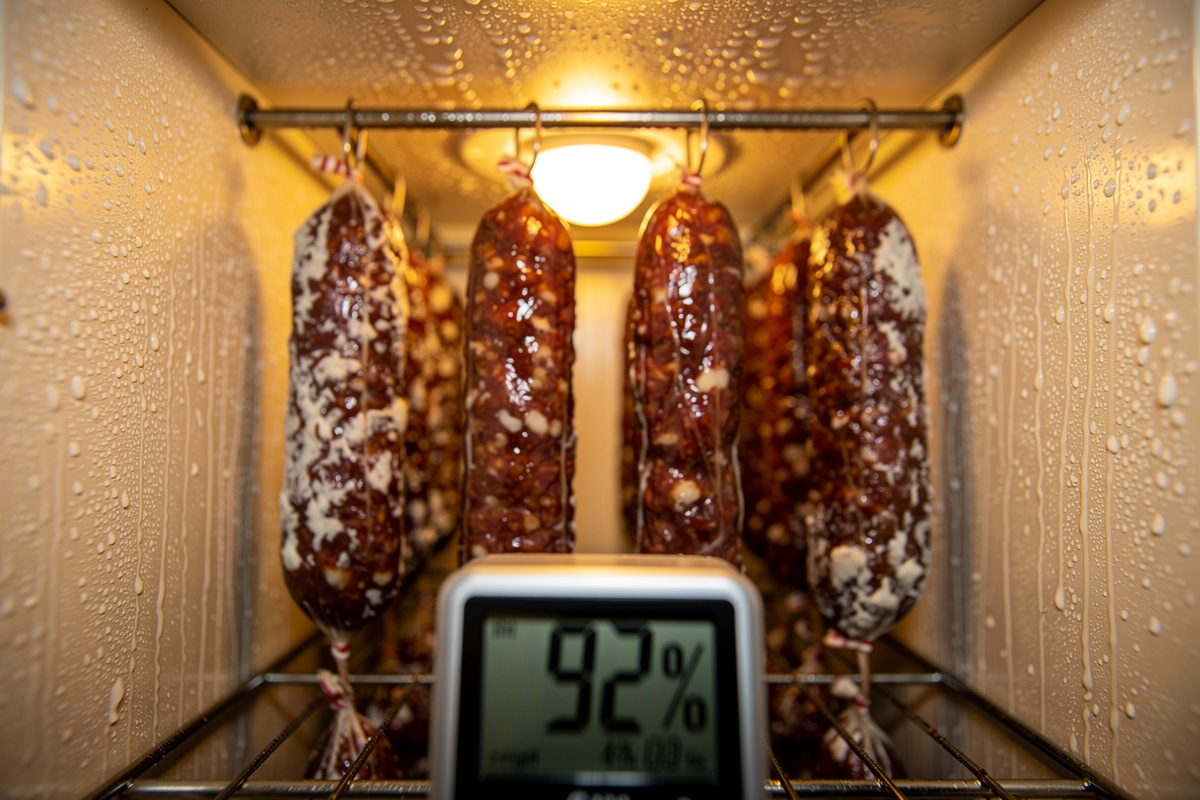

I drop curing chamber humidity from 90%+ down to 75% in under 4 hours by combining three immediate actions: unplug the humidifier completely, increase fan run-time by 50%, and add a 2-pound tray of dry rice or coarse salt to the chamber floor as a desiccant.
The salt-or-rice tray absorbs about 2 to 4% of chamber RH per hour for the first 6 hours and then plateaus. I crack the door 1/4 inch every 30 minutes during the first 2 hours to dump saturated air. This rescue sequence saved my first 5-week coppa run when an overnight ambient drop spiked the chamber to 94% RH.
Long-term fix is preventing the spike in the first place: a properly tuned humidity controller (I run an Inkbird IHC-200 set to a 75% setpoint with a 3% deadband), a humidifier that doesn’t run at full output (use the controller’s outlet, never wire the humidifier to a wall plug), and avoidance of the 4 most common humidity-spike causes. This guide covers the rapid-rescue sequence, the controller setup, and the prevention checklist. The broader climate-control framework is in curing chamber climate control: the complete guide.
Why a Curing Chamber Goes Too Humid
Four common causes account for almost all humidity overshoots. Cause 1: humidifier wired to a wall plug instead of a controller outlet. The humidifier runs continuously, ignores the chamber RH, and rapidly fills the air. The fix is mandatory: every humidifier in a curing chamber must be plugged into the humidity controller’s outlet so it cycles on and off based on actual humidity readings. I made this exact mistake on my first build — left the MistAire on a wall plug for 18 hours because the controller cord was tangled, and the chamber sat at 96% RH the whole night.
Cause 2: brand-new fresh meat hung in the chamber. A fresh prosciutto leg or salami chub releases roughly 30 to 100 grams of moisture per day during the first week of curing. This is normal — the meat is supposed to dehydrate — but the released moisture spikes chamber RH if the chamber is small. A 4 cu ft chamber with 2 fresh prosciutto legs will spike to 90%+ RH within 24 hours of hanging.
Cause 3: ambient temperature drop overnight. Cool air holds less moisture, so a chamber that’s at 60% RH at 65°F can hit 80% RH at 50°F without any water added. Basement chambers are the most prone to this because basement temperature swings 5 to 10°F overnight. The psychrometric math is just dew-point physics — the Engineering Toolbox dew-point reference shows the relationship if you want the equation rather than the rule of thumb.
Cause 4: probe placement wrong. The Inkbird humidity probe should hang in the open chamber air at meat-height, not near the humidifier outlet (where it reads artificially high) or against a chamber wall (where condensation gives false readings). Wrong probe placement is the most common reason controllers don’t respond properly. The full calibration walk-through is in smart temperature and humidity sensors for curing chambers.
The Rapid Rescue Sequence (Under 4 Hours)
Step 1 (0 to 5 minutes): Unplug the humidifier completely from the wall and from the controller. Don’t just turn it off — physically unplug it. This guarantees no accidental cycling during recovery.
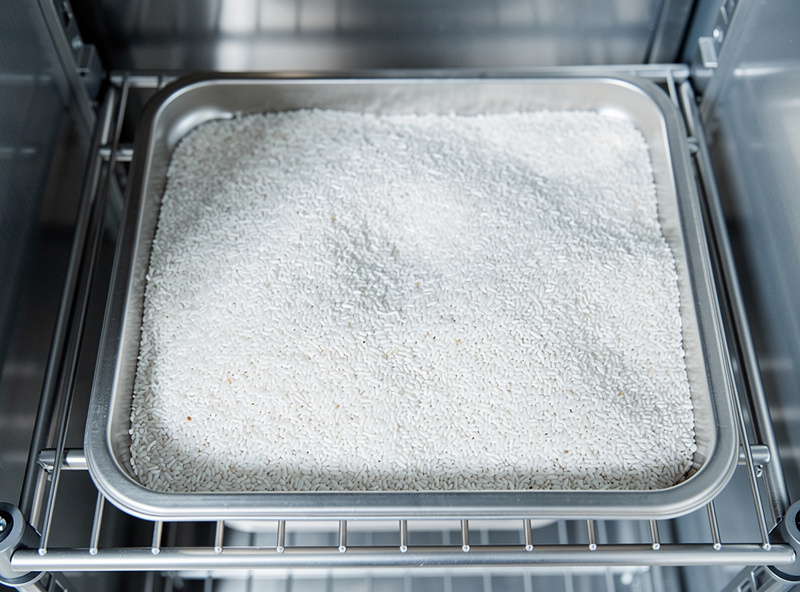
Step 2 (5 to 15 minutes): Place a 2-pound tray of uncooked rice or kosher salt on the chamber floor. Both work as desiccants. Spread the contents in a thin even layer across the largest tray you can fit. Larger surface area absorbs faster — a 12 x 8 inch tray works better than a deep 6 x 6 bowl.
Step 3 (15 to 60 minutes): Crack the chamber door open about 1/4 inch and prop it with a small wedge or folded paper. This dumps the existing humid air. Re-close after 5 minutes to let the chamber re-stabilize, then check humidity. Repeat every 20 to 30 minutes until RH drops below 80%.
Step 4 (continuous): Increase chamber fan run-time. If your fan was on a 30-on/30-off cycle, switch to continuous for the next 4 hours. Continuous airflow accelerates the moisture absorption by the desiccant tray and helps moisture migrate to the chamber walls where it can drip down rather than sit on the meat.
Step 5 (after 4 hours): RH should be in the 75 to 80% range. Plug the humidifier back into the controller outlet (not the wall) and verify the controller setpoint is correct (75% standard for charcuterie, 70% for dry aged beef). The chamber should now self-regulate. If you’re running a smart-plug-driven setup instead of an Inkbird, the equivalent rule patterns are in smart plug curing chamber schedule.
What “Too Humid” Actually Looks Like
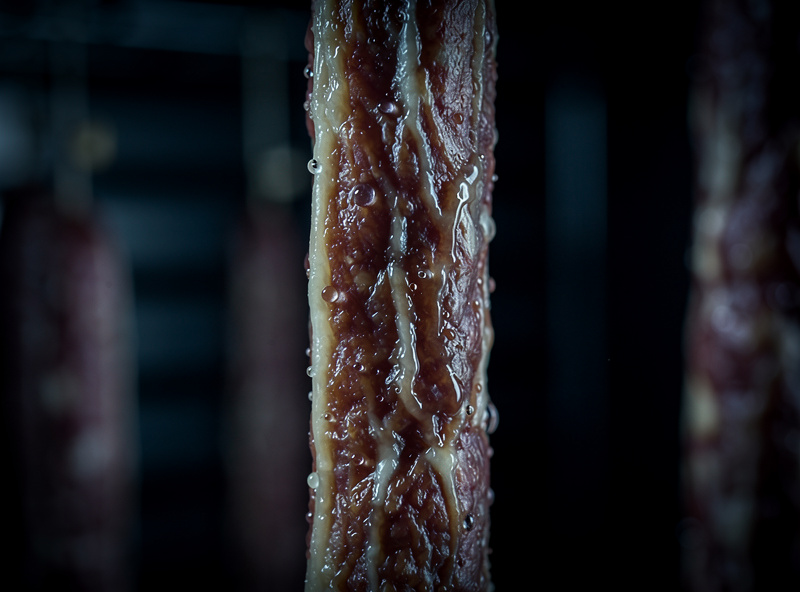
Visible signs of over-humidity, in order of severity: condensation droplets on the chamber ceiling and walls (RH near 95%, dew point reached); slimy or wet surface on hanging meat (RH 88-92% sustained); white mold growth becomes patchy and discolored (RH 85-90%, white mold weakening); black mold spots beginning to bloom (RH 85%+ for 24+ hours). The slime and patchy mold appear within 24 to 48 hours of sustained over-humidity.
Less visible but more dangerous: case hardening reversal. When chamber humidity exceeds 90% for 3+ days, the outer salami case absorbs moisture back from the air and softens, while the interior continues to dehydrate. The result is a salami with a soft outer 5 mm and a dry-firm interior — the opposite of the proper texture profile. The mechanism in detail is in case hardening in curing chambers.
The smell test: a properly humidified chamber smells faintly of cured meat and white mold (slightly mushroomy). An over-humidified chamber smells musty, sour, or has a noticeable wet-leather quality. If your chamber smells off when you open the door, check humidity first. The first time I caught one of my own chambers in this state, the smell hit me from three feet away — sour cardboard, almost ammonia under it.
Desiccant Options Compared
| Desiccant | Absorption Rate | Cost | Replacement Frequency | Best For |
|---|---|---|---|---|
| Uncooked rice (2 lbs) | Moderate (2 to 3% RH/hr) | $2 to $4 | Replace when sticky | Cheap fast rescue |
| Coarse kosher salt (2 lbs) | Moderate (2 to 4% RH/hr) | $2 to $5 | Replace when crusty | Reusable after drying |
| Damp-Rid Refillable (16 oz) | Slow (1 to 2% RH/hr) | $6 to $10 | Refill every 2 to 4 weeks | Long-term humidity buffer |
| Silica gel beads (1 lb) | Fast (4 to 6% RH/hr) | $15 to $20 | Bake to regenerate (300°F, 2hr) | Emergency fast drop |
| Dehumidifier (mini desktop) | Fast (3 to 8% RH/hr) | $30 to $60 | Empty tank daily | Chronic over-humidity |
For one-time rescue, rice or salt at $2 to $5 is the cheapest and most accessible option — most homes have either ingredient already. For ongoing humidity buffering in chambers prone to overshoot (basement chambers in summer), Damp-Rid is the long-term solution at about $1 per week of operation. I keep a 2 lb bag of coarse kosher salt and a stainless tray on the shelf above my chamber specifically as the rescue kit; rotating that tray dry in a 200°F oven for an hour resets it for the next event.
Inkbird IHC-200 Setpoint and Deadband Setup
The IHC-200 has two key settings that prevent overshoot: the setpoint (target RH) and the differential/deadband (how far above or below setpoint the controller waits before cycling). A tight deadband causes constant on/off cycling and overshoot. I run mine at a 3% differential on the humidify side — narrower than the factory default, but it’s the setting that stopped the short-cycling I was getting on mine when I first installed it.
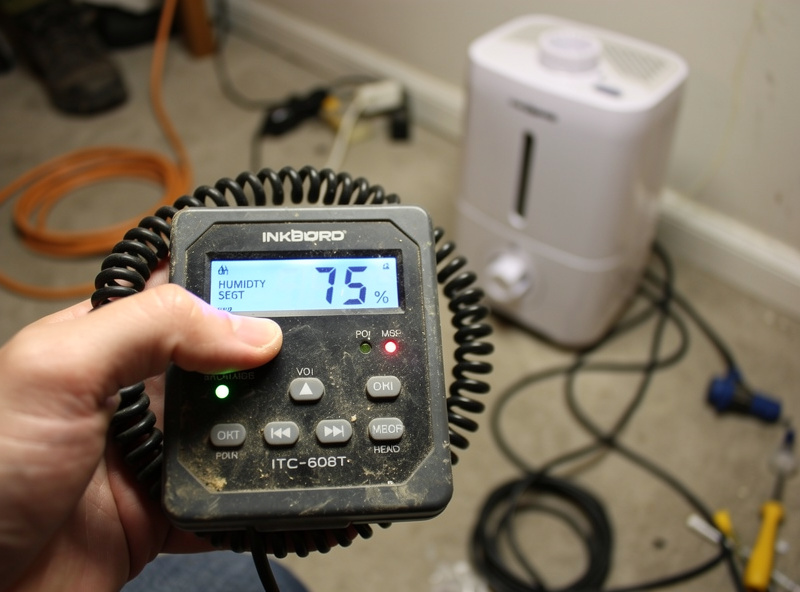
For charcuterie at 75% target, set humidity setpoint to 75% and humidity deadband to 3%. The humidifier will then turn ON when RH drops below 72% and turn OFF when RH reaches 78%. This 6% range gives the chamber time to mix air and prevents the rapid on-off cycling that causes overshoots above 80%.
For dry aged beef at 70% target, use 70% setpoint with 3% deadband (range 67 to 73%). Dry aging tolerates slightly drier conditions than charcuterie because the goal is moisture loss, not moisture maintenance. The product-specific reasoning behind these setpoints is in ideal humidity for dry aging beef vs charcuterie: why they differ.
Prevention: Pre-Curing Setup Checklist
Before hanging the next batch, verify all four humidity-control checkpoints. Checkpoint 1: humidifier plugged into the controller outlet, not the wall. The controller’s humidity outlet is usually labeled “Humidify” — confirm this is where the humidifier cord goes.
Checkpoint 2: humidity probe positioned at meat-height in open chamber air. Hang the probe with the included wire so it dangles in the middle of the chamber, not against any wall, not near the humidifier outlet, not in the corner. The probe should “see” the same air the meat sees.
Checkpoint 3: deadband set to 3% (not the factory 1%). This single setting prevents most overshoot events.
Checkpoint 4: a backup wireless hygrometer (SwitchBot, Govee, etc., $15 to $25) confirms the controller probe reading. Place the backup at a different chamber location and compare readings. A 5%+ discrepancy means one probe is wrong or one is in a poor location. I run a SwitchBot Hub 2 above the chamber’s middle shelf as a sanity check; it caught a probe drift on my Inkbird in week three of a 14-week salami cure when the readings diverged by 7%.
Special Case: First-Week Spike With Fresh Meat
A spike to 85 to 90% during the first 5 to 7 days after hanging fresh charcuterie is normal — the meat is releasing moisture as the cure draws water out. Don’t panic-unplug the humidifier in week one; the spike will resolve naturally as the meat moisture content drops.
The fix for week-one spikes is to load the chamber appropriately for its volume. Rule of thumb: maximum 2 lbs of fresh meat per cubic foot of chamber for the first week. A 4 cu ft chamber should not start with more than 8 lbs of fresh meat or the moisture release will overwhelm the dehumidification.
If you can’t reduce the load, run the chamber fan continuously for the first 7 to 10 days, position a small desiccant tray (1 lb rice or salt) on the chamber floor, and accept that humidity will run 80 to 85% during this period. Lower it to 75% by week 3 once the meat moisture release rate drops. The fresh-meat hanging protocol is also covered in curing chamber troubleshooting: the complete guide, alongside other first-week stabilization tips.
Frequently Asked Questions
How do I quickly lower humidity in my curing chamber?
Three immediate actions: unplug the humidifier completely, place a 2-pound tray of uncooked rice or kosher salt on the chamber floor as a desiccant, and crack the chamber door 1/4 inch every 30 minutes for 2 hours to dump humid air. RH should drop from 90 percent to 75 percent within 4 hours.
What is the ideal humidity for a curing chamber?
75 percent for charcuterie (salami, prosciutto, pancetta), 70 percent for dry-aged beef. Set the Inkbird IHC-200 humidity setpoint to 75 percent with a 3 percent deadband — the humidifier cycles on at 72 percent RH and off at 78 percent.
Why is my curing chamber humidity spiking above 90 percent?
Most common cause is the humidifier wired to a wall outlet instead of the controller outlet — it runs continuously and overshoots. Other causes: fresh meat releasing moisture in week one, ambient temperature drop overnight, or humidity probe in the wrong location.
Can I use rice as a desiccant in a curing chamber?
Yes — 2 pounds of uncooked white rice in a shallow tray absorbs about 2 to 3 percent RH per hour for the first 6 hours, then plateaus. Replace the rice when it feels sticky or shows visible moisture clumping. Coarse kosher salt works similarly and is reusable after drying.
What humidity deadband should I use on the Inkbird IHC-200?
3 percent works well for most chambers. The factory default is wider and causes more cycling than necessary. With a 3 percent deadband at 75 percent setpoint, the humidifier turns on at 72 percent RH and off at 78 percent — wide enough to prevent rapid cycling.
Will high humidity ruin my charcuterie?
Sustained humidity above 90 percent for 3+ days causes case hardening reversal (soft outer surface, dry interior), encourages black mold growth, and can produce slimy bacterial overgrowth. A short spike to 90 percent is recoverable; sustained over-humidity damages the cure permanently.
Related Articles
- Curing Chamber Climate Control: The Complete Guide
- Ideal Humidity: Dry Aging Beef vs Charcuterie
- Curing Chamber Humidity: Hydroponic Reservoir Tech
- Smart Temperature and Humidity Sensors for Curing Chambers
- Case Hardening in Curing Chambers
- Sticky or Slimy Charcuterie: How to Fix It