Curing Chamber Shelving Material: Wood vs Stainless Steel vs Plastic-Coated Wire
May 12, 2026

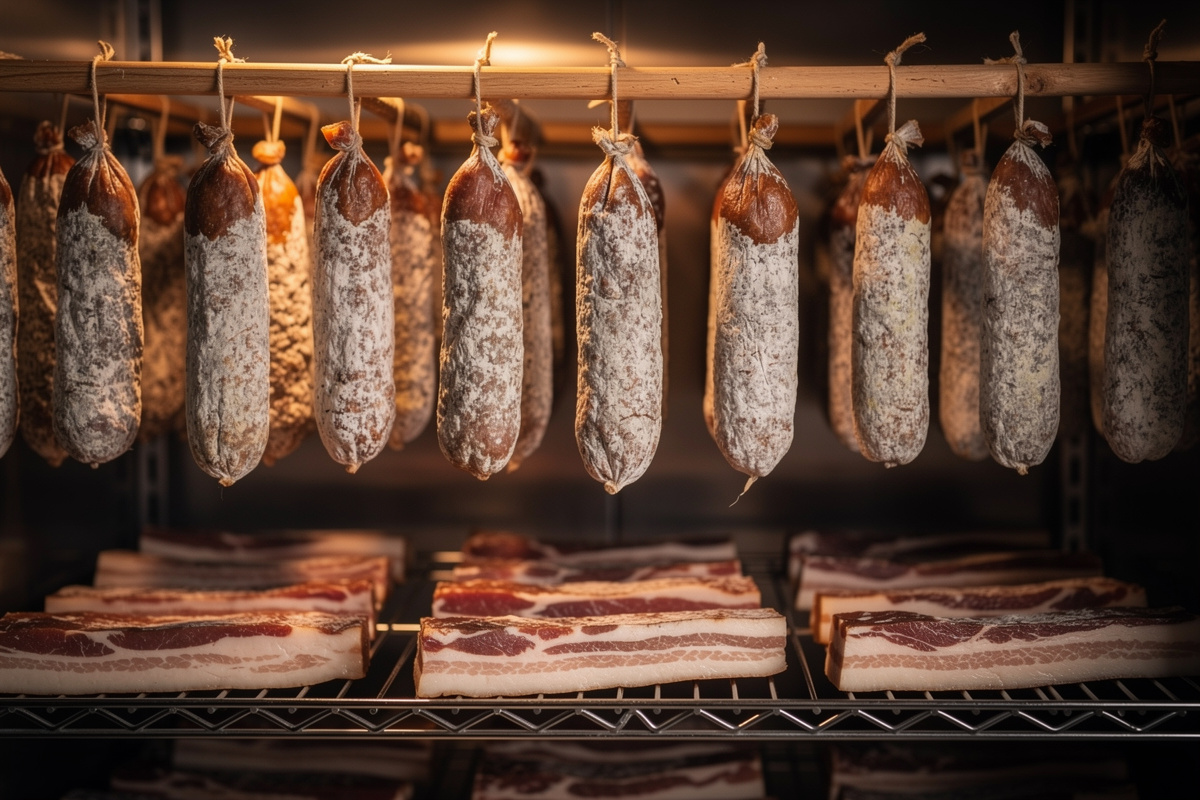
Two materials touch the meat in a curing chamber that works long-term: unfinished hardwood dowels for hanging salami and whole muscles, and 304 stainless steel wire shelves for flat cuts like pancetta and cheese. The wood wicks surface moisture from the casings; the stainless takes 75% humidity for years without rusting or leaching. Plastic-coated wire, galvanized steel, and particle board all come out of my chambers within the first month — the failure modes for each are below.
Shelving is the part of a chamber build most people grab from the hardware store without thinking, and it is the surface that touches your meat for six to twelve weeks. Every shelf or dowel in the chamber sits in a 75% humidity, 55°F environment with airborne mold spores, salt residue, and the occasional drip of rendered fat. The wrong material rusts, harbors bacteria in cracks, or outgasses something you would not want next to a pancetta. I have run three different shelving materials across my chambers and pulled out the ones that did not survive. Here is what I use now and why.
Hardwood Dowels: The Gold Standard for Hanging Meat
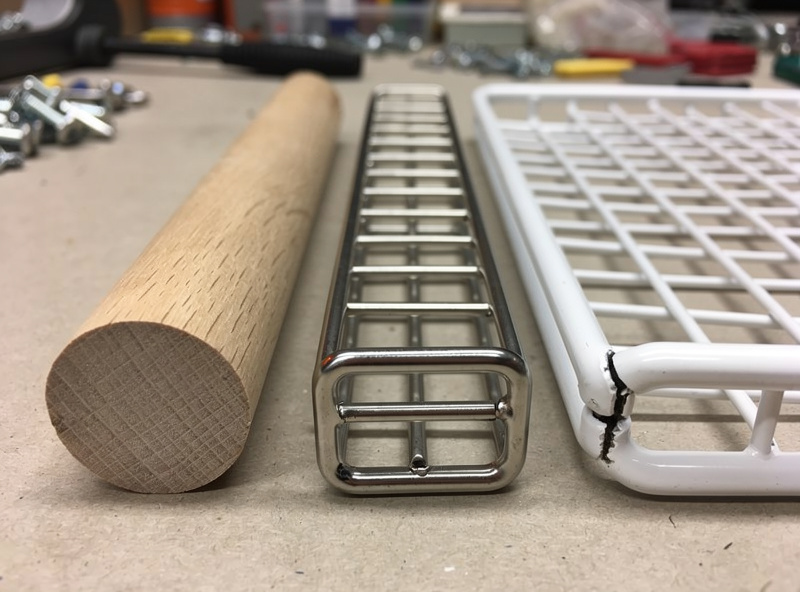
Unfinished hardwood dowels are the best hanging surface in a curing chamber. A 1-inch oak or maple dowel cut to the interior width of the fridge supports twelve to fifteen chubs of salami without bowing, absorbs surface moisture from the casings at the contact point, and develops a harmless patina over months of use without molding. The key word is unfinished — no varnish, no polyurethane, no stain. Raw wood only.
The moisture-absorption property is what makes wood superior to any metal or plastic alternative. When a salami casing rests against a wooden dowel, the wood wicks away the condensation that forms at the contact point. On a stainless steel or plastic rod, that same condensation sits between the casing and the rod and creates a damp microclimate where mold colonies start. After three weeks on a wooden dowel, the salami has a clean, dry contact line. On a stainless rod, the same salami has a faint gray ring at the contact point — not dangerous, but not the uniform white mold coverage you want.
Hardwood species matter. Oak, maple, and birch are tight-grained enough that salt and fat do not penetrate deep into the wood, and they do not split when a 5-pound coppa hangs from the center of a 24-inch span. Pine and fir are too soft — they dent under tension, the dents trap moisture, and the resin in softwood can transfer a faint pine smell to casings during the first few weeks. I use 1-inch Madison Mill oak dowels from Home Depot — about $5 for a 48-inch length that yields two chamber dowels — cut to 21 inches for my 4.5-cubic-foot chamber, sanded to 220 grit and wiped down with distilled water before first use. The Madison Mill dowels are kiln-dried tighter than the bargain craft-store dowels, and they have not warped on me across multiple humidity-cycle seasons.
Wood dowels need replacement after about eighteen months of continuous use. The salt absorption eventually saturates the surface, and microscopic cracks from humidity cycling start trapping bacteria that a wipe-down cannot reach. At $4 to $6 per dowel, replacing them annually is an easy cost. I mark the installation date on the end of each dowel with a Sharpie — when the date is more than a year old, the dowel becomes a garden stake and a fresh one goes in.
304 Stainless Steel: The Shelf Material That Does Not Quit
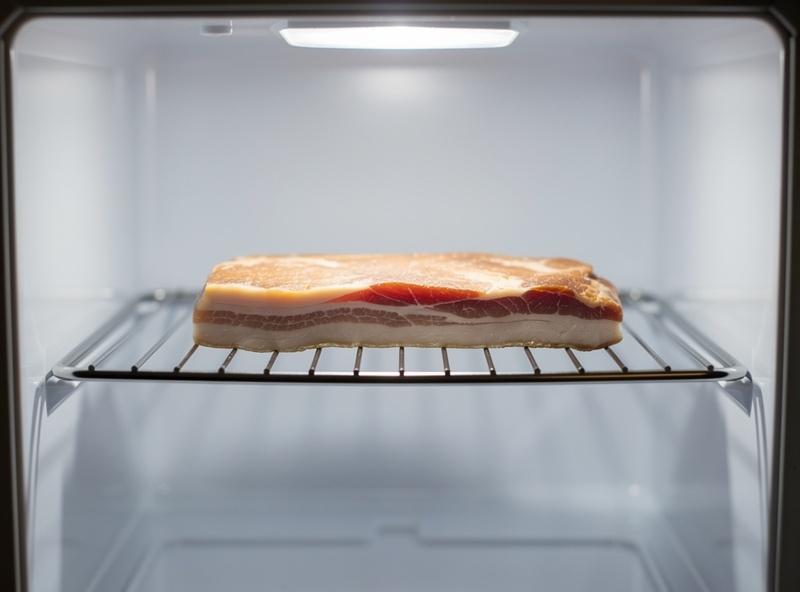
Stainless steel wire shelving is the only metal I trust inside a curing chamber long-term. Specifically 304-grade stainless — sometimes labeled 18/8 — which contains 18% chromium and 8% nickel. This alloy resists corrosion from salt, acid, and the perpetually damp curing environment. 316-grade is even better for marine environments but overkill for a chamber at $30 to $40 per shelf versus $15 to $20 for 304. I run a Regency 14″×24″ NSF wire shelf in my current chamber — $22 from WebstaurantStore, NSF/ANSI 2 listed for commercial food equipment, and the only thing on the build that has not needed replacement after three years. NSF/ANSI 2 is the standard restaurant supply houses certify wire shelving to for the food zone, which is exactly what a salami-hanging shelf has to handle.
The advantage of stainless wire shelves is airflow. The open-grid design lets air circulate around every surface of a flat-laying piece like pancetta or a cheese wheel, which eliminates the need to flip. On a solid shelf, the bottom of the meat sits against a non-breathing surface and collects condensation. On a wire shelf, the chamber fan pushes air through the grid and the bottom dries at the same rate as the top. For flat-cured cuts like pancetta and guanciale, the whole muscle charcuterie guide covers the exact weight-loss targets that airflow-dependent shelving helps hit.
The disadvantage is price and availability in the right size. A standard kitchen wire shelf is 18 inches by 24 inches, which does not fit most mini fridges. You need to either find a shelf that matches your interior dimensions or buy a 24-inch by 24-inch grid and cut it with a hacksaw or angle grinder. Cutting stainless wire leaves sharp burrs at every cut end — each one needs filing smooth with a metal file or a Dremel with a grinding stone. A burr on a shelf inside a chamber is a cut waiting to happen when your hand reaches past it.
Stainless shelves in my chambers get scrubbed with hot water and unscented dish soap between batches, dried immediately with a clean towel, and wiped with a distilled white vinegar solution before reloading. The vinegar removes any residual salt film that soap leaves behind and drops the surface pH enough that mold spores landing on the shelf do not germinate before the meat is hanging.
Plastic-Coated Wire: The Budget Option With a Catch
Plastic-coated wire shelving is the default in most kitchen and closet organizer systems, and it is $6 to $10 per shelf at any big-box store. The white PVC or vinyl coating looks clean and food-safe, and it fits standard fridge interior dimensions without cutting. The problem is the coating eventually fails, and the failure mode is hidden until it is too late.
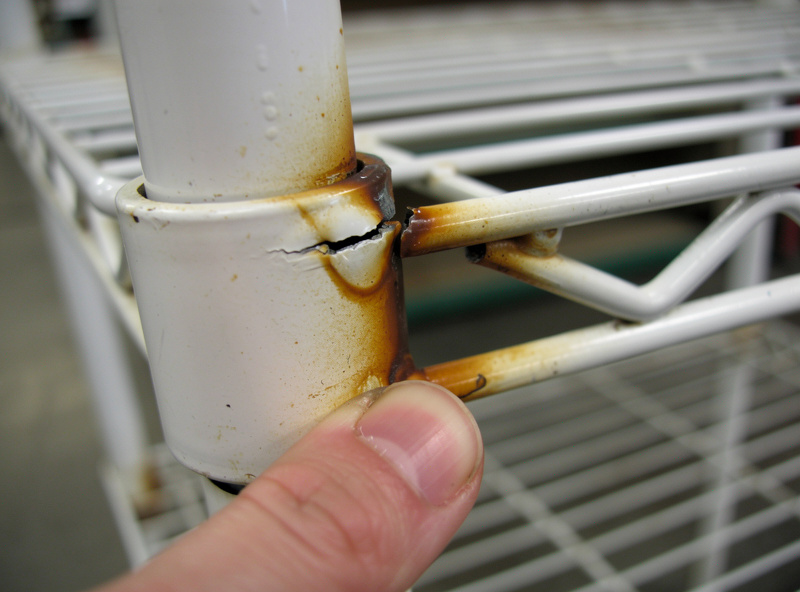
The coating separates from the steel wire core at weld points and cut ends first, where moisture creeps under the plastic and starts rusting the wire from the inside. You cannot see the rust because the coating hides it, but the rust-weakened wire snaps under load — and the load is five salami chubs weighing 8 pounds total, which falls onto the shelf below and knocks everything down. I have had a plastic-coated shelf fail in month three of a six-month chamber run, and replacing a shelf mid-cure means opening the door, disturbing the climate, and handling meat that should not be touched.
If budget demands plastic-coated shelves, inspect them weekly. Run your finger along every weld point feeling for cracks in the coating. Look for any orange discoloration seeping from under the plastic — that is rust water, and the wire underneath is already compromised. The shelf has six to eight weeks of life left from the first sign of rust seepage, which is long enough to finish the current batch if the batch is already hanging. If you caught the problem early enough, you can swap in a new shelf without disturbing the chamber climate control — slide the old shelf out, slide the new one in, close the door, and the humidity recovers within twenty minutes.
| Material | Cost Per Shelf | Lifespan | Mold Resistance | Best For |
|---|---|---|---|---|
| Hardwood Dowel (Oak/Maple) | $4-$8 per dowel | 12-18 months | Excellent (absorbs surface moisture) | Hanging salami, coppa, bresaola |
| 304 Stainless Steel Wire Rack | $15-$25 per shelf | Indefinite | Very Good (non-porous, cleanable) | Flat items: pancetta, cheese, bacon |
| 316 Stainless Steel Wire Rack | $30-$40 per shelf | Indefinite | Excellent (marine-grade) | Overkill for standard chambers |
| Plastic-Coated Wire Shelf | $6-$10 per shelf | 6-12 months | Poor once coating cracks | Temporary or budget builds only |
| Galvanized Steel | $8-$12 per shelf | 3-6 months | Dangerous — zinc leaches | Never. Do not use. |
What Should Never Touch Meat in a Curing Chamber
Galvanized steel is the dangerous one that shows up in garage shelving units. The zinc coating that makes it rust-resistant reacts with the salt and acid in curing meat, leaching zinc into anything that touches the shelf. Zinc toxicity from food contact is uncommon but real — FDA guidance on galvanized food-contact surfaces approves galvanized steel for general food preparation and conveyance but specifically excludes high-acid foods, since acid attacks and accelerates corrosion of the zinc coating. A fermented salami dropping to pH 4.7-5.3 during the cure is squarely in that acidic range, on top of weeks of salt exposure — the worst case the exclusion describes.
Raw steel or iron — including uncoated wire shelving, cut rebar, or chain — rusts within 48 hours in a 75% humidity chamber. The rust flakes onto the meat below and stains anything it touches. More importantly, rust is porous and holds moisture and bacteria in a way that smooth, non-porous surfaces do not.
Particle board, MDF, and plywood are unacceptable. The adhesives that bind engineered wood products — urea-formaldehyde and phenol-formaldehyde — outgas at detectable levels in a closed chamber. Even if the health risk is minimal at the concentrations involved, the smell transfers to the meat. I unscrewed a particle-board shelf from a Craigslist mini fridge before my first build and the fridge still smelled like formaldehyde two weeks after the shelf was removed. The plastic liner had absorbed it.
Aluminum is borderline. It does not rust, but it reacts with salt and the mild acidity of fermenting meat, forming a dull gray oxide layer that rubs off on anything it touches. The oxide is not toxic but it discolors the outside of a white-mold salami where the casing contacts the shelf. For a shelf that holds wrapped cheese, aluminum is fine. For direct meat contact, skip it.
Cleaning and Maintenance Between Batches
Every shelf and dowel comes out of the chamber between batches. The chamber gets a full cleaning, and the shelving gets its own process because it is the surface that touched raw meat. On a budget build, the $18 for three new dowels and a nylon brush is the cheapest food-safety upgrade you can make between batches. Wood dowels get wiped with a 50/50 distilled white vinegar and water solution, then air-dried in direct sunlight for two hours — UV light is a natural mold spore killer, and the few hours outdoors resets the dowel surface better than any chemical sanitizer.
Stainless shelves get scrubbed with hot water and a nylon brush, not steel wool. Steel wool leaves microscopic iron particles embedded in the stainless surface that rust independently, creating tiny orange spots on a supposedly rust-proof shelf. Nylon brush only, hot water, unscented dish soap, rinse, towel dry, vinegar wipe.
The chamber troubleshooting guide covers the full between-batch cleaning routine including the walls, fan, and drain line. The shelving cleaning above is the minimum — if you skip everything else between batches, do not skip the shelving.
Frequently Asked Questions
What is the best wood for curing chamber dowels?
Unfinished hardwood dowels in oak, maple, or birch are ideal. These tight-grained hardwoods absorb surface moisture without splitting under load and do not transfer resin smells to casings. Avoid pine and fir — they are too soft and the resin in softwood can taint meat during the first weeks.
Can I use plastic-coated wire shelves in a curing chamber?
Plastic-coated wire shelves work temporarily but the coating cracks at weld points within 6-12 months, hiding rust underneath. Inspect weekly for cracks and orange rust seepage. Once the coating fails, replace the shelf before the rust-weakened wire snaps under load.
Is stainless steel wire shelving worth the extra cost?
304 stainless steel wire shelves cost $15-$25 each but last indefinitely in a curing chamber. The open-grid design allows airflow under flat-laying meat like pancetta, eliminating the need to flip. There is no coating to crack and no rust risk from the 75% humidity environment.
Why should I not use galvanized steel in a curing chamber?
Galvanized steel leaches zinc into meat through salt and acid contact over weeks of exposure. The zinc coating that prevents rust is not food-safe for prolonged contact with curing meat. The regulatory standard for food-contact zinc is far below what a galvanized shelf releases in a salt-and-humidity chamber.
How often should I replace wooden dowels in a curing chamber?
Replace hardwood dowels every 12-18 months. Salt absorption saturates the wood surface over time, and microscopic cracks from humidity cycling trap bacteria that surface cleaning cannot reach. At $4-$6 per dowel, annual replacement is a minor cost for food safety.
How do I clean shelves between curing batches?
Wood dowels: wipe with 50/50 vinegar and water, air-dry in direct sunlight for two hours. Stainless steel: hot water scrub with nylon brush (never steel wool), unscented dish soap, towel dry, vinegar wipe. Remove all shelving from the chamber between every batch.
Related Articles
- How to Build a Curing Chamber: The Complete Guide
- Best Refrigerator for a Curing Chamber Conversion: Size, Type, Door Orientation
- Curing Chamber Climate Control: Temperature, Humidity, and Airflow Science
- Curing Chamber Troubleshooting: The Complete Guide
- Home Salami Making: The Complete Guide from Grind to Cure