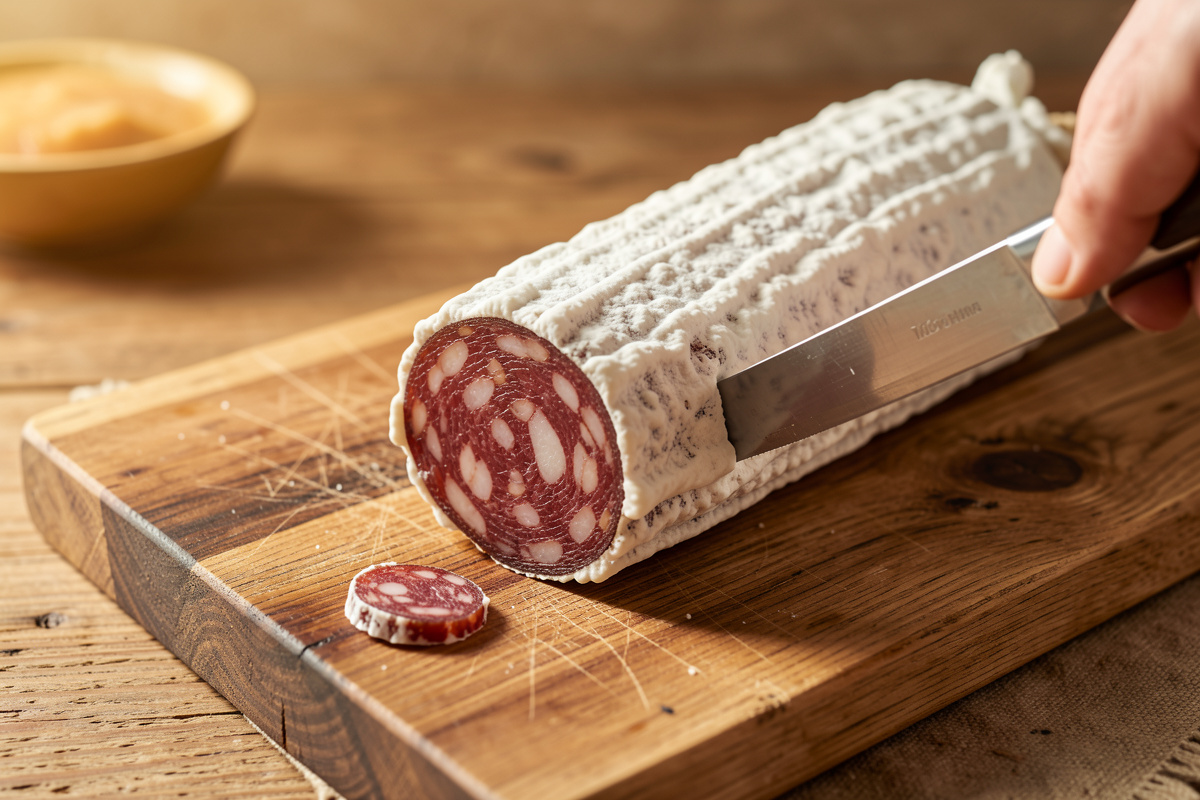
Reusing Mold From a Finished Salami to Inoculate the Next Batch
July 17, 2026

Yes, you can reuse the white mold from a finished salami to inoculate your next batch — cut a coin of well-bloomed casing, blend it into a little dechlorinated water to release the spores, strain out the solids, and spray that slurry onto the fresh pieces exactly as you’d apply a bought culture. Once my house culture stabilized, this is how I seed most of my runs, and I go months without opening a new sachet of commercial Penicillium.
The appeal isn’t just thrift. A mold strain that has already thrived through a full cure in your chamber is adapted to your exact temperature, humidity, and airflow — it often blooms faster and more vigorously than a fresh commercial culture that’s meeting your conditions for the first time. There’s a real caveat around purity that I’ll be honest about below, but done right, reusing mold is one of the quiet satisfactions of running a chamber long enough to have a resident culture worth harvesting.
This is the payoff step in managing mold in your curing chamber — the point where the biome you’ve cultivated starts seeding itself. It builds directly on knowing how to spray culture for even coverage, because the application is identical; only the source of the spores changes.
Can You Really Reuse Salami Mold?
Yes — a finished salami’s white coat is living Penicillium nalgiovense, the same organism sold in a sachet, so it works as an inoculum. Commercial charcuterie operations have propagated house molds this way for generations; the “back-slopping” logic is identical to keeping a sourdough starter or a vinegar mother alive across batches. You’re not inventing anything, you’re just harvesting what your chamber already grew.
The mold you’re reusing is the same protective coat: it consumes surface oxygen, moderates the drying rate to fight case-hardening, and out-competes spoilage molds through competitive exclusion. None of that changes because the spores came from your last coppa instead of a foil packet. What changes is consistency — a commercial culture is one known, pure strain, while your harvested slurry is whatever grew on that particular rind. Usually that’s overwhelmingly the good white mold, because you’d only harvest from a clean piece. But it’s worth understanding the trade before you rely on it.
How Do I Harvest the Mold and Make the Slurry?
Harvest by cutting a coin of casing an inch or two across from the most evenly white-coated part of a finished piece, dropping it into a small jar with a few ounces of distilled or dechlorinated water, agitating hard to knock the spores loose, then straining the liquid through a fine sieve or cloth into your sprayer. The strained, faintly cloudy water is your inoculum.
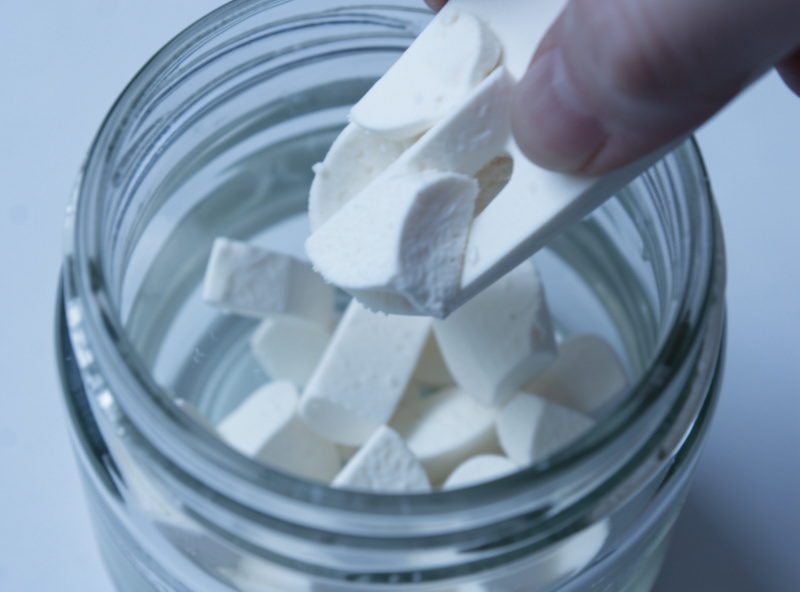
Here’s my actual process. I take the trimmings I’d cut off a finished salami anyway — the end coin, or the casing I peel before slicing — choosing the parts with the cleanest, most powdery white. I put those in a jar with distilled water (never chlorinated tap; chlorine kills the spores I’m trying to harvest, the same rule as mixing a bought culture), and I shake it hard or give it a quick pulse with a stick blender to release the spores from the mycelium. Let it sit half an hour so the spores disperse, then strain the liquid — you want the spore-laden water, not the chunks of casing — into a clean, culture-only spray bottle. Then I spray the fresh batch within its first day of hanging, from all angles, exactly the way I’d apply a commercial culture.
Use it fresh. Unlike a freeze-dried sachet, this slurry is a live suspension with a short shelf life; make it the day you’re going to spray and don’t try to store it more than a day or two refrigerated. And keep your sanitation tight while you do it — clean jar, clean sprayer, clean hands — because you’re deliberately concentrating and spreading live culture, and you don’t want to concentrate anything else along with it.
Which Salami Can I Harvest Mold From?
Only harvest from a piece with a clean, even, fully white or grey-white coat and no off patches — that’s the entire safety rule for reuse. If the source salami had any green, black, fuzzy, or slimy growth on it, do not reuse its mold; you’d be propagating and concentrating exactly the organisms you spend every batch trying to exclude.
I learned this the mildly annoying way. Early on I harvested from a salami that had a small green patch I’d wiped but not fully cleared, figuring the white was dominant enough. The next batch bloomed unevenly and grew more green than usual, and I ended up wiping those pieces repeatedly before the white took over — the very problem covered in wiping unwanted mold off without killing the cure. I’d concentrated the green right along with the white. Now I only harvest from pieces that were flawlessly white end to end, and I toss the idea entirely if a source piece was ever a problem child. The purity of your inoculum is the purity of your next batch — this is also why what spreads between pieces matters so much upstream.
Reused Rind or Commercial Culture: Which Is Better?
Neither is strictly better — they trade purity against adaptation. A commercial culture is a single, known, quality-controlled strain of Penicillium nalgiovense, so it’s the reliable choice when you’re establishing a new chamber or resetting after a contamination problem. A reused rind slurry carries a chamber-adapted population that often blooms faster and more vigorously, at the cost of being whatever grew on that rind rather than a guaranteed pure strain.
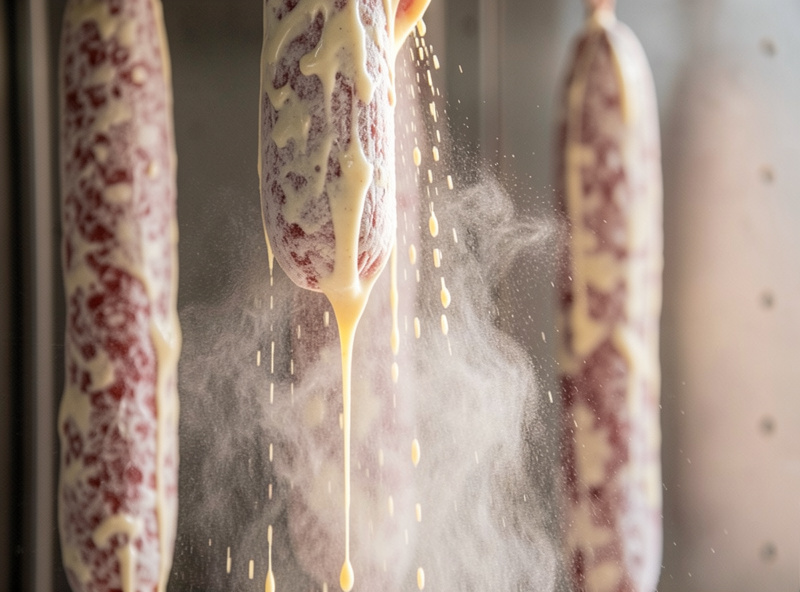
The way I actually run it: commercial culture to establish, reused rind to maintain. When I built my overflow chamber I seeded it with a fresh sachet to guarantee a clean start. Once it had grown a few clean batches, I switched to harvesting rind from its own output, and the house strain took over — vigorous, fast, and free. If a batch ever goes sideways with bad mold, I reset with a fresh commercial sachet rather than risk propagating a problem. Think of the bought culture as your reference standard and the reused rind as the working culture you run day to day. Keeping a sachet of commercial Penicillium nalgiovense culture on the shelf as a reset button is cheap insurance even once you’re mostly self-seeding.
As an Amazon Associate I earn from qualifying purchases.
How Do I Keep a House Culture Going Across Batches?
You keep a house culture going mostly by not fighting it — an established chamber’s walls, shelves, and air already carry a resident Penicillium population that seeds new pieces automatically, so light cleaning between batches preserves it while heavy sanitizing wipes it out. Harvesting rind is really just topping up and directing a culture the chamber is already maintaining.
The balance point is cleaning discipline. I do a light wipe-down between clean batches specifically to preserve the house culture, and a full strip-and-sanitize only when a batch ended badly — two different resets I cover in the chamber mold-management guide. Between those poles, the mold reservoir lives in the box. When I want to guarantee a strong start on a new batch anyway, I harvest a rind coin and spray, but honestly, in my primary chamber the new pieces often bloom from the ambient house culture before I even get around to spraying. That’s the sign of a mature chamber: the biome does the work. This is the same principle a fermenter relies on — the pH drop that finishes a salami is the same lactic-acid chemistry that keeps a sauerkraut crock going, a resident culture you feed and steer rather than rebuild from scratch each time. A good ferment feeding the culture upstream gives the mold a healthier surface to colonize downstream.
One honest limit: reusing mold changes nothing about the underlying safety of the meat. A salami is safe because of cure #2, a proper pH drop, and drying to 30–40% weight loss — not because of which mold coat it wears. Harvest and reuse the white mold all you like; it makes better, more consistent charcuterie, but it never replaces doing the cure correctly.
Can I reuse mold from a finished salami on the next batch?
Yes. Cut a coin of well-bloomed white casing, blend it in distilled or dechlorinated water to release the spores, strain out the solids, and spray that slurry onto the fresh batch within its first day of hanging. A chamber-adapted house strain harvested this way often blooms faster than a fresh commercial culture.
How do I make a mold slurry from finished salami rind?
Put a clean, evenly white coin of casing in a jar with a few ounces of distilled water, agitate hard or pulse briefly with a stick blender to knock the spores loose, let it sit about half an hour, then strain the cloudy liquid through a fine sieve or cloth into a culture-only spray bottle. Use it fresh the same day, since it is a live suspension with a short shelf life.
Which salami can I harvest mold from?
Only harvest from a piece with a clean, even, fully white or grey-white coat and no off patches. If the source had any green, black, fuzzy, or slimy growth, do not reuse its mold, because you would be concentrating and propagating exactly the spoilage organisms you want to exclude. The purity of your inoculum becomes the purity of your next batch.
Is reused rind better than commercial culture?
They trade purity for adaptation. Commercial culture is a single known pure strain, best for establishing a new chamber or resetting after contamination. Reused rind carries a chamber-adapted population that often blooms more vigorously but is whatever grew on that rind. A good approach is commercial culture to establish and reused rind to maintain.
Does reusing mold affect whether the salami is safe?
No. Reusing mold changes only the surface coat, not the preservation. A salami is safe because of the correct cure #2, a fermentation that drops pH toward 4.6 to 5.2, and drying to 30 to 40 percent weight loss. The mold, whether bought or harvested, rides on top of that safe foundation and never replaces it.
Further Reading
- Managing Mold in Your Curing Chamber: The Complete Guide
- How to Spray Penicillium Mold Culture on Salami
- How to Wipe Off Unwanted Mold Without Killing the Cure
- Will Mold Spread Between Pieces in the Same Chamber?