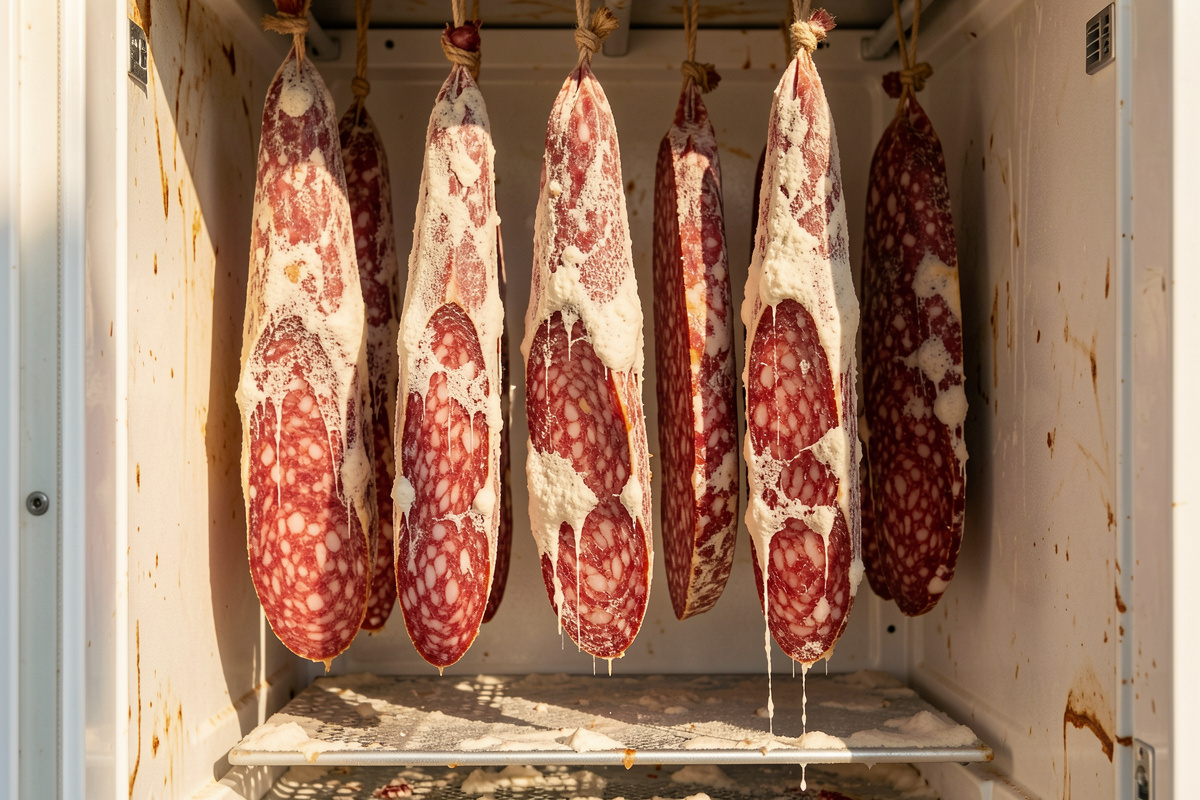

Yes — mold spreads readily between pieces in the same curing chamber, carried on the shared air and by direct contact. For the white Penicillium coat you want, that spread is a gift: a strong bloom on one salami colonizes its neighbors and builds a “house culture” over successive batches. For the green, grey, and black molds you don’t want, the same airflow is a liability, which is why one neglected piece can seed a whole rack.
I watched this play out the first winter I ran two chambers side by side. The primary had been running for months and grew a clean white coat on everything within a week, almost without my help. The freshly-built overflow chamber, sterile and new, took forever to bloom the same salami until I moved one well-coated piece over from the primary. Within days the new chamber “caught” — the spores had simply spread from the seeded piece to the bare ones. That is cross-contamination working in your favor.
Understanding which direction the spread runs — good or bad — is the heart of managing mold in your curing chamber. This article is about steering it.
How Does Mold Travel Between Pieces in a Chamber?
Mold travels three ways inside a chamber: airborne spores drifting on the air-exchange current, direct contact where two casings touch, and settled spores on shelves, hooks, and walls that get stirred up when you open the door. Airborne is by far the dominant route — mold spores are microscopic and effectively weightless, so any air movement carries them piece to piece.
This is exactly why a curing chamber wants gentle, intermittent air exchange rather than dead-still air or a howling gale. In my primary chamber a 120mm computer fan runs on a 5-minute-on, 25-off cycle. That slow drift is enough to distribute good spores evenly across the batch and keep pockets of stale, over-humid air from forming, without drying the surfaces so fast they case-harden. Still air lets one piece bloom while its neighbor stays bare; too much air both dries the casings and flings any bad spores around aggressively. The chamber biome is essentially an air-mixing problem.
Contact spread matters too, and it’s the one most people underestimate. Where two salami hang pressed together, the touching faces share mold directly and — more importantly — trap humid air between them, creating a damp, unventilated seam where the wrong molds thrive. Space your pieces.
Is White Mold Spreading Actually a Good Thing?
Yes, white mold spreading between pieces is one of the most useful things that happens in an established chamber, because of a principle called competitive exclusion: a surface already colonized by Penicillium nalgiovense has no room and no free nutrients left for spoilage molds to establish. A vigorous white coat literally crowds the bad organisms out.

This is why a chamber gets easier the longer you run it. The first few batches, you spray culture and hope. After a season, the walls, shelves, and air carry a resident population of the good mold, and new pieces bloom fast because they’re being seeded from every direction the moment they hang. That resident population is your house culture, and it’s genuinely valuable — often more vigorous and better adapted to your specific temperature and humidity than a fresh commercial sachet. It’s the same reason I don’t nuke the chamber sterile between every batch; I want to keep that culture alive. You can even harvest it deliberately, which ties into spraying culture for even coverage when you’re first establishing a bloom.
The practical upshot: don’t panic when white mold jumps from a coated piece to a bare one. That’s the system working. What you’re steering is the ratio — you want the good mold so dominant that the bad mold never gets a foothold to spread from.
Can Bad Mold Spread From One Piece to the Others?
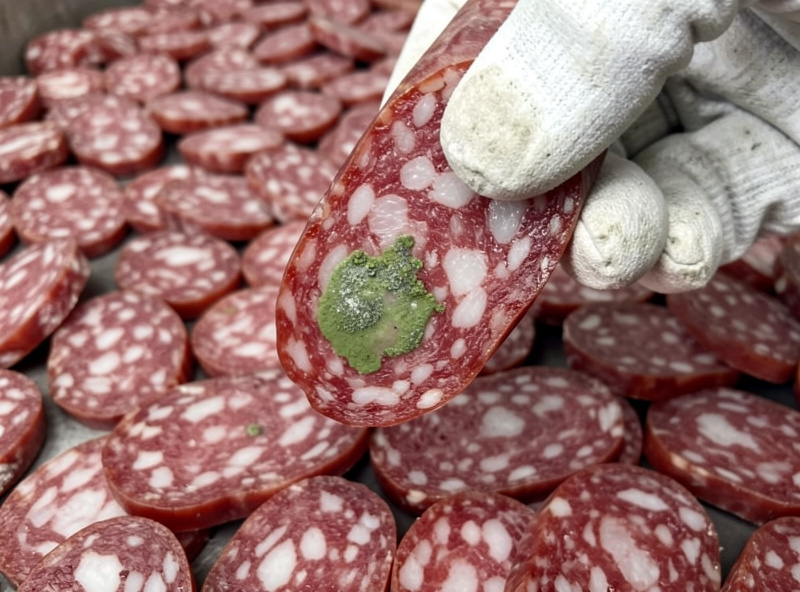
Absolutely, and it’s the real risk of a shared chamber — a piece growing fuzzy green, grey “spider” mold, or black spoilage mold will seed those same organisms onto its neighbors through the shared air. The bad molds play the competitive-exclusion game too; give them an unbloomed surface and time, and they’ll colonize it before your white culture does.
The danger window is a fresh, unbloomed batch. New casings are bare protein and moisture — a blank surface that will grow whatever spore lands first. If your chamber currently holds a piece going wrong, and you hang a fresh run beside it, you’ve handed the bad mold a fresh territory to invade. This is the single most important timing rule in chamber management: never introduce a naked new batch into a chamber with an active bad-mold problem. Deal with the problem first.
Colored, slimy, or sour-smelling growth is your stop sign. Fuzzy black or a pink-red slime is a discard — don’t try to save that piece, and don’t eat around it, because by the time you see surface spoilage the organisms have often penetrated deeper. The USDA’s guidance on molds in food is blunt about this for soft and high-moisture products: when in doubt, throw it out. A single salami is never worth the gamble.
Do Whole-Muscle Pieces and Salami Cross-Seed Each Other?
Yes — a coppa, lonzino, or bresaola hanging in the same chamber as bloomed salami will pick up that same white mold, and generally you want it to. The protective white coat is just as beneficial on a whole-muscle piece as on a fermented sausage; it moderates the drying rate and helps prevent the case-hardening that ruins whole muscle even more often than salami.
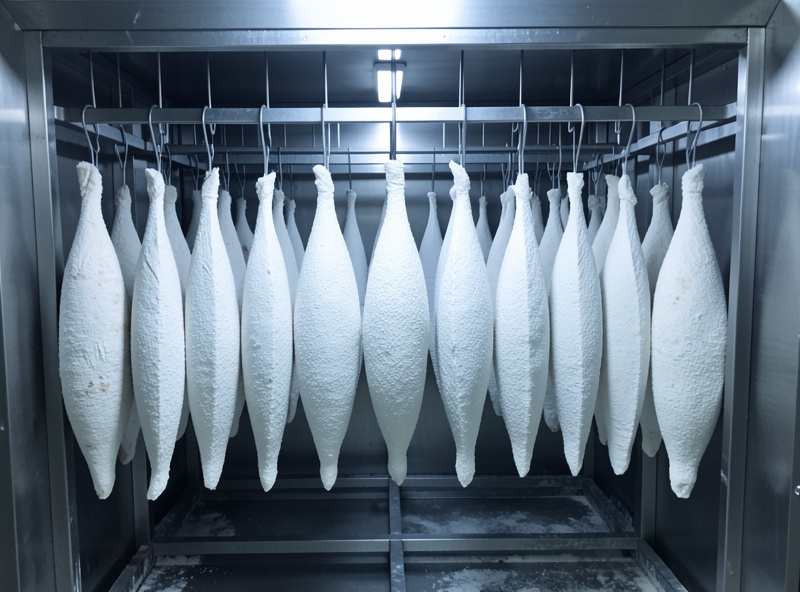
The last coppa I pulled had never been sprayed with culture at all — it simply caught the house mold from the salami hanging next to it and came out with a lovely even coat and a smooth weight-loss curve to about 38%. There’s no downside to whole-muscle pieces sharing the salami’s biome, as long as the mold in question is the good white one. The only thing to watch is that whole-muscle pieces dry slower and hang longer, so they spend more time exposed to whatever the chamber grows — another reason to keep the good mold dominant.
Good Spread vs Bad Spread: What Am I Steering?
The whole game is tipping the balance toward the good spread and starving the bad. Here’s the contrast I keep in mind at the chamber door.
| Factor | Good spread (encourage) | Bad spread (prevent) |
|---|---|---|
| Organism | White Penicillium nalgiovense | Green, grey, black, or pink molds |
| Mechanism | Competitive exclusion of spoilage | Colonizing bare, unbloomed surfaces |
| You want it to | Reach every piece fast | Never establish in the first place |
| Key defense | Seed early, keep a house culture | Remove problem pieces immediately |
| Airflow role | Distributes good spores evenly | Flings bad spores if a piece is left |
Read that table and the strategy falls out of it: get the good mold established and dominant as early as possible, and the moment a piece goes wrong, isolate or remove it before it can share its problem with the rack.
How Do I Stop Bad Mold From Spreading?
You stop bad mold spreading with four moves: space pieces so no two casings touch, keep the good white mold dominant, deal with any problem piece the day you spot it, and never hang a bare fresh batch alongside a compromised one. In practice it’s less about killing bad mold and more about never giving it an opening.
When I do catch a green or fuzzy patch early, I wipe it back with a brine- or vinegar-dampened cloth right there in the chamber before it can sporulate and travel — the technique matters enough that it has its own place in the mold-management workflow. If a piece is clearly past saving — black fuzz, slime, a sour ammonia smell — it comes out immediately and goes in the bin, and I check its neighbors closely for the next few days. A resident white culture buys you real margin here, because bad spores landing on an already-coated piece have nowhere to go.
Spacing and airflow do the quiet work. Hang pieces a couple of inches apart minimum, stagger them so air can move between, and run gentle intermittent air exchange rather than still air. If your chamber can’t circulate evenly, that’s a build problem worth fixing — my multi-zone chamber setup and the upgrade checklist both cover getting air movement right, and the cold smoking safety notes reinforce why surface conditions decide what grows.
One last honest note: mold spreading between pieces changes nothing about the underlying safety of the meat. A salami is safe because it was made with cure #2, fermented to a proper pH drop, and dried to 30–40% weight loss — not because it grew a nice coat or avoided a bad one. Good mold management makes better, cleaner charcuterie; it is not a substitute for doing the cure correctly.
Will white mold spread from one salami to another?
Yes, and you want it to. A strong white Penicillium bloom on one piece spreads through the shared chamber air to colonize its neighbors, which is how a house culture builds up over successive batches. Established chambers bloom new pieces faster because the resident good mold seeds them from every direction.
Can bad mold spread to my other pieces?
Yes. Green, grey, or black spoilage molds spread through the same shared air that carries the good mold. The biggest risk is hanging a fresh, unbloomed batch next to a piece that is going wrong, because bare new casings will grow whatever spore lands first. Remove any problem piece before introducing a new batch.
Do whole-muscle pieces catch mold from salami?
Yes, and it is beneficial. A coppa, lonzino, or bresaola hanging near bloomed salami picks up the same white coat, which moderates its drying and helps prevent case-hardening. Whole-muscle pieces hang longer than salami, so keeping the good mold dominant matters even more for them.
How far apart should I space pieces to control mold?
Hang pieces at least a couple of inches apart so no two casings touch. Where casings press together they share mold directly and trap humid, unventilated air in the seam, which is exactly where the wrong molds thrive. Spacing plus gentle intermittent air exchange distributes the good mold evenly and denies the bad mold damp pockets.
Should I remove a piece with bad mold from the chamber?
If it is clearly spoiled with black fuzz, slime, or a sour ammonia smell, remove and discard it immediately and watch its neighbors closely for a few days. If it is a small early green or fuzzy patch, you can often wipe it back with a brine or vinegar cloth before it spreads. When you genuinely cannot tell, throw the piece out.
Related Articles
- Managing Mold in Your Curing Chamber: The Complete Guide
- How to Spray Penicillium Mold Culture on Salami for Even Coverage
- Multi-Zone Curing Setup: Ferment and Dry at Once
- Upgrading a Curing Chamber: The Priority Checklist