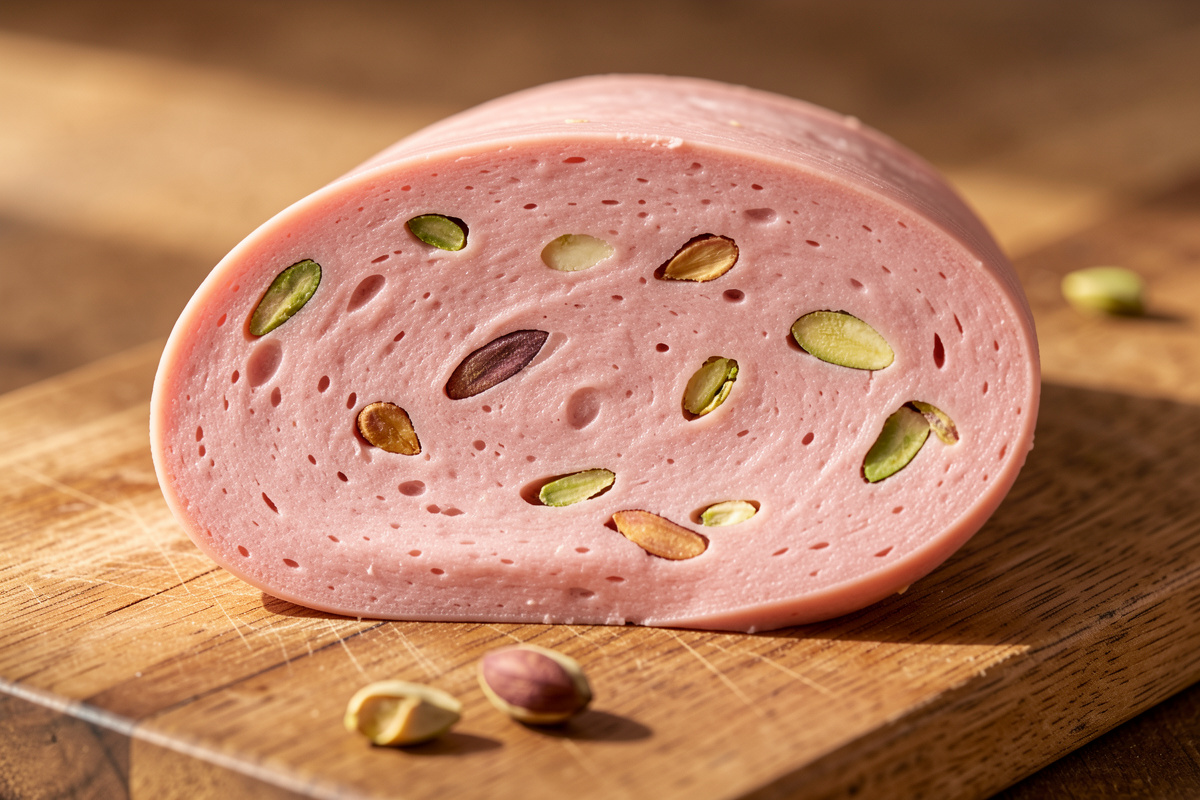

To make bologna at home you build the same fine beef emulsion as a frankfurter — beef or beef-and-pork, about 30% fat, salted near 2% and bound with ice water — then scale it up: stuffed into a beef round or bung, or shaped as a loaf, smoked warm, and cooked to a 155 °F (68 °C) internal by steam or poach. The reward is a slice that’s smooth, pink, and tender enough to fold, with a smoke ring and a texture no grocery plastic can match. Here is the method I run for both ring and loaf bologna.
Bologna is the best argument for learning the emulsion, because at a large caliber the bind is laid bare — a 60 mm ring hides nothing, and a greasy or crumbly slice is instantly obvious. I treat it as the grown-up version of the frankfurter: same chemistry, more forgiving on the casing, less forgiving on the cook, because a thick chub carries heat slowly and overcooks from the outside in if you rush it. The family overview lives in my cooked sausage guide; the emulsion mechanics that make or break the slice are in the emulsion build guide, and I lean on both below without repeating them.
What Is Bologna, and How Is It Different From a Hot Dog?
Bologna is a large-caliber fine-emulsion cooked sausage — same paste as a frankfurter, scaled up — traditionally beef or a beef-and-pork blend, smoked and fully cooked. The difference from a hot dog is format and cook time, not chemistry: a frank is a 22 mm sheep-casing emulsion poached in 25 minutes, while a bologna chub is 50–90 mm across and needs an hour or more to reach a safe internal without the outside turning to meal. Scale it up and the same recipe becomes a different technical problem.
Italian-American tradition ties bologna to mortadella, the pistachio-studded emulsion sausage of Bologna (the city), and that lineage is real but contested in the details — I won’t wade into who claims what. What’s useful is that the technique transfers cleanly: a mortadella is a bologna with pistachios and whole-pepper bits folded into the finished paste, and a ring bologna is the same emulsion in a beef round. Once you can make one, you can make the family.
What Meat and Fat Ratio for Homemade Bologna?
I run an all-beef bologna most often — lean beef chuck or eye of round with firm cold beef back-fat at 30% of the batch — because beef holds its shape in a large chub and gives the rosy color people expect from a deli slice. A beef-and-pork blend (half lean beef, half lean pork, with back-fat to 30%) is softer and richer and closer to a classic ring bologna; I make that one when I want the slice to read more luxurious. For a 5 lb batch of all-beef that’s about 3.5 lb lean beef and 1.5 lb cold back-fat, weighed to the gram.
The lean must be genuinely lean — 90% or better — because the fat target is set by the back-fat you add, not by marbling in the cut. A common mistake is using pork shoulder as both the lean and part of the fat, which lands the batch somewhere between 25% and 38% fat depending on the shoulder, and produces a different texture every time. Buy the lean lean and the fat fat, weigh them apart, and the 30% target becomes reproducible. A tablespoon of non-fat dry milk powder in the bind is an old trick that lightens the color and improves the slice’s moisture — I use it about half the time.
How Do I Build the Bologna Emulsion for a Smooth Slice?
Build it exactly as you would a frankfurter emulsion, cold and in order: grind the lean fine, chop it with the salt and Cure #1 until glassy and sticky, then add the colder-than-cold fat and ice water and cut only until smooth, keeping the finished paste under 55 °F. The only bologna-specific wrinkle is that for a smoother, more uniform slice you want the paste finer than a frank — I take the lean through a 3 mm plate or finish it longer in the processor — because a coarse particle shows up glaringly in a 3-inch slice the way it disappears in a thin frank.
If you’re folding in pistachios or cracked pepper for a mortadella-style bologna, do it at the very end, by hand, after the emulsion is finished and still cold — never through the blade, which would crush the nuts to green smear. The spices are simple: black pepper, a little coriander, a whisper of nutmeg or mace, garlic, and a small amount of sugar to round the smoke. Keep the salt at 1.8–2.2%; the same over-salt line that makes a frank rubbery makes a bologna tough and salty at once.
Do I Need to Smoke Bologna, and With Cure #1?
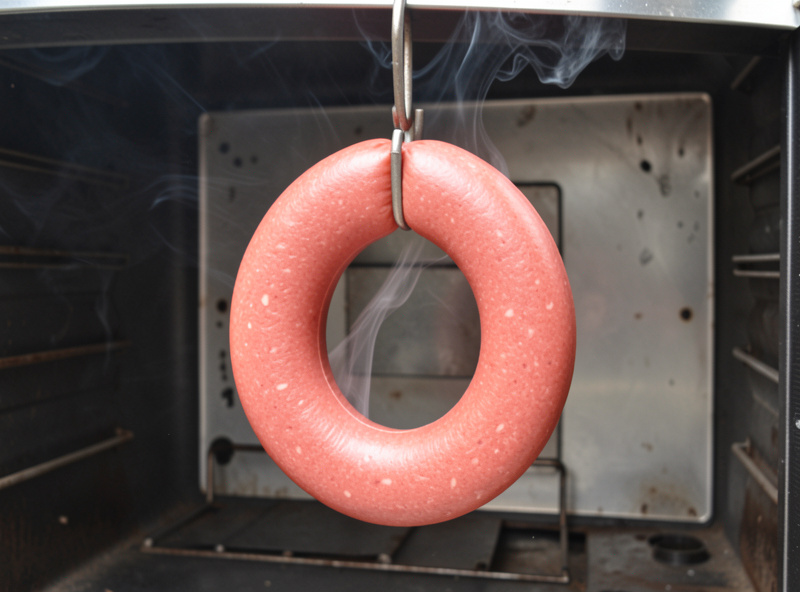
You don’t strictly need to smoke it — a loaf bologna can be baked or steamed and still be excellent — but a smoked bologna is the one most people are chasing, and smoking means Cure #1. The chub sits in the 120–140 °F (49–60 °C) smoke for 3–5 hours, which is squarely in the danger zone where Clostridium botulinum can produce toxin, so one level teaspoon of Cure #1 per 5 lb of meat is non-negotiable for a smoked bologna. The pink-salt reasoning and the Cure #1-versus-#2 choice are covered elsewhere; the short version for bologna is #1, because there’s no long dry to convert nitrate.
I smoke with a ProQ-style pellet maze, smoke generated off the chub and drifted in, and I track chamber temp on my SensorPush HT.W to keep it under 140 °F. A mild wood suits bologna — a light hickory or a fruitwood; the wood-pairing guide covers the options, and the cold-smoking discipline of “smoke without cooking” applies even though bologna is warm-smoked. The color develops as the nitrite sets in the smoke, going from grey-pink to the familiar bologna rose.
What Casing (or No Casing) for Bologna?
For a ring bologna you want a beef round (40–45 mm) tied into a ring; for a thick deli-style chub, a beef bung or a large collagen casing in the 60–90 mm range; and for a no-fuss home batch, a loaf pan with no casing at all works fine and slices beautifully once cold. The casing-types guide maps these in detail. The practical rule for a beginner: start with a loaf or a collagen chub, because beef rounds and bungs need soaking, flushing, and careful stuffing under low pressure or they blow out.
As an Amazon Associate I earn from qualifying purchases.
Stuff firmly but slowly — a large casing under too much pressure splits along the seam the moment heat hits it, and a bologna split is a mess of emulsion squeezing out into the poach. I stuff bologna at a lower, steadier pressure than I would a frank, and I prick any visible air pockets with a sterile needle before cooking so they don’t balloon in the heat. If you’re casing-free in a loaf pan, press the paste in firmly to eliminate voids, cover with foil, and treat the pan as the casing.
How Do I Cook Bologna to the Right Internal Without It Splitting?
Cook the chub slowly to a 155 °F (68 °C) internal — I take bologna to 155–158 °F for margin on a thick piece — using a water bath or steam held at 170–180 °F (77–82 °C), never a boil. A 60 mm chub takes 60–90 minutes to reach internal; a 90 mm bung can take two hours. Probe the dead center, because a large chub finishes minutes after its surface does, and pull it the instant the center reads temp. Then shock it in an ice bath to stop the carryover cook — without that, residual heat carries a big chub another 8–10 °F and the slice goes mealy.
The casing-split risk on a bologna is higher than on a frank precisely because the chub is big and holds pressure. Two things prevent it: don’t over-stuff (leave a little give), and keep the water under 185 °F. If a casing does split during the cook, the sausage is still safe to eat — the emulsion is already mostly set by the time a split happens — but the shape is ruined and you’ll lose some paste. I treat a split as a plating problem, not a safety one, and slice the damaged chub for frying where the tear doesn’t show.
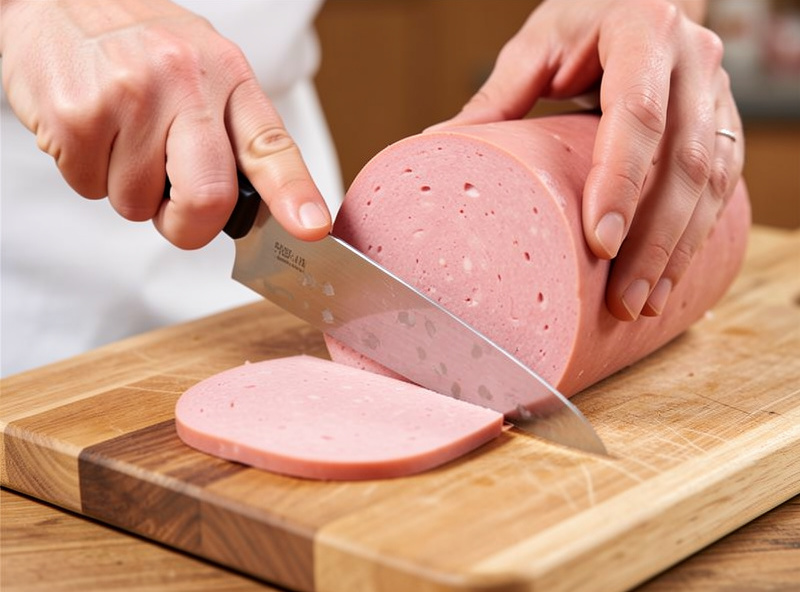
The Slice That Told Me I’d Got It Right
My first few bologna batches were edible but wrong — one was greasy because I’d cut the emulsion warm (the classic break, and the one I’d already paid for on franks), one was mealy because I’d skipped the ice bath and let a 70 mm chub coast to 168 °F internally, and one split its casing because I’d stuffed it bursting-tight and poached at a near-boil. Each failure was a different lesson, and none of them was the recipe. The batch that finally read right was all-beef, smoked three hours over a light fruitwood, stuffed into a collagen chub with a little give, and pulled at 156 °F straight into an ice bath.
The slice from that batch is what I judge every bologna against now: smooth and uniform, no fat cap, no greasy film on the knife, a faint smoke ring at the edge, and tender enough to fold without cracking. The smell as it cooled was clean cold meat and smoke — the same calibration I use on every emulsion now, where a flat fatty smell means the bind is going and a clean metallic smell means it held. FSIS treats bologna as a cooked, ready-to-eat sausage, and once it’s hit internal and been shocked cold through the 40–140 °F danger zone, it keeps a week in the fridge and slices best cold the next day.
What I’d do starting today, if I’d never made one: skip the natural beef casings, start with a loaf pan or a collagen chub, master the emulsion cold, smoke it mild, and pull it at 155–158 °F into an ice bath. Get those five things right and the bologna is essentially solved — the rest is seasoning to taste. If you’re coming to this from fresh sausage and finding the emulsion fiddly, that’s the correct reaction: bologna is the cooked-sausage technique that earns the patience, because the slice is the proof.
More Cooked-Sausage Guides
- How to make hot dogs at home — the small-format fine emulsion this recipe scales up from.
- Fixing a broken meat emulsion — what to do when a bologna paste goes greasy or grainy.
- Poaching temperature for cooked sausage — bringing a thick chub to internal without splitting.
- Do cooked sausages need Cure #1? — the cure decision behind a smoked bologna.
Can I make bologna without a casing?
Yes. Press the emulsion firmly into a loaf pan to eliminate voids, cover with foil, and cook it in a water bath or steam to a 155 Fahrenheit internal. The pan acts as the casing, and once cold it slices as cleanly as a cased chub. It is the easiest way to start.
Why is my homemade bologna greasy?
The emulsion broke, usually because the fat got warmer than 60 Fahrenheit during cutting or was added before the lean was solubilised. Keep the lean and fat at 33 to 40 Fahrenheit going in, build the primary bind first, and cut only until smooth. A greasy slice is a bind failure, not a fat-quantity problem.
Does bologna need Cure #1?
A smoked bologna needs Cure #1, because it sits in the 120 to 140 Fahrenheit danger zone for hours and the nitrite prevents botulinum toxin. Use one level teaspoon per 5 pounds of meat. An unsmoked, immediately steamed loaf can argue otherwise, but most bologna is smoked.
What internal temperature is bologna done?
Cook bologna to a 155 to 158 Fahrenheit internal at the center, in water or steam held at 170 to 180 Fahrenheit, then shock it cold in an ice bath. A large chub can coast 8 to 10 degrees after you pull it, so the ice bath matters as much as the cook to keep the slice tender.
Is mortadella the same as bologna?
Broadly, mortadella is the Italian ancestor of American bologna, a fine emulsion sausage with pistachios and cracked pepper folded in. The technique is the same. Fold the pistachios in cold by hand at the very end, never through the blade, or they smear green into the paste.