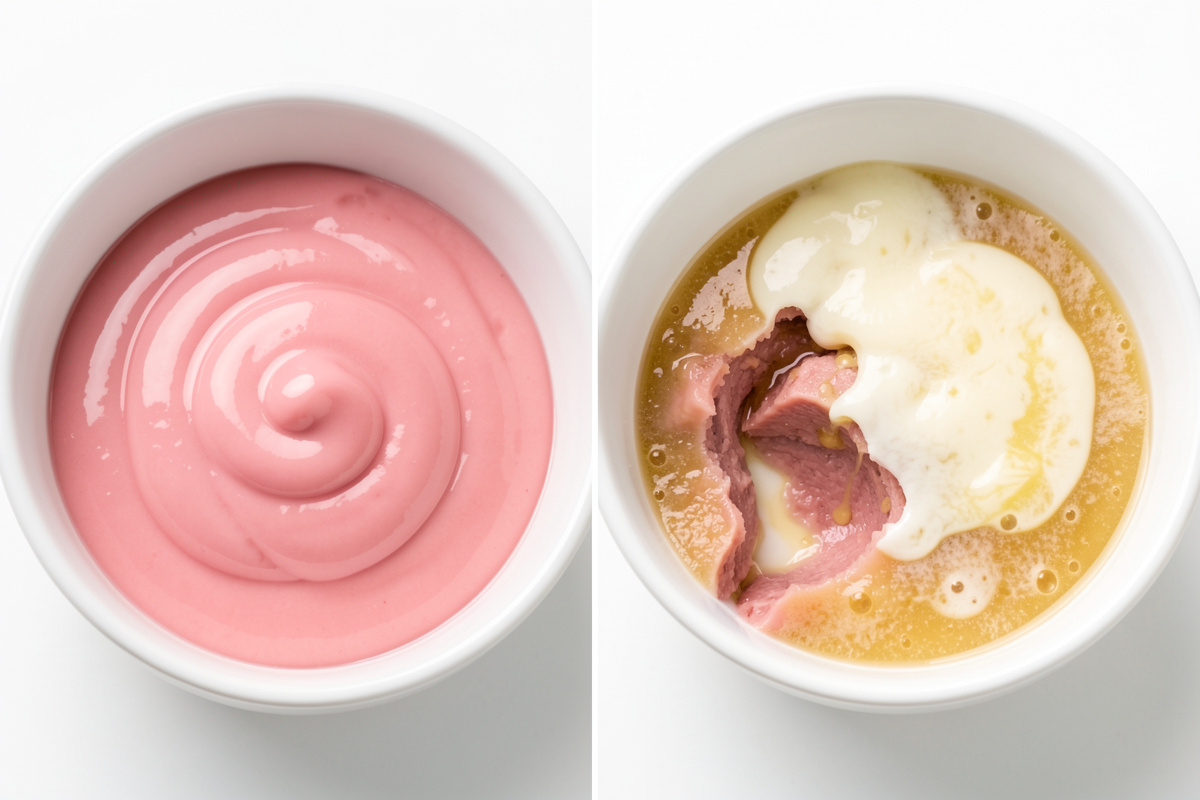

A meat emulsion breaks when the fat melts out of its protein cage — usually because the paste got warmer than about 60 °F (15.6 °C) during cutting — and the reliable fix is prevention, not rescue: keep lean and fat at 40 °F (4 °C) going in, build the primary bind before any fat touches it, and cut only until smooth. Once fat has smeared, no amount of re-blending puts it back. This page is the diagnostic I run when a batch goes wrong, and the setup I use so it doesn’t.
I’ve broken more emulsions than I’ve saved, and that ratio is normal — the chemistry is unforgiving in a way that, say, a bratwurst is not. The point of writing it down is that the failure is almost never random. It’s one of four causes, and each one announces itself before the batch is ruined if you know what to watch for. If you’re new to the family, the cooked sausage guide covers the emulsion theory in overview; this is the troubleshooting deep-dive.
What Does a “Broken” Meat Emulsion Look Like?
A broken emulsion looks separated: instead of one smooth, glossy, uniform pink paste, you get a grainy or curdled mass with fat visibly pooling on top or weeping out at the edges, and a texture that reads greasy rather than cohesive. In the poach, the diagnosis confirms itself — fat floats to the surface of the water as a slick, and the finished sausage is dense, dry, and greasy on the tongue all at once. A good emulsion, by contrast, holds a glossy peak when you lift the blade and reads almost like a cold meat mayonnaise.
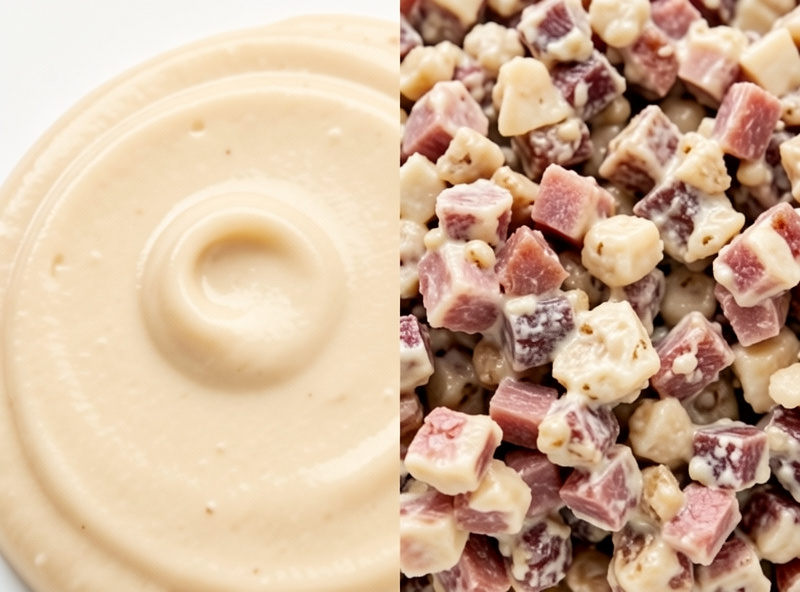
The visual difference is stark enough that once you’ve seen both you stop confusing them. The smooth side of that comparison is a continuous phase — fat, water, and protein indistinguishable under the eye. The grainy side is two phases that have given up on each other: discrete fat particles sitting in a wet, grey lean matrix, with no film holding them in suspension. Every broken batch looks, up close, like that grainy side; the question is only how far it’s gone.
The earliest sign comes before any of that, while you’re still cutting. A healthy bind climbs the blade in a sticky, glassy sheet and pulls the whole mass around the bowl as one body. A breaking emulsion stops climbing, goes dull and wet-looking, and you can see fat separating into distinct particles instead of disappearing into the paste. The moment you see that dull, separated look, stop — every additional second of cutting makes it worse, because you’re driving the temperature higher and smearing more fat.
Why Does a Meat Emulsion Break in the First Place?
A meat emulsion is a fat-in-protein matrix: salt dissolves the myosin out of the lean muscle, that myosin forms a thin film around thousands of tiny fat droplets, and ice-cold water is the bridge that lets the two phases mix into one paste. It “breaks” when that film ruptures and the fat droplets merge back into a separate phase — exactly like a mayonnaise splitting. The film is a physical structure, and like any physical structure it has a temperature limit: above roughly 60 °F the fat softens enough to push through it.
This is why salt is structural in an emulsified sausage and not just seasoning. At about 2% of meat-and-fat weight, salt dissolves enough myosin to build a complete cage; drop below roughly 1.6% and the cage has holes, water weeps out, and the fat isn’t fully encapsulated. The grinding and temperature rules that secure a salami apply identically here — cold in, grind once, never let the auger warm the meat — because the underlying protein chemistry is the same. The crossover that made this click for me is fermentation: the pH drop that sets a salami is a different mechanism, but it’s doing the same job — something has to fix the structure, and in a cooked sausage that something is heat-set protein.
What Temperature Does a Meat Emulsion Break At?
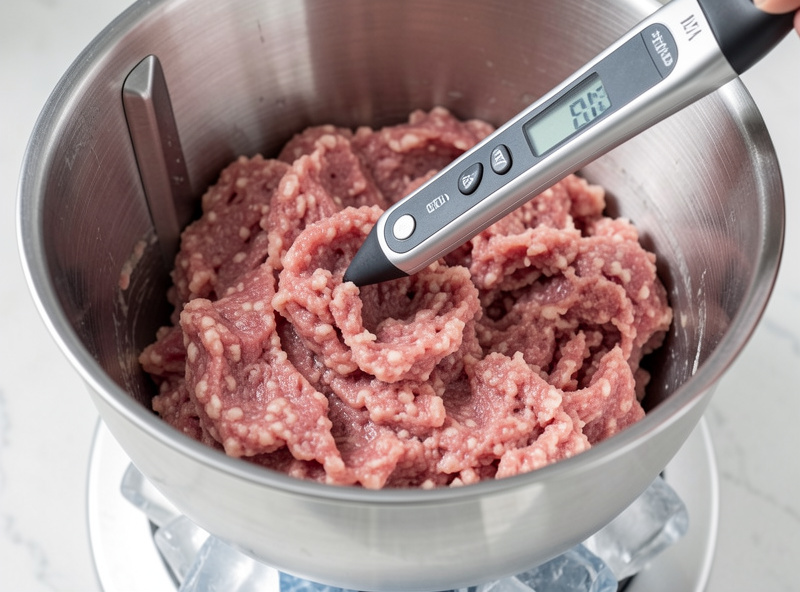
The line is about 60 °F (15.6 °C) for the finished paste — keep the emulsion between 45 and 55 °F through the whole cut and it will not break from heat alone. The meat and fat going into the grinder should be colder still, 33–40 °F (0.5–4 °C), because the cutting adds several degrees of friction heat and you need that headroom. Above 60 °F the fat’s melting point is crossed, the myosin film can no longer hold it, and the emulsion collapses in seconds. I treat 58 °F on the probe as my hard stop.
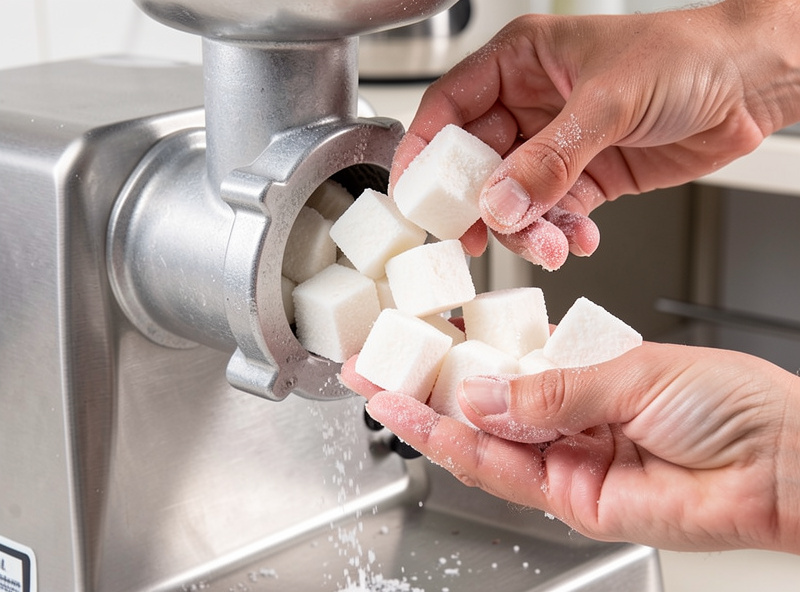
The practical implication is that everything that touches the meat has to be cold: the grinder plate and blade live in my freezer, the lean and fat are cubed and frozen-edged on a sheet pan for 30–40 minutes before I start, and the food-processor workbowl rests on a bag of ice between pulses. I track the paste temperature with a fast probe dipped into the mass every minute or so — the temperature discipline that protects a cold smoke is the same muscle, just applied to a wet paste instead of a chamber. If your kitchen is warm, work in smaller batches so each one is done before friction warms it.
The Four Causes of a Broken Emulsion — and How I Diagnose Each
Almost every broken batch I’ve seen or caused traces to one of four root causes, and each pairs with a distinct symptom. The table below is the diagnostic I run when something goes wrong — match the symptom to the cause before you reach for a fix, because the wrong fix (cutting longer to “smooth out” a batch that’s already over-cut) makes the real problem worse.
| Symptom | Likely root cause | The fix (next batch) |
|---|---|---|
| Fat pooling on top; greasy mouthfeel; fat slick in the poach water | Emulsion got too warm during cutting (>60 °F) | Colder inputs (33–40 °F); shorter cuts; rest the bowl on ice |
| Grainy, mealy paste that won’t go smooth | Fat over-cut and smeared against the blade | Cut only until uniform; add fat last; sharper blade |
| Paste won’t bind; weeps water; crumbly cooked texture | Under-salted lean, or lean not cut to the glassy stage | Salt to ~2% of meat weight; cut the lean longer before fat goes in |
| Soft, runny paste that won’t hold a peak or stuff cleanly | Too much added water for the protein to bind | Cap ice water at ~20–25% of meat weight; weigh it by gram |
| Tough, rubbery, bouncy cooked texture (the opposite failure) | Over-mixed — too much myosin extracted | Stop the instant the lean turns glassy and sticky; don’t chase smoothness |
Notice that “add more fat” appears nowhere on that list. People reach for fat because a broken emulsion reads as dry, but the problem is almost never fat shortage — it’s that the fat already in there isn’t being held. Adding more un-encapsulated fat to a broken batch just gives you more grease to pour off. The same logic is why fat smear ruins a salami — it’s the identical defect, fat pushed past its protein film, in a product where you can see it smeared across the cross-section.
Can You Save a Broken Emulsion Batch, or Do You Start Over?
Honestly, most of the time you start over — but a partially broken batch can sometimes be re-purposed rather than binned. If the paste is only slightly greasy and still reasonably cohesive, you can chill it back to 35 °F, re-cut it very briefly with a small splash of ice-cold water and a pinch of salt, and sometimes pull it back across the line. It will not be a pristine emulsion, but it can stuff and poach into an acceptable coarse sausage. If the fat has fully separated into a distinct layer, re-blending will not re-encapsulate it — you’re just smearing it finer.
The honest rescue is re-purposing. A broken emulsion that’s gone greasy still tastes fine; it’s just texturally wrong for a frank or a bologna. I re-cut a failed fine-emulsion batch coarse, re-season it, and turn it into a fresh coarse sausage for the grill, or into meatballs, or into the base of a ragù. None of those care that the emulsion broke. What you must not do is serve a broken batch as if it were a proper cooked sausage and hope no one notices — the texture gives it away on the first bite, and a weeping, greasy frank is exactly the kind of thing that makes people distrust homemade charcuterie.
How Do I Set Up So It Never Breaks?
The prevention is a checklist, not a talent: cold inputs, weighed salt and water, the right order, and a hard temperature stop. Cube lean and fat separately and freeze-edge both for 30–40 minutes. Weigh salt at 2% of meat-and-fat weight and Cure #1 at one level teaspoon per 5 lb (only if you’ll smoke — the cure decision is separate, and nitrite handling has its own rules). Grind the lean through a 4.5 mm plate and the fat separately through a 3 mm plate, blade and plate pulled straight from the freezer. Then build the primary bind — lean, salt, cure — until it’s glassy and sticky, add the fat and weighed ice water, and cut only until smooth.
Equipment matters less than temperature but it sets the ceiling. I grind with a #22 grinder with chilled plates and finish the bind in short pulses in a food processor with the bowl on ice, because I don’t own a commercial bowl chopper — the tool that would give a truly glassy paste. If you’re shopping, a grinder you can chill and a gram-accurate scale are the two purchases that most reduce your break rate; a bowl chopper is the dream upgrade but not required. The instant-read probe that catches the emulsion at 55 °F is the same one that confirms your finished sausage hit a safe internal — cooked sausage is done at a verified internal temperature, not by time, and a fast probe is what lets you trust it. The same probe discipline governs the cool-down: once poached, the sausage has to cross the 40–140 °F danger zone quickly enough to stay safe, which is why the ice-bath shock matters as much as the poach.
As an Amazon Associate I earn from qualifying purchases.
The Batch I Broke on Purpose to Learn From It
Once I understood the theory, I broke a batch deliberately to see the failure with my own eyes. I took the same frankfurter recipe I now run reliably in my hot dog method, started with meat at 50 °F instead of 35 °F, added the fat before the lean had gone glassy, and buzzed the food processor for a full two minutes past smooth. The transformation was educational and quick: for about ninety seconds it looked like a perfect emulsion, glossy and climbing the blade; then the sheen went dull, the mass stopped pulling as one body, and a layer of liquid fat began to pool at the bottom of the bowl. By the time I stopped, it was the grainy, greasy puddle I’d produced by accident the first time — only now I understood exactly which of the four causes I’d tripped (all of them, in that case).
The smell told me the rest. A good emulsion in progress smells of cold, clean raw meat — almost metallic. A breaking one goes flat and fatty as the fat comes out of suspension. I keep that sensory calibration now and trust it ahead of the thermometer: if the paste suddenly smells warm and greasy, the emulsion is already going, regardless of what the probe says. The last good batch I pulled — a beef-and-pork frank, poached to 155 °F and shocked cold — snapped under the knife the way a deli dog only pretends to, and that snap is the sound of every temperature and order decision in this page having been done right.
If you take one thing from this, take the order and the cold: lean and salt first, fat last, everything under 40 °F going in and under 60 °F coming out. Get those two things right and the emulsion almost cannot break on you — and when it does, you’ll know which of the four causes to blame before you reach for the next batch.
Related Guides for Emulsion and Cooked Sausage
- How to make hot dogs at home — the fine-emulsion frankfurter method this troubleshooting page protects.
- How to make bologna at home — the same fine-emulsion bind in a larger casing or loaf.
- Poaching temperature for cooked sausage — what to do once the emulsion actually holds.
- Do cooked sausages need Cure #1? — the separate cure decision for a smoked, emulsified sausage.