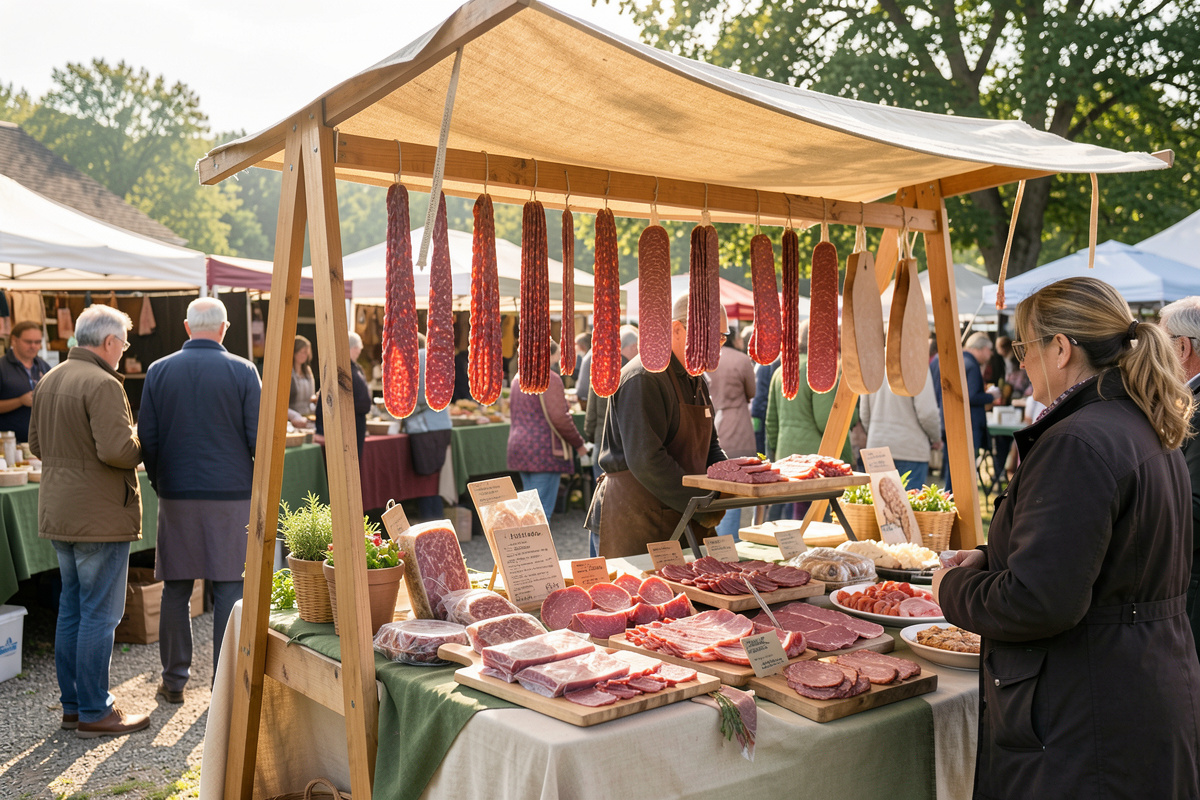

Selling charcuterie at a farmers market is a cold-chain problem before it is a sales problem. You can only be there at all if you already hold the correct license to produce what you are selling — the market does not grant that — and once approved, your real daily challenge is holding cured meat at or below 4 °C (40 °F) in the open air. Bring a thermometer, an iced cooler, and a temperature log, because an inspector and the weather will both test your setup before any customer does.
I run converted-fridge curing chambers in Sweden, where the weather does half my cold-chain work for free for much of the year — but a warm market day anywhere is a different story. This guide is part of the broader selling homemade charcuterie cluster, and it assumes you have already cleared the licensing gate. If you have not, start with the food safety licensing guide, because turning up to a market without a license is the fastest way to be sent home.
The market is a second layer of rules, not the first
A farmers market does not replace food law — it sits on top of it. To trade cured meat you first need whatever license your jurisdiction requires to produce and sell it, which for your own dry-cured product almost always means an inspected facility rather than your home chamber. The cottage food law guide explains why home-cured meat rarely qualifies for the easy exemptions. Only once that base is sorted does the market’s own layer apply.
That market layer typically means the manager will ask for proof of your license, product liability insurance, and sometimes a copy of your HACCP documentation before they assign you a stall. Markets protect their own reputation, so a well-run one vets vendors carefully. Have a tidy folder of your paperwork ready — it signals professionalism and gets you approved faster. Many markets also limit how many vendors of a given category they accept, so apply early and have your documentation in order before you ask.
Cold chain is the whole game outdoors
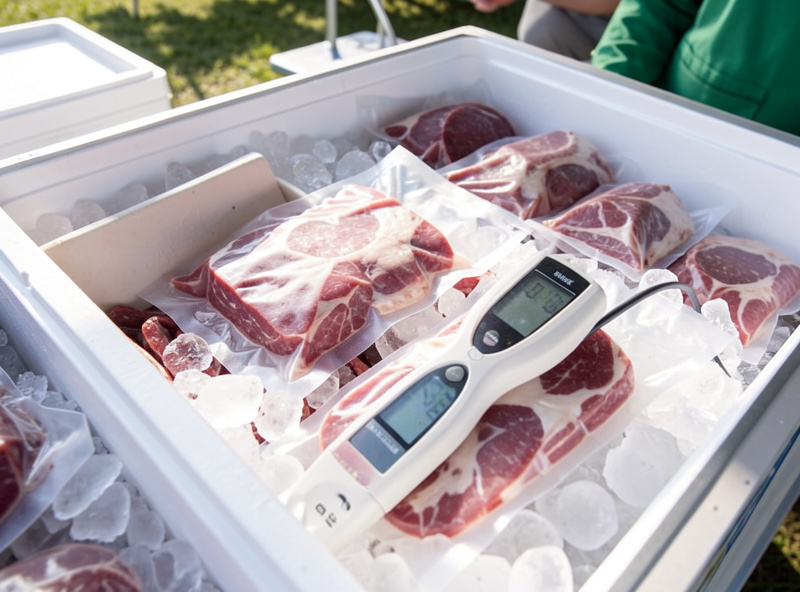
Here is the safety heart of market selling. Properly dry-cured, low-water-activity product is shelf-stable by design, but sliced product, softer pieces, and anything you want to keep at its best still needs to be held cold — and regulators frequently require refrigeration for product offered at market regardless. A market stall has no wall socket and no fridge, so you build a portable cold chain and you prove it with a log.
| Element | What to bring | Why it matters |
|---|---|---|
| Cold storage | Iced coolers or 12V fridge, pre-chilled | Holds product in the safe cold range all day |
| Thermometer | Calibrated probe or digital reader | Proves the temperature, not just hopes it |
| Temperature log | Sheet logged at set intervals | The record an inspector asks to see |
| Shade | Canopy, away from direct sun | Stops display pieces warming and sweating |
| Backstock separation | Sealed cooler for unsold stock | Keeps the bulk cold while a few pieces display |
The trick I would use is to display minimally and store the bulk cold. Put one or two pieces out where customers can see and smell them, keep everything else sealed and iced in the cooler, and rotate. That way the warm, sunlit part of your setup only ever holds a small, replaceable amount, while your real inventory stays in the safe range. Log the cooler temperature on a simple sheet every hour or two — it takes seconds and it is the single most convincing thing you can show an inspector who stops by. The same logging instinct that runs my chamber runs the stall: measure it, write it down, trust the number.
Setting up a stall that sells
Beyond safety, the market is theatre. Cured meat sells on appearance and smell, so a stall that lets people see whole hanging pieces, smell a freshly cut slice, and taste a sample (where local rules permit sampling) converts browsers into buyers. Height helps — hanging a couple of pieces draws the eye from across the market in a way a flat table never does. Clear, honest signage of what each product is, how it was made, and how to store it does double duty: it sells the craft and it satisfies the labeling expectations covered in the packaging guide.
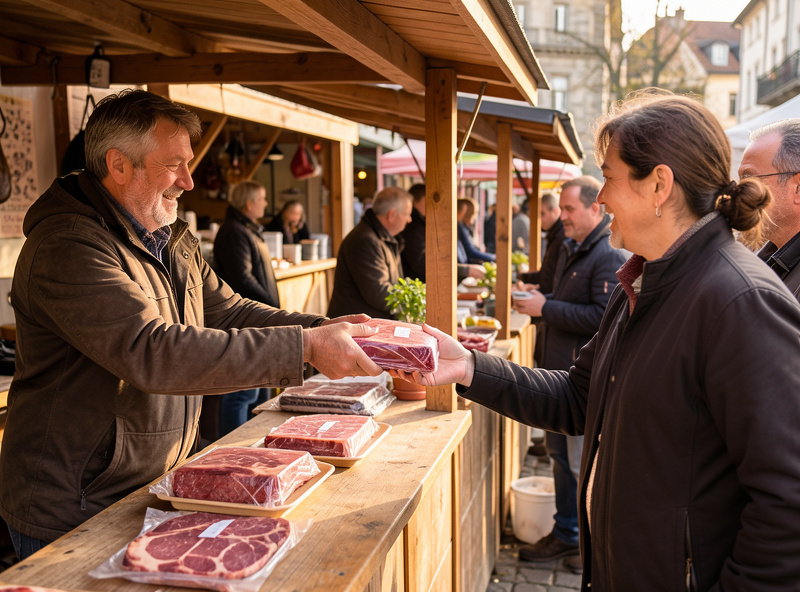
Think about flow, too. A stall people can approach from two sides, with the product between them and you behind it, moves more customers than a single-file queue against a back wall. Keep your card reader and cash float within reach so a sale never stalls while someone waits to pay, and keep the cutting and wrapping area clean and visible — watching a piece get cut and wrapped to order is part of what people are buying. Small frictions cost sales at a busy market, and the vendors who do well have usually ironed out the choreography of taking money and handing over product without ever leaving the cold chain unattended.
Sampling, where it is allowed, is your strongest tool — cured meat largely sells itself once someone tastes it — but it comes with its own hygiene rules: covered samples, clean utensils, a hand-sanitising setup, and often a separate permit. Check whether your market and jurisdiction allow it before you plan around it. When sampling is not permitted, a vivid description and a piece people can see and smell does much of the same work.
Pricing and stock for a market day
Markets reward a mix of price points. Whole and half muscles for the serious buyer, smaller pre-packaged pieces for the impulse purchase, and perhaps a few of your shelf-stable non-meat items — a cure-salt rub or a spice blend — that sidestep the meat rules entirely and add margin. Price using the same cost-stack logic as everything else; the pricing guide shows how to build market-day prices that cover your stall fee, travel, and the hours the day actually costs you. Bring slightly less than you think you will sell on your first few markets — running out is a better problem than carrying perishable stock home, and it teaches you your real demand without waste.
Turning a market stall into a customer base
The market is not the end of the sale — it is the start of a relationship. The single most valuable thing you leave a market with is not the cash in the till but the contacts you make: the customer who wants a whole coppa for Christmas, the café owner who asks whether you supply wholesale, the home cook who wants to learn. Collect interest where you legally can — a sign-up sheet, a card with your details, a simple way for people to reach you — and the market becomes a funnel into direct orders that don’t depend on a stall fee and a 6 a.m. setup.
Repeat custom is also where the economics actually work. A first-time market day is mostly cost: stall fee, travel, hours, and the learning curve. The producer who turns a fraction of each market’s browsers into people who order again — directly, or at the next market knowing exactly what they want — is the one for whom the numbers eventually add up. Treat your first season as paid market research as much as sales. You are learning which pieces move, what people will pay, and which stories about your process make someone reach for their wallet. That data is worth as much as the takings, and it feeds straight back into how you price and what you choose to cure next.
One caution on scaling from a stall: demand at a good market can outrun your licensed capacity fast, and the answer is never to quietly cure more at home to keep up. If the market creates demand you cannot legally meet, that is a signal to expand your inspected production properly, not to cut a corner. Growth that outpaces your compliance is how good small producers get themselves shut down.
Treat every market as a reputation deposit
A farmers market is a small world, and your reputation travels stall to stall. The producer who keeps an honest cold chain, labels clearly, and never sells a piece they had any doubt about builds the kind of trust that turns a market into a customer list. The producer who cuts a corner on a hot day and makes someone ill is finished there overnight — and rightly so. Everything that protects your customer also protects your business, which is the same lesson the chamber teaches: the discipline is not the obstacle, it is the product. Confirm your market’s specific vendor rules and your jurisdiction’s food law before your first stall, because the details are local and they are not mine to promise.
Further Reading
If you are working toward a market stall, the next steps are sorting your food safety license, getting your packaging and labels compliant, and pricing your product to cover a market day. For the bigger picture, the main selling guide ties the whole path together, and the charcuterie board business guide covers a lower-barrier route if full licensing is still some way off.