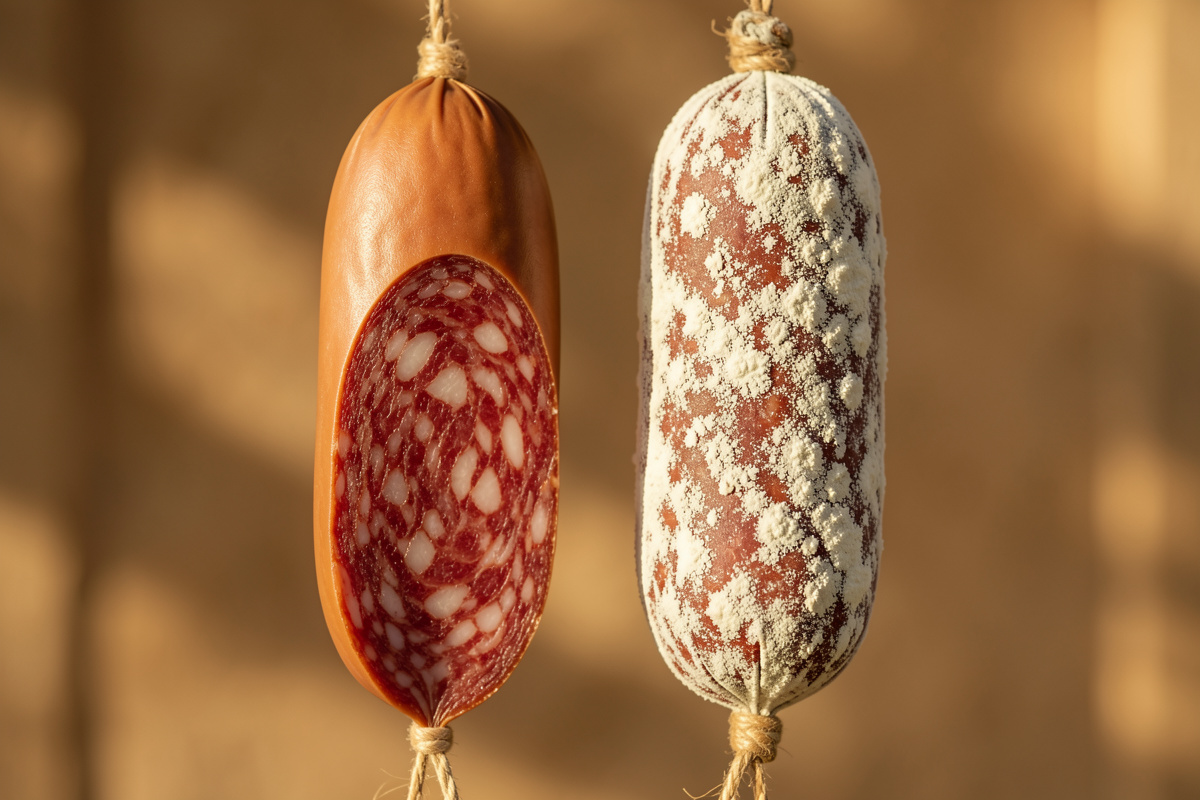

Collagen casings resist white mould because their surface is smooth, processed, and often treated in a way that gives Penicillium nalgiovense nothing to grip. Natural casings are a porous protein membrane the mould can root into; extruded collagen is a uniform film that frequently stays bald no matter how carefully you spray it. If your collagen salami will not take the culture, the culture is almost never the problem — the casing is.
This one frustrates people more than almost any other casing question, because they do everything right — buy a good nalgiovense culture, spray it on, hold the humidity high — and still get a bare, mould-free salami sitting next to a natural-cased piece furred in beautiful white bloom. I get shown that side-by-side photo constantly. The answer is not a better culture or a wetter chamber. It is the substrate. Let me explain what white mould actually needs, why collagen so often denies it, and what you can realistically do about it.
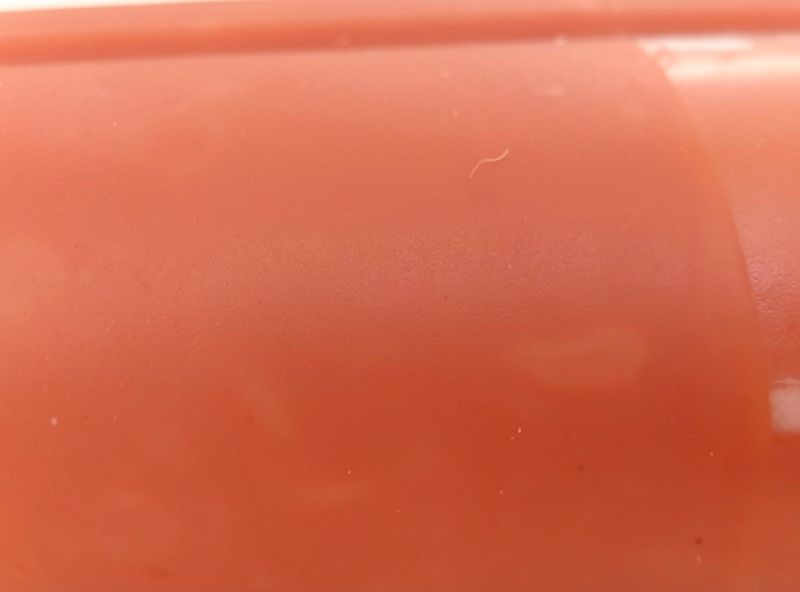
It is one of the trickier questions in the whole casing preparation and stuffing workflow, precisely because the failure looks like a chamber or culture problem when it is really a material-science one.
Why Won’t Collagen Casing Grow White Mold?
Collagen casing will not reliably grow white mould because its surface is too smooth and uniform for the mould’s hyphae to anchor into. Penicillium nalgiovense colonises by rooting into a textured, porous protein surface; a natural casing is exactly that, while extruded collagen is a manufactured film, often with surface treatments that make it release cleanly — the opposite of what a mould needs to grab.
Think of it like trying to grow moss on polished glass versus on a rough stone. The moss is fine; the glass is the problem. Across the chambers I run, the same batch of culture that furs a natural-cased salami white in a week will sit on a collagen piece and do very little, because there is nothing for it to hold. This is not a defect in your spray technique or your humidity — both can be perfect and the collagen still stays bald. Once you understand it is the surface, you stop chasing fixes that were never going to work.
What Does White Mold Need to Grow?
Penicillium nalgiovense needs three things: a porous surface to anchor into, high humidity of roughly 85 to 90% during the early days, and a temperature in the low-to-mid teens Celsius. Give it those on a natural casing and it colonises fast, forming the powdery white coat that protects the salami surface, competes out unwanted moulds, and moderates drying. Take away any one — and collagen takes away the first — and colonisation stalls.
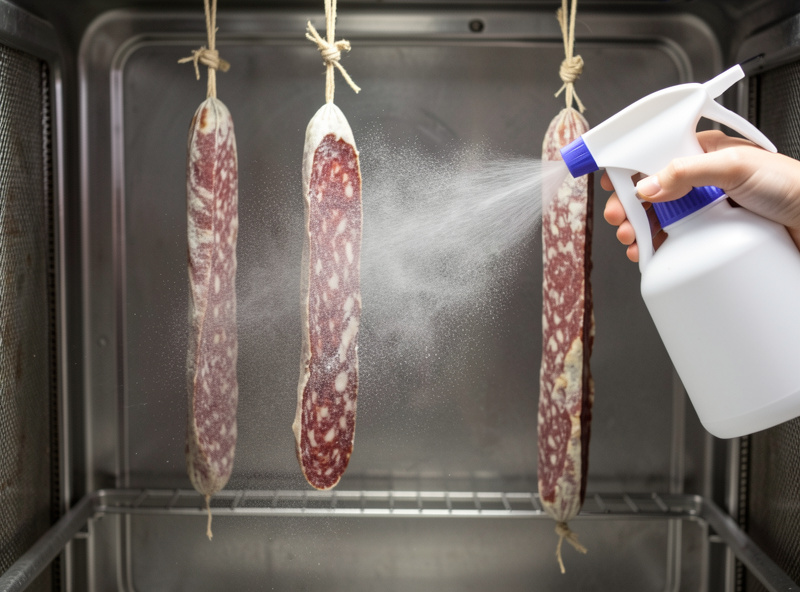
The way I run it: I rehydrate the mould culture, spray a fine mist over the freshly stuffed natural-cased pieces, and hold them warm and humid for the first days — the same window as the fermentation phase, around 20 to 24 °C and 90% RH — then let the chamber settle to drying conditions. On a natural casing the white bloom appears within days. The mould is doing real work: it forms a living surface that shields the meat, discourages the fuzzy green and black moulds you do not want, and slows moisture loss so the piece dries evenly rather than case-hardening. The concept is close cousin to what happens on a bloomy cheese rind — the same genus of protective mould culture I lean on when thinking about mould-ripened cheese, just on a different surface.
Do All Collagen Casings Resist Mold Equally?
No — collagen casings vary. Thin, heavily processed collagen intended for fresh or cooked sausage is the most mould-resistant, while some thicker collagen casings marketed specifically for dry-cured salami are made with a rougher, more porous surface designed to accept mould better. If you are set on collagen and want bloom, buying a collagen casing explicitly sold for dry-curing gives you a fighting chance where a snack-stick collagen will not.
Even then, manage your expectations. The best dry-cure collagen I have worked with takes mould patchily and slowly compared to a natural casing — a thin, uneven bloom rather than the dense even coat natural gives. It is a real difference in the material, not something you can fully spray or humidity your way around. If a supplier does not specify that a collagen casing is meant for mould-ripened dry-curing, assume it will stay bald. The casing you choose at the start decides what is even possible, which is the whole theme of choosing the right casing before you grind.
How Can You Improve Mold Growth on Collagen?
If you must use collagen and want mould, stack the odds: choose a dry-cure-specific collagen, mist the surface lightly with water before applying the culture so the spray adheres, use a fresh well-rehydrated nalgiovense culture, and hold the first days genuinely humid at 85 to 90% RH. Some makers lightly rough the surface or re-spray after a couple of days. None of it guarantees an even coat, but together they move the needle.
Honestly, the biggest lever is picking the right casing in the first place; everything after that is damage control. I have coaxed a passable bloom onto dry-cure collagen by re-misting on day two and holding the humidity high, but it never matched a natural-cased piece from the same batch hanging beside it. If the mould-ripened look is the whole point of your project, spending your effort on the casing choice pays off far more than spending it on culture tricks. The white coat is worth the trouble because of what it does for the piece — but it needs a surface it can live on.
Is Bald Collagen Salami Safe Without Mold?
Yes — and this is the crucial point. White mould is a surface protector and a flavour and drying moderator, but it is not what makes a salami safe. Safety comes from the cure: salt, cure #2 supplying nitrite and nitrate, a fast pH drop below 5.3 from a starter culture, and the long slide in water activity as the piece loses 30 to 40% of its weight. A bald but properly cured and dried salami is safe; a mould-covered but under-cured one is not.
I want to be very clear here, because people sometimes treat the white bloom as the safety step and it is not. The hurdles that actually secure a fermented salami are the ones you control at mixing and during the ferment and dry — the correct cure #2 usage of 2.5 g per kilo, the culture that acidifies the meat, and the weight-loss endpoint you verify on a scale. The mould helps the surface and the flavour and competes out worse moulds, but if your collagen piece stays bald and you cured and dried it correctly, it is safe to eat. What is never safe is a piece growing fuzzy green, black, or “spider-web” mould — that goes in the bin regardless of the casing. When in doubt, throw it out.
Does Bald Collagen Risk Growing the Wrong Mold?
It can. One of the quiet jobs the white nalgiovense coat does is competitive exclusion — a dense good-mould surface leaves no room for the fuzzy green, grey, and black moulds you do not want. A bald collagen piece has that surface real estate wide open, so if your chamber carries stray spores, an uncolonised casing is more likely to grow something unwelcome than a well-bloomed natural one.
In practice this means a bald collagen salami needs a cleaner chamber and a closer eye. I wipe any early stray spots off a bald piece with a cloth dampened in a light vinegar-water solution and keep the airflow and humidity in range so nothing gets a foothold — the same 5-minutes-on, 25-off fan cycle and steady RH I run for everything. What I never do is try to eat through a fuzzy green or black or spider-web growth: that goes straight in the bin, collagen or not, because unwanted mould on an uncured or under-cured surface is a real risk, not a cosmetic one. A properly cured piece with a small amount of surface wild mould can sometimes be wiped and saved; anything slimy, foul-smelling, or deeply coloured is a throw-it-out call every time. The absence of a protective coat is exactly why collagen dry-curing rewards a tidier setup.
Should You Just Use Natural Casing for Mold-Ripened Salami?
If you want a reliable, even white bloom, yes — use natural casing. It is the path of least resistance and it is what the mould evolved to colonise. Natural hog, beef middle, and beef bung all take nalgiovense beautifully, giving the dense protective coat that collagen struggles to grow. Reserve collagen for fresh, cooked, and snack-stick sausage where mould is not the goal.
That is the choice I make almost every time for dry-cured, mould-ripened salami. Collagen has genuine strengths — consistency, convenience, no soaking for most types — but a lush white coat is not among them. If the bloom matters to you, start with a natural casing, prep it properly by soaking and flushing, and give the culture the porous surface it wants. The full prep for that is in how to soak and flush natural hog casings, and the trade-offs between the big natural casings are in choosing a wide casing. Choose the substrate for the result you want, and the mould takes care of itself. For the microbiology and safe-handling fundamentals behind mould-ripened curing, the USDA Food Safety and Inspection Service and the National Center for Home Food Preservation are the references I check against.
Why won’t my collagen casing grow white mold?
Collagen casing resists white mould because its surface is smooth, processed, and often treated so the mould’s hyphae cannot anchor. Penicillium nalgiovense needs a porous protein surface like a natural casing to root into. The culture is almost never the problem; the collagen surface is.
Can any collagen casing take white mold?
Some collagen casings sold specifically for dry-cured salami have a rougher, more porous surface and will take mould patchily, while thin collagen for fresh or cooked sausage stays bald. Even dry-cure collagen colonises more slowly and less evenly than a natural casing, so manage your expectations.
Is salami safe if the casing stays bald with no mold?
Yes, if it was cured and dried correctly. Safety comes from salt, cure #2, a fast pH drop below 5.3 from a starter culture, and the piece losing 30 to 40 percent of its weight. White mould protects the surface and adds flavour but is not the safety step. A properly cured bald salami is safe.
How can I improve mold growth on collagen casing?
Choose a collagen casing made for dry-curing, lightly mist the surface with water before applying the culture, use a fresh well-rehydrated nalgiovense culture, and hold the first days at 85 to 90 percent humidity. Re-misting on day two can help. None of it guarantees an even coat.
Should I use natural or collagen casing for mold-ripened salami?
Use natural casing for a reliable, even white bloom, since it is the porous surface the mould evolved to colonise. Reserve collagen for fresh, cooked, and snack-stick sausage where mould is not the goal. Choosing the right casing at the start decides what is possible.
Further Reading
- Preparing Sausage Casings: A Complete Guide
- How to Soak and Flush Natural Hog Casings the Right Way
- Best Casing for ‘Nduja: Wide Beef Bung vs Sewn-End Caps
- Blue Cheese Making at Home: Mould, Piercing, and Aging