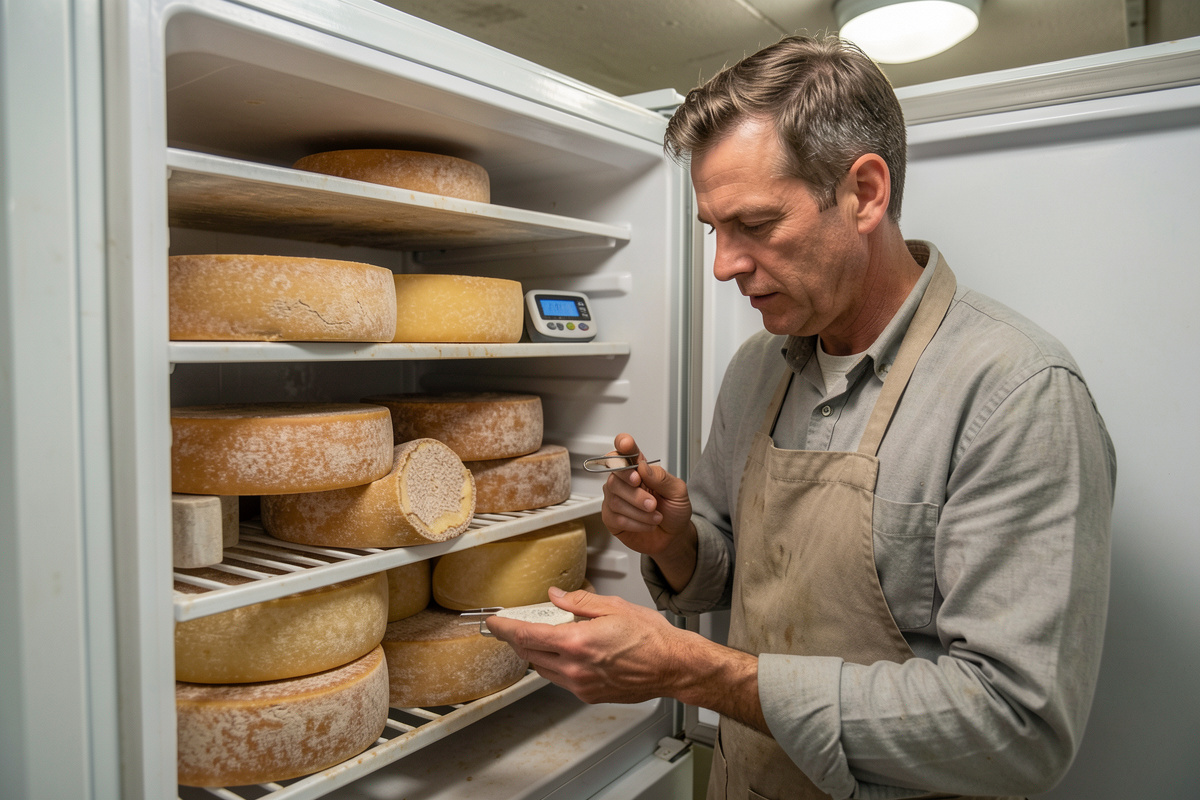

Most cheese aging problems trace back to one number: humidity. Across the wheels I have aged in my converted-fridge chamber, a rind that cracks, dries, slimes, or grows the wrong mould is almost always a humidity or airflow fault, not bad luck — and the weight log usually flags it days before your eyes do. Get the chamber holding 80–85% RH steadily for hard cheese and the great majority of these faults never start.
I came to cheese from charcuterie, where a drifting chamber ruins a coppa just as fast, so I troubleshoot cheese the same way: read the environment first, the wheel second. This guide walks the faults I actually see, what causes each, and how to fix it — or when to accept that a wheel is gone. Throughout, the theme is that a stable chamber prevents far more problems than any rescue can fix.
Quick diagnosis table
Before the detail, here is the fast lookup. Each of these is expanded below, but if you are standing at the chamber with a problem wheel, start here.
| Symptom | Most likely cause | First fix |
|---|---|---|
| Cracked, hard rind over softer interior | Humidity too low (case-hardening) | Raise RH to 80–85%, turn wheel, slow the dry |
| Slimy, sticky, or wet rind | Humidity too high, airflow too low | Increase air exchange, drop RH a few points |
| Fuzzy black, pink, or orange mould | Unwanted contamination | Brush or pare if surface-only; discard if deep |
| Fine brown dust at the wheel base | Cheese mites | Cold knock-back, brush, improve airflow |
| Bitter or acrid flavour | Aging too warm / over-ripening | Lower temperature to 10–13 °C, taste earlier |
| Cheese cracked through and crumbly-dry | Aged too long or too dry | Wax or vacuum-seal to halt moisture loss |
| Strong ammonia smell | Over-ripening (soft/blue especially) | Wrap to slow it; discard if it has gone through |
Case-hardening and cracking: the number-one killer
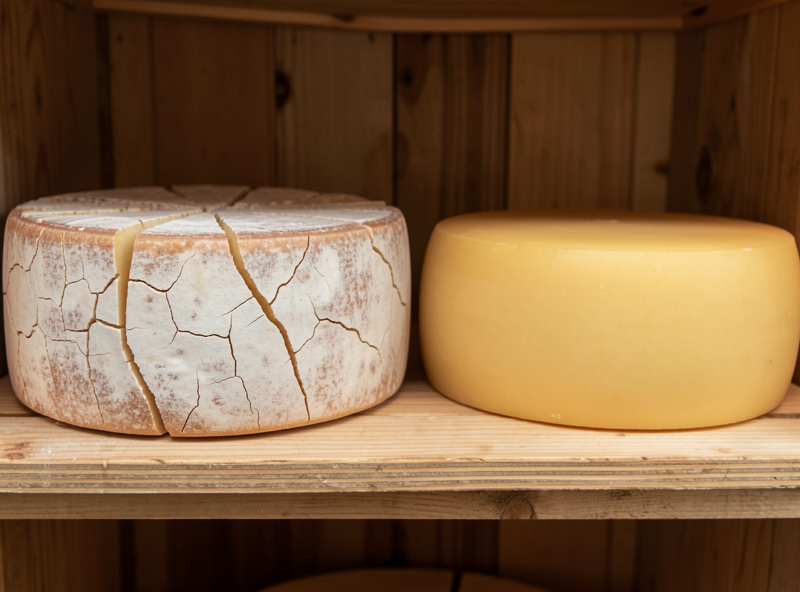
Case-hardening is when the rind dries faster than the interior, sealing a hard shell over a still-moist core that then cracks as it continues to shrink. It is the same defect that ruins charcuterie, and on cheese it shows first on the weight log: a wheel shedding weight much faster than its neighbours is drying its surface ahead of its core. The cause is low humidity — a chamber sitting below roughly 70% RH, or swinging wildly between damp and dry. The fix is to raise and steady RH to 80–85%, turn the wheel so no face dries unevenly, and on a young wheel the paste can re-equilibrate. The cracks themselves are an entry point for the wrong moulds and mites, so close the humidity gap before anything gets in. My guide to aging cheddar and hard cheese covers holding that envelope, and the per-style targets are in the cheese aging temperature and humidity chart.
Slimy rind: the wet-end failure
The opposite problem is a rind that turns sticky, slimy, or wet. This is humidity too high combined with too little air movement — damp, stagnant air letting unwanted surface bacteria and yeasts take hold. It is most common in chambers that humidify well but do not exchange air. The fix is airflow before anything else: I run a 120mm fan on a five-minute-on, twenty-five-off cycle, which keeps the air moving enough to keep surfaces from sweating without drying the wheels out. Drop the RH a few points too if you are up near saturation for a cheese that does not need it. A lightly tacky natural rind can be wiped back with a cloth dipped in saturated brine; a wheel that has gone genuinely slimy and sour-smelling through the rind is usually past saving. If your whole chamber is sitting wet, the same fixes I use for charcuterie apply — see curing chamber too humid.
Good mould vs mould that means trouble
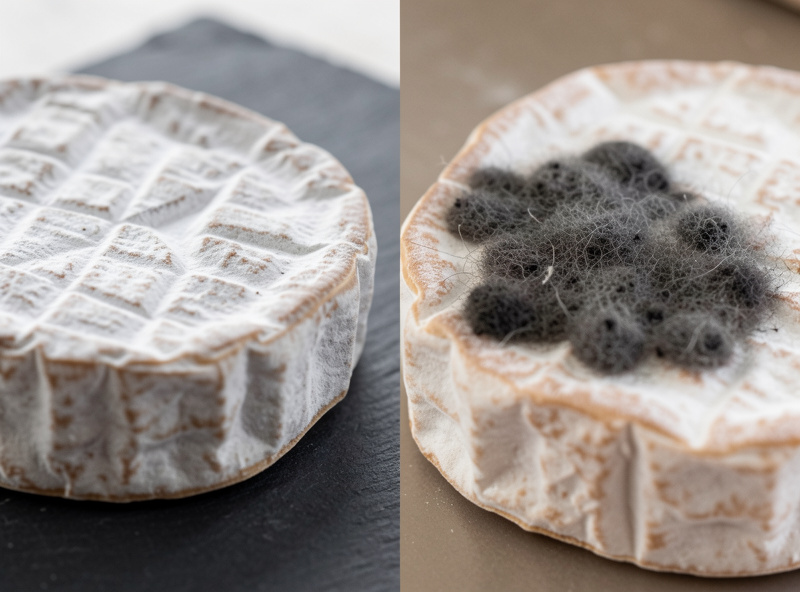
Not all surface mould is bad — in fact most aged wheels grow some, and on a natural or clothbound rind a felt of grey, white, or pale blue-green growth is normal and brushes back. What you are looking out for is the growth that signals contamination: fuzzy black mould, bright pink or orange patches, or hairy growth with a musty, ammoniated smell. On a hard wheel, mould that is clearly surface-only can be pared or brushed off, and a saturated salt-brine or vinegar wipe knocks back the rest. The judgement call is depth and smell — if the wheel smells of ammonia underneath, feels slimy, or grows something I cannot confidently identify as friendly, I throw it out rather than gamble. Blue cheeses are the exception where blue-green mould is the whole point; I cover that intentional mould in the blue cheese making guide.
Mites, bitterness, and over-ripening
Three more faults round out what I actually see. Cheese mites announce themselves as fine brown dust at the base of a wheel, usually on a clothbound or natural rind; the fix is cold knock-back, brushing, and better airflow, which I detail in cheese mites on aged cheese. Bitterness or an acrid edge usually means the wheel aged too warm and over-ripened — drop the chamber to 10–13 °C and taste plugs earlier so you catch the wheel at its peak rather than past it. An ammonia smell is over-ripening too, most often on soft and blue cheeses; wrapping the wheel slows it, but a cheese that smells of ammonia all the way through has gone too far. Reading these signals in time is the whole subject of when is aged cheese ready.
When a wheel is dry, hard, or crumbly
Sometimes the problem is just that a wheel lost too much moisture — aged too long, or in a chamber that ran dry, until it is hard and crumbly rather than the texture you wanted. You cannot put moisture back, but you can stop the loss: waxing or vacuum-sealing the wheel halts further drying and lets it rest in cold storage. A very dry hard cheese is often still excellent grated, so it is rarely a total loss. The prevention, as always, is humidity and the weight log — I pull wheels at the loss percentage I am targeting rather than letting the calendar run, which is exactly why I weigh every wheel. The waxing guide covers sealing a wheel mid-age, and the whole troubleshooting picture sits under the complete home cheese aging guide.
The one fix that prevents most problems
Almost everything above is downstream of an unstable chamber. The single best investment is monitoring you can trust: I run a SensorPush HT.W at wheel height as the reference, cross-checked against an Inkbird IBS-TH3, both salt-test calibrated and logged so an out-of-band reading reaches me before a rind ever shows it. A chamber that holds its setpoint quietly for months is what lets the cheese — and the maker — relax. As an Amazon Associate I earn from qualifying purchases. A reliable digital hygrometer and thermometer is the cheapest insurance against the entire list above.
Frequently Asked Questions
Why is my aging cheese cracking?
Cracking is almost always case-hardening from low humidity. The rind dries faster than the interior, seals over a still-moist core, and splits as the wheel shrinks. Raise and steady humidity to 80 to 85 percent RH and turn the wheel regularly.
My cheese rind is slimy. Can I save it?
A lightly tacky natural rind can be wiped back with a cloth dipped in saturated brine. The cause is humidity too high with too little airflow, so increase air exchange and drop RH a few points. A wheel that has gone genuinely slimy and sour through the rind is usually past saving.
How do I tell good cheese mould from bad?
Grey, white, and pale blue-green felt on a natural or clothbound rind is normal and brushes back. Fuzzy black, bright pink, or orange growth signals contamination. Surface-only mould on a hard wheel can be pared off, but ammonia smell, sliminess, or unidentifiable growth means discard it.
What causes bitter flavour in aged cheese?
Bitterness usually means the cheese aged too warm and over-ripened. Lower the chamber to 10 to 13 degrees Celsius for hard cheese and taste plugs earlier so you catch the wheel at its peak. Excess or the wrong cultures during the make can also contribute.
Why does my cheese smell like ammonia?
Ammonia is a sign of over-ripening, most common on soft and blue cheeses. A faint whiff at the rind can be normal, but a strong ammonia smell through the paste means the wheel has gone too far. Wrapping slows ripening; a cheese that reeks of ammonia throughout should be discarded.
Can I fix a cheese that dried out too much?
You cannot add moisture back, but you can stop further loss by waxing or vacuum-sealing the wheel and resting it in cold storage. A very dry hard cheese is often still excellent grated, so it is rarely a total loss.
What is the single best way to prevent aging problems?
Stable humidity and temperature, verified by trustworthy monitoring. Most faults are downstream of a chamber that swings or drifts. Hold 80 to 85 percent RH and 10 to 13 degrees Celsius for hard cheese, log the readings, and weigh every wheel to catch drift early.
Related Articles
- Home Cheese Aging: The Complete Guide
- Cheese Aging Temperature and Humidity Chart by Type
- Cheese Mites on Aged Cheese: Control and Removal
- Aging Cheddar and Hard Cheese at Home
- When Is Aged Cheese Ready? How to Tell