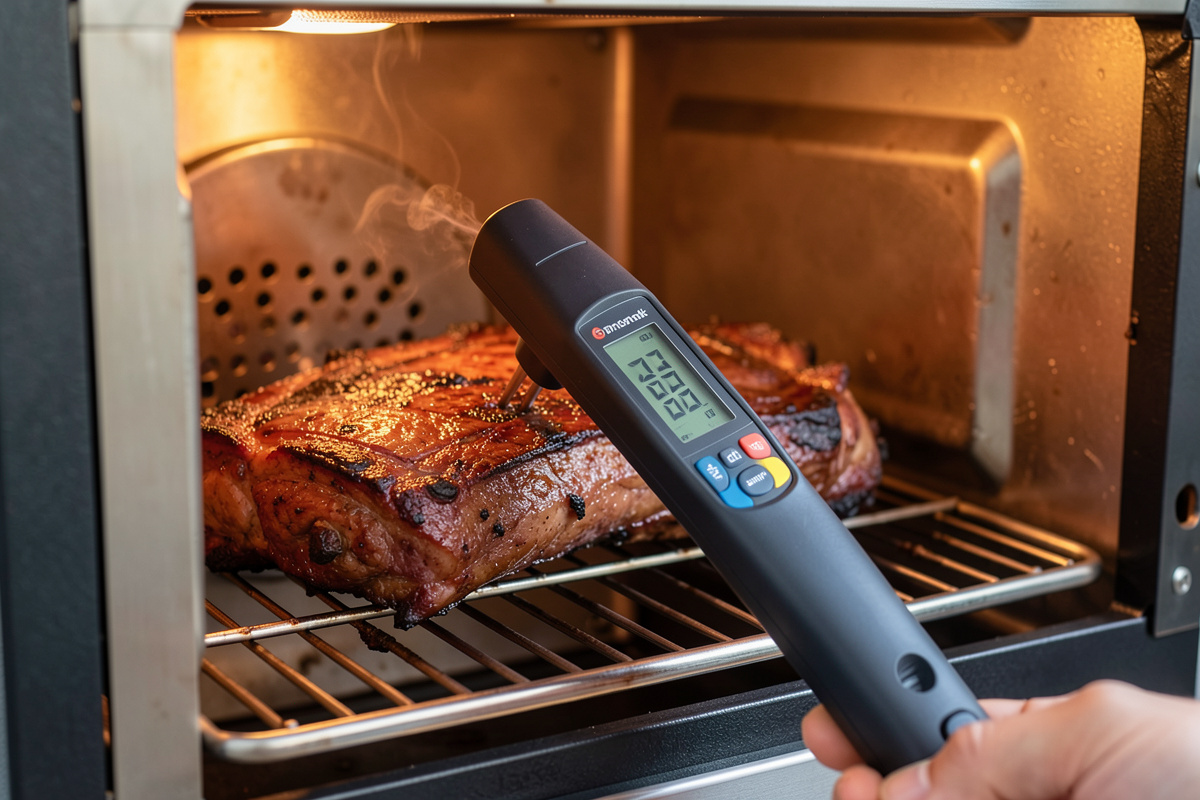

Hot smoking involves two temperatures, and confusing them is the root of most failed cooks. The smoker temperature is the air inside the chamber — usually 107–135 °C (225–275 °F), or 60–80 °C (140–176 °F) for fish. The internal temperature is the number inside the meat, and that is the one that decides whether the food is safe and done: 74 °C (165 °F) for poultry, 63 °C (145 °F) for fish and whole-muscle pork or beef.
On the curing bench my doneness signal is weight loss; on the smoker it is internal temperature, and I trust the probe over every other instinct in the shop. Colour lies, bark lies, “it has been six hours” lies. The number in the centre of the meat is the only honest voice in the room. This guide is everything I know about reading, measuring, and trusting temperature in a hot smoke — the discipline that separates consistent results from lucky ones.
Two temperatures, and why internal wins
The smoker temperature determines how fast the meat cooks and how the surface behaves; the internal temperature determines whether it is safe and done. You set and manage the smoker temperature, but you cook to the internal temperature. A smoker holding a perfect 110 °C tells you nothing about whether the brisket inside is ready — only a probe in the meat does.
This is the mental shift that took me longest coming from curing, where I judge a coppa by how much weight it has lost. On the smoker, time and smoker temperature are inputs you manage, but the internal temperature is the output you actually care about. Two briskets at the same smoker temperature for the same hours can finish at wildly different internal temperatures depending on the meat and the weather. Stop cooking to the clock and start cooking to the probe, and your results stop being a gamble.
The danger zone and why hot smoking is safe
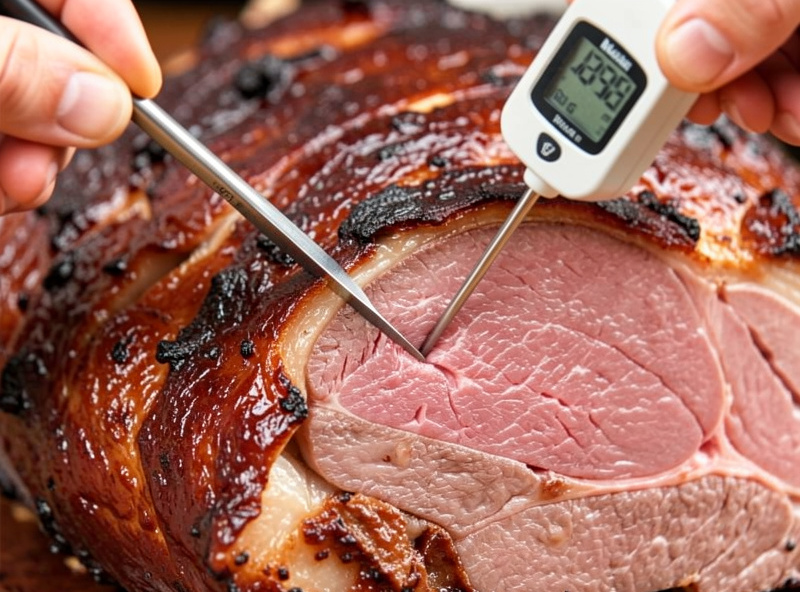
The danger zone is 4–60 °C (40–140 °F), the range where bacteria multiply fastest. Hot smoking is safe precisely because it drives the meat up through that band and out the top to a safe finish, rather than parking it there. The risk is a slow climb — a big, cold piece of meat creeping through the zone too slowly.
For intact whole-muscle cuts the bacteria live on the surface, so the outside passes through the danger zone quickly even on a slow cook, which is why a brisket can take many hours safely. Ground or stuffed products are different: contamination is mixed throughout, so they need to move through the zone more promptly. The standard caution is that the surface of intact meat should not dwell in the danger zone for more than about four hours total. This is the same logic that governs the strict protocol on the cold-smoking side, where there is no heat to climb through the zone at all.
Safe internal temperatures by protein
These are the finish temperatures I cook to, measured in the thickest part of the meat with an instant-read probe. They are not negotiable on the safety side, though some — like brisket — you deliberately cook well past for texture. This is the chart I keep taped inside the workshop cabinet.
| Protein | Smoker temp | Safe internal finish | Note |
|---|---|---|---|
| Poultry (chicken, turkey) | 120–135 °C | 74 °C (165 °F) | Absolute, no lower option |
| Fish (salmon, trout) | 60–80 °C | 63 °C (145 °F) | Smoke low and gentle |
| Whole pork / beef | 110–120 °C | 63 °C (145 °F) + rest | Safe point for tender cuts |
| Ground / stuffed (sausage) | 100–120 °C | 71 °C (160 °F) | Higher than whole muscle |
| Brisket / pork shoulder | 107–120 °C | 93–96 °C (200–205 °F) | Cook past safe for tenderness |
| Pork belly (smoked bacon) | 90–110 °C | 66 °C (150 °F) | Cure #1 in the belly first |
Notice that ground and stuffed products finish higher than whole-muscle cuts — 71 °C versus 63 °C — because grinding spreads any surface bacteria all the way through the meat. The same reasoning makes poultry the strictest at 74 °C, and lets a tender salmon fillet come off at a gentle 63 °C.
The safe-versus-tender gap
For tough, collagen-rich cuts like brisket and pork shoulder, the safe temperature and the good temperature are far apart. They are microbiologically safe at 63 °C, the same as a steak, but they only become tender near 93–96 °C, where the collagen finally renders to gelatin. You cook them far past food-safe purely for texture.
This is the single hardest idea for a precise, by-the-numbers curer to accept: that “done” means different things for different cuts. A salmon fillet is ruined past 65 °C; a brisket is barely started. Holding both ideas at once — pull the fish the instant it is safe, push the brisket forty degrees past — is what it means to actually understand temperature, and it is laid out cut by cut in the brisket guide.
The stall: when the temperature stops climbing
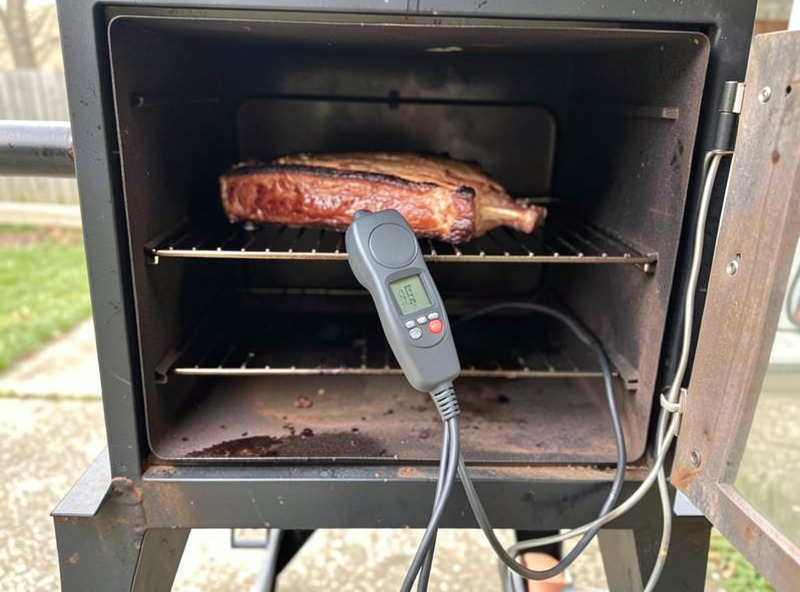
On any long smoke the internal temperature will climb steadily, then stall around 65–70 °C (150–160 °F), sometimes for hours. This is not your smoker failing — it is evaporative cooling, the meat sweating moisture off its surface as fast as the heat goes in, exactly like a damp cloth staying cool in warm air.
The stall terrifies first-timers because the probe seems frozen. It is not. Wait it out, which can add hours, or wrap the meat tightly in foil or butcher paper to stop the evaporation and push through. Whatever you choose, do not crank the smoker temperature to force it — that just dries the surface. The stall is a moisture phenomenon, the same evaporative physics a humidifier fights inside my curing chamber, running the opposite direction.
Holding a steady smoker temperature
Managing the smoker temperature is mostly about airflow and fuel. More air to the fire means a hotter, cleaner burn; choking the vents down to lower the heat is the classic mistake, because a starved fire smoulders and throws the bitter white smoke that ruins meat. Control the temperature with fuel quantity and intake air, and keep the exhaust vent open so the smoke keeps moving.
Weather works against you more than beginners expect. A cold, windy day pulls heat out of a thin-walled smoker fast, so the vent setting that held 120 °C in summer struggles in winter — something I plan around constantly in my Swedish shop, where January cooks run longer and need more fuel. A water pan inside the chamber is the single most useful stabiliser: the thermal mass of the water buffers swings and keeps the temperature from spiking and crashing every time you open the door. Aim to manage the smoker in a band rather than chase a single exact number; a pit drifting between 110 and 120 °C is cooking just fine, and fighting it to hold exactly 115 only frustrates you and dumps heat every time you fiddle with the vents.
Carryover and resting
Meat keeps cooking after it leaves the smoker, as residual heat in the surface migrates inward — carryover. A thick cut can climb a few degrees during the rest, so for cuts where overshooting matters you pull a little early and let carryover finish the job. For a thick beef roast that might mean pulling at 60 °C to land at 63 °C.
I am careful not to over-rely on carryover with poultry, though — with chicken I want to see a true 74 °C on the probe before it comes off, not 71 °C “and it will climb,” because the stakes are higher. Resting also lets the juices redistribute: ten minutes for a chicken, up to an hour or two loosely wrapped for a brisket. The rest is part of the cook, not an afterthought, and skipping it pours onto the board the moisture you spent hours protecting.
Measuring temperature correctly
A thermometer is only as good as where you put it and whether it is calibrated. Probe the thickest part of the meat, away from bone and away from large fat pockets, both of which read differently from the muscle and will fool you. For poultry, check both the breast and the thigh, since they reach temperature at different rates.
I run two kinds: a fast instant-read for spot checks and a leave-in probe to watch the climb without opening the smoker and dumping heat. Calibration matters — I check my probes in ice water, which should read 0 °C, the same salt-and-ice calibration habit I use on my chamber sensors. A probe reading three degrees high will have you serving undercooked poultry while believing you hit the number. The same logging sensors that watch my chambers watch a long smoke too, turning the whole cook into a graph I can read from the sofa.
The temperature mistakes I see most
Three errors account for most ruined cooks. The first is cooking to time instead of internal temperature — “it has been six hours, it must be done” — when the probe is the only thing that knows. The second is trusting an uncalibrated thermometer, which quietly reads high or low and has you serving undercooked poultry or bone-dry beef while believing you hit the number. Check it in ice water before any cook that matters.
The third is opening the smoker constantly. Every time you lift the lid you dump heat and stall the climb, adding time and drying the surface. A leave-in probe solves it: you watch the internal temperature on a readout without ever opening the door. Resist the urge to peek — as the pitmasters say, if you’re lookin’, you ain’t cookin’. Manage by the numbers on the screen, not by eye.
If you take one principle from all of this, make it the separation between smoker temperature and internal temperature: manage the air, cook to the meat. That single discipline underpins every protein in my hot smoking for charcuterie guide, decides which side of the line you are on in hot versus cold smoking, and is the same lesson the curing chamber taught me years ago — measure what actually matters, log it, and let the number tell you when it is done.
More From the Workshop
- Hot Smoking for Charcuterie: The Complete Guide
- Hot Smoking vs Cold Smoking Explained
- Hot-Smoked Salmon: Brine, Pellicle, and Smoke
- Hot-Smoked Chicken and Poultry
- BBQ Brisket From a Curing Perspective
- Best Wood for Smoking Meat