
To calibrate curing chamber sensors, use the saturated salt test for hygrometers (a salt-water paste in a sealed container reads exactly 75% RH at 25°C) and the ice-water test for thermometers (a stirred ice bath reads 32°F / 0°C). Both take household materials and a few hours.
Every control decision your chamber makes — humidifier on, dehumidifier off, compressor cycling — rests on a sensor reading, and a cheap hygrometer can be 8 to 15% RH wrong straight out of the box. I calibrate every sensor before it goes in a chamber and re-check them on a schedule, because a sensor that lies confidently is worse than no sensor at all. Here are the two tests that pin a sensor to a known reference, exactly as I run them on my bench.
Why Calibration Is Non-Negotiable
A drifted sensor does not just give you a wrong number, it makes your control loops actively harmful. A hygrometer reading 75% when the chamber is really at 85% keeps the humidifier adding moisture, driving RH higher and growing mold; a thermometer reading low lets the chamber sit warmer than you think, edging toward unsafe territory.
That is the safety stake. The 50–60°F band charcuterie dries in is chosen partly to keep meat out of the temperature danger zone, and a thermometer reading 4°F low quietly defeats that. On the humidity side, the gap between a mold-prone 85% and a case-hardening 65% is only a calibration error wide. This is why the climate control hub treats sensors and calibration as their own control layer, and why I never trust a fresh hygrometer’s display until the salt test confirms it.
The Saturated Salt Test for Hygrometers
The saturated salt test is the gold standard for hygrometer calibration: a saturated solution of plain table salt in a sealed container holds the air above it at exactly 75% RH at 25°C (77°F), regardless of the salt’s brand or age. Put your hygrometer in that air for 6+ hours and compare its reading to 75%.
Here is the method I use. Half-fill a bottle cap or small dish with plain non-iodized table salt, add water a few drops at a time, and stir to a wet slurry — thick paste, not a puddle. Place the dish and the hygrometer together in a sealed clear container or zip bag with no air gap to the room, keep it somewhere with a stable temperature near 25°C, and wait at least 6 hours (overnight is better). A correctly reading sensor shows 75%. If it reads 70%, it runs 5% low; note that offset and either adjust it in the sensor’s calibration setting or mentally correct every reading. Cheap dial hygrometers routinely come in 8–15% off and many cannot be adjusted — those get replaced. Use non-iodized salt because iodine and anti-caking agents can skew the result, the same reason iodized salt is wrong for the cure itself.
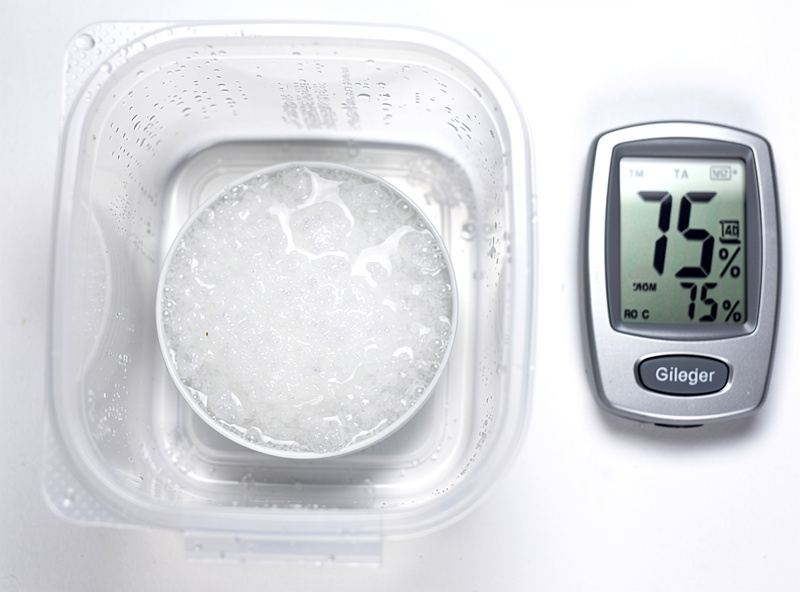
A pre-made 75% RH calibration kit (a two-way salt packet) does the same job in a sealed bag if you would rather not mix slurry.
Disclosure: CuringChamber is reader-supported. As an Amazon Associate I earn from qualifying purchases made through links in this article, at no extra cost to you. I only point to gear I actually use or would buy for my own chamber.
The Ice-Water Test for Thermometers
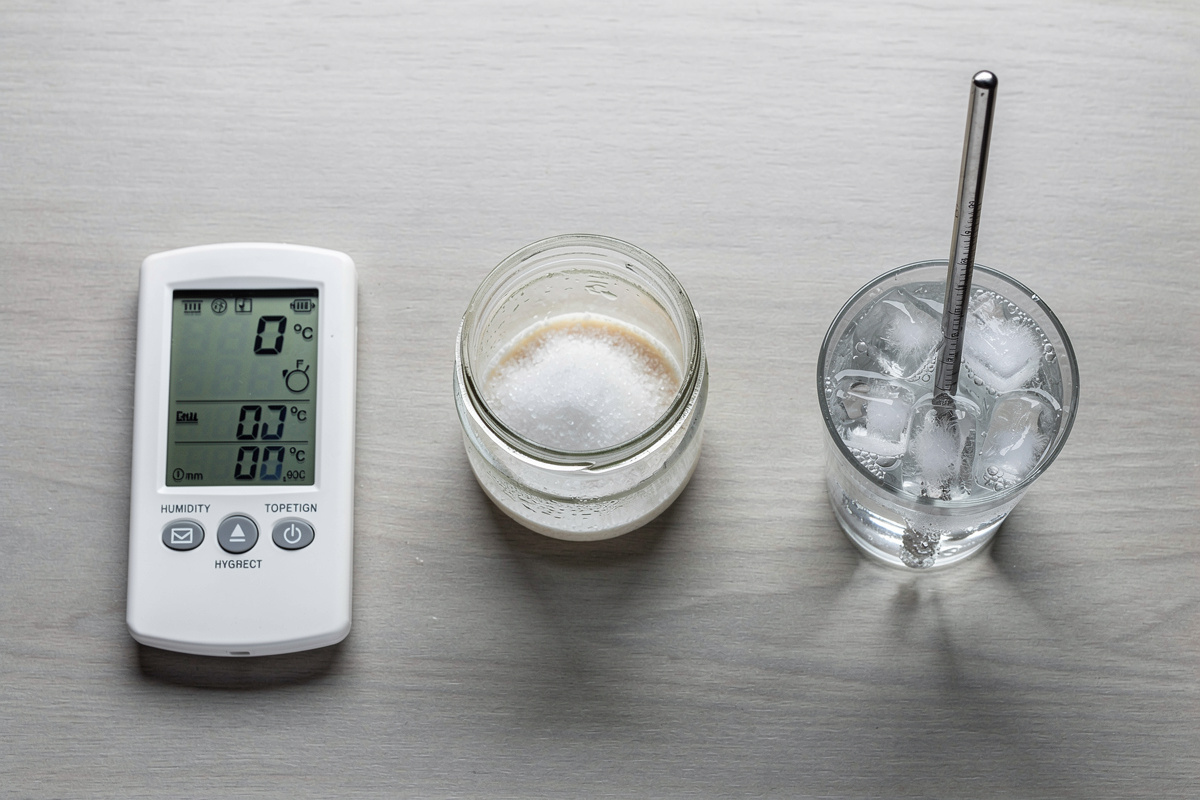
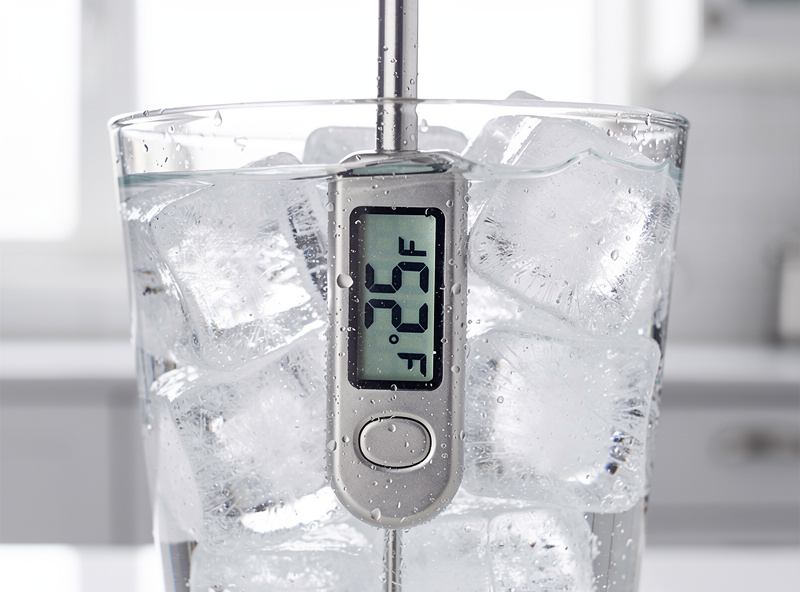
The ice-water test calibrates thermometers against a fixed physical point: a well-stirred slurry of crushed ice and water sits at exactly 32°F (0°C) as long as ice remains. Insert the probe into the center of the slurry without touching the container, wait for the reading to settle, and compare to 32°F.
Fill a glass with crushed or cubed ice, top with cold water, stir for 30 seconds, and let it sit a minute so the whole bath equilibrates. Suspend the thermometer probe in the middle — not against the glass wall or bottom, which read warmer — and give it time to stabilize. A good thermometer reads 32°F (0°C); note any offset. This is the test I trust most because the reference is a law of physics, not a manufactured value. For a second fixed point you can use a rolling boil, which is 212°F (100°C) at sea level — but correct for altitude, since the boiling point drops roughly 1°F per 500 feet of elevation, so the ice point is the safer reference for most people. The instant-read probe I lean on most lives in my apron pocket; a reliable instant-read digital thermometer is worth calibrating and keeping.
Calibration Methods Compared
Each method pins a different sensor to a different known reference. Salt fixes humidity, ice and boiling fix temperature, and a trusted reference sensor cross-checks both. Here is when to reach for each.
| Method | Calibrates | Reference value | Time | Notes |
|---|---|---|---|---|
| Saturated salt test | Hygrometer (RH) | 75% RH at 25°C | 6+ hours | Use non-iodized salt, sealed container |
| Salt calibration packet | Hygrometer (RH) | 75% RH (two-way) | 6+ hours | Pre-made, no mixing |
| Ice-water test | Thermometer | 32°F / 0°C | Minutes | Most trusted; probe centered, stirred |
| Boiling-water test | Thermometer | 212°F / 100°C (sea level) | Minutes | Correct for altitude (~1°F per 500 ft) |
| Reference-sensor cross-check | Both | A known-good sensor | Hours in chamber | Catches in-place drift over weeks |
Cross-Checking with a Reference Sensor
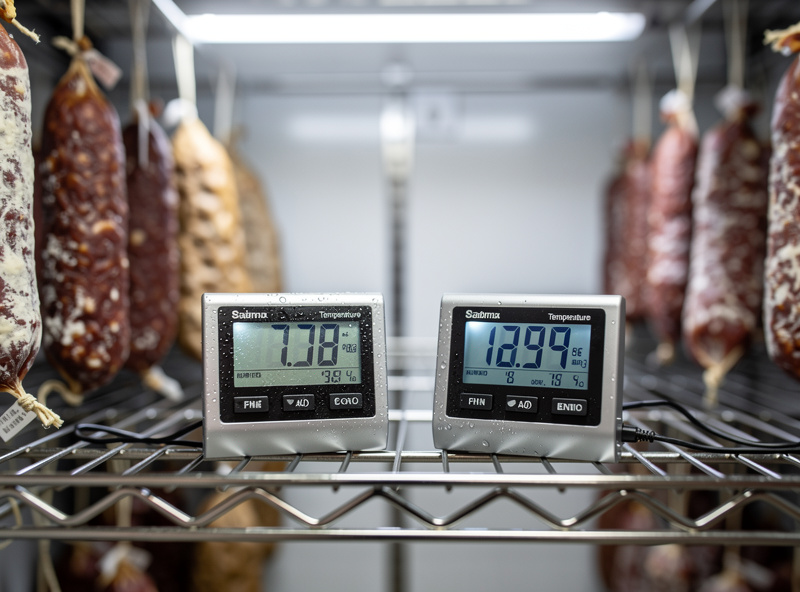
Calibration is not a one-time event, because sensors drift in service. The practical defense is running two sensors in the chamber and cross-checking them against each other and against your bench reference, so a slow drift shows up as a growing gap rather than ruining a batch unnoticed.
In my primary chamber I run a SensorPush HT.W at meat-shelf height as the trusted reference, plus an Inkbird IBS-TH3 in the coil zone, and I watch the difference between them. On my first long salami run that pairing earned its keep: the controller probe drifted 7% high while the SensorPush stayed accurate, and the discrepancy caught a 5-day overshoot before it cost me the batch. SwitchBot and Govee sensors do the same redundant job cheaply. The point is never to trust a single number — full sensor selection, placement, and logging is its own guide in smart temperature and humidity sensors for curing chambers, and capturing those readings remotely is in curing chamber data logging without opening the door. A trusted wireless reference hygrometer makes the cross-check effortless.
How Often to Re-Calibrate
Re-calibrate at the start of every curing season and any time two sensors disagree by more than a few percent. A sensor that passed the salt test six months ago can drift, and the cheap ones drift fastest, so a quick re-test before a big batch is cheap insurance against a ruined cure.
My rhythm is a salt test on the humidity sensors and an ice-water test on the thermometers each autumn before the main curing season, plus an immediate re-check whenever the in-chamber pair starts disagreeing or a reading looks suspicious against how the meat actually looks and weighs. If a sensor fails the test and cannot be offset-adjusted, replace it — a $10 hygrometer is not worth a $40 coppa. Trustworthy numbers are the foundation everything else stands on: the temperature controller, the humidifier, and the dehumidifier are only as good as the sensor feeding them.
Frequently Asked Questions
How do I calibrate a curing chamber hygrometer?
Use the saturated salt test. Mix plain non-iodized table salt with a few drops of water into a wet paste, seal it in a container with the hygrometer for at least 6 hours at about 25 degrees C, and compare the reading to 75 percent RH. Note any offset and adjust it in the sensor, or replace cheap units that read more than 5 percent off and cannot be adjusted.
Why does a salt test read exactly 75 percent humidity?
A saturated solution of sodium chloride holds the air above it at a fixed equilibrium of about 75 percent relative humidity at 25 degrees C, a known physical property independent of salt brand or quantity. That makes it a reliable, free reference point for checking and adjusting any hygrometer at home.
How do I calibrate a curing chamber thermometer?
Use the ice-water test. Fill a glass with crushed ice, top with cold water, stir for 30 seconds, and suspend the probe in the center without touching the glass. A correct thermometer reads 32 degrees F (0 degrees C). Note any offset. For a second point, boiling water is 212 degrees F at sea level, corrected for altitude.
How accurate are cheap curing chamber sensors?
Cheap dial and digital hygrometers commonly read 8 to 15 percent RH off straight out of the box and drift further over months. Many cannot be calibrated at all. Always salt-test a new sensor before trusting it, note or adjust the offset, and replace any unit that drifts more than 5 percent and has no adjustment setting.
How often should I calibrate curing chamber sensors?
Re-calibrate at the start of each curing season and any time two in-chamber sensors disagree by more than a few percent or a reading looks wrong against how the meat looks and weighs. Cheap sensors drift fastest, so a quick salt and ice-water re-test before a big batch is cheap insurance against a ruined cure.
Should I use iodized salt for the calibration test?
No. Use plain non-iodized table salt. Iodine and anti-caking additives can skew the equilibrium humidity slightly, throwing off the 75 percent reference. It is the same reason iodized salt is wrong for the cure itself, where iodine can inhibit fermentation. Plain salt gives the reliable 75 percent RH point.
Why run two sensors in a curing chamber?
Because sensors drift in service and a single reading can be confidently wrong. Running two sensors and watching the gap between them turns a slow drift into a visible warning instead of a ruined batch. Keep one trusted reference sensor at meat-shelf height and cross-check the others against it and your bench calibration.
Related Articles
- Smart Temperature and Humidity Sensors for Curing Chambers — choosing and placing the sensors you calibrate.
- Curing Chamber Climate Control: The Complete Guide — sensors as Layer 4 of the system.
- Curing Chamber Too Humid: How to Fix Oversaturation Fast — what a drifted hygrometer leads to.
- Inkbird vs Auber vs Willhi Curing Chamber Controller — the controller acting on your sensor data.
- Case Hardening in Curing Chambers — what a drifted humidity reading can cause.