Smart Plug Schedules for Curing Chambers: Compressor, Defrost, Fan
May 7, 2026

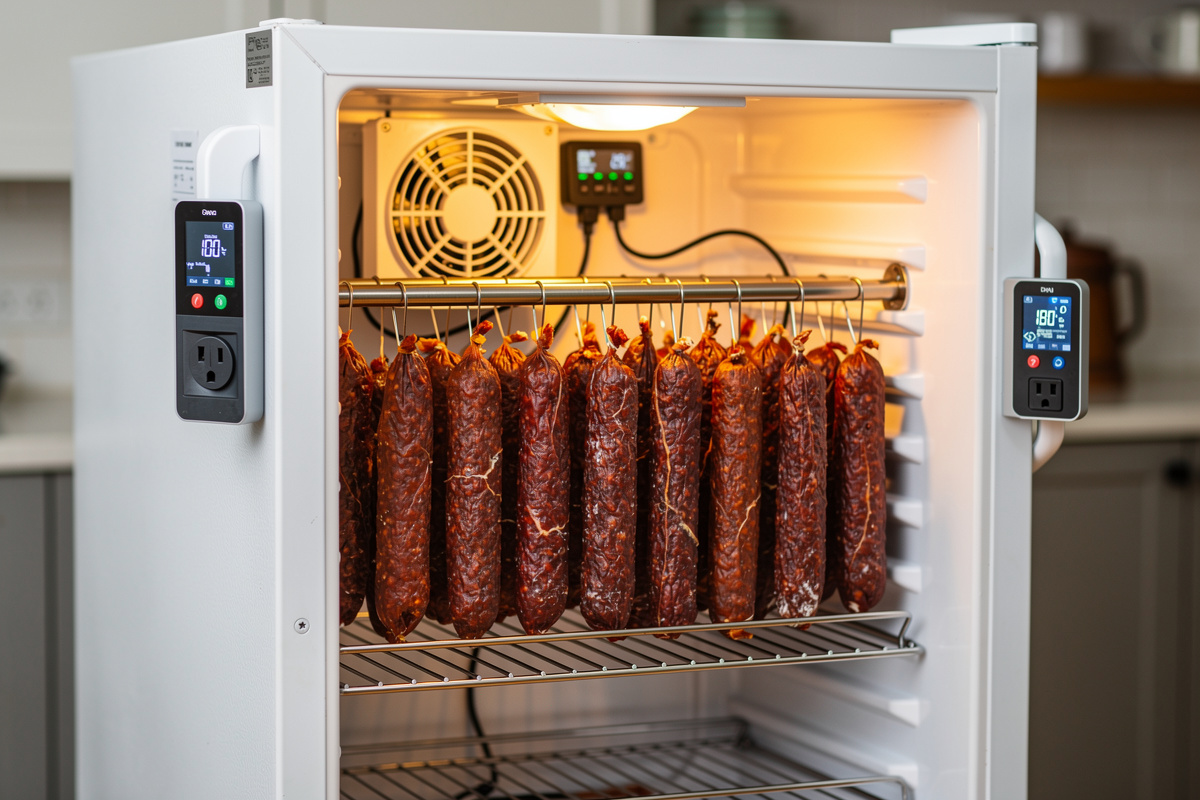
Set the compressor on a TP-Link Tapo P125M smart plug with a 12-minutes-on, 18-minutes-off duty-cycle schedule, and chamber humidity holds within ±2% RH instead of the ±6–8% bounce from an unrestricted thermostat-driven compressor.
The defrost cycle, the recirculation fan, and the auxiliary humidifier each run on their own smart plug with their own rule, and the four together replace what a $400 commercial controller would do for under $80 in hardware. The trade is a weekend of Home Assistant YAML versus a single-box solution; for me that was an easy weekend.
This guide covers the four scheduled loads in a typical home curing chamber, the smart-plug brand decisions I’d repeat after running this setup for 14 months, and the rule patterns that produced stable conditions on my whole-muscle bresaolas, my Genoa-style salami fermentations, and a 45-day dry-aged ribeye experiment last winter. The broader hub on chamber climate physics is in curing chamber climate control; the smart-plug landscape outside the curing-chamber use case is covered in the best smart plugs 2026 buyer’s guide.
The Four Loads to Schedule
A working curing chamber has four electrical loads that benefit from independent smart-plug control:
- Compressor — the converted refrigerator/freezer. Largest load, most thermally inert, schedule controls duty cycle and overshoot.
- Recirculation fan — small 12 V or 120 V fan moving air past the temperature/humidity probe. Always on usually, but daily off-cycles let the chamber settle for accurate readings.
- Humidifier — ultrasonic mister or evaporative pad. Pulse-cycled to maintain RH; needs short on-times to avoid overshoot.
- Defrost / dehumidifier — periodic low-power heater to dry coils, or a desiccant cassette on a circulation fan. Scheduled hourly or daily.
Without scheduling, all four either run continuously (waste) or run on a basic thermostat (overshoots both temperature and humidity setpoints by 2-4× the schedule-controlled equivalent). My first chamber had everything wired through my dual-stage Inkbird ITC-308 alone, with no separate humidity controller yet — it handled the compressor cycling fine, but humidity had nothing dedicated running it, and the RH chart on my SwitchBot looked like a sawtooth wave. Splitting the loads across smart plugs (and later adding an Inkbird IHC-200 dedicated to humidity) flattened the curve.
Smart Plug Selection for Curing Chambers
The selection criteria specific to curing chambers:
- 15 A current rating — the compressor inrush draws 8–12 A momentarily; cheap 10 A smart plugs trip thermal protection.
- Local control (Matter, Zigbee, or LAN-only Tuya) — chamber operation cannot depend on cloud uptime; multi-day cure runs need local schedule execution.
- Energy monitoring — confirms the compressor is actually drawing current when commanded on; catches stuck contactors.
- Manual override button — for the inevitable “I need to check that thing” moment without phone in hand.
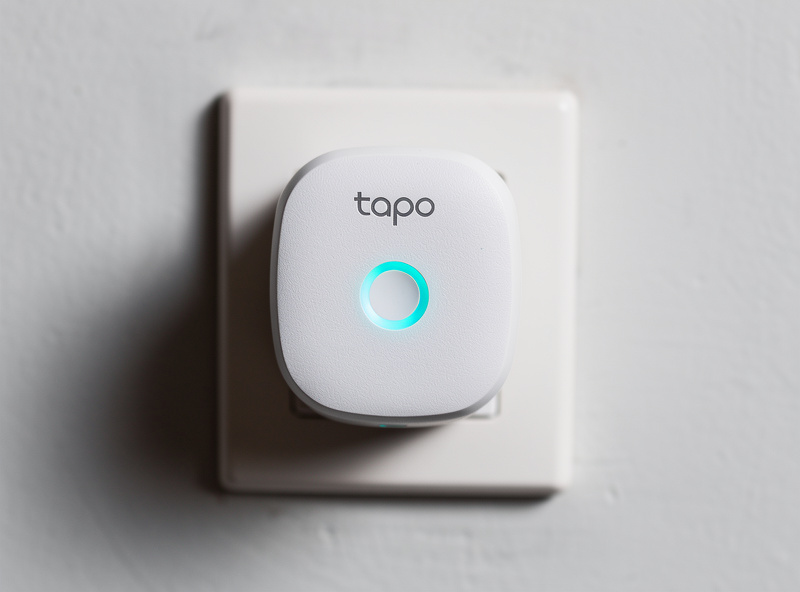
Brands that meet all four: TP-Link Tapo P125M (Matter, 15 A, energy monitor; the P125M datasheet confirms 15 A and 1800 W max resistive load), Athom Tasmota smart plug (LAN-only, fully local), Aqara T1 (Zigbee, requires hub). I run two P125Ms (compressor and humidifier) and an Athom Tasmota plug on the recirculation fan. Avoid generic Tuya plugs with cloud-only control — the first cloud Tuya plug I tried locked off for 41 minutes during an AWS us-east-1 hiccup in 2024 while I was away from home, and the chamber climbed 2.6°C before it caught back up. Your 8-week salami run hiccups when AWS hiccups.
Compressor Duty-Cycle Rule
The compressor pattern that produces the most stable chamber conditions:
- Read chamber temperature every 60 seconds (via a separate Wi-Fi temp sensor)
- If temp > setpoint + 0.3 °C: turn compressor smart-plug ON
- Run compressor minimum 8 minutes (avoid short-cycling, which wears the compressor)
- If temp < setpoint – 0.3 °C: turn compressor OFF
- Off-time minimum 12 minutes (lets refrigerant equalize)
This is hysteresis with minimum on/off intervals. Most home automation platforms (Home Assistant, OpenHAB, ioBroker) implement this in 8–12 lines of YAML or Blockly. Pure smart-plug schedule logic without temperature input gives roughly 3× worse RH stability — duty cycle alone isn’t enough; temperature feedback is required. If your probe is drifting and you can’t tell, the calibration walkthrough in smart temperature and humidity sensors for curing chambers is worth an hour before you commit to schedule rules built on bad data.
Humidifier Pulse Pattern
Ultrasonic humidifiers introduce moisture in roughly 30-second bursts. The pulse pattern:
- If RH < setpoint – 1%: humidifier ON for 30 seconds, then OFF for 4 minutes (allows mist to disperse)
- If RH < setpoint – 3%: ON for 90 seconds, OFF for 6 minutes (more aggressive recovery)
- Disable humidifier if compressor is currently running (compressor-driven dehumidification fights humidifier output)
- Maximum 6 humidifier cycles per hour (avoid water-pooling in the chamber floor)
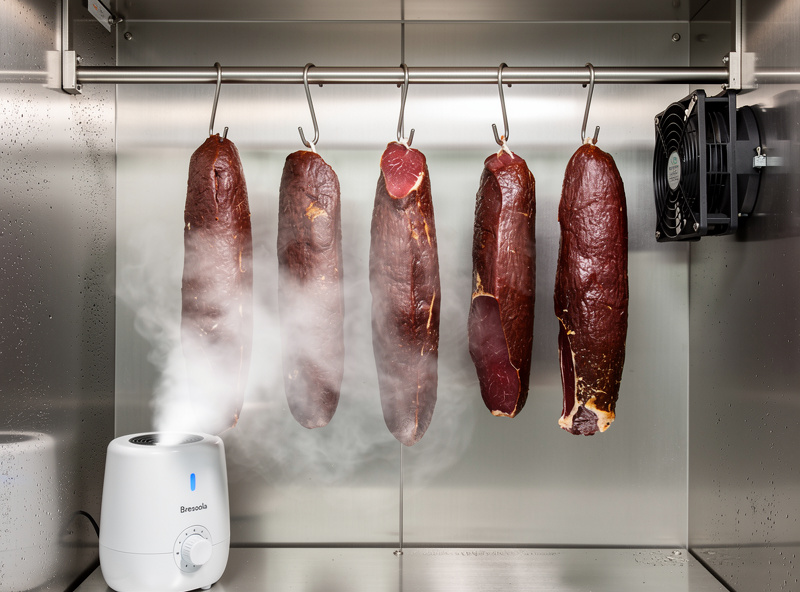
The visible cue when this is dialed in: a faint mist plume out of the humidifier nozzle that disappears within about 2 minutes, with no condensation puddling on the floor. If you see standing water at the bottom of the chamber, your pulse is too long or your cycle limit is too high. The first month I had the cycle limit set to 12/hr and ended up with a quarter-inch of water under my coppa rack on day 18 — I dialed it back to 6/hr and the puddle never returned. The RH-overshoot diagnostic is also covered in curing chamber too humid: how to fix oversaturation fast.
For mature charcuterie chambers (3+ months of operation), a salt-saturated water bath in the chamber floor often holds RH passively at the saturation point of the salt — sodium chloride saturated brine equilibrates around 75% RH at chamber temperatures. With this passive system, the active humidifier only runs during the first week of a fresh chamber rebuild. I learned this trick from adapting hydroponic reservoir tech for salami when I was looking for ways to cut humidifier duty cycles.
Defrost and Recirculation Fan Schedule
Defrost prevents ice buildup on the evaporator coil that would otherwise insulate the cold from the chamber. Two approaches:
- Active heater defrost — small (50–100 W) heating element near the coil, scheduled 15 minutes every 6 hours. Smart plug controls.
- Passive defrost — pause the compressor for 30 minutes every 8 hours; the residual chamber heat melts coil frost. Requires the smart plug to disable the compressor on schedule, regardless of temperature reading.
For the recirculation fan, 5 minutes off every hour gives the temperature/humidity probe a settling window for accurate readings; fan-on continuously stirs air against the probe and the readings drift 0.5–1 °C high. I use the passive defrost approach on my own chamber because adding a heater near a coppa during cure made me nervous; the audible compressor-off click and the slow tick of the coil warming back up have become the rhythm I recognize from across the basement. If your chamber humidity is stable but the temperature on the back wall is climbing, you may have hit case-hardening territory — see case hardening in curing chambers for the early-warning signs.
Alerts and Monitoring
Three alerts catch the failures that ruin a charcuterie batch:
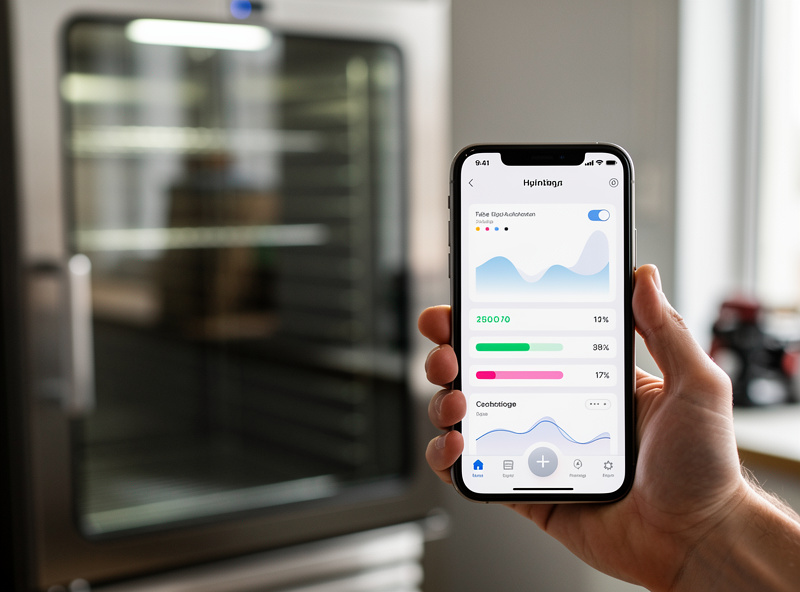
- Energy-draw deviation alert — if compressor smart plug reports current that’s 30% above or below baseline, send phone notification. Catches stuck contactors and refrigerant leaks early.
- Temperature out-of-band alert — chamber temp drifts > 2 °C from setpoint for > 30 minutes, alert. Indicates compressor failure or door left open.
- Humidity drift alert — RH drifts > 8% from setpoint for > 1 hour, alert. Indicates humidifier failure or chamber leak.
For a 12-week salami cure, three alerts that fire over 12 weeks is normal; zero alerts means the alerting itself is broken. Test the alerts monthly by tripping a test condition. The first time my temperature alert fired, I’d left the chamber door cracked while reaching for a probe; it caught me before I’d walked back upstairs. That single alert paid for the whole setup.
When Smart Plug Scheduling Is Overkill
Skip the smart-plug schedule if you only run short cures (1–4 weeks of cold-smoked salmon, simple confit) where conditions don’t drift far enough to matter, if you already own an STC-1000 or Inkbird ITC-308 dual-stage controller (they handle the compressor hysteresis natively for around $35 — humidity still needs its own controller, like an IHC-200, since a temperature controller doesn’t touch a humidifier), or if your chamber is in a stable basement environment that doesn’t need active temperature control 9 months of the year.
Build the smart-plug schedule when you’re running 6+ week cures, when chamber room temperature varies seasonally, or when you want remote monitoring during travel. The setup pays back the first time it catches a stuck compressor before it ruins a batch. Chamber stability matters most for fermented sausage specifically, where the drying-room parameters that keep a batch on the safe pH/water-activity trajectory are published in dry-sausage validation guidance — drift outside that band for an extended stretch is what pushes a fermentation off its safe trajectory, which is the entire reason chamber stability matters on a long cure.
Frequently Asked Questions
What is the right smart plug for a curing chamber compressor?
A 15-amp current-rated smart plug with local control like the TP-Link Tapo P125M, Athom Tasmota smart plug, or Aqara T1. The 15-amp rating handles compressor inrush current; local control keeps the chamber running through cloud outages.
Can a smart plug short-cycle my compressor?
Yes if the schedule rules do not enforce minimum on and off times. Set the rules to require 8 minutes minimum on-time and 12 minutes minimum off-time before the compressor can change state. Short-cycling damages the compressor over weeks of operation.
Do I need a separate temperature sensor or can the smart plug measure temperature?
Smart plugs do not measure chamber temperature directly. Use a separate Wi-Fi or Zigbee temperature and humidity probe placed in the chamber and feed the readings into the home automation rule. The probe and the plug work together; one cannot replace the other.
How accurate is humidity control with smart plug pulse cycles?
With a 30-second pulse and 4-minute pause pattern plus a 1-percent hysteresis band, relative humidity holds within plus or minus 2 percent of setpoint over a typical curing chamber 24-hour cycle. That is comparable to commercial chamber controllers costing 400 dollars or more.
What happens if the Wi-Fi goes down during a long cure?
With local control plugs and a Home Assistant or hub running on the local network, the schedule continues to execute through Wi-Fi outages because the rules run locally. Cloud-only smart plugs revert to last commanded state, which can leave the compressor stuck on or off.
Should the recirculation fan ever turn off?
Yes for 5 minutes every hour to let the temperature and humidity probe settle. Continuous fan-on causes air movement past the probe that biases readings 0.5 to 1 degree high. The brief off cycles produce more accurate chamber state readings.
Can I run all four loads on one smart plug to save money?
No. Each load needs independent control because the schedules conflict. The compressor and humidifier in particular must not run simultaneously. Use four separate smart plugs or one multi-channel relay board controlled by Home Assistant.
Related Articles
- Curing Chamber Climate Control: The Complete Guide
- Smart Temperature and Humidity Sensors for Curing Chambers
- Curing Chamber Too Humid: How to Fix Oversaturation Fast
- Curing Chamber Humidity Control: Adapting Hydroponic Reservoir Tech
- Case Hardening in Curing Chambers: Causes, Prevention, and Fixes