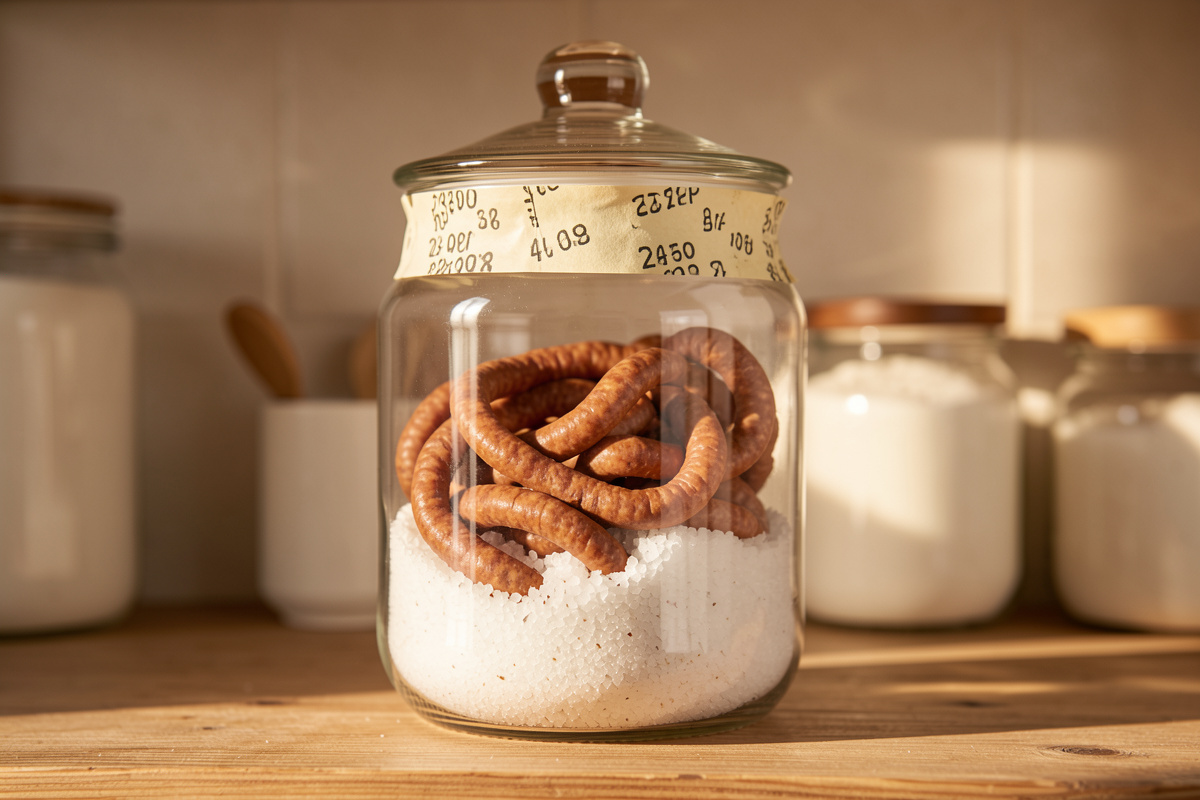

Repack leftover natural casings in plenty of plain non-iodised salt, seal them airtight, and refrigerate — stored that way they keep for a year or more. Salt drops the water activity so low that spoilage bacteria simply cannot function. The enemies of stored casings are not time but drying out, moisture creeping back in, and cross-contamination from a sloppy repack.
Natural casings are shipped salt-packed for exactly this reason, and there is no mystery to keeping your leftovers the same way — you are just recreating the condition they arrived in. What trips people up is treating casings like a fresh food that spoils in days, when in fact a properly salted hank outlasts almost everything else in the fridge. I have pulled casings from salt after well over a year and stuffed them without a problem. Let me lay out how to store them so they keep, and how to tell when one has actually gone off.
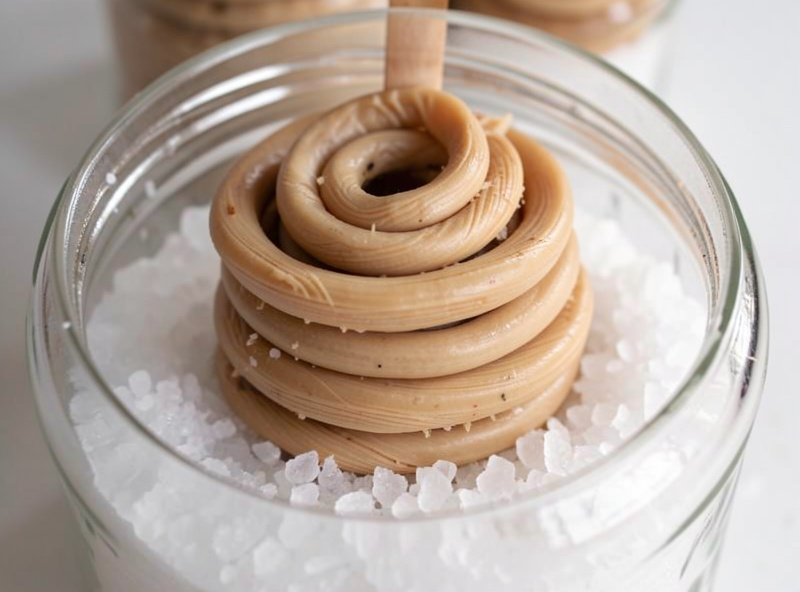
This is the last step in the casing preparation and stuffing workflow — what you do with the casing you prepped but did not use. Get it right and a single hank serves you across many batches instead of being thrown out half-used.
How Long Do Salted Casings Last?
Salt-packed natural casings kept airtight in the fridge last a year or more — often well beyond that. The salt cure that preserves them does not expire; as long as the casings stay buried in salt, sealed from moisture, and cold, they remain stuffable. Many suppliers quote a year for unopened hanks, and in practice a well-repacked opened hank matches that easily.
The clock only really starts if the salt gets diluted or the casings dry out to brittleness. That is why the repack matters more than the calendar. I date my containers with tape purely so I use the oldest first, not because there is a hard cliff at twelve months. Compare that to a soaked casing, which is a fresh, perishable thing good for only a day or two — the salt is doing all the preservation work, and the moment you soak it out, the timer changes completely. Keep them salted and cold and time is genuinely on your side.
How Do You Store Leftover Salted Casings?
Drain the casings well — never store them wet from a soak — then coil them, bury them heavily in plain coarse non-iodised salt so every surface is coated, pack them into an airtight container, and refrigerate. Use enough salt that the casings are surrounded, not just dusted, because it is the salt in direct contact that holds the water activity down.
My own method: I coil each opened hank loosely, lay it in a lidded plastic or glass container, and pour coarse salt over and through the coils until they are buried. I press it down, seal the lid, label it with tape and a date, and it goes on a low fridge shelf. If a casing came out of a soak and I did not use it, I drain it thoroughly, pat it down, and salt it heavily again — wet casing put into salt just makes a wet salt slurry that will not preserve properly, so drying it first is the key move. The same discipline applies whether you are storing the tail end of a hank of soaked hog casings or a spare length of wide beef casing.
Can You Freeze Sausage Casings?
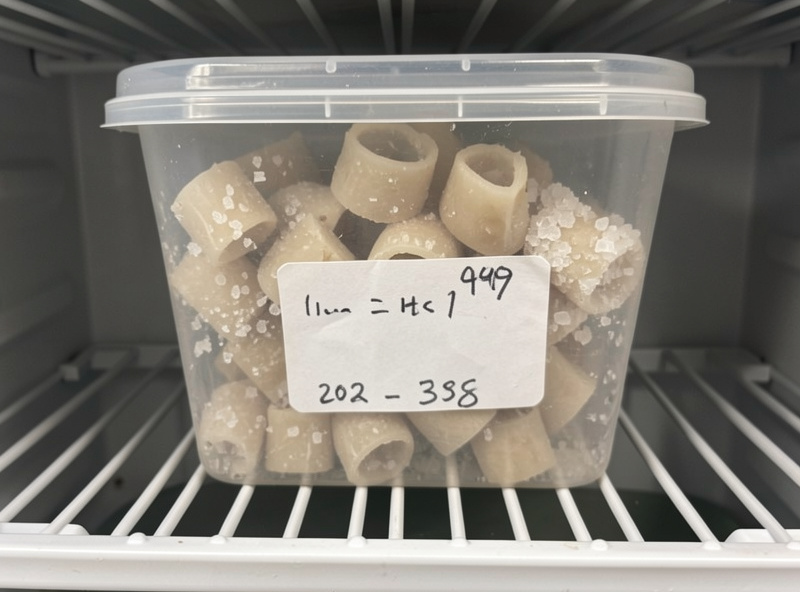
Yes, you can freeze salt-packed natural casings, and it extends storage well beyond a year, but it is rarely necessary because salted casings already keep so long in the fridge. If you do freeze them, keep them salted and airtight, and expect them to be slightly more fragile after thawing, since freezing can weaken the collagen structure a little.
I freeze casings only when I have bought in bulk and genuinely will not get through a hank within a year or so. When I do, I thaw them slowly in the fridge before soaking, never in warm water, so they rehydrate evenly and do not shock. Honestly, for most home makers the freezer is overkill for casings — the fridge and a good salt pack do the job. I reserve my freezer space for the things that actually need it, like the grinder plates and stuffer canister I chill before a batch. Freezing is a valid backup, not a default.
Can You Store Casings in Brine Instead of Dry Salt?
You can store casings in a saturated salt brine as an alternative to dry salt, and some makers prefer it because the casings stay supple and ready to flush. The brine must be fully saturated — salt dissolved until no more will go in — and kept cold and airtight, or it will not preserve. Dry salt keeps longer and travels better; brine keeps the casings more immediately usable.
I keep most of my casings in dry salt because it is the most robust and forgiving method, but a saturated brine jar in the fridge is a reasonable choice if you stuff often and want casings a step closer to ready. The one thing you cannot do is store them in plain water or weak brine — anything short of saturation lets bacteria grow and the casings turn slimy. As with everything in this hobby, it is the salt concentration doing the safety work, exactly the way a saturated cure protects a piece of fish or the way the right salt matters in curing fish.
What Salt Should You Use to Store Casings?
Use plain, non-iodised salt — coarse or fine both work, though coarse is easier to brush off later. Never use iodised table salt, because iodine is antimicrobial in a way that works against the natural casing’s chemistry, the same reason iodised salt is a mistake in a cure or a ferment. Plain sea salt, kosher salt, or dedicated coarse salt are all fine.
This is one of those small details that separates casings that keep from casings that do not behave. Iodine can interfere with the casing and, more importantly for anyone who reuses the salt-adjacent habits, it inhibits the lactic-acid bacteria you rely on elsewhere in charcuterie. So I keep a bag of plain coarse salt specifically for casings and cures, well away from the iodised stuff in the kitchen. It is cheap insurance.
As an Amazon Associate I earn from qualifying purchases. A bag of plain coarse non-iodised salt and a set of airtight storage containers are all you need to keep leftover casings for months.
Which Casing Storage Method Should You Choose?
| Method | Keeps for | Best for | Watch out for |
| Dry salt pack, fridge | A year or more | Most home makers; leftovers | Must be well-drained and fully buried in salt |
| Saturated brine, fridge | Several months to a year | Frequent stuffers wanting ready casings | Brine must be fully saturated, kept cold |
| Frozen, salted & airtight | Well over a year | Bulk buyers who stuff rarely | Slightly more fragile after thaw; thaw in fridge |
| Plain water (do not) | Days at best | Nothing — avoid | Grows bacteria; casings turn slimy |
For the overwhelming majority of home charcutiers, the dry salt pack in the fridge is the right answer — robust, cheap, and forgiving. The other methods are situational. If in doubt, salt it heavily, seal it, and chill it.
Should You Vacuum Seal Casings for Storage?
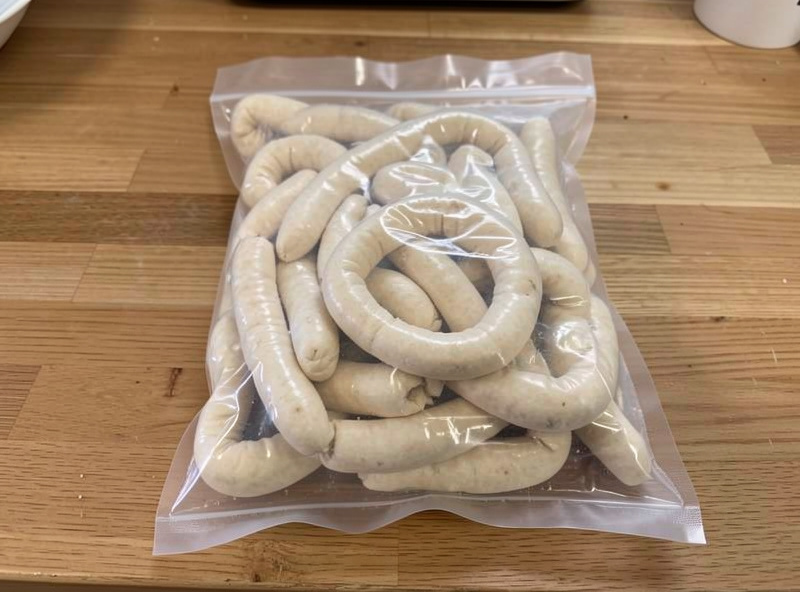
Vacuum sealing salted casings is a genuinely good option, especially for portioning a big hank into batch-sized amounts. Salt the casings as normal, drop a portion into a vacuum bag, seal it, and you have an airtight, moisture-proof pack that keeps for a year in the fridge or longer in the freezer. The vacuum removes the air that carries moisture and slows any oxidation of the packing.
What I like about vacuum sealing is that it lets me split a bulk hank the day it arrives into several single-batch packs, so I only ever open the salt on the portion I am about to use and the rest stays perfectly sealed. That is the same logic as portioning any bulk buy — open one, leave the others untouched. The one caution is not to seal casings that are still wet from a soak; drain and salt them first, exactly as you would for a jar, because a vacuum bag will preserve whatever state you seal in, good or bad. Sealed dry-salted casings, though, are about as low-maintenance as storage gets, and a cheap vacuum sealer earns its keep across a curing kitchen for far more than casings alone.
How Do You Tell If Casings Have Gone Bad?
Good stored casings smell of little more than salt and faintly of clean meat, and they rinse and rehydrate to a supple, neutral casing. Casings that have gone off announce themselves: a sour, rotten, or ammonia-like smell, a persistent sliminess that does not rinse away, or a grey-green discoloration that is not just packing salt. When any of those show up, throw the casing out.
The sensory check is quick and worth doing every time. When I pull a hank from salt, I rinse a length and give it a genuine sniff — clean and salty is good; sour or putrid is a bin decision, no debate. A casing that stays slippery-slimy after a proper rinse, rather than becoming smooth and elastic, has broken down and is not worth the risk to a batch that will hang for three months. This is the same conservative rule I apply to any piece in the chamber and to any questionable mould: when in doubt, throw it out, because a natural casing costs a fraction of the meat and time you would lose to a spoiled one. Storage buys you months of convenience; it does not turn a bad casing good.
What Storage Mistakes Should You Avoid?
The mistakes are simple and all preventable: storing casings wet, using too little salt, using iodised salt, leaving the container open to fridge moisture, and keeping them at room temperature. Any of those shortens storage from a year to days.
The one I see most is storing casings still wet from a soak, which just dilutes the salt into a useless slurry. I made a version of this mistake early on by leaving a half-used, damp hank loosely covered in the fridge, thinking the residual salt would carry it — a week later it was slimy and had to go. Now the rule in my kitchen is absolute: drain, dry, bury in plenty of plain salt, seal, date, chill. Do that and a single hank of casings quietly serves batch after batch, which is exactly the kind of low-drama reliability this whole slow hobby rewards. For the food-safety fundamentals behind salt storage and safe handling, the USDA Food Safety and Inspection Service and the National Center for Home Food Preservation are the references I check against.
Keep Building
- Preparing Sausage Casings: A Complete Guide
- How to Soak and Flush Natural Hog Casings the Right Way
- Best Casing for ‘Nduja: Wide Beef Bung vs Sewn-End Caps
- Best Salt for Curing Fish: Coarse vs Fine and Why It Matters