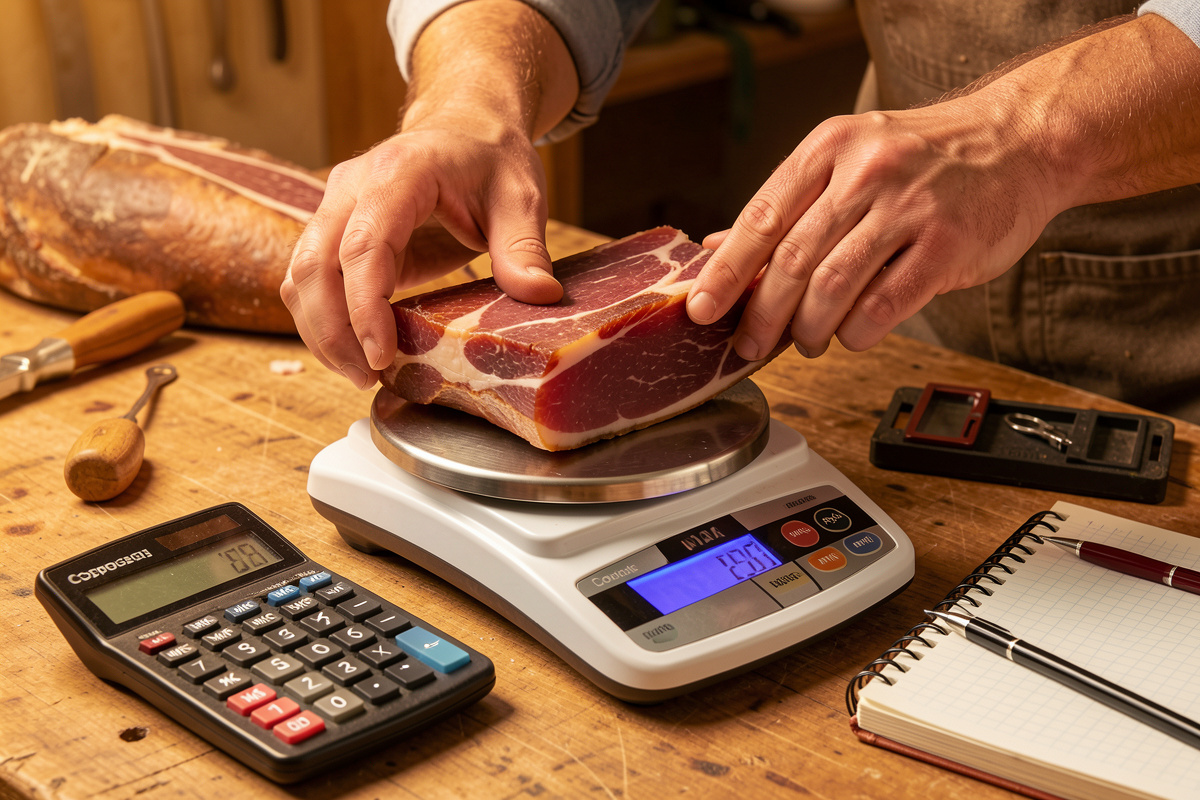

Price homemade charcuterie on the time and the weight loss, not the cheap starting meat. A pork shoulder is inexpensive, but by the time it becomes coppa it has spent three to four months in the chamber and shed 35% of its weight — so a kilo of fresh muscle yields only about 650 grams to sell. Cost the yield loss, the months of held humidity, the risk you carried, and your labour, and the right price stops looking expensive and starts looking honest.
This is the question that trips up almost every home charcutier who turns a hobby toward income, and it is part of the wider selling homemade charcuterie cluster. I run converted-fridge chambers and log the weight of every piece I hang, so pricing is just arithmetic on top of data I already keep. I won’t hand you a “$X a month” figure — that depends entirely on your facility costs and local market, and anyone promising one is selling a course. What I can do is build the cost stack with you so your price covers reality.
Start with yield, because it eats a third of your cost
The single number most people omit is drying loss. Whole-muscle charcuterie and finished salami both lose roughly 30 to 40 percent of their starting weight before they are ready — that weight loss is literally the doneness signal I use to know a piece is safe and finished. If you price off the green (fresh) weight, you are quietly giving away that third of your raw material for free.
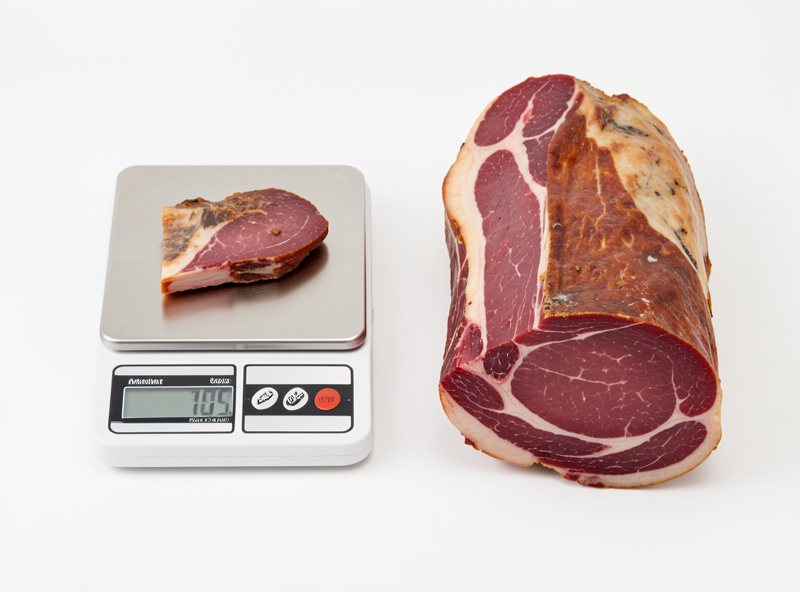
So the first move is to convert raw cost into finished cost. If a 2 kg pork collar costs you a given amount fresh and finishes at 1.3 kg of coppa, your meat cost per finished kilo is the raw price divided by 0.65, not by 1. That alone raises your true meat cost by more than 50 percent over the naive figure. Every other cost gets layered on top of that corrected number. A reliable digital scale that reads to the gram is the cheapest business tool you will buy — I weigh every piece in and out, and the log is what makes this calculation trustworthy. As an Amazon Associate I earn from qualifying purchases. If you need one, a basic digital gram scale is enough to run the whole weight log.
The full cost stack
Once meat is corrected for yield, the rest of the stack is straightforward to itemise. The mistake is stopping at “meat plus a markup.” A real price covers everything the piece consumed on its way to the customer, including the unglamorous overheads that quietly bleed margin.
| Cost line | What it covers | Easy to forget? |
|---|---|---|
| Meat (yield-corrected) | Raw cost divided by finished fraction (~0.65) | The yield division itself |
| Cure and culture | Cure #1 or #2, salt, dextrose, starter culture, mould spray | Rarely — but cheap per piece |
| Casings and twine | Natural, collagen or fibrous casing, curing twine, hooks | Sometimes |
| Chamber energy | Compressor, humidifier, fan running for months per batch | Almost always |
| Facility fee | Shared-kitchen or commissary rent per session | Only if you forget you legally need one |
| Packaging and label | Vacuum bag, label printing, any branded sleeve | Often underpriced |
| Insurance and licensing | Product liability, permit and inspection fees amortised | Almost always |
| Labour | Your time at a real hourly rate | Constantly — people value their time at zero |
Two of those lines deserve emphasis because they are the ones home producers zero out. Chamber energy is real: a compressor, humidifier and fan cycling for three or four months per batch draws power continuously, and across a year that is a line item, not a rounding error. And labour is not free just because you enjoy it — if you don’t pay yourself, your “profit” is an illusion that collapses the moment you value your weekends. Build both in.

Marking up from cost to price
Cost tells you the floor; the market tells you the ceiling. Specialty cured meat is a premium, hand-made product, and the customer who seeks it out at a market or specialty shop is paying for craft and story, not commodity protein. That gives you room above cost — but the markup has to clear not just your direct costs but the share of overhead and the risk premium for the batches that don’t make it. Some pieces case-harden, some get pulled for bad mould; the survivors have to carry the failures.
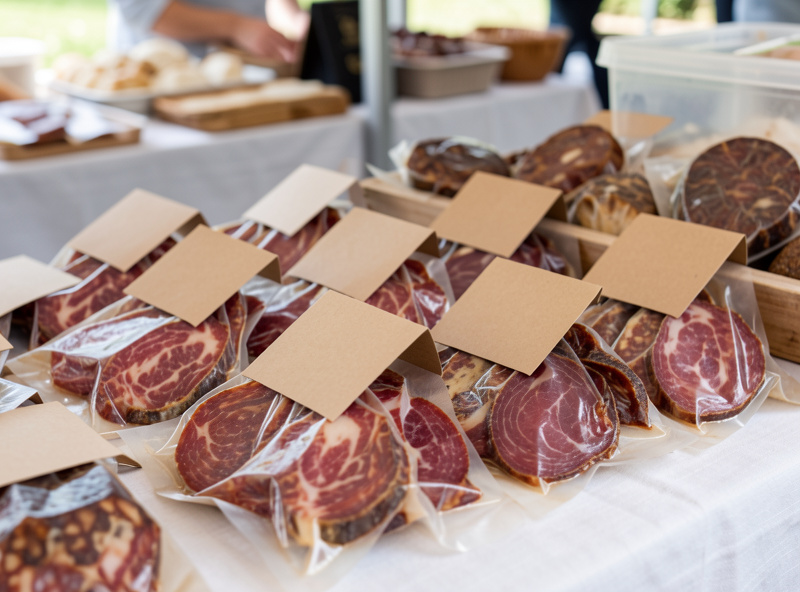
A practical approach is to total your true per-kilo cost, decide a markup that reflects your local premium-food market, then sanity-check the result against what comparable artisan producers charge in your area. If your honest cost-plus number lands far above the local going rate, the problem is usually upstream — your batch sizes are too small to spread overhead, or your yield losses are heavier than they should be. That is a chamber problem to fix, not a price to fake. The packaging guide also affects perceived value: a well-presented, properly labelled piece justifies a higher price than the same meat in a bare bag.
Why you should never advertise an income figure
You will see “make $2,000 a month selling salami” headlines everywhere. Ignore them. Real margins swing wildly with your facility costs, your local meat prices, your market’s willingness to pay, and how much your time is worth. A producer renting an expensive commissary in a high-cost city and one curing in a cheap rural shared kitchen have completely different economics for the identical product. Quoting a universal income number is not just misleading — it is the kind of unverifiable earnings claim that invites trouble. Price from your own real numbers and let the income be whatever the honest maths produces.
A worked way of thinking about one coppa
Walk a single coppa through the logic without inventing currency figures. You buy a collar; it finishes at about 65 percent of its weight, so your meat cost per finished kilo is the raw cost divided by 0.65. Add a few cents of cure and culture, a share of a casing and twine, the slice of chamber energy that batch used, the per-piece amortised facility and insurance cost, the packaging and label, and an honest hour or two of your labour spread across the batch. Total those, divide by the finished weight, and you have a true cost per kilo. Apply your market markup, and that is your price. Do it once on a spreadsheet and you will never guess again — and you will probably discover you have been undercharging, which is the near-universal beginner’s error. The board business guide runs the same logic for assembled grazing tables, where labour and styling are a bigger share of the price than the meat itself.
Frequently Asked Questions
How do I account for drying weight loss when pricing charcuterie?
Divide your raw meat cost by the finished fraction. Whole muscle and salami finish at roughly 60 to 70 percent of their starting weight, so a kilo of fresh meat that finishes at 650 grams means your true meat cost per finished kilo is the raw cost divided by about 0.65 — over 50 percent higher than the naive figure.
What costs do home charcutiers usually forget to include?
Chamber energy over the months of curing, your own labour at a real hourly rate, product liability insurance, amortised licensing and facility fees, and packaging. People routinely value their time at zero and ignore the power a compressor and humidifier draw across a full batch.
How much should I mark up cured meat over cost?
Enough to clear direct costs, a share of overhead, and a risk premium for batches that fail, then check the result against local artisan prices. There is no universal multiple — premium hand-cured product supports a healthy markup, but the market sets the ceiling.
Can I really make a set monthly income selling charcuterie?
No honest figure exists, because margins depend entirely on your facility costs, local meat prices, market demand and the value of your time. Treat any fixed income promise as marketing. Build your price from your own real numbers instead.
Does better packaging let me charge more?
Yes. A properly labelled, well-presented piece reads as a premium product and supports a higher price than the same meat in a bare bag. Packaging and labelling are part of perceived value, not just protection, so cost them in and use them to justify your price.
Keep Reading
- Selling Homemade Charcuterie: The Complete Legal Guide
- Packaging Cured Meats for Sale
- Charcuterie Board Business Guide
- Farmers Market for Charcuterie
- Food Safety Licensing for Charcuterie