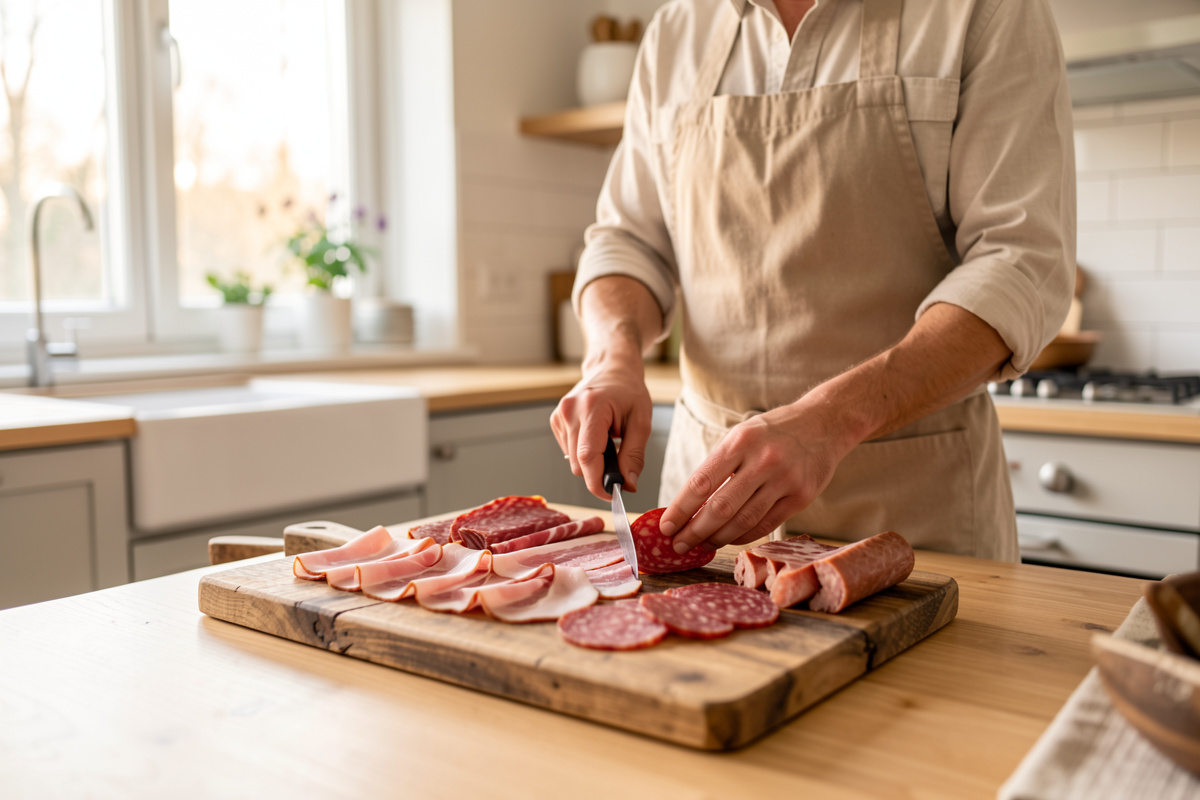

Selling homemade charcuterie is mostly a legal question, not a culinary one. In most of the United States, dry-cured meat is excluded from cottage food exemptions because it counts as a potentially hazardous food, so the legal route runs through an inspected kitchen and a state or USDA meat-processing license rather than your home chamber. The product is the easy part; the paperwork is where people stall.
I run converted-fridge curing chambers in Sweden, and I have hung enough coppa, pancetta, bresaola and fermented salami to know that making a sellable piece is well within reach for a careful home charcutier. But wanting to sell it and being legally allowed to sell it are two different animals. This guide walks the whole path the way I think about it from the chamber side: what the law actually allows, how to price honestly, how to package cured meat for sale, and which markets are realistic. None of this is legal advice — rules vary by country, state and county, and the only authority that matters is your local food regulator. Treat everything here as a map of the questions to ask them.
The honest legal reality: cured meat is rarely a cottage food
Here is the part most “sell your charcuterie” articles skip. Cottage food laws were written for low-risk, shelf-stable items — baked goods, jams, dry mixes, candies — that don’t support the growth of dangerous bacteria. Dry-cured and fermented meats are the opposite category: they are classified as potentially hazardous foods, and almost every US cottage food statute specifically excludes meat and poultry products. That means you generally cannot sell home-cured salami or pancetta out of your kitchen under a cottage food permit, no matter how good your weight-loss log looks.
Why the hard line? Cured meat carries real risk — Clostridium botulinum, Listeria monocytogenes, and the nitrite chemistry that controls them. Regulators treat it as a process that needs verification: a documented cure, a validated pH or water-activity endpoint, and usually an inspector who can confirm you hit it. A jar of jam can’t grow botulism; a fermented sausage held wrong can. The law reflects that gap. I cover the food-safety credential side in detail in the food safety licensing for charcuterie guide, because it is the single biggest gate between a hobby and a business.
So what is legal? Broadly, there are three paths, and the rest of this cluster breaks each one down. The full regulatory picture lives in the cottage food law and charcuterie guide, but here is the shape of it.
Three legal paths to selling charcuterie
There is no single “charcuterie business license.” What you need depends entirely on which of these models you choose, and each one sits in a different regulatory bucket. Pick the model first; the licensing follows from it.
| Model | What you sell | Typical regulator | Barrier to entry |
|---|---|---|---|
| Home-cured meat (manufacturing) | Your own dry-cured salami, coppa, pancetta | State meat inspection / USDA FSIS | Highest — inspected facility + HACCP |
| Charcuterie boards / grazing | Boards assembled from purchased cured meats | Cottage food or food-handler rules (varies) | Low to moderate |
| Co-packing / shared kitchen | Your recipe, made in a licensed facility | State + facility license | Moderate — rent + compliance |
The first path — selling charcuterie you cured yourself — is the dream for most chamber builders, and it is also the hardest. In practice it means producing in a licensed, inspected facility (not your converted larder fridge), writing and following a HACCP plan, and holding a state meat processor license or operating under USDA inspection. Some states run a “state meat inspection” program that mirrors USDA rules for in-state sales; others push everything to federal inspection. This is exactly the kind of thing you confirm with your state department of agriculture before you spend a krona.
The second path is the clever workaround that an enormous number of small operators actually use: build and sell charcuterie boards assembled from commercially produced, already-inspected cured meats and cheeses. You are not manufacturing a hazardous food — you are assembling and presenting one, which in many jurisdictions falls under cottage food, a food-handler card, or a simple home-kitchen registration. It is the lowest-friction way to turn the aesthetic of charcuterie into income without an inspected meat facility. The catch is that you cannot quietly slip your own homemade salami onto that board; the moment you do, you are back in path one.
The third path — renting time in a licensed commissary or shared-use kitchen, or partnering with an inspected co-packer — is the realistic middle ground for someone who genuinely wants to sell their own recipe. You keep your formulation and process; the facility provides the inspected environment and often the compliance scaffolding. It costs money and it means your process gets scrutinised, but it is how a lot of small cured-meat brands actually start.
Pricing: cured meat is a time business, not a meat business
Charcuterie pricing confuses people because the raw material looks cheap. A pork shoulder is not expensive. But you are not selling pork — you are selling four months of held humidity, a 35% weight loss, the spoilage risk you carried, and the skill that kept it safe. Price the time and the loss, not the starting weight of the muscle.

The single number people forget is yield. Whole-muscle charcuterie and finished salami both lose roughly 30–40% of their starting weight to drying — that is the doneness signal I use on every piece. A kilo of fresh coppa becomes 600–650 grams of sellable product. If you price off the green weight you are quietly giving away a third of your cost base. The pricing homemade charcuterie guide works through a full cost stack — meat, cure, casings, energy for the chamber, packaging, the licensed-facility fee, and your labour — and shows where home charcutiers consistently underprice. I won’t put a fake “earn $X a month” figure on it, because honest margins depend entirely on your facility costs and local pricing, and anyone promising you a monthly income number is selling a course, not the truth.
Packaging cured meat so it survives the journey
A piece that is perfect on your shelf can fail in a customer’s fridge if you package it wrong. Cured meat is alive in a slow way — it keeps losing moisture, it can sweat, and a sealed bag traps condensation that softens the bloom and invites the wrong surface growth. Packaging for sale is a different problem from storing your own, and it is where labels become a legal minefield too.
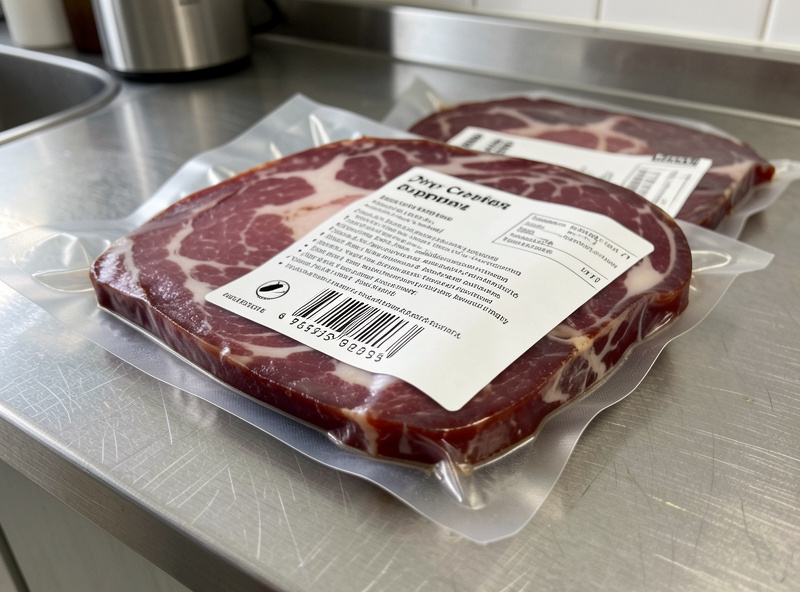
Vacuum sealing whole muscle works well once the piece has finished drying, but a piece that is still actively losing weight will keep doing so inside the bag and pool liquid. Sliced product oxidises fast and needs either vacuum or modified-atmosphere packaging to hold colour. And every sealed package that crosses a counter for money needs a compliant label — net weight, ingredients (including the cure and any allergens), the responsible business name and address, lot or batch identification, and storage instructions. The packaging cured meats for sale guide covers materials, shelf-life framing, and the labeling fields regulators look for. Get the label wrong and an inspector will pull the product regardless of how good the meat is.
Where to actually sell it
Assuming you have cleared the licensing gate, the realistic channels are farmers markets, local specialty shops, direct online sales within your legal shipping zone, and events or grazing-board bookings. Each has its own rules layered on top of the food law.
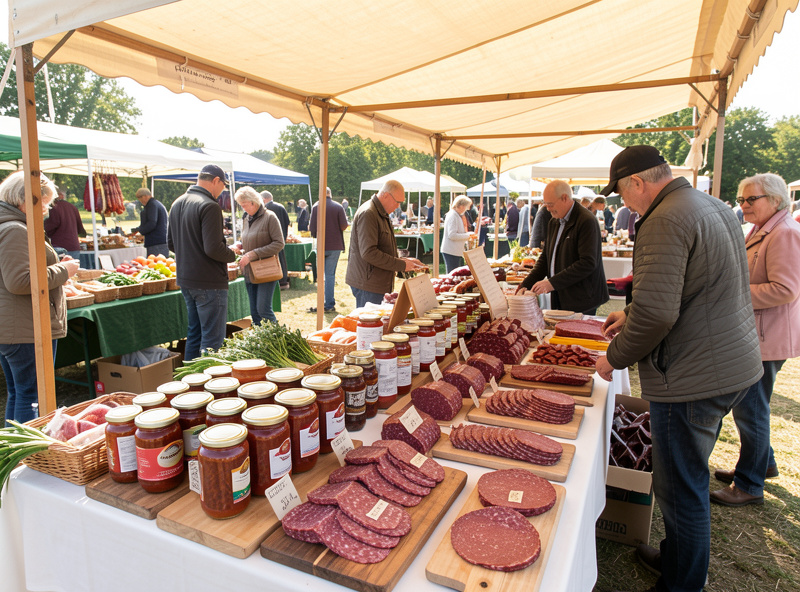
Farmers markets are the classic entry point because they put you face to face with the exact customer who pays a premium for hand-cured product. But markets have their own vendor requirements — a market manager will usually ask for your license, your liability insurance, and sometimes a sample of your HACCP documentation before they give you a stall. The farmers market for charcuterie guide covers stall setup, the cold-chain you have to maintain in the open air, and the temperature logging that keeps both the inspector and your conscience happy. Selling cured meat outdoors in summer is a cold-chain problem before it is a sales problem.
The board-and-grazing route deserves its own mention because it scales differently. A charcuterie board business sells presentation and convenience — you are paid for assembly, styling, and delivery as much as for the food. Because you are working with pre-inspected components, the legal barrier drops, and the margins on a well-styled grazing table can be excellent. It is the path I would point a hobbyist toward first if they want cash flow while they sort out the harder licensing for their own cured product. The charcuterie board business guide covers sourcing, costing and the board styling that justifies the price.
Don’t sell anything you wouldn’t eat blind
The fastest way to end a small food business is to make someone sick. Selling raises the stakes on every safety call you make in the chamber, because now strangers are eating it and a regulator is watching. This is where the chamber discipline pays off: use the correct curing salt for the method — cure #1 for short or cooked cures, cure #2 for anything fermented or long-dried — hit a verified pH drop on fermented product, dry to a real weight-loss endpoint rather than a guessed one, and throw out anything with fuzzy black or green growth or an off smell. When you are unsure, the answer is always the bin, not the customer.
I treat the weight log as the honest contract. Every piece I would consider selling has a logged drying curve that shows it crossed into the safe water-activity range, not a vague “it felt ready.” That record is also exactly what a HACCP plan formalises — the business version of the notebook I already keep. If you have been logging weight loss as a hobbyist, you are closer to a compliant process than you think; you just have to write it down in the format an inspector recognises. The same instincts that keep your family safe are the ones that keep your business legal.
Insurance, liability and the unglamorous paperwork
Once money changes hands, you are a food business, and food businesses carry liability that a hobby never does. Product liability insurance is the piece most new sellers underestimate — if someone claims your product made them ill, the policy stands between you and a ruinous bill, and most farmers markets and stockists will not let you trade without proof of it. Budget for it from day one and fold the premium into your pricing rather than treating it as an afterthought; the pricing guide shows where it belongs in the cost stack.
Beyond insurance, expect to register your business, keep traceability records that let you identify which batch went to which customer, and retain your process logs in case of a complaint or an inspection. None of this is exotic — it is the administrative shadow of the weight-and-pH discipline you already practise in the chamber. The traceability a regulator wants is the same lot tracking that good packaging and labeling already forces you to do. If your records are tidy, an inspection is a conversation rather than a crisis. The full credentialing picture is in the food safety licensing guide.
Selling outside the United States: a quick orientation
This cluster leans on US terminology because that is where the cottage-food question is asked most, but the underlying logic travels. In the UK, food businesses register with their local authority and the Food Standards Agency framework expects an HACCP-based food safety management system even for small producers. Across the EU, member states implement the EU hygiene regulations, and selling cured meat typically means registration or approval as a food business operator with documented hazard control. Here in Sweden the municipal environmental office is the first door I would knock on. The names and thresholds differ, but the principle is identical everywhere I have looked into it: cured meat is treated as higher-risk, so the regulator wants a documented, verifiable process before you sell. Wherever you are, the cottage food and charcuterie law guide explains the questions to take to your local authority — and confirming with that authority is non-negotiable, because I am a chamber builder, not your lawyer.
A realistic first-year path
If you asked me how to start without lying to yourself, I would say this: begin with charcuterie boards built from purchased, inspected components, because that gets you legally trading, building a customer base, and learning the market while you save up. In parallel, talk to your state department of agriculture about what it actually takes to sell your own cured product — the license, the facility, the HACCP plan — and cost it honestly using the pricing guide. Then, when the numbers work and the paperwork is real, move your own salami and coppa into the mix through a licensed facility. That sequence respects both the law and your wallet, and it never asks you to gamble a customer’s health on a shortcut.
The romance of selling your own cured meat is real, and it is achievable. It is just gated by genuine, well-founded rules rather than by your skill in the chamber. Clear the gate properly and you get to do the thing for money. Try to sneak around it and you risk your customers, your reputation, and a regulator’s patience all at once — and none of those are worth a faster start.
Frequently Asked Questions
Can I sell homemade charcuterie under a cottage food law?
Generally no. Almost every US cottage food law excludes meat and poultry because dry-cured meat is classified as a potentially hazardous food. Selling your own cured meat usually requires an inspected facility and a state or USDA meat-processing license, not a cottage food permit.
What is the easiest legal way to start a charcuterie business?
Selling charcuterie boards assembled from commercially produced, already-inspected cured meats and cheeses. Because you are assembling rather than manufacturing a hazardous food, this often falls under cottage food or food-handler rules with a much lower barrier than selling your own cured meat.
Do I need a HACCP plan to sell cured meat?
For selling your own dry-cured or fermented meat, almost always yes. A HACCP plan documents your cure, your fermentation pH, and your drying endpoint so an inspector can verify the process is safe. It is essentially the formal, written version of the weight and pH log a careful home charcutier already keeps.
How should I price homemade charcuterie?
Price the time and the weight loss, not the cheap starting meat. Whole muscle and salami lose roughly 30 to 40 percent of their weight to drying, so build that yield loss plus cure, casings, chamber energy, facility fees, packaging and labour into the price. Anyone quoting a guaranteed monthly income figure is guessing.
Is it legal to sell cured meat at a farmers market?
Only if you already hold the correct license for producing it and the market approves you as a vendor. Markets typically ask for your license, liability insurance and sometimes HACCP documentation, and you must maintain the cold chain at the stall. The food law applies first; the market rules sit on top.
Can I just sell my homemade salami to friends and neighbours?
Selling, even informally, generally triggers the same food laws as selling to strangers. Giving it away is a different situation, but the moment money changes hands you are subject to your jurisdiction’s meat-processing rules. Confirm with your local regulator before you trade anything cured.
Related Guides
- Cottage Food Law and Charcuterie: What You Can and Can’t Sell
- How to Price Homemade Charcuterie
- Packaging Cured Meats for Sale
- Charcuterie Board Business Guide
- Farmers Market for Charcuterie
- Food Safety Licensing for Charcuterie