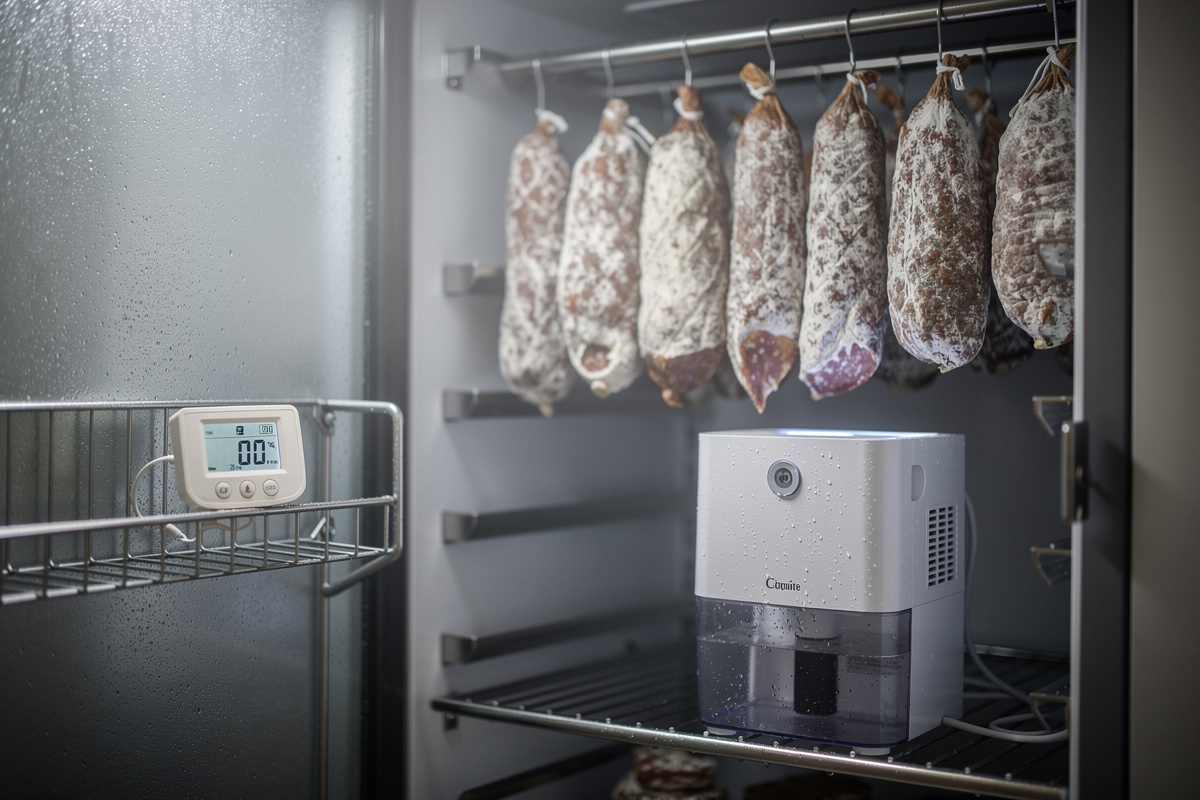

You need a dehumidifier in a curing chamber whenever incoming moisture outpaces what the chamber can shed — the first 48 hours of a fresh batch, humid summers, and auto-defrost spikes. Size it to your chamber volume and moisture load: a small Peltier unit handles most home boxes; a compressor mini handles the worst.
Most beginners obsess over adding humidity and forget the opposite problem, then watch a fresh salami sit at 90% RH for three days growing the wrong mold. A dehumidifier is the other half of climate control. Across the chambers I run I keep a small thermoelectric unit on the primary box and a compressor mini on standby for summer, and I size both to the actual water the meat is throwing. Here is when a dehumidifier earns its spot and how to pick one that matches your chamber.
When a Curing Chamber Actually Needs a Dehumidifier
A curing chamber needs active dehumidification in three situations: the first 24–48 hours of a fresh cure when the meat dumps surface moisture, humid summer months when ambient air seeps in above target, and on auto-defrost donor fridges that spike RH 10–15% each defrost cycle. Outside those windows a well-sealed chamber often holds target on its own.
The moisture math is simple. A few kilos of fresh meat releases water fast in the early days, and a sealed box has nowhere to put it — RH climbs and stays there. Add summer ambient humidity leaking in every door-open, plus the condensate an auto-defrost fridge re-evaporates back into the box, and you have three moisture sources stacking up. If your chamber chronically reads above 85% RH, start with the diagnostics in curing chamber too humid; if it spikes only at predictable moments, a sized dehumidifier on a humidistat is the clean fix, working as the mirror image of the humidifier on the dry side.
Dehumidifier Types for a Curing Chamber
Home charcuterie chambers use one of four approaches: thermoelectric (Peltier) mini-dehumidifiers, rechargeable desiccant units, small compressor dehumidifiers, and passive desiccant tubs. They differ in capacity, heat output, and how much babysitting they need — and a curing chamber’s hard rule is the same as for humidifiers: do not add heat you do not want.
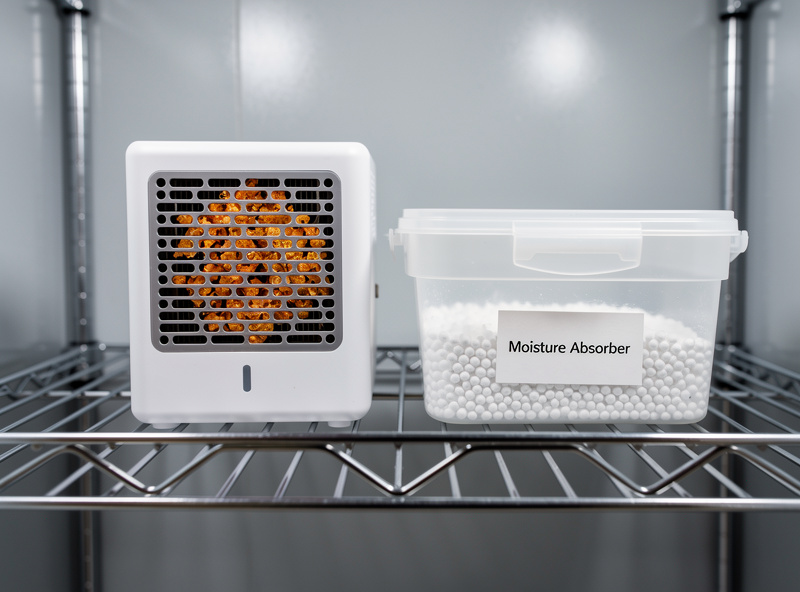
A Peltier unit pulls a small amount of water onto a cold plate and is the quiet default for routine spikes of 5–15% above target. A rechargeable desiccant dehumidifier (the kind you dry out in the oven or a wall socket) is silent, heat-free, and perfect for a tiny bar-fridge chamber. A compressor mini-dehumidifier moves real water for the worst summer or first-48-hour loads but adds heat and noise. Passive desiccant tubs — calcium-chloride crystals or rechargeable silica — are the damp-sponge-in-reverse fallback I have run head-to-head: no power, no control, but they quietly buffer a stable chamber. Match the tool to the load.
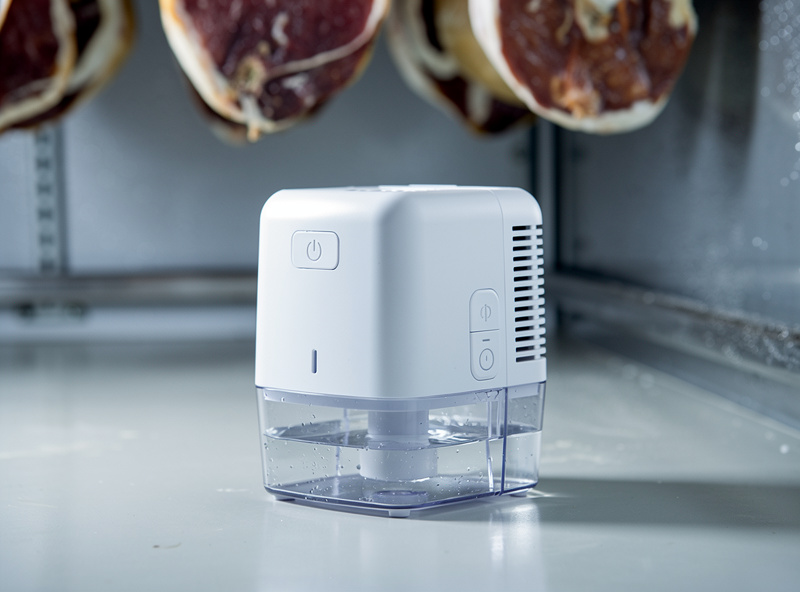
For most home chambers a quiet mini Peltier dehumidifier on a humidistat is the right first buy.
Disclosure: CuringChamber is reader-supported. As an Amazon Associate I earn from qualifying purchases made through links in this article, at no extra cost to you. I only point to gear I actually use or would buy for my own chamber.
How to Size a Dehumidifier to Your Chamber
Size a curing chamber dehumidifier by chamber volume and peak moisture load, not by the big-room ratings on the box. A typical converted full-height fridge is only 8–15 cubic feet, so a unit rated to remove a few hundred milliliters per day is plenty for routine control; reserve a compressor mini (pints per day) for heavy first-48-hour or summer loads.
Work from the load, not the rated capacity. Peak demand is the fresh-batch window: a chamber packed with new salami throws more water in two days than it will across the next four weeks combined. If you mostly run one or two pieces at a time in a small sealed box, a Peltier or rechargeable desiccant unit keeps up. If you fill a tall chamber with a full batch in a humid climate, undersize a passive tub and you will chase RH for days — that is when a small compressor dehumidifier earns its noise. Whatever you pick, switch it with a humidistat so it only runs when RH climbs above your ceiling, exactly like the controller logic in the temperature controller shootout. Cross-check the RH it acts on against a calibrated sensor so you are not dehumidifying against a lying hygrometer, using the smart sensors as a reference.
Dehumidifier Types Compared
The trade is capacity versus heat and noise. Peltier and desiccant stay cold and quiet but move little water; compressor units move real water but heat the box; passive tubs cost nothing to run but cannot be controlled.
| Type | How it works | Capacity | Adds heat? | Best for |
|---|---|---|---|---|
| Peltier (thermoelectric) | Cold plate condenses water | Low (~250–500 ml/day) | Minimal | Routine spikes, most home chambers |
| Rechargeable desiccant | Silica/gel adsorbs, dried to reset | Very low | None | Tiny sealed bar-fridge chambers |
| Compressor mini | Refrigeration condenses water | High (pints/day) | Yes — noticeable | First-48h and humid-summer loads |
| Passive desiccant tub | Calcium chloride / silica crystals | Variable, uncontrolled | None | Buffering an already-stable chamber |
| Door-crack (manual) | Vent moist air out | As needed, hands-on | No (lets warm air in) | Emergency short-term spikes |
Heat, Drainage, and Placement
The two things that catch people out are heat and water disposal. A compressor or thermoelectric unit exhausts some warmth, so place it low and let the cold air settle while the fan distributes; empty or auto-drain the collected water before it overflows back into the box.
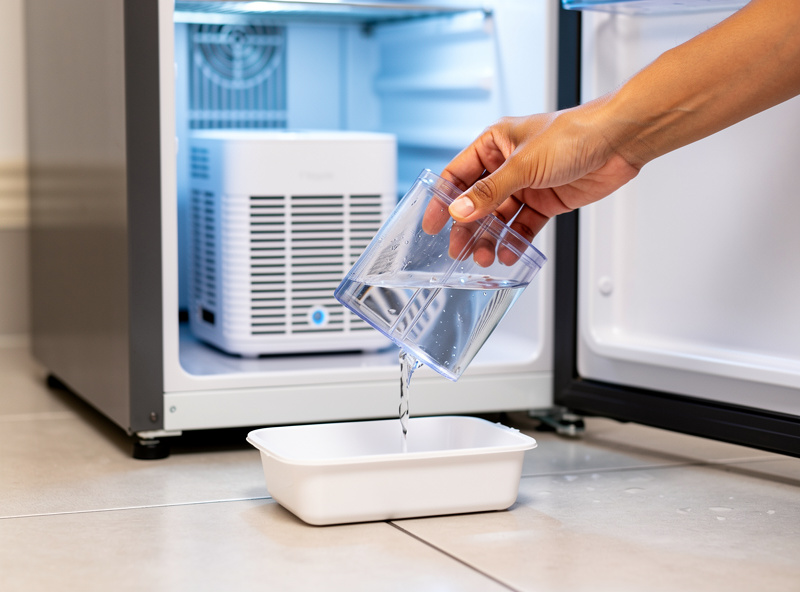
Set the dehumidifier on the chamber floor where its slight exhaust heat rises away from the meat, and keep its sensor — or the humidistat probe controlling it — at meat-shelf height, far from both the dehumidifier and the humidifier so it reads the chamber rather than either device. On Peltier and compressor units the tank fills; a small chamber can fill a Peltier reservoir in a day during a fresh batch, so check it daily that first week or rig a drain hose to a tray outside. The other half of the placement story is airflow: without the circulating fan, the dehumidifier only dries the air around itself while a saturated boundary layer still clings to the meat, the exact mechanism behind case hardening. Get airflow, control, and drainage right and the dehumidifier becomes invisible — which is the goal, the same as everything else in the climate control system.
Do Not Over-Dry: The Case-Hardening Trap
A dehumidifier that runs unchecked is as dangerous as no dehumidifier at all. Drive RH too low and the meat surface dries faster than interior moisture can migrate out, sealing a hard shell that traps a wet, spoiling core — case hardening, the failure that kills more pieces than mold ever does.
The defense is a humidistat with a sensible band, not a dehumidifier left on. Set it to switch on only above your ceiling (around 80% RH) and off back at target, so it shaves spikes without chasing RH into the 60s. If you pull a piece that is rock-hard outside and squishy inside, the dehumidifier (or too much airflow) over-dried the surface; the recovery is to raise RH and slow things down, detailed in the case hardening guide. Weight loss is still your real doneness signal — aim for the gradual 30–40% loss, not a fast crust. A controlled dehumidifier protects the cure; an uncontrolled one ruins it.
Frequently Asked Questions
Do I need a dehumidifier for a curing chamber?
Often yes, at least part-time. A sealed chamber needs dehumidification during the first 24 to 48 hours of a fresh cure when meat dumps moisture, in humid summers, and on auto-defrost fridges that spike RH each cycle. A well-sealed chamber with light loads may hold target on its own, but most builders need a humidistat-switched unit on standby.
How do I size a dehumidifier for a curing chamber?
Size by chamber volume and peak moisture load, not the room rating on the box. A converted full-height fridge is only 8 to 15 cubic feet, so a Peltier unit removing 250 to 500 ml per day handles routine control. Reserve a compressor mini rated in pints per day for heavy first-48-hour or humid-summer loads.
What type of dehumidifier is best for a curing chamber?
For most home chambers a quiet thermoelectric Peltier unit on a humidistat is best, handling routine 5 to 15 percent spikes without much heat. Use a rechargeable desiccant unit in tiny sealed chambers, a compressor mini for the worst summer loads, and passive desiccant tubs to buffer an already-stable box.
Will a dehumidifier add heat to my curing chamber?
Compressor mini-dehumidifiers add noticeable heat and force the temperature controller to work harder, so place them low and size them only for heavy loads. Peltier units add minimal heat. Desiccant and passive tubs add none. Because a chamber must hold near 55 degrees F, prefer the low-heat options unless your moisture load truly demands a compressor unit.
Can a dehumidifier over-dry a curing chamber?
Yes, and it is a real risk. An uncontrolled dehumidifier drives RH too low, drying the meat surface faster than interior moisture migrates out and sealing a hard shell over a wet core, known as case hardening. Always switch it with a humidistat set to run only above your ceiling, around 80 percent RH, and stop at target.
How often do I empty a curing chamber dehumidifier?
During a fresh batch a small Peltier or compressor unit can fill its tank within a day, so check daily that first week. Once the batch settles, every few days is enough. Rig a drain hose to a tray outside the chamber for hands-off operation, or you risk the tank overflowing moisture back into the box.
Is cracking the door a substitute for a dehumidifier?
Only as a short-term emergency measure. Cracking the door 10 minutes twice a day vents moist air and shaves an acute spike, but it also lets warm room air and contaminants in and gives you no steady control. It works to ride out the first 48 hours on a budget, but a humidistat-switched dehumidifier is the proper long-term fix.
Related Articles
- Curing Chamber Too Humid: How to Fix Oversaturation Fast — diagnosing chronic over-humidity.
- Curing Chamber Humidifier: Ultrasonic vs Wick vs Steam — the other half of humidity control.
- Curing Chamber Climate Control: The Complete Guide — how the four layers interact.
- Case Hardening in Curing Chambers — what over-drying does to a cure.
- Smart Temperature and Humidity Sensors for Curing Chambers — calibrated RH the dehumidifier acts on.