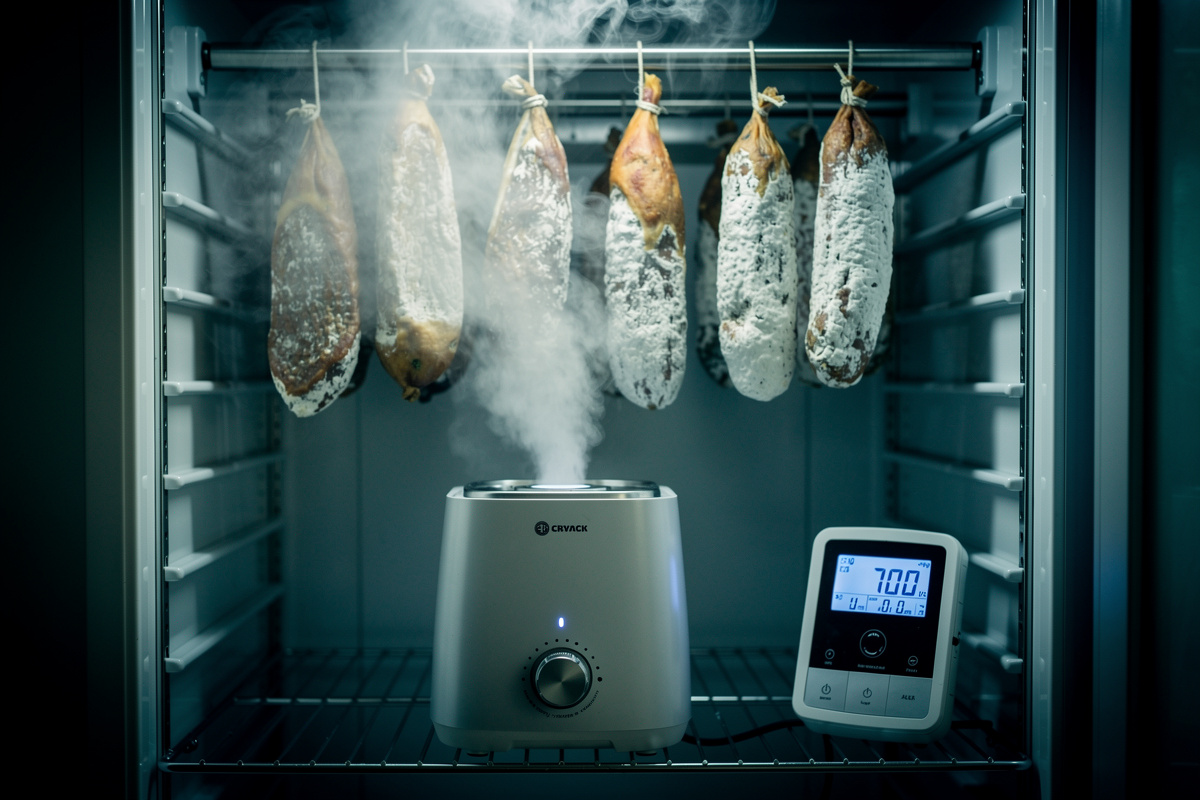

The best humidifier for a curing chamber is a cold-mist ultrasonic unit, because it adds moisture without adding heat — and a curing chamber has to stay near 55°F. Steam and warm-mist humidifiers fight your temperature controller; evaporative wick units self-regulate but cannot keep up.
Humidity is the variable that decides whether a coppa finishes silky or case-hardens into a brick, and the humidifier is how you defend the top of that envelope. Across the chambers I run I have driven RH with ultrasonic foggers, evaporative wick boxes, and a warm-steam unit I will never use in a cure again. Here is what each technology actually does to a 55°F / 75% RH drying box, and why ultrasonic wins for nearly every home charcutier.
Why a Curing Chamber Needs Cold Moisture
A curing chamber holds about 55°F (13°C) at 75% relative humidity, so any humidifier that warms the air is working against the temperature controller. Every watt of heat a steam unit adds is a watt your compressor then has to pull back out, and the cycling wrecks your stable envelope.
That single constraint — add water, do not add heat — eliminates half the humidifier market before you start. Bathroom and bedroom humidifiers are sold on warm, cozy mist; that is exactly wrong here. You want to raise the water content of cold air and leave the temperature untouched, then let a humidistat switch the unit on below target and off a few points above. The target band and how it couples with temperature is laid out in the curing chamber climate control guide, and the device that switches the humidifier on and off is its own decision I cover under control below.
Ultrasonic: The Default Choice
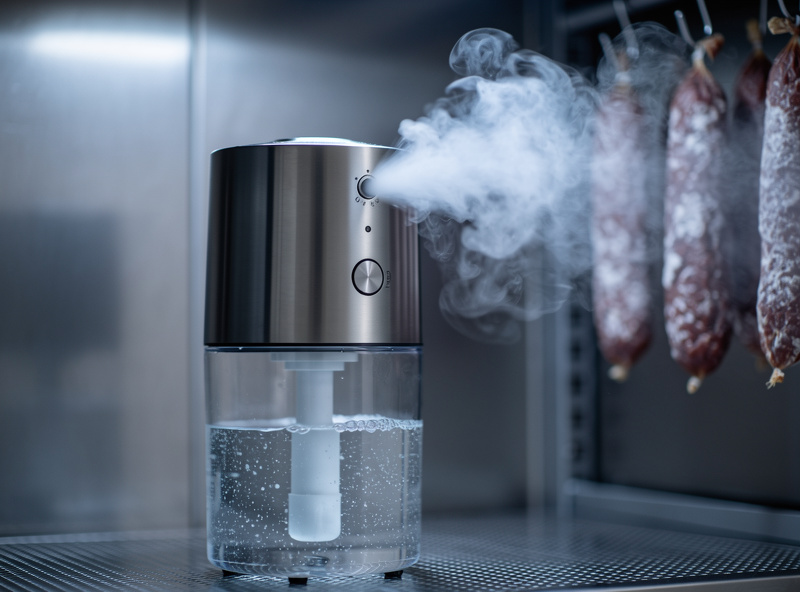
An ultrasonic humidifier uses a piezo disc vibrating at high frequency to fling water off the surface as a cold fog. It adds zero heat, sips power, and puts out enough moisture to recover a chamber quickly — which is why it is the unit I run in my primary larder chamber and recommend first.
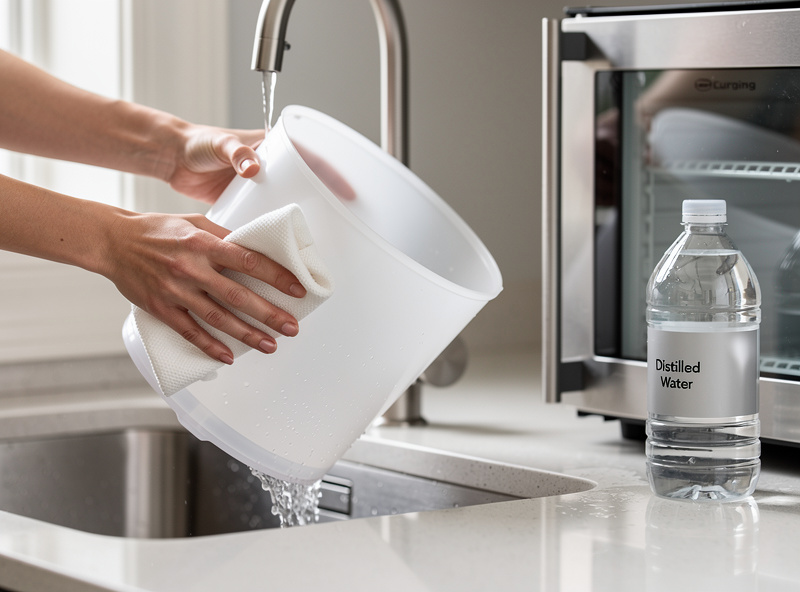
The practical wins are real. Cold mist means no fight with the temperature controller. High output means a chamber that drifts to 68% RH climbs back to 75% in minutes, not hours, which matters during the moisture-hungry first days of a fresh batch. The one discipline it demands is water quality: fill the reservoir with distilled water, never tap, because ultrasonic foggers aerosolize everything in the water — minerals settle as white dust on your meat, and a dirty reservoir can throw microbes into the air. I empty and wipe mine weekly and refill with distilled. Wire it to a humidistat and it runs hands-off for a week at a time. A standard cool-mist ultrasonic humidifier is the cheap white nursery type; that is all you need.
Disclosure: CuringChamber is reader-supported. As an Amazon Associate I earn from qualifying purchases made through links in this article, at no extra cost to you. I only point to gear I actually use or would buy for my own chamber.
Evaporative Wick: The Self-Regulating Passive Option
An evaporative wick humidifier draws water up a porous wick and lets a slow fan blow air across it, so moisture only leaves the wick as fast as the air can absorb it. That makes it beautifully self-limiting — it physically cannot push RH past saturation — but its output is low and it cannot recover a dry chamber fast.
I think of the wick box as the grown-up version of the damp-sponge passive fallback I have run head-to-head against the fogger. In a small, well-sealed bar-fridge chamber that only needs a gentle top-up, a wick unit (or even a tray of water with a wicking cloth and the circulation fan) holds RH steady with almost no risk of over-humidifying. Its weakness is the first 48 hours of a fresh cure, when meat is dumping its own moisture and you actually need to dehumidify, then later need fast humidity recovery the wick simply cannot deliver. As a hands-off maintainer for a stable chamber it is excellent; as your only humidifier on a hungry batch it falls behind. If you want the device version rather than the sponge, an evaporative wick humidifier is the category.
Steam and Warm-Mist: Leave It for the Living Room
A steam or warm-mist humidifier boils water to release vapor. It is the most hygienic in the sense that boiling kills microbes, but it dumps heat directly into a box you are trying to hold at 55°F — the one thing a curing chamber cannot tolerate. I tried it once; the temperature controller never stopped fighting it.
The heat problem is disqualifying on its own, but there is a second issue: warm-mist units put out humidity in bursts tied to their boil cycle, so you get spikes rather than the steady hold curing wants. The only context where a warm element earns a place is a cold-smoking or very cold winter garage chamber where a touch of heat is actually welcome — a narrow exception, not the rule. For a standard 55°F drying chamber, steam is the wrong tool, full stop. When the opposite problem hits and the chamber runs too wet, that is a dehumidifier and airflow question covered in curing chamber too humid.
Ultrasonic vs Wick vs Steam: Side by Side
The decision comes down to one axis — does it add heat — and a second, how fast it can recover a dry chamber. Ultrasonic wins both for active curing; wick wins on safety-from-over-humidifying in a tiny stable box; steam loses for cold work.
| Factor | Ultrasonic (cold mist) | Evaporative wick | Steam / warm mist |
|---|---|---|---|
| Adds heat? | No — cold fog | No (slight cooling) | Yes — disqualifying |
| Output / recovery speed | High, fast | Low, slow | Bursty, spiky |
| Over-humidify risk | Yes, needs humidistat | Self-limiting | Yes |
| Water quality needs | Distilled (aerosolizes minerals) | Tolerant of tap | Tolerant (boils clean) |
| Power use | Very low | Low | High |
| Maintenance | Weekly clean + refill | Wick swaps, descale | Descale boil chamber |
| Best for | Most curing chambers | Small stable maintainer | Not curing (living room) |
Controlling the Humidifier: Humidistat, Not Guesswork
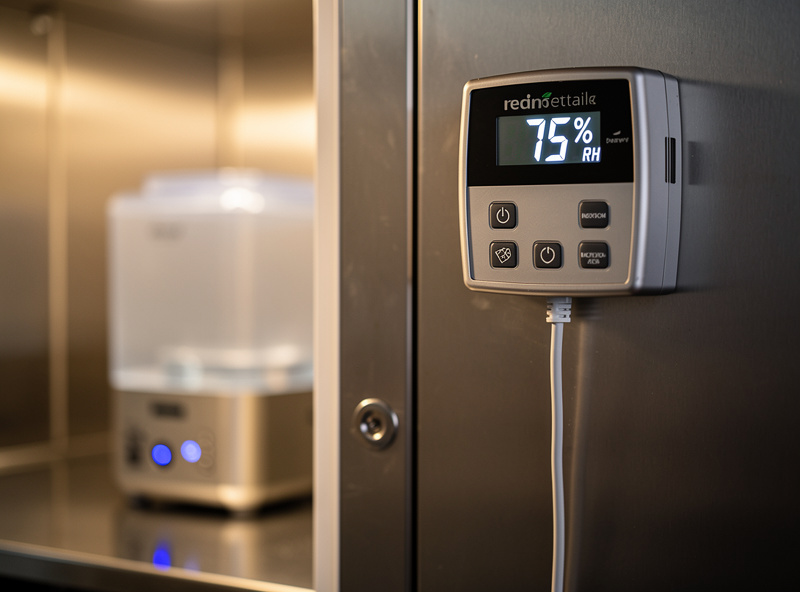
Whatever humidifier you pick, it must be switched by a humidistat, not left running. A dedicated humidity controller reads chamber RH and powers the humidifier outlet on below your floor (say 75%) and off at a ceiling a few points up (78%), holding a tight band the way a temperature controller holds degrees.
I run an Inkbird humidity controller on the moisture side, paired with a separate temperature controller on the compressor — two independent boxes so each probe can sit where it needs to. Place the humidity probe at meat-shelf height and well away from the humidifier outlet, or it reads the transient fog instead of the chamber and short-cycles. The reservoir-management trick of borrowing a hydroponic auto-fill float so you are not topping up by hand every two days is in curing chamber humidity control: adapting hydroponic reservoir tech, and choosing the controller itself is the same logic as the temperature controller shootout. A dedicated plug-in humidity controller turns any humidifier into a regulated one.
Placement, Water, and Mold Hygiene
Mount the humidifier low in the chamber so cold fog can rise and disperse, route its output away from direct contact with meat, and let the circulation fan distribute it — a fogger blowing straight onto a salami soaks the surface and grows the wrong mold. Distilled water and a weekly reservoir clean keep the system honest.
Standing water plus warmth is exactly what spoilage organisms want, so the humidifier reservoir is the dirtiest spot in an otherwise clean chamber. Empty it, wipe it, and refill with distilled every week; descale any wick or steam unit on its own schedule. Pair the fogger with the cycling 120mm fan so humidity is even rather than pooling around the outlet, the same airflow logic that prevents the boundary-layer problem and case hardening detailed in case hardening in curing chambers. Get water in, keep it clean, and let air movement spread it — that is the whole humidity game, and it starts the moment you finish the chamber build.
Frequently Asked Questions
What is the best humidifier for a curing chamber?
A cold-mist ultrasonic humidifier is best for a curing chamber. It raises humidity without adding heat, so it does not fight the temperature controller holding 55 degrees F, and its high output recovers a dry chamber in minutes. Run it on distilled water, switched by a humidistat at a 75 to 78 percent RH band.
Can I use a warm-mist or steam humidifier for curing?
No, not for a standard 55 degrees F chamber. Steam and warm-mist humidifiers dump heat into the box, forcing the temperature controller to fight them and wrecking the stable envelope. They also deliver humidity in spikes. Use cold-mist ultrasonic instead; reserve warm units for a cold-smoking or very cold winter chamber where a little heat helps.
Do I need distilled water in a curing chamber humidifier?
For an ultrasonic humidifier, yes. The vibrating disc aerosolizes whatever is in the water, so tap water leaves white mineral dust on your meat and can throw microbes into the air. Distilled water avoids both. Empty and wipe the reservoir weekly to stop spoilage organisms breeding in standing water.
Why is my curing chamber humidity hard to control in the first days?
Fresh meat dumps a lot of its own moisture in the first 24 to 48 hours, pushing RH above target. During that window you often need to dehumidify, not humidify. A self-limiting evaporative wick cannot help here; use a humidistat-switched ultrasonic plus a small dehumidifier or brief door-cracking to ride out the spike.
Where should I place the humidifier in the chamber?
Mount it low so cold fog rises and disperses, aim its output away from direct contact with the meat, and let the circulation fan spread the moisture. A fogger blowing straight onto a salami soaks the surface and grows unwanted mold. Keep the humidity probe at meat-shelf height, far from the outlet, so it reads the chamber not the fog.
How do I control when the humidifier runs?
Wire it to a humidistat or plug-in humidity controller that powers the outlet on below your floor (around 75 percent RH) and off at a ceiling a few points up (78 percent). This holds a tight band instead of running continuously. An Inkbird humidity controller on the moisture side, paired with a separate temperature controller, is the standard home setup.
Is an evaporative humidifier good enough for curing?
For a small, well-sealed, already-stable chamber that only needs a gentle top-up, an evaporative wick unit is excellent because it self-limits and cannot over-humidify. Its weakness is low output and slow recovery, so it falls behind on a hungry fresh batch. As a hands-off maintainer it works; as your only humidifier on an active cure it does not.
Related Articles
- Curing Chamber Climate Control: The Complete Guide — how humidity couples with temperature and airflow.
- Curing Chamber Humidity Control: Adapting Hydroponic Tech — auto-fill reservoir tricks for the humidifier.
- Curing Chamber Too Humid: How to Fix Oversaturation Fast — when the problem flips to too much moisture.
- Inkbird vs Auber vs Willhi Curing Chamber Controller — the controller logic for the humidity side too.
- Case Hardening in Curing Chambers — what too-dry, too-fast humidity does to a cure.