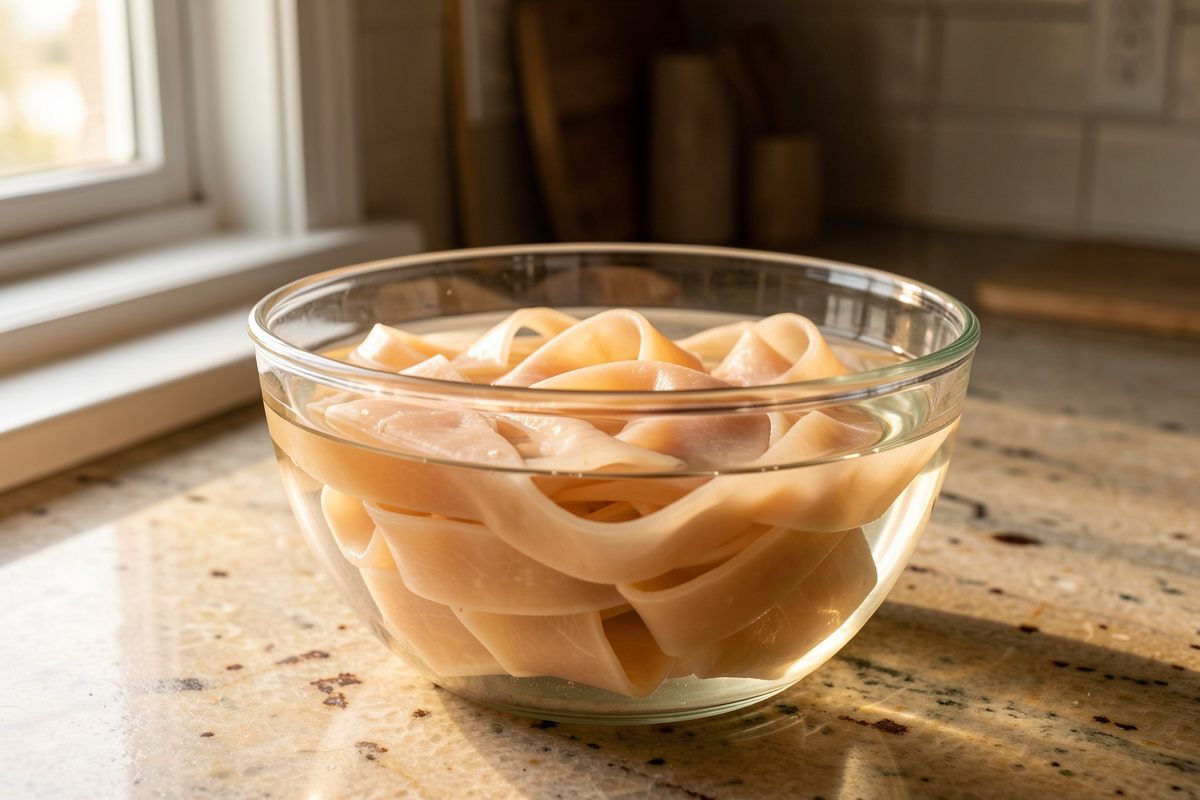

Soak salt-packed hog casings 30 to 60 minutes in lukewarm water around 30 °C, then flush the lumen from the tap until the water runs clear. That is the whole job, but the details decide whether the casing slides sweetly onto the horn or splits at the first twist. A properly hydrated, flushed casing is supple, leak-checked, and ready; a rushed one tears and turns stuffing into a fight.
Natural hog casings arrive packed in salt for a reason: salt drops the water activity so low that nothing spoils, and they keep for a year or more that way. But that same salt has to come out, and the casing has to drink back the water it lost, before it will behave. Skip or shortcut the soak and you have built a defect into the piece before the meat is even ground. I have learned this the expensive way, and the fix costs ten minutes of patience.
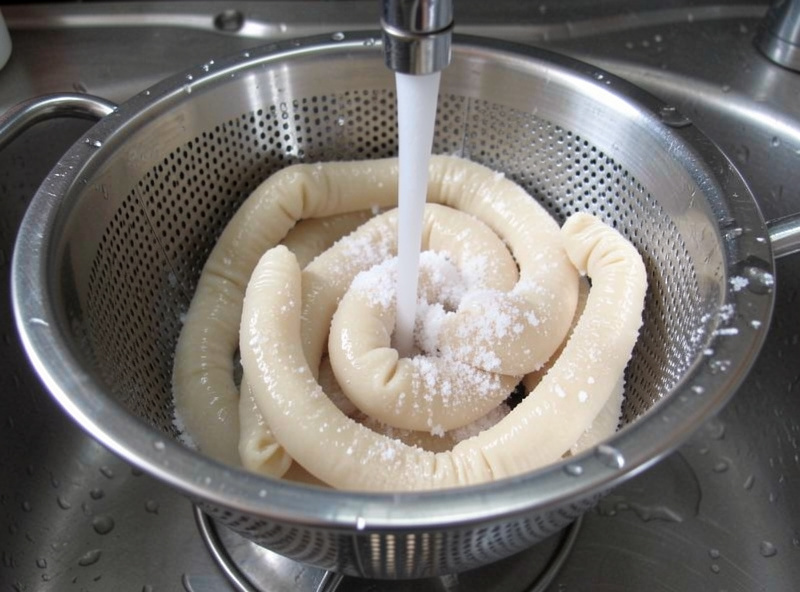
This is the first, unglamorous step in the whole casing preparation and stuffing workflow, and it is the one beginners rush the hardest. Let me walk it the way I do it in my own kitchen in Sweden, on every batch, before the stuffer ever comes out.
How Long Should You Soak Natural Hog Casings?
Soak natural hog casings for 30 to 60 minutes in lukewarm water. Thirty minutes is the minimum to rehydrate a standard 32 to 42 mm hog casing to the point it is supple; an hour is better if the casing has been in salt for many months, because older salt-packed casings drink more slowly. You want them flexible enough to stretch gently without any papery stiffness.
The test I use is simple and tactile: after 30 minutes I pull a length between my fingers and feel for spring. A ready casing is soft, elastic, and slightly slippery, with no crackle or brittleness. If it still feels like wet paper, it goes back in for another 15 minutes. I change the water once halfway through the soak, because the first bath pulls a surprising amount of salt out and the casing rehydrates faster in fresh water. Rushing this is the classic beginner error — a half-soaked casing looks fine and then splits under the first bit of stuffing pressure, which is exactly the failure I break down in the preparation guide’s section on blowouts.
What Water Temperature Is Best for Soaking Casings?
Lukewarm water, roughly 30 °C or hand-warm, is the sweet spot. Cold water leaves the casing stiff and slow to hydrate, so it stays prone to splitting; genuinely hot water is worse, because heat starts to break down the collagen and the casing turns fragile and tears in your hands. Aim for the temperature of comfortable bathwater and you cannot go wrong.
I check it with the same instant-read thermometer that lives on my stuffing bench — the one that honestly gets more use than my kitchen scale. Hand-warm reads around 28 to 32 °C, and that is where I keep the bath. If the room is cold, as my basement workshop usually is in a Swedish winter, I top the bowl up with a splash of warm water partway through so the soak does not chill down and stall. Temperature is a lever most people never touch, and it is the difference between a casing that cooperates and one that resists.
How Do You Flush a Hog Casing?
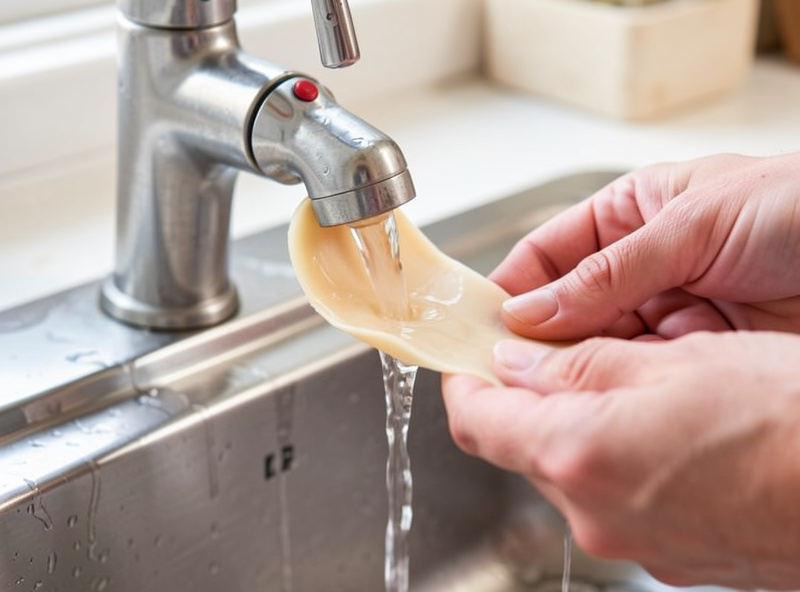
Flush a hog casing by finding one open end, slipping it over the kitchen tap, and running lukewarm water straight through the lumen until it comes out clear at the far end. The flush rinses residual salt from inside the casing, opens it up so it slides onto the stuffing horn, and — most valuable of all — reveals pinhole leaks before your farce ever fills them.
The trick is to watch the far end and the whole length as the water passes. Where the casing is sound, water runs out the open end in a steady stream. Where there is a pinhole, you will see a fine jet or a bead of water spraying sideways — a tiny fountain marking a weak spot. When I find one, I cut the casing at that point, discard the bad section, and carry on with the good length. Finding a leak now costs you a few centimetres of casing; finding it mid-stuff costs you a blowout and a patch job. The whole flush takes a couple of minutes per length and it is the single best piece of quality control in the entire process.
One sensory detail worth naming: a good flush has a sound to it, a soft even gurgle as the water finds its path through the lumen. When that sound stutters or you feel back-pressure in your hand, the casing is either kinked or blocked with a plug of salt — work it loose gently rather than forcing the water, or you will burst the casing right there at the tap.
How Do You Find Pinholes and Weak Spots?
The flush finds most pinholes, but a second pass under good light finds the rest. Hold a soaked length up to a window or a lamp and look for thin, papery, translucent patches — these are weak spots that will blow even if they are not yet holed. Run water through once more and watch specifically at those patches for a sideways spray.
On the last hog run I did, I flushed a hank that looked perfect and still caught two pinholes and one thin patch near a natural seam. Cutting back to sound casing cost me maybe 20 cm total and saved me two blowouts. Beef casings hide their weak spots better than hog and want an even more careful inspection, which is part of why I treat the big wide beef casings with extra respect. With hog, the light-and-flush check is quick and it is enough — do it every time and stuffing stops surprising you.
How Much Casing Do You Need Per Batch?
As a rough rule, one full hank of hog casing — around 90 metres — stuffs roughly 45 to 55 kilos of sausage. For a typical home batch of 2 to 3 kilos of farce, two or three metres of casing is plenty. Always soak and flush more than the calculation says, because you will cut away weak sections and you never want to run short mid-stuff with farce warming on the bench.
I prep about 20% more casing than I think I need. It costs nothing — leftover soaked casing that I did not use goes straight back into heavy salt and keeps for months. Running short, on the other hand, means either stopping to soak more while the farce sits and warms (inviting the smearing that causes blowouts) or scrambling for a substitute casing that changes the drying time of the batch. Prep generously; it is the cheapest insurance in sausage-making, right alongside keeping the meat cold and pricking the air out.
Can You Soak Casings Too Long?
You can, but it takes a while. Casings left soaking for many hours or overnight at room temperature start to weaken and can begin to smell as bacteria wake up in the warm, salt-free water. An hour or two of soaking is fine; leaving them in the bowl on the counter all day is asking for slippery, fragile, off-smelling casing that you should not stuff.
If I need to prep casings well ahead of stuffing, I soak them, flush them, then keep them in the fridge in a bowl of clean water, or I return them to salt. A cold soak buys you time that a warm one does not, for the same reason a cold ferment behaves differently from a warm one — temperature governs how fast bacteria move. When a casing comes out of a long soak feeling slimy or smelling sour rather than neutral, I throw it out. That is the same conservative rule I apply to any piece in the chamber: when in doubt, bin it, because a natural casing is cheap and a ruined batch is not.
As an Amazon Associate I earn from qualifying purchases. If your salt-packed hanks are running low, restock natural hog casings from a supplier who ships them properly salted and dated.
How Do You Load a Soaked Casing Onto the Stuffer?
Once a casing is soaked and flushed, load it wet: leave a little water inside the lumen and slide the whole length onto a lightly moistened stuffing horn, ruffling it up like a sleeve until nearly all of it is gathered on the horn with a short tail hanging off the end. The residual water is a lubricant — a dry casing drags and tears, a wet one glides.
I keep the soaking bowl right next to the stuffer and pull each length straight from the water onto the horn, dipping the horn tip in the bowl first so it is slick. Leave the end open at first and let a little farce push the trapped air out before you tie off the tail — that habit alone prevents the first air pocket of the batch. Do not overload the horn so tight that the casing stretches thin; a casing pre-stressed on the horn is one that blows under stuffing pressure. Snug and slippery, with a tail to tie, is the state you want before the first turn of the crank.
What Are the Most Common Soaking Mistakes?
The mistakes are almost all impatience or the wrong water. Under-soaking leaves the casing brittle; hot water makes it fragile; skipping the flush leaves salt inside and hides pinholes; and leaving casings soaking warm all day breeds spoilage. Each one shows up as a split or a leak at the stuffer, far from where you can see the cause.
My own worst version of this: early on I soaked a hank in water that was too hot because I wanted it supple fast, then wondered why the casing kept tearing like wet tissue as I stuffed. It was not the stuffer and it was not my technique — I had par-cooked the collagen. Now the water is always hand-warm, the soak is always at least half an hour, and the flush is never skipped. Once you internalise those three, hog casings become the easy, forgiving part of a project that has plenty of harder parts, from the cooking of a fresh sausage to the long slow dry of a fermented spreadable salami. For the fundamentals of safe handling behind all of this, I check my practice against the USDA Food Safety and Inspection Service and the National Center for Home Food Preservation.
Do you have to soak natural hog casings before stuffing?
Yes. Natural hog casings are shipped packed in salt and must be rinsed, soaked in lukewarm water for 30 to 60 minutes, and flushed through the lumen before stuffing. Soaking rehydrates the casing so it is supple, and flushing rinses out residual salt and reveals any pinholes.
What temperature water should I use to soak casings?
Use lukewarm, hand-warm water around 30 degrees Celsius. Cold water leaves the casing stiff and prone to splitting, while genuinely hot water breaks down the collagen and makes it fragile. Aim for the temperature of comfortable bathwater.
Why do I need to flush water through the casing?
Flushing does three jobs. It rinses residual packing salt from inside the casing, it opens the casing so it slides onto the stuffing horn, and it finds pinhole leaks before your meat fills them. Watch for a sideways spray of water, which marks a weak spot to cut around.
How long can I leave casings soaking?
An hour or two at room temperature is fine. Leaving casings soaking warm all day lets bacteria grow in the salt-free water, and they turn slippery and off-smelling. If you need to prep ahead, soak them, then hold them in clean water in the fridge or repack them in salt.
Can I reuse hog casings I soaked but did not stuff?
Yes. Drain the leftover soaked casing, bury it heavily in plain non-iodised salt, seal it airtight, and refrigerate. Stored that way it keeps for months. Never leave it wet, and never use iodised salt.
Related Articles
- Preparing Sausage Casings: A Complete Guide
- Best Casing for ‘Nduja: Wide Beef Bung vs Sewn-End Caps
- Cooked Sausage Making Guide: The Complete Chamber Method
- How to Make ‘Nduja at Home: Calabrian Spreadable Salami